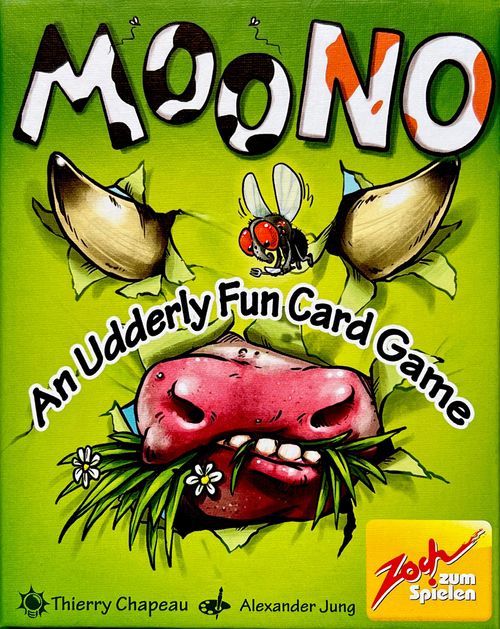
Kuhno
Kuhno Rulebook
Table of Contents
Table of Contents
Game Materials
64 cards, 5 different background colors:
- 10 Flower cows
- 6 Party cows
- 10 Cowpat cows
- 34 Pasture cows
- 4 Milk cows
Each card shows a cow with 1 to 4 spots. The back side of each card shows a cowpat.
Object of the Game
Be the first to get rid of all your cards! In this case, the other players get one dung point for each cow spot they still have in their hand. If you have the fewest dung points after several rounds, you'll win the game.
Set-Up
Shuffle all cards with the cowpat side facing up. Each player gets 7 cards and takes them into his hand so that he can see the cows on them. Put the remaining cards in the middle of the table, with the cowpat facing up; they form the cowpat pile. Kuhno is always sitting on these cowpats.
(The printed heading reads "SEIT-UP", a typo for "Set-Up" in the source.)
Course of a Round
The youngest player begins the game; then the others follow in clockwise order.
On your turn, you place one cow alongside one of the four sides of the cowpat.
For this, you need to meet these 3 conditions:
- Put the cow in the right place.
- Place the cow so that its head points in the right direction.
- The cow must have a spot in the right place.
1. Keep to the Direction of Placement
Place your cow around the corner of the cowpat that the previously placed cow is facing. If there is already a cow lying there, you cover it. If you are the starting player, you may choose where to put your first cow.
2. Keep to the Direction of View
Place your cow so that its rear part shows toward the same corner of the pat that the previously placed cow is facing.
3. Where Is Kuhno Sitting?
Always observe on which side of the cowpat Kuhno, the dung fly, is sitting! You may place a cow only if it has a spot that matches Kuhno's position on the cowpat. In this context, it doesn't play a role whether the cow you play has any further spots.
Example (printed as "Beispiel", a German word left in the English edition): In turn, Carl (1), Eva (2), and Alfredo (3) place their cows. Each cow "looks" at the rear part of the next cow. Now Carl has his next turn. He places his second cow on position (4). Then Eva puts her second cow on position (1), covering the cow that has been lying there, etc. Kuhno, the dung fly, is currently sitting on the "upper" side of the cowpat. Carl, Eva, and Alfredo – one after another – have played cows that have a spot in this place. Of the hand cards Carl has available at the moment, he would only be able to play the milk cow on position (2), since only this one has a spot in the right place.
And What If You Have No Suitable Card?
If you are not able to play any cow from your hand, you take the top card from the cowpat pile. If you now have a suitable cow, you may place it. Otherwise, your turn ends and it's the next player's turn.
Attention! When you pick a card from the cowpat pile, pretty often — on the new top card of the pile — Kuhno will appear in a different position on the cowpat. This way, you might now be able to place cards that didn't match before.
The Cow Cards
Pasture Cow (34x)
A pasture cow has no special effect. After you have placed it (correctly), your turn ends.
If, in order to become familiar with the game, you want to play "the easy way," you can agree to act as if all cards show pasture cows. So you play without any special effects to begin with. In later games, you can then — as you like — gradually introduce the effects of the different types of cows into the game.
Milk Cow (4x)
The number of its cow spots indicates how many subsequent players lose a turn. All players affected have to be aware when the time comes that they don't take their turn.
Cowpat Cow (10x)
The number of its cow spots indicates how many cards your left neighbor has to draw from the cowpat pile. However, this player doesn't have to pick any cards if he now also plays a cowpat cow. In this case, he adds the spots of your cow to the spots of his cow; then the next player has to pick the respective number of cards from the cowpat pile, etc. If a player, on his turn, is unable or unwilling to play any further cowpat cow, he draws the number of cards required; then he carries out his turn as usual.
Party Cow (6x)
A) Change the Direction of View and Placement
A party cow is placed the other way around — that means it looks at the same corner as the previously placed cow. With this, the direction of view as well as of placement of the next cows is reversed. Attention! Players continue playing in clockwise order — this never changes!
Example: You play a party cow (1). It faces the previously laid-out cow (2). The next cow to be laid now has to be placed on top of that cow, keeping the direction introduced by the party cow. Should this cow now be again a party cow, it changes again the direction the following cows will take.
B) Introduce a New Animal Sound
If you play a party cow, you accompany this with a new animal sound. In doing so, you
- may not make "moo";
- may not make "bssszzzz" (this is reserved to Kuhno);
- may not repeat any animal sound that has already been made.
Example: You play a party cow and call out "meow." Sometime later, another player plays a party cow as well and whinnies like a horse. The next party cow player could oink like a pig, and so on.
Flower Cow (10x)
The spots of a flower cow allow you to immediately play additional cards.
- If you place a flower cow with one spot, you may place one more cow from your hand on the next position, in compliance with the rules.
- A flower cow with two spots allows you to
- play two more cows, provided the first of the two cows is a pasture cow or party cow;
- play only one more cow, if this is a milk cow or a cowpat cow;
- play another flower cow. This cow (and only this one) indicates with its spots, how many cards you are allowed to play.
If you are not able or willing to play any more card(s) although your flower cow would entitle you to, you announce this to the other players. Then it's the next player's turn.
Attention! You may not play a flower cow as the first card in a round.
Examples: First you place a flower cow with 2 spots. If you then place …
- a party cow, this changes — as usual — the direction of view and placement, and you make a new animal sound. After that, you may play another card.
- a milk cow, 1 or 2 players — depending on its number of spots — lose a turn. You may not play an additional card for the second spot of your flower cow.
- another flower cow, only the spots of the just-placed flower cow apply.
"Moo!" and "Kuhno"
When placing your next-to-last card, you make the animal sound introduced by the previous party cow. If no party cow has been played yet, you call out "moo!"
If you play a party cow as your next-to-last card, you first repeat the most recent animal sound, and then make a new one.
When placing your last cow correctly, you call out "Kuhno." Ignore the function of the last card, or, if it is a party cow, you no longer make any animal sound.
"Bssszzzz"
If you notice that one of the other players has made a mistake, you give Kuhno a voice and call out "bssszzzz!"
If you are caught making a mistake, you draw a card from the cowpat pile. If you have already placed cards, you take the last card that you have played back into your hand. Then your turn ends immediately.
Possible mistakes are, for example:
- playing a cow that doesn't have a spot in the place required
- playing a cow in the wrong direction of view
- placing a cow in an incorrect position
- calling out a wrong animal sound or not calling out any if one is required
- incorrectly calling out "bssszzzz!"
- placing a cow although it is not your turn.
Another mistake is not placing a cow even though it is your turn. (The players may ask anytime whose turn it is. If it is your turn and you don't respond, this is considered a mistake.)
End of a Round
As soon as one player places his last cow correctly ("Kuhno!"), the round ends immediately, no matter what cow is shown on that card.
A round also ends once a player picks the last card from the cowpat pile. (If he had to take more cards than are left in the pile, these cards would go to waste.)
Each player who still has cows in his hand adds up their spots and notes the total on a sheet of paper; these are his dung points.
End of the Game
Play as many rounds as there are players. The player who has the fewest dung points at the end of all rounds wins the game.
Rules for Real Kuhno Fans
Beware of Red Eyes!
If a cowpat shows Kuhno with red eyes, you may not place any cow along the side of the cowpat where Kuhno is sitting. Whereas you would normally have to put a cow on this position, you now skip this place and put a cow on the next position instead.