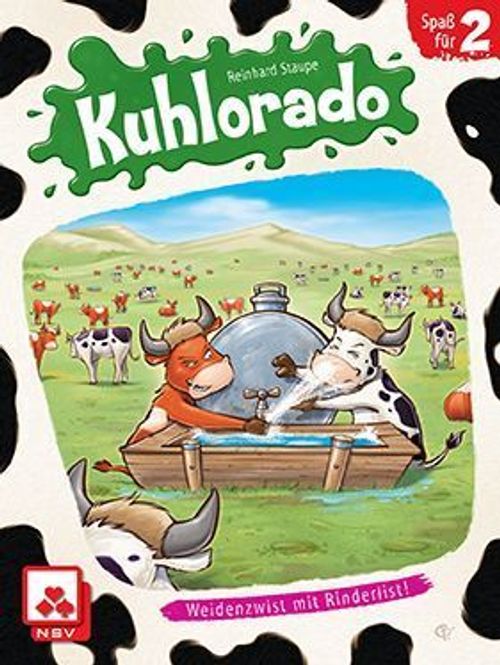
Kuhlorado
Kuhlorado Rulebook
Table of Contents
Table of Contents
Contents
1 Game pad and 2 dice
The players take it in turns to throw the dice. If a player throws two numbers, he may only mark one square on the sheet. However, if he throws one number and a cow (or even two cows), he may mark two squares on the sheet, which is usually an advantage.
At the end of the game, victory points are awarded for three things:
-
For boundary pastures: each of the four boundary pastures (north pasture, east pasture, south pasture, west pasture) consists of 8 squares, which lie around the edge of the game board, including the two corner squares. The boundary pastures are easily recognisable by the dark green meadow and the white numbers.
-
For possession of troughs: for the possession of troughs those squares are significant which are directly horizontally and/or vertically (not diagonally!) adjacent to the trough in question.
-
For land areas: if 5 or more player's squares connect horizontally and/or vertically, they count as one land area (diagonal connections do not count!).
Note: Squares on the outer boundaries can form part of land areas.
Diagram captions: "4 squares are directly horizontally or vertically adjacent to this small trough. These 4 squares determine who owns the trough." "Land area, currently consisting of 8 squares. Attention: The square below left, marked with a cross, is not connected to the land area."
Game preparation
The game pad is placed in the centre of the table. You will also need a pencil. One player plays the crosses, the other one plays the circles. Lots are drawn to decide who begins.
Carefully tear off the top sheet of the game pad (score summary) and place it in full view beside the game pad. Use this for further rounds.
Game procedure
When it is a player's turn, he takes both dice and throws. He has two attempts. After the first throw, he may use as many dice as he likes for the next throw – one, both or none.
Afterwards the player must mark one or two squares on the sheet. There are three possibilities:
A throw of two cows
The player must mark exactly two random (free) cow squares on the sheet.
Note: Should there be only one free cow square left, then the player marks this square only.
A throw of two numbers
The player must mark exactly one square on the sheet that matches one of the two numbers thrown. The player has a complete choice of which (free) matching square he marks.
Note: Should there be no more free matching squares left, then he marks nothing. Bad luck, unfortunately.
A throw of one cow and one number
In any case, the player must mark at least one square, either a cow square or a square with the number thrown. The player may decide freely which one of the two he would like to mark, cow or number.
However, if he wishes (and if possible), the player may use both, the cow and the number thrown, and mark two corresponding squares, providing that both squares, the cow square and the number, are horizontally, vertically or diagonally separated by exactly one square.
Attention: A trough square between the two marked squares is allowed.
Examples:
- Left: Tim has thrown a cow and a 3. There is exactly one square (vertically) between the two marked squares.
- Right: Tim has thrown a cow and a 4. There is exactly one square (diagonally) between the two marked squares. The trough is jumped over.
Once the player has marked the square or both squares, it is the other player's turn to throw the dice. Play continues as described.
Attention: Trough squares can never be marked. In some cases, troughs can mark the boundaries between land areas.
End of the game
The game ends, when there are no more empty cow squares after one player's turn or if there is a total of 5 free number squares. Now the score is counted up.
Scoring
-
For each boundary pasture (north, east, south, west) 3 points are scored. The points are awarded to the player who has marked more squares in the corresponding boundary pasture than the other player.
-
A large trough is worth 4 points, a small trough 2 points. The points are awarded to the player who has marked more squares directly adjacent to the corresponding trough (horizontally and vertically – not diagonally!) than the other player.
-
If there is a connected land area of at least 5 squares, 2 points are awarded. 5 points are awarded for at least 10 squares. 12 points are given for at least 15 squares. And for at least 20 squares, 20 points are given.
Note: If a player has several land areas, he receives points for each of these land areas.
Example: Sarah (crosses) holds the majority in the south pasture (= 3 points). She owns the large trough at the top (= 4 points) and the small trough at the bottom (= 2 points). For her land area (18 squares) she receives 12 points. Altogether Sarah has gained 21 points. Tim (circles) holds the majority in the north and west pastures (3 points each) and owns the large trough on the left (= 4 points). For his two land areas he receives 2 and 5 points respectively, making a total of 17 points.
Scoring overview
| Item | Value |
|---|---|
| Boundary pastures | each 3 points |
| Troughs, small | 2 points |
| Troughs, large | 4 points |
| Land areas, 5+ squares | 2 points |
| Land areas, 10+ squares | 5 points |
| Land areas, 15+ squares | 12 points |
| Land areas, 20+ squares | 20 points |
Advanced version
The game procedure remains completely unchanged, i.e. exactly as described. As soon as a total of 9 cows has been marked on the game pad, the interim scores are checked. Only the double squares score.
- Exactly two squares (never more) of any one player, either horizontally or vertically adjacent, form one double square. For each double square owned by a player, 2 points are noted down. After the interim score check, play continues as usual. At the end of the game, no further points are scored for double squares.
Diagram caption: "2 different double squares".