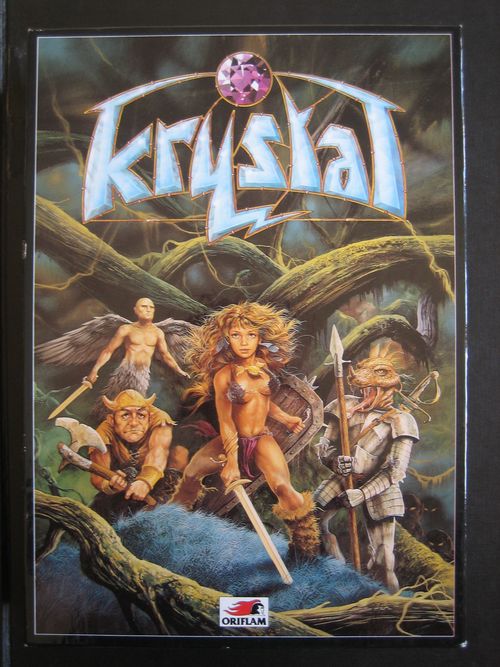
Krystal
Krystal Rulebook
Table of Contents
Table of Contents
- I Goal of the game
- II Game material
- III Game mechanics
- IV Setup (for 2 to 4 players)
- V The turn
- VI Cards and play
- VII Special rules for 5 and 6 players
- VIII Advice for beginners
- IX Negotiations
- X Optional rule
- Optional setup (handwritten on the scan, page 8)
- Value chart (handwritten on the scan, page 8)
I Goal of the game
To be the first player to bring back to its Gate four different "Stones of Lumière": a Cristal, a Rubis, an Emeraude and a Diamant.
II Game material
A game for 2 to 6 players, ages 10 and up.
2-1 The components
The Krystal game box contains:
- 1 game board
- 6 people sheets and hero sheets
- 120 game cards
- 18 hero figures
- 18 "Energy" cursor pawns
2-2 The game board
The board represents the kingdom of Krystal with its 25 Locations (Sites) and its 6 Access Gates (one Gate per people). Each Location is consecrated to a god and bears the symbol of the people who worship that god. The number printed on a Location is the Divine Power of that Location.
Note: the Clearing of the Gods is consecrated to all peoples.
Facing each Gate are the spaces for the cards: a draw pile and a discard pile for each pile of cards.
2-3 The people sheets and hero sheets
Each of the six sheets represents one of the six peoples. Each sheet shows the name of the people and its symbol, a short description, a "Divine Power Modifier" table (explained below), and the three illustrations and spaces for the Heroes of the people.
Each of the three Heroes of a people specializes in one domain:
- The Guardian: for Strength.
- The Mage: for Magic.
- The Marauder: for Trading (Marchandage).
On each Hero space is the Hero's symbol and its basic abilities in the three types of combat. The Energy scale of each Hero records its personal Energy level. The cards owned by the Hero are placed on its sheet, in the space reserved for them.
The six peoples and their symbols are:
- Reptile Men (Hommes Reptiles): an aggressive people that worships Yoldana, goddess of the Waters. Their clan symbol is the rune of the Serpent.
- Amazons (Amazones): worship Ouendou, god of the Wood. Their symbol is the rune of the Wood.
- Centaurs (Centaures): a strong and proud people that swears only by Rwal, lord of the Earth. Their symbol is the rune of the Earth.
- Nomads (Nomades): lean men with insect eyes, worshippers of Zimtzin, god of Fire. Their symbol is the rune of the Lightning.
- Gnomes: live in the deepest caverns and honour Klumtz, god of Metal. Their symbol is the rune of Iron.
- Bird Men (Hommes Oiseaux): a winged people that addresses prayers to Ghat, god of Air and Sky. Their symbol is the rune of Air.
2-4 Figures
Each figure represents one Hero of a people.
2-5 Game cards
The 120 game cards are divided into 5 types:
2-5-1 The 51 combat cards, of which:
- 17 physical combat cards (Force)
- 17 magic combat cards (Magic)
- 17 trading cards (Marchandage)
2-5-2 The 24 "Stones of Lumière" cards, of which:
- 6 "Cristal" cards
- 6 "Rubis" cards
- 6 "Diamant" cards
- 6 "Emeraude" cards
Each card shows a description of its power, usable during the game.
2-5-3 The 12 "Creature" cards. They represent the various creatures that can be met during the game. Each card shows an illustration of the creature, a short description of how it fights, and its combat value (Force or Magic).
2-5-4 The 21 "Magic Object" cards. They represent the various objects that can be found during the game. Each card shows an illustration of the object and the conditions and effects of its use.
2-5-5 The 12 "Divine Intervention" cards. They describe an event that affects the course of the game.
2-6 Energy points
Each Hero has an Energy scale on its people sheet. On each scale an Energy pawn shows the number of Energy points that the Hero currently has. At the start of the game, each Hero has six Energy points.
III Game mechanics
Each player represents one of the six peoples of the game. Starting from the Gate of its people, the player must travel through the Locations of the kingdom with its three Heroes, spending Energy points for their movements.
When stopping on a Location, a Hero may either recover Energy points, or explore it by drawing cards from the draw pile matching the symbol of the Location. The cards drawn may trigger an immediate event (Divine Intervention, a Creature encounter), or be kept by the Hero.
When Heroes of opposing peoples meet on the same Location, they fight.
When a Hero holds one or more "Stones of Lumière" cards, it may return to its Gate to deposit them.
As soon as one player has brought four different "Stones of Lumière" to its domain, it wins the game and the game ends.
IV Setup (for 2 to 4 players)
- A. Each player draws one of the six people sheets.
- B. Remove from the deck, for each people not represented by a player, 5 cards: 4 "Stones of Lumière" (one of each type) and the "Divine Intervention" card marked with an asterisk and the symbol of that people.
- C. Shuffle the remaining cards and place them one by one on the 6 draw pile spaces of the board, forming 6 distinct piles.
- D. Each player places its people sheet in front of it and places a pawn (serving as a "cursor") on the Energy scales at space six.
- E. Each player places the three figures of its Heroes on the Gate of its people.
- F. The first player of the game is designated at random.
V The turn
On his turn, each player carries out the following phases in this order:
- A. Movement of its Heroes.
- B. Actions or combats of its Heroes.
5-1 Hero movement (general)
- On its turn, a player may move all or part of its Heroes, spending Energy points for each of them.
- Each Energy point spent allows a Hero to move from one Location to an adjacent Location, that is, one connected to it by a path.
- A Hero may only move if it still has Energy points.
- Energy points spent are subtracted from the Hero's Energy scale.
- As soon as the player has finished all its movements, it passes to phase B.
5-1-1 Movement rules
- Energy points cannot be lent, exchanged or sold. They are personal, not only to the player but also to each Hero of the same player.
- In all cases, a Hero entering a Location occupied by one or more opposing Heroes must stop; its movement ends (except for Negotiations, see below).
- A Hero entering the Gate of its own people must stop there and its movement ends. It must necessarily move on its next turn.
- A Hero may never pass through or stop on the Gate of another people (except by Negotiation, see below).
- A Hero may pass without stopping on a Location occupied by another Hero of its own people, unless opposing Heroes are present.
5-2 Actions
Once movement is finished, the player passes to phase B.
5-2-1 A Hero alone on a Location
- The player has the choice between two actions:
- -1- Recover Energy points.
- -2- Explore the site.
5-3 Divine Power of a Location
To carry out an action, it is necessary to know the real Divine Power of the Location where the Hero is.
To find it, read the Divine Power number printed on the Location. To this power, the Hero must apply the Modifier of its people, according to the Location.
Example: a Nomad Guardian finds itself on a Location bearing the Amazon symbol and a Divine Power of 3. The player looks for the Nomad modifier applied to the Amazons; it is found on the Amazon people sheet and is -1. The real Divine Power of the Location for the Nomad Guardian is therefore (3 - 1) = 2.
5-4 Recovering Energy points
The Hero choosing this action recovers a number of Energy points equal to the real Divine Power of the Location. Its phase B is then finished.
5-5 Exploring a Location
The Hero choosing this option draws from the draw pile matching the symbol of the Location where it stands a number of cards equal to the real Divine Power of the Location.
- The cards are drawn one at a time by the player, who looks at them secretly. As soon as it draws a "Divine Intervention" or "Creature" card, the player stops its draw pile and either activates the "Divine Intervention" card, or fights the "Creature".
- When a "Divine Intervention" card has been activated, the player takes its draw pile back.
- In the case of a "Creature" card, the Hero only wins the combat it can then continue its draw pile.
- If a Hero draws a "Stone of Lumière", "Combat" or "Magic Object" card, it keeps it and continues its draw normally.
- A single Hero may not hold more than five cards. If it has more at the end of a draw, it must discard the surplus, at its choice, and place its cards in the discard pile of the same draw pile.
5-6 The Clearing of the Gods
- This is the central location of the game board.
- On the Clearing of the Gods, a player may draw one card from any draw pile, or recover one Energy point.
- No combat between Heroes is possible in the Clearing of the Gods.
5-7 Rules on actions
5-7-1 Hero that has not moved during the turn
A Hero that has not moved during the turn cannot explore the Location where it stands. It may only recover Energy points.
5-7-2 Hero returning to the same Location in the same turn
If a Hero, in the same turn, moves to return to the Location it has just left (by making a round trip), it cannot explore the Location. It may only recover Energy points.
5-7-3 Heroes of the same people on the same Location
- Several Heroes of the same people on the same Location may only carry out one single and same action (exploration or recovery) together. They may share the benefits of this action as the controlling player wishes.
- It suffices that one of the Heroes has remained still or made a round trip for the recovery action to be possible.
- Heroes of the same people located on the same Location may, moreover, freely exchange cards (remember the maximum of five cards each). They may not, however, exchange Energy points.
5-7-4 Heroes of opposing peoples on the same Location
- Heroes in this situation must necessarily fight (except by negotiation, see below). The player whose turn it is is called the Attacker; the other players are the Defenders.
- If a player controls several Heroes in a combat situation, it must resolve the combats one after the other, in the order of its choice.
- Heroes that fight may not take any other action (except in case of total victory, see 5-8-9 as printed in the source; the total-loss rule is given in section 5-9 below).
5-8 Combats
There are three types of combat:
- Physical combat. (The Force cards are used.)
- Magic combat. (The Magic cards are used.)
- Trading. (The Trading cards are used.)
5-8-1 Combat modalities
A Hero may use any type of combat.
- The Attacking player declares the type of combat it chooses for its Hero and places, face down, on the board, a combat card of that type taken from the reserve of that Hero.
- The Defending player places in turn a combat card of that same type in the same way. If it has no card of that type, it places any other card.
- The two cards are turned face up.
- Both players add to the value of the card played the ability of their Hero in the type of combat played.
- If a combat card played is not of the right type, its value is considered equal to zero.
- The winner is the Hero with the highest value.
- The difference between the two values is the amount of the losses of the loser.
5-8-2 Losses
The losses of a defeated Hero depend on the type of combat played:
- For a physical combat, the defeated Hero loses Energy points.
- For a trading combat, the defeated Hero loses cards, drawn at random from its reserve, by the winner.
- For a magic combat, the winner has the choice between making the loser lose Energy points or making it lose cards. It may also split, that is, make it lose points AND cards; in that case one card is equal to one Energy point.
5-8-3 Particular combat rules
- Cards become the property of the winning Hero.
- Points are subtracted from the Hero's Energy scale.
- Cards played during a combat return automatically to the draw pile.
- If the winner, after taking cards, finds itself above the maximum number of cards allowed, it must discard.
- If a defeated Hero cannot supply the count of points or cards lost, the remainder is ignored.
- The attacker must possess a combat card of the type it chose, otherwise it must choose another type of combat.
- If an attacker has no combat card of any type, it must declare it. It is then the defender who takes the initiative of the combat and chooses the type of combat.
- If Heroes do not have combat cards, they each lose one Energy point.
- In a tie in a combat, the attacker loses 1 Energy point or one combat card chosen according to the type of combat.
Example of a clash: A Mage of the Amazons enters a Location occupied by a Marauder of the Centaurs. Since it is the Amazon player's turn, it is the Attacker, and it chooses the type of combat. It opts for magic combat (normal! it is its specialty, and it has 4 base points in magic). The Amazon player announces its intention and places a magic combat card from its Mage's reserve face down on the table. The Centaur player, who is therefore the Defender, consults the sheet of its Marauder. The Marauder has only a magic power of 1 but, by luck, it has a magic combat card of 4 in its reserve; it places it on its turn, face down. The cards are turned over:
- AMAZONS: Magic Power 4 + magic combat card 3 = 7
- CENTAURS: Magic Power 1 + magic combat card 4 = 5
The Amazons win the combat, the difference being 7 - 5 = 2. As this is a magic combat, the Amazon player chooses to split. It asks the Centaur player to make its Marauder lose 1 Energy point, and it takes one card from its reserve.
5-8-4 Combats between groups of Heroes
- All the Heroes of the player whose turn it is are attackers; all the other Heroes are defenders.
- Whatever the possible combinations, combats are always resolved one against one, and one after the other.
- Each Hero, as far as possible, must take part in the combat.
5-8-5 Combats take place in place of actions
Combats take the place of actions. However, an attacking Hero may carry out an action on the Location of the combat won, once all its adversaries have been dematerialized.
Example: The Mage and the Marauder of the Amazons enter a Location occupied by the Guardian and the Mage of the Centaurs and the Marauder of the Nomads.
The player of the Amazons is the Attacker.
- -1- It decides to make its Mage fight the Guardian of the Centaurs. This combat is resolved.
- -2- It must make its Marauder fight one of the two remaining adversaries. It chooses to fight the Mage of the Centaurs. This combat is resolved.
- -3- There remains a defender that has not fought (the Marauder of the Nomads). If the Mage and the Marauder of the Amazons are still alive, the player must choose between these two Heroes to attack the Marauder of the Nomads. This combat is resolved.
5-9 Total loss of Energy points
- When a Hero no longer has any Energy points at all, whether at the end of a combat or at the end of its turn, it is dematerialized. All the cards in its reserve are immediately placed on the discard pile of the symbol of the Location where it stands. Its figure is removed from the board and placed on the sheet of its people.
- On the next turn of the game, the player who controls the Hero places its figure on the Gate of its people and takes back six Energy points.
- It may only move on the next turn.
- A Hero reaching zero Energy points during its movement phase must stop; it may nevertheless carry out its actions normally in that turn.
VI Cards and play
6-1 Draw piles and discard piles
- All handling of cards by a Hero (draws, discards) must always be done in the draw pile or discard pile bearing the same symbol as the Location where that Hero stands.
- When a draw pile is empty, shuffle the cards of its discard pile. They are placed face down and become the new draw pile.
- Under no circumstances may cards be transferred from one pile to another. If a pile is empty it can only be refilled by cards discarded by Heroes on Locations bearing the same symbol.
6-2 Possession of cards
- At the start of the game, no Hero owns any cards. The only way to acquire them is to explore the Locations of the board.
- A Hero's cards, which form its Reserve, must be clearly placed on the sheet of its people, in the space reserved for that Hero. A Hero may only use the cards of its Reserve.
- The only possible transfers of cards between Heroes of the same people are when those Heroes are on the same Location without any opposing presence.
- A Hero may never possess more than five cards.
6-3 Divine Intervention cards
- When such a card is drawn, it must be placed face up on the Clearing of the Gods.
- Its effect is immediately applicable and lasts until the end of the next complete turn of the player who drew it. At that point the card is definitively removed from the game.
- If, in the meantime, other "Divine Intervention" cards are drawn, they must immediately be discarded to the discard pile of the Location (and not removed from the game).
- The player draws another card to replace a "Divine Intervention" thus cancelled.
6-4 Creature cards
- A Hero that draws a "Creature" card must immediately show it to the other players and fight the creature in a single duel. The type of fight and the combat value of the creature are indicated on the card. The Hero of the player concerned is the defender.
- If the Hero wins the combat, the "Creature" card is definitively removed from the game, and the player may continue its draw if applicable.
- If the creature wins the combat, the Hero loses Energy points and/or cards according to the type of combat of the creature, exactly as in a combat between Heroes. The cards the Hero must lose are drawn at random from its reserve by the player to its left. That same player decides the split between Energy points and cards in a magic combat. The cards must be discarded to the discard pile of the Location of the combat. The creature's card is also placed in that discard pile; it may come back into play.
- In a tie, the Hero wins the combat and the creature is definitively removed from the game.
- Certain creatures, when they win a combat, imply a different resolution (see the text on the cards).
- When a creature's victory implies another combat (against the same Hero or against another), that combat is immediately resolved.
6-5 Magic Object cards
- When a "Magic Object" card is drawn, the player places it face up in the reserve of the Hero that has just drawn it.
- A Hero may use a Magic Object card as stated on the card. When such a card is used, its effect is immediate and the card is definitively removed from the game.
6-6 "Stone of Lumière" cards
Recovering "Stones of Lumière" is the goal of the game, but they also have particular uses.
- At any moment, a Hero may activate the power of a "Stone of Lumière" card from its reserve. It turns the card face up and benefits from the power printed on it. A card so activated remains active for as long as the Hero does not decide to discard it voluntarily, does not have it stolen, and does not deposit it on the Gate of its people.
- This card remains part of the total maximum of five cards that a Hero may own.
- When a Hero must lose cards, the cards to be lost are shuffled with its reserve before the draw is made. If such a card is not stolen, the Hero must replace it face up in front of it.
- A Hero may activate only one card at a time. If it has several, it may keep the others in its reserve and change the activated card whenever it wishes, to benefit from a more useful power at a given moment.
- It is forbidden to bring two identical stones to the Gate of its people.
- When a stone is placed on the Gate, it can no longer serve the Hero. It can no longer be taken back, and it can no longer be stolen by another player.
VII Special rules for 5 and 6 players
With five or six players, each player takes only two Heroes per people, of its choice. All other rules apply normally.
VIII Advice for beginners
Beginners are advised to take only two Heroes per people, the Guardian and the Mage. The management of the Heroes will be greatly simplified.
IX Negotiations
Negotiations between players are always possible, provided that all players agree to this rule before the start of the game. In that case:
- Combats between Heroes located on the same Location are not obligatory. One of the Heroes may give one or more cards in exchange for which the other Hero does not attack it.
- Free passage may also be negotiated. When a Hero wishes to pass through a Location occupied by an opposing Hero, it may avoid stopping and fighting in exchange for the transfer of one or more cards, or any other agreement reached.
- The negotiation time between players is limited to one minute. Past this time, if no agreement has been found, the game continues normally.
- In all cases, Energy pawns may never be the object of a negotiation.
X Optional rule
The number of "Stones of Lumière" to bring back to one's Gate may be raised to five.
The fifth stone is chosen by the player; the four others must always be a series of different stones. All other rules remain valid. If this rule is played, be aware that the game may last longer.
Optional setup (handwritten on the scan, page 8)
The following appears on page 8 of the scan as a setup sheet headed "MISE EN PLACE: (Optionnelle)". The page is annotated by hand: several printed entries are crossed out and the handwritten corrections are reproduced below as they read, and the handwritten words are marked as such.
- For two players: keep two series of "Stones of Lumière" plus one other "Stone of Lumière" of your choice.
- For three players: keep three series of "Stones of Lumière" plus one "Rubis" card and one "Diamant" card. (Printed text: "plus une carte «Cristal» et une carte «Rubis». " The "Cristal" entry is struck through by hand and "Diamant" is written in by hand beside it.)
- For four players: keep four series of "Stones of Lumière" plus one "Cristal" card, one "Rubis" card and one "Diamant" card. (Printed text: "plus une carte «Cristal» et une carte «Rubis»". The words "et une carte Diamant" are added by hand.)
- For five players: keep all the "Stones of Lumière". (Printed text: "On garde cinq séries de «Pierres de Lumière» plus une carte «Cristal», une carte «Rubis» et une carte «Emeraude»". The series count and the three card entries are struck through by hand, and "toutes les «Pierres de Lumière»" is written in.)
Note: the handwritten corrections on the scan are partly hard to read; the readings above are the best available and should be checked against the original sheet if one is found.
Value chart (handwritten on the scan, page 8)
A handwritten chart headed "CARTES" and "valeur" appears on page 8 of the scan. It has three rows, one per combat card symbol (sword = Force, mask = Trading, spiral = Magic) and six columns, headed by the values 1 to 6 (each drawn in a box or a circle), with a handwritten "nombre" (number) label at the right. The values in each row read as follows.
| Card symbol | 1 | 2 | 3 | 4 | 5 | 6 |
|---|---|---|---|---|---|---|
| Sword (Force) | 1 | 3 | 4 | 4 | 3 | 2 |
| Mask (Trading) | 2 | 4 | 5 | 3 | 3 | 0 |
| Spiral (Magic) | 2 | 4 | 5 | 3 | 3 | 0 |
Each row sums to 17, which matches the 17 combat cards of each type given in section 2-5-1. The printed rules do not state what this chart is for; the reading that the numbers are the count of cards of each value in each type is an inference from the totals and is not stated on the sheet.