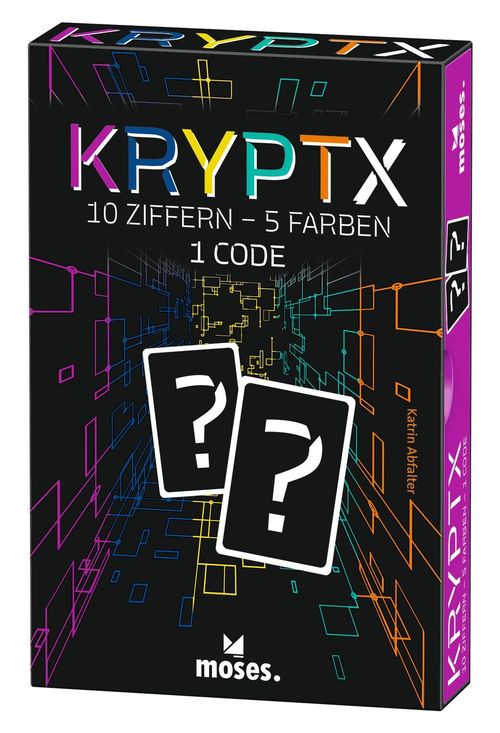
KryptX
KryptX Rulebook
Table of Contents
Table of Contents
Game Contents
- 9 card stands
- 50 number cards (0 to 9 in five colors)
- 8 control cards
- 1 game block
- Each player will also need a pen.
Setting Up the Game
- Remove all of the cards and the card stands from the box.
- Shuffle all of the number cards, then deal them out to the players. Check the table below for details of how many cards each player should get. These are your secret code cards.
| Players | Code cards |
|---|---|
| 2 | 4 |
| 3 | 3 |
| 4 | 2 |
Important! Keep your code cards secret from the other players!
- Place the remaining number cards face down as a draw pile. In addition, next to it, a discard pile is created over the course of the game.
- Each take a card stand for each of your code cards. Line the code cards up in front of you so that only you can see their front. Each card stand bears a different letter, allowing you to assign each code card a unique name (e.g., "Code card A" or "Code card B").
- Each take one red and one green control card. Lay these ready in front of you, turned face down.
- You should each also grab a sheet from the game block as well as a pen.
- Now each draw three cards from the draw pile.
- Before you start the first round, place these three cards in front of or next to your cards in the card stand, as explained in "1. Draw and play hand cards."
The picture on the right here shows how your table should now look. Now you're ready to get started!
(The setup picture shows a sample setup with four players.)
How to Play
The game involves a series of rounds. Play in turn, in a clockwise direction. The last person to pick a lock starts. Is it your turn? Then perform the following steps one after the other:
-
Draw and play hand cards. Draw three cards from the draw pile. These are your hand cards for this turn. Now play any one of your hand cards by placing it face up on the table for all to see ...
- ... either directly in front of any of your code cards bearing the same value or color,
- ... or on their side next to your code cards if the card played bears a different value or color than all your code cards.
Tip: Has the draw pile been used up? Then shuffle the cards in the discard pile and lay them ready as a new draw pile.
-
Guess the code card. Point to one of the code cards of any other player. Say a number or color of your choice out loud and ask if you're correct. Your fellow player must answer this question truthfully with "Yes!" or "No!".
-
Guessed right or wrong? Depending on the answer, the next step is as follows:
- Is the answer to your question "Yes!"? Then place your two remaining hand cards face down on the discard pile.
- Is the answer to your question "No!"? Then you must play another hand card of your choice face up. Then place your remaining hand card face down on the discard pile.
Have you performed all three steps? Then your turn has now ended and it's the turn of the person to your left.
Example (step 1, captions in the picture): "Same number" marks a card placed in front of a code card with the same number; "Same color" marks a card placed in front of a code card with the same color; "Different color and number than all code cards" marks a card placed next to the code cards because it differs in both color and number from all of them.
Example (step 2, captions in the picture): A player points to one of a fellow player's code cards and asks "Is this card blue?" The fellow player answers "Yes!"
Make Notes
You can make a note of the information you receive during the game on your sheet and cross out each number card you can see, for example. This is because each card is only included in the game exactly once and therefore cannot be on any of the other code cards. Keep your notes hidden from your fellow players at all times!
Crack the Code to Win
You can interrupt the game at any time to solve the code. Think you know the code? Then do as follows:
Say out loud: "Stop! I can solve the code!"
-
Name the numbers you think are on each of your fellow players' code cards—the color doesn't matter!
-
The following now applies for everyone else: Silently check whether the information applies to your code cards. Then place one of your two control cards face down at the center of the table: Green if all of the information is correct. Red if at least one item of information is incorrect. Set your remaining control cards aside, turned face down.
-
Shuffle all of the control cards at the center of the table, then turn them over one by one. There are now two options:
- Are all of the control cards green? Then you've successfully cracked the code and won the game. A round of applause, please! You're a genius codebreaker!
- Is at least one control card red? Then you're unfortunately wrong. You must turn over one of your code cards that has the fewest cards turned face up in front of it and show it to everyone. You may only attempt to crack the code again after another player has attempted (unsuccessfully) to crack the code.
Editor's note: the printed English rulebook reads "rot" here (an untranslated German word for red); it is rendered as "red" to match the control card colors named in step 2.
-
Take the control cards that were set aside and are at the center of the table and deal out one green and one red control card to each player again. Now the player who was just having their turn can continue playing.
Two-Player Game
When you're playing with two people, you can guess a code card as usual or alternatively draw an additional card from the draw pile, look at it, and then place it face down on the discard pile together with the other two cards in your hand.
Tip: By the way, you cannot ask questions secretly (see pro game variation).
Play Variation for Experienced Players
Skilled codebreakers are able to play the pro version. In this play variation, when you guess a code card of a fellow player, you may do so secretly. Instead of saying the value or color out loud, write your guess on a piece of paper and hand it to your fellow player. They then answer "Yes!" or "No!" as usual.
- Is the answer "Yes!"? Then put your remaining hand card on the discard pile as usual.
- Is the answer "No!"? Then you must play both of your remaining hand cards.
The other players then don't know what your guess was and receive less information. This makes it harder for them to guess the code.