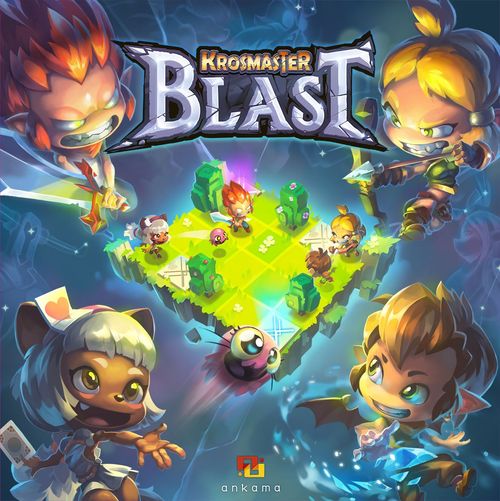
Krosmaster: Blast
Krosmaster: Blast Rulebook
Table of Contents
Table of Contents
Goal of the Game
The player who knocks out at least half of the opponent's Krosmasters wins the game!
If, after five rounds, no Krosmasters have been KO'd, the player who controls the most Glyph cells wins the fight.
Components
- 1 double-sided game board
- 6 Krosmaster miniatures
- 6 Krosmaster Blast cards
- 7 Divine Challenge cards
- 10 Krosmic Favor cards including 4 Superior Krosmic Favor cards
- 9 Minion cards
- 8 Glyph Tiles
- 1 Dofus token
- 2 dice
- 4 Trees
- 17 Minion tokens
- 12 Special Terrain tiles
- 4 Bushes
- 10 Movement Point markers
- 20 1-Injury markers / 12 5-Injury markers
- 10 Action Point markers
Setup
- Put the board in the center of the table. The color on your side of the board (blue or pink) will be yours throughout the game.
- Put the trees and bushes on their respective spots.
- Each player takes two Krosmaster miniatures at random, the corresponding Blast cards, and one die.
THE FIRST TIME YOU PLAY:
- Shuffle the 10 Krosmic Favor cards and put them face down next to the board. The Divine Challenge cards will not be used the first few times you play. Leave them in the box.
- Among the Minion cards, take the Fleeflee card and the Black Tiwabbit cards and put them within reach. Put the corresponding Minion tokens on top of them. Leave the other cards and Minion tokens in the box for your first game.
- Among the Special Terrain tiles, take the Fire and Ice Tiles and put them within reach. You won't need the other Special Terrain tiles for your first game.
- Put all the Glyph Tiles, and the Injury, Action Point and Movement Point markers within reach.
To decide who will be the first player, flip a Glyph Tile. The player whose color wins the Glyph toss is the first player. The first player chooses the starting positions for their Krosmasters from among the starting cells located on the first two rows on their side of the board. The starting cells are indicated by Dragoturkey footprints.
Then, their opponent does the same and takes the Dofus token. LET THE BATTLE BEGIN!
How to Play
Krosmaster Blast is played in turns.
When it is their turn, the first player draws a Krosmic Favor and plays their Krosmasters. Then it is their opponent's turn to draw a Krosmic Favor and play their Krosmasters. Then it is the first player's turn again, and so on until a player has won.
Your Krosmasters' Blast cards provide all the information you need to play:
MP (Movement Points) — This is the Krosmaster's ability to move. The Krosmaster may move one cell per MP during their turn.
HP (Health Points) — This is the Krosmaster's ability to withstand blows. When the Krosmaster has as many injury markers as HP, the Krosmaster is KO'd and the player controlling that Krosmaster loses the game. So be careful!
AP (Action Points) — This is the Krosmaster's ability to act. Each spell cast uses up 1 Action Point. During a Krosmaster's turn, you can therefore cast as many spells as the Krosmaster has Action Points.
RA (Range) — A spell's range, given in the number of cells, is the distance at which the spell can reach its target (Min. - Max.).
SPELLS — These are the Krosmasters' attacks.
ELEMENT — There are 4 types of elements in the game: Fire, Water, Earth, and Air. Some effects and powers are directly related to an element.
POWERS — These are the Krosmasters' special abilities. Don't forget them.
In Krosmaster Blast, you'll sometimes see the term "Fighter"; it designates both Krosmasters and Minions.
Stages of a Player's Turn
- Reveal a New Krosmic Favor
- Play Krosmasters
- Play Minions
1. Reveal a New Krosmic Favor
At the start of each turn, the active player turns over a new Krosmic Favor and places it to the right or left of the Krosmic Favor draw pile.
If the position you choose is already occupied by a Krosmic Favor, the new Krosmic Favor is placed on top of the previous Krosmic Favor, covering it.
Krosmic Favors offer additional possible actions or improve certain actions. Using a Krosmic Favor for one of your Krosmasters uses up 1 of the Krosmaster's Action Points.
Each player may use each Krosmic Favor once per turn: One Krosmaster may use both, or each Krosmaster may use one.
IMPORTANT: The player who has the Dofus token (for more about how the Dofus token changes hands, see Movement, below) may use Krosmic Favors for free, without paying the Action Point cost, but the player is still subject to the limit of once per turn for each Krosmic Favor.
2. Play Your Krosmasters
At the start of each turn, your Krosmasters have all their Action Points and Movement Points.
These totals may be altered by the presence of Action Point and/or Movement Point markers placed on the Krosmasters' cards.
On your turn, you may play your Krosmasters one after the other in the order of your choice.
You may move a Krosmaster by using its Movement Points and cast spells using its Action Points. Each 1-cell movement uses up 1 of the Krosmaster's Movement Points, and each spell cast (or Krosmic Favor used) uses up 1 Action Point.
MOVEMENT
Using 1 Movement Point lets you move one Krosmaster to an adjacent cell in a straight line forwards, backwards or sideways (but never diagonally).
Krosmasters may not be moved onto occupied cells (i.e. cells containing a tree, bush, another Krosmaster or a Minion).
When one of your Krosmasters moves onto a Glyph cell, put a Glyph Tile in your color on it and take the Dofus token if you do not already have it. Please note that the Dofus token cannot be taken during the first player's first turn, even if a Glyph cell is captured.
Glyph cells with Glyph Tiles on them are still free, so Fighters can be placed on them.
If you capture a Glyph cell controlled by your opponent, simply turn over the Glyph Tile!
ACTION
Using 1 Action Point lets you:
- use a Krosmic Favor; or
- cast a spell (see Casting Spells, below),
- use an active ability from a Divine Challenge.
3. Play Your Minions
Once you've played your Krosmasters, you may play your Minions, if you have any on the board, one after another in the order of your choice.
Minions, like Krosmasters, have Action Points and Movement Points. These totals may be altered by the presence of Action Point and/or Movement Point markers added to the Minions' tokens.
Minions are played following the same rules as the Krosmasters.
However, Minions may not use Krosmic Favors, and may not take control of Glyph cells (but they can occupy Glyph cells). See Summoning, below.
IMPORTANT: All Fighters' Action Points and Movement Points can be spent in any order. For example, you can use 1 Movement Point to move one cell, then cast a spell by spending 1 Action Point, then move two cells by using the remaining 2 Movement Points, and then cast another spell if the Fighter can and has enough Action Points.
Casting Spells
When a Fighter casts a spell, follow these steps:
Example "Catroulette": Spell Range 2-3, Spell Name "Catroulette" (Your next Catroulette spell must have a different target.), Spell Damage and Attack Element 1.
To be able to cast a spell, the following requirements must be met:
- THE FIGHTER STILL HAS AT LEAST 1 ACTION POINT.
- THE SPELL IS AVAILABLE.
- THE TARGETED CELL IS WITHIN RANGE.
- THERE IS A CLEAR LINE OF SIGHT BETWEEN THE CASTER AND THE TARGETED CELL (see below).
1. The Fighter Still Has at Least 1 Action Point
Each time a spell is cast, 1 Action Point is used up. Once all the Action Points indicated on the card (plus possible modifiers) have been used up, no more spells can be cast.
2. The Spell Is Available
Some spells may only be cast once per turn. If a spell of this type has already been cast, you can no longer cast it during the turn.
This is indicated by the 1/hourglass symbol on the card.
Example: "Capitol Punishment" 1/hourglass, range 2-2, "4 Glyphs: Places a -1 Action Point marker on the target.", damage 2.
3. Spell Range
All spells have a range composed of two values. The first is the minimum range: If your target is closer to you than this, you cannot cast the spell. The second is the maximum range: If your target is further away than this, you cannot cast the spell.
Distance is never counted along the diagonal (just like movements).
4. Line of Sight
For a spell to reach its target, you must be able to draw an imaginary straight line from the center of the cell occupied by the caster to the center of the targeted cell.
This line must not cross any cells that block line of sight.
Only cells occupied by a tree or a Fighter block line of sight. Bushes and Glyphs do not block line of sight. Among the Special Terrain tiles, only Fog Tiles block line of sight.
Example: The Catroulette spell can be cast with a minimum range of 2 cells and a maximum range of 3 cells. The targeted cell must therefore be within the caster's range, i.e. 2 or 3 cells away; there must be a clear line of sight.
- Green cells: Cells within range.
- Red cells: Cells within range but with blocked lines of sight.
Spell Resolution
Once these verifications have been made, spells are resolved in two stages. First, the spell effects are applied, if it has any. Then, a combat roll is performed to apply damage.
Spell Effects
Some spells have additional text describing spell effects. Apply these effects before performing the combat roll and applying damage.
AP/MP Markers — Some effects say to place Action Point or Movement Point markers on the target. The targeted Fighter's Action Points and/or Movement Points are modified accordingly. These markers disappear once the Fighter has been played.
The Action Point/Movement Point markers are placed:
- on the card of the targeted Krosmaster; or
- on the token of the targeted Minion.
Note: A Fighter that receives a marker during their turn is affected by the marker immediately.
Summoning
Summoning spells are special spells that put Minion tokens into play on empty targeted spaces on the board but do not do direct damage.
When you cast a Summoning spell, place the corresponding Minion card in front of you, next to your Krosmaster cards. This card indicates your Minion's characteristics.
Note that when a Minion is put into play by other means (Krosmic Favor, Divine Challenge), the Minion's card is placed nearby so that both players can consult it easily.
Then, place the corresponding Minion token on the board, with your color showing.
Once you have played both your Krosmasters, you can play your Minions.
Example: MARTINE GALE can cast the Fleabag spell to put a Fleeflee into play.
"Fleabag" 1/hourglass, range 1-1: MARTINE GALE summons a Fleeflee (maximum 1).
Shove
Some spells shove the target a certain number of cells away from the caster. Move the target the number of cells indicated or until it runs into the edge of the board or an obstacle (tree, bush, or Fighter).
Number of Glyphs
The use of certain spells and powers depends on the number of Glyph cells you control. For example, the Spin Again ability is only active if you have 4 or more Glyph cells under your control.
Combat Roll
Once the spell effects have been applied, roll a die to perform a combat roll.
If you roll a critical or a critical-joker, you've hit a weak spot and the attack does 1 additional damage. If you roll a shield, the target defended themself and the attack inflicts 1 less damage.
Put as many injury markers on the target of the attack as damage done.
For example, you attacked with the Catroulette spell, which does 1 base damage:
"Catroulette", range 2-3: Your next Catroulette spell must have a different target. Damage 1.
- if you roll a critical or a critical-joker, your spell does 2 damage (1 base + 1 from the combat roll);
- if you roll a shield, your spell does 0 damage (1 base -1 from the combat roll); and
- if you roll anything else, your spell does the base damage (1 in this example).
Note: The first time you play the game, only take into account the critical, critical-joker and shield sides of the dice. The other sides are explained below.
Fight Outcome
Once the injury markers are placed on the target, verify whether the number of injuries is equal to or higher than the target's Health Points. If so, the target is KO'd.
IMPORTANT
When a Minion is KO'd, remove it from the board.
In a 1 v 1 game with teams of 2 Krosmasters, the game ends (see End of the Game, below).
End of the Game
The game ends when one of the following two things happens:
A Krosmaster is KO'd. At least half of the opponent team's Krosmasters is KO'd.
The Krosmic Favor draw pile is empty. When, at the end of a turn, the Krosmic Favor draw pile is empty, the game ends (each player will have played 5 turns).
In this case, the players count the number of Glyph cells that they control; the player controlling the most is declared the winner. If both players control the same number of Glyph cells, there is no winner.
Advanced Rules
As soon as you feel at ease with the basic rules, we suggest you add the following rules to explore Krosmaster Blast more fully.
Krosmic Favors
During setup, add the Superior Krosmic Favors to the 10 basic Krosmic Favors. Shuffle these cards and put 10 randomly face down next to the board. Put the remaining cards away in the box without looking at them.
Playing Fields
Krosmaster Blast has a double-sided board. Each side of the board can be played with two different orientations, providing varied challenges for your games.
The two players still place their Krosmasters on the board on the first two lines on their side, regardless of which side and orientation are chosen.
Dice Sides
When you roll the die, the joker side acts as a joker. You immediately place the die so that it shows one of the following four sides: critical, shield, critical-joker or shield-joker. Then, apply the consequences of the roll.
The shield-joker side now functions like the joker side, except that you may only choose between shield-joker and critical-joker before applying the consequences of the roll.
Tackle Zones
The Krosmasters exercise their influence over the cells adjacent to them (never diagonally). These cells make up their "tackle zone".
If you want to move one of your Fighters located in the tackle zone of an opposing Krosmaster, you must succeed at a dodge roll. There is no need to perform a dodge roll when the movement is caused by the effects of a spell or power.
Dodge Rolls
Roll 1 die:
- If you roll a joker, your Fighter may leave the cell and move normally.
- If you do not roll a joker, you are "caught". Your Fighter cannot move and loses all their remaining Movement Points.
In addition, if you roll a shield-joker, you have been "tackled". Your Fighter cannot move and loses all their remaining Movement Points. In addition, that Fighter loses all their remaining Action Points.
It is possible to be in the tackle zones of more than one of your opponent's Krosmasters simultaneously. In this case, perform two dodge rolls:
- If you roll 2 jokers, your Fighter may leave the cell and move normally.
- If you roll 1 joker or do not roll a joker, you are "caught". Your Krosmaster cannot move and loses all their remaining Movement Points.
In addition, if you roll at least one shield-joker, you have been "tackled". Your Fighter cannot move and loses all their remaining Movement Points. In addition, that Fighter loses all their remaining Action Points.
Note: Minions do not have tackle zones.
Divine Challenges
At the start of the game, draw one Divine Challenge card from among the available ones and put it next to the board so that it is visible to both players.
This card is in effect throughout the game. It offers new possibilities and makes the Glyph cells more important.
Each Divine Challenge lets you unlock new powers based on the number of Glyph cells that you control.
Each Divine Challenge has 3 thresholds (blue / dark blue / red), which are unlocked only when you control the required number of Glyph cells (1 Glyph cell / 3 Glyph cells / 5 Glyph cells).
The effects of the thresholds are cumulative: If you control 3 Glyph cells, you get the bonus from the first threshold (1 Glyph cell) AND the second threshold (3 Glyph cells).
There are two types of bonuses:
- Passive bonuses apply for free as long as you control the required number of Glyph cells.
- Active bonuses can be used by your Krosmasters for 1 Action Point as long as you control the required number of Glyph cells (each Krosmaster can only use a given active bonus once per turn).
Note: Minions may not use the active bonuses from Divine Challenges.
Example card — "Iop's Brawl-for-All":
- Braaaawl! (passive) — 1x: Every time an allied Krosmaster captures a Glyph cell, that Krosmaster immediately gains 1 Movement Point.
- Amped-Up (passive) — 3x: Allied Krosmasters' spells that inflict damage do +1 damage.
- Iop's Wrath (active) — 5x: Inflicts 2 damage on all Fighters one or two cells away from the active Krosmaster.
Example: During a game with the "Iop's Brawl-for-All" Divine Challenge, the first two levels are passive bonuses, and the third level is an active bonus.
With the passive bonus "Braaaawl!", if you already have one Glyph cell under your control, each time you capture a new Glyph cell, the Krosmaster that captured it gains +1 Movement Point for the turn.
Tip: For a really wild ride, feel free to play with two or even three Divine Challenges at the same time!
Special Terrain Tiles
There are three different types of Special Terrain tiles: Ice, Fire and Fog.
Special Terrain tiles can only be put into play on free cells, that is to say cells that do not contain a tree, bush, or Fighter.
Note: Terrain tiles cannot be placed on Glyph cells, nor on another Special Terrain tile.
There can only be four Special Terrain tiles of the same type at any one time. If you can place a new Special Terrain tile on the board but this limit has already been reached, remove one Special Terrain tile of the same type from the board before placing the new one.
Example: There are four Ice Tiles and two Fire Tiles on the board. You would like to place an additional Ice Tile, but the maximum has already been reached for this type of tile. You must therefore remove one Ice Tile from the board before placing the new one.
COLD WAVE — You may place an Ice Tile on the board. Whenever a Fighter moves onto an Ice Tile from an adjacent tile, it slips and continues its movement one cell further in the same direction.
BRAZIER — You may place a Fire Tile on the board. Whenever a Fighter moves onto a Fire Tile, it receives 2 injury markers.
FOG BANK — You may place a Fog Tile on the board. Fog Tiles block line of sight. Fighters may move onto Fog Tiles. When they do, the Fog dissipates (remove the Fog Tile from the board).
Even More Miniatures
Krosmaster Blast is the newest addition to the Krosmaster line, a set of collectible miniatures.
Thus, if you get other Krosmasters, you can combine them with yours to make new teams!
Find out everything you need to know on the www.krosmaster.com website!
Player Aids
Order of Actions
- Draw a New Krosmic Favor
- Play Your Krosmasters
- Play Your Minions
Reminder
| Name | Movement | Line of Sight |
|---|---|---|
| Bush | Impassable | Does Not Block |
| Tree | Impassable | Blocks |
| Krosmaster | Impassable | Blocks |
| Minion | Impassable | Blocks |
| Special Terrain tile (except Fog Tile) | Free Cell | Does Not Block |
| Fog Tile | Free Cell | Blocks |
| Glyph Cell and Tile | Free Cell | Does Not Block |
Line of Sight
- Line of sight is an imaginary straight line that starts in the center of the attacker's cell and stops in the center of the target's cell.
- It must not pass through any cells that block line of sight (trees, Fighters, and Fog Tiles).
Casting Spells
REQUIREMENTS
- Check that 1 AP is left
- Check availability
- Check range
- Check line of sight
SPELL RESOLUTION
- Spell effects
- Combat roll
- Apply injury markers
Using MP and AP
MOVEMENT
Move one cell — Cost: 1 MP
ACTION
Cast a spell — Cost: 1 AP
ACTIONS RESERVED FOR KROSMASTERS
- Use an active bonus from a Divine Challenge — Cost: 1 AP
- Use a Krosmic Favor — Cost: 1 AP (0 AP with the Dofus token)
- Capture a Glyph cell — Cost: Free