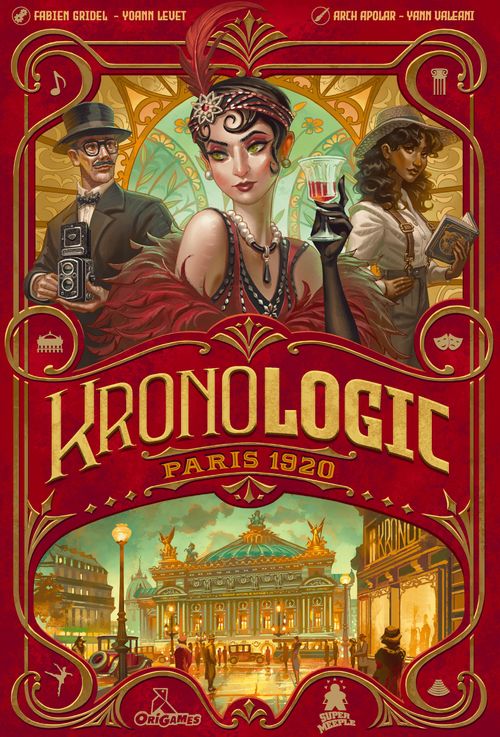
Kronologic: Paris 1920
Kronologic: Paris 1920 Rulebook
Table of Contents
Table of Contents
Components
- 1 pad of note sheets - 4 pencils
- 6 TIME tiles
- 6 CHARACTER tiles
- 1 game board
- 4 screens
- 3 Scenario envelopes, each containing: 1 booklet of 5 Investigations, with a description of the mystery to be solved, its specific rules, the victory conditions, the solutions, and 30 LOCATION cards (6 per Investigation).
Setup
I) Choose a Scenario, then one Investigation among the 5, taking into account the difficulty level, represented by stars. For your first game, we advise you to play Investigation no. 1 of the scenario Poison in High Society, of difficulty level 1 star.
II) Equip yourself with a screen, a note sheet and a pencil. Place the game board in the centre of the table.
III) Read carefully:
- the description of the Scenario
- the specific rules of the chosen Investigation
- the question or questions you must answer in order to solve the Investigation
IV) Place the TIME and CHARACTER tiles in the centre of the table.
V) Place the LOCATION cards of the chosen Investigation in the centre of the table (without turning them over — the table of values must not be visible).
VI) Determine who among you will start playing (the first person who gives the exact time). Then investigate in turn, clockwise.
Leading the Investigation
On your turn, you will be able to investigate in a specific Location. You will be able to learn either the number of Characters present there at a given Time, or the number of times a Character passed through it across all Times combined (from 1 to 6).
Note: The game board helps you to better visualise the different locations.
Select the LOCATION card that interests you, then turn it over (without looking at it) by placing it directly either under the TIME tile of your choice, or under the CHARACTER tile of your choice.
Look for the rounded corner of the tile (on the right) to know which way round to place the card underneath. The shapes of the tile and of the card must match, and the logo of the Location must appear in the hole of the tile (see below).
You will then be able to read the 2 pieces of information that appear:
- In green with the group-of-people icon, this is the SHARED INFORMATION, which you must announce out loud.
- In white with the single-person icon, this is the PRIVATE INFORMATION, it is only for you!
Example 1 — LOCATION + TIME
You want to find out "Who was in the Auditorium at Time 3?" Take the LOCATION card "the Auditorium" and turn it over under the TIME 3 tile.
The SHARED information that you give out loud (on a green background) indicates "x2": 2 different Characters are in the Auditorium at Time 3.
The PRIVATE information that you keep for yourself (on a white background) indicates "S": the Servant is therefore one of these 2 Characters present at Time 3 in the Auditorium.
Summary: Everyone knows that there are 2 Characters in the Auditorium at Time 3, but you alone know that among these 2 characters is the Servant.
Example 2 — LOCATION + CHARACTER
You want to find out how many times the Journalist passed through the Singing Foyer, across all Times combined? Take the LOCATION card of the Singing Foyer and turn it over under the CHARACTER tile of the Journalist.
The SHARED information that you give out loud (on a green background) indicates "x1": the Journalist therefore came 1 time into the Singing Foyer across all Times combined. The PRIVATE information that you keep for yourself (on a white background) indicates "5". The journalist therefore came into the Singing Foyer at Time 5.
Summary: Everyone knows that the Journalist came 1 time into the Singing Foyer, but you alone know that it was at Time 5.
Take notes, leave the others time to make their own deductions, and indicate to the investigator on your left that it is their turn to lead the investigation.
Generic Rules
Unless otherwise stated in the Investigations booklet:
- Characters always move from one Location to another adjacent one between each Time (they never stay two consecutive Times in the same Location).
- This movement is only made one room at a time.
- These rooms must be connected to one another by a passage (see the Plan).
Anatomy of the Components
The Opera Note Sheets
The note sheets consist of a plan of the Opera for each of the 6 Times. Each of the Locations of the Opera is represented by a symbol (dancer, musical note, theatre masks, column, staircase, opera facade).
A Location is adjacent to another when it is linked by a passage (white space between two Locations).
The central part of the note sheet allows you to write down information concerning the Characters. You can indicate there the number of times a Character is present in a Location.
Tip: If you know where and when a Character is, write their initial directly in the Location and the Time in question.
The LOCATION Cards
Each card is made up of:
- the name of the Location,
- its symbol,
- the title of the Scenario and the number of the Investigation (on the front only),
- the information that the card can give.
0, x1, x2, x3… = Number of Characters present in the Location at the consulted Time, or number of times a Character passed through this Location across all Times combined.
1, 2, 3, 4, 5, 6 (clock icons) = Time at which a consulted Character was present in the Location.
A, B, C, D, J, S = Character present in the Location at the consulted Time.
Replay symbol (two red arrows) = This symbol indicates that you must play again immediately after everyone has taken their notes. It appears when the answer to the question gives the same amount of information to everyone.
The TIME Tiles
On the front of the tile is the number of the Time in question. When you use a TIME tile, this face must be visible.
Note: the cut-out shapes of the tiles and of the questioned cards must match.
The CHARACTER Tiles
On the front of the tile is the role of the Character in question and their initial. When you use a CHARACTER tile, this face must be visible.
Example of Note-Taking
Here is an example of possible notation to help you note down the information. But every detective has their own way of doing things!
- "I copy the starting information onto my sheet."
- "I know that the Journalist has never been in this Location." (the Journalist's initial is crossed out in that Location)
- "I know that there is only a single Character at Time 4 in this Location and that it is the Detective."
- "I know that there are x2 Characters in this Location, but I do not know which ones."
Solo Game
In the solo version of Kronologic, you try to solve the Investigation as quickly as possible.
Each time you ask a question, you obtain the PRIVATE information and the SHARED information.
A question is the association of a LOCATION card with a TIME tile or a CHARACTER tile.
Note carefully the number of questions you ask. At the end of the game, this number will determine your investigation level. Refer to the table below to evaluate yourself.
Careful: in this solo mode, if you obtain a "replay" symbol during your investigation, you must count that question. It is not "free".
Poison in High Society
| Investigation 1 | Investigation 2 | Investigation 3 | Investigation 4 | Investigation 5 | |
|---|---|---|---|---|---|
| Difficulty | 1 star | 2 stars | 2 stars | 2 stars | 3 stars |
| Gold Magnifying Glass | 1-7 | 1-9 | 1-8 | 1-9 | 1-12 |
| Silver Magnifying Glass | 8-13 | 10-15 | 9-14 | 10-15 | 13-18 |
| Bronze Magnifying Glass | 14+ | 16+ | 15+ | 16+ | 19+ |
The Phantom of the Opera
| Investigation 1 | Investigation 2 | Investigation 3 | Investigation 4 | Investigation 5 | |
|---|---|---|---|---|---|
| Difficulty | 3 stars | 3 stars | 4 stars | 4 stars | 4 stars |
| Gold Magnifying Glass | 1-15 | 1-15 | 1-18 | 1-18 | 1-18 |
| Silver Magnifying Glass | 16-22 | 16-22 | 19-25 | 19-25 | 19-25 |
| Bronze Magnifying Glass | 23+ | 23+ | 26+ | 26+ | 26+ |
The Singer's Jewels
| Investigation 1 | Investigation 2 | Investigation 3 | Investigation 4 | Investigation 5 | |
|---|---|---|---|---|---|
| Difficulty | 3 stars | 4 stars | 4 stars | 4 stars | 5 stars |
| Gold Magnifying Glass | 1-12 | 1-18 | 1-16 | 1-16 | 1-20 |
| Silver Magnifying Glass | 13-18 | 19-25 | 17-22 | 17-22 | 21-26 |
| Bronze Magnifying Glass | 19+ | 26+ | 23+ | 23+ | 27+ |
Example: You play Investigation 2, of level 2 stars, of the Scenario Poison in High Society. You found the solution after asking 12 questions. You are in the "10-15" bracket, so you obtain the Silver Magnifying Glass for this Investigation!
End of the Game
At any moment during the game, when you think you can answer all the questions of the Investigation, announce it and stop the investigations. Write your answers secretly on your note sheet and consult the solution in the scenario booklet.
If your deduction is correct, you win the game!
Otherwise, it is lost, you are eliminated (do not communicate the right answers publicly).
Several investigators can check their theory at the same moment and win the game together.
If everyone was wrong, the game is lost. Then start a new Investigation!