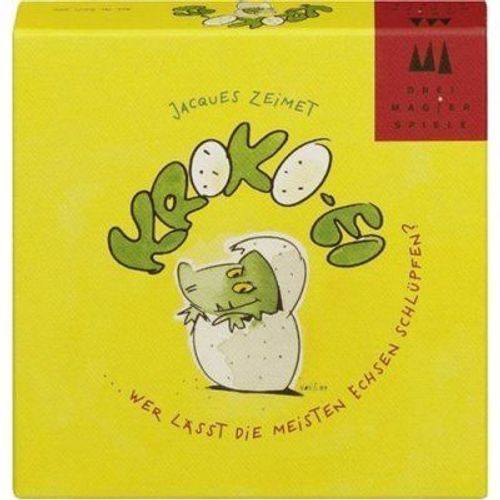
Kroko-Ei
Kroko-Ei Rulebook
Table of Contents
Table of Contents
Material
- 24 square "Kroko-Ei cards" with pictures on both sides
- Rule sheet
Preparation
All Kroko-Ei cards are shuffled face down on the table. The heads and tails of the crocodiles must face down.
The children then lay out three arbitrary cards next to each other so that eight coloured eggs are visible.
Goal of the Game
Story: Eight crocodile eggs lie on the bank of the Nile. Slowly the shells crack open, and the crocodile babies begin to hatch.
The children can help them by swapping and turning over cards, to conjure up eight small crocodiles in which all three parts have the same colour.
Winning: Whoever has the most single-coloured crocodiles at the end is the Crocodile King (Krokodil-König/-Königin)!
Note: The same winning condition is printed again at the end of the Course of Play section, and is transcribed in place there.
Important
Two cards can be swapped with each other only if they are either two middle cards or two outer cards. If two cards from the outer rows are swapped, it does not matter whether they come from one row or from both rows.
If a player's action places two same-coloured parts of a crocodile next to each other, that player takes another turn.
Course of Play
The youngest player begins. Then each player takes a turn in clockwise order.
On their turn, the player has two options:
- Either turn over any card, or
- swap two cards from two different eggs (without turning the cards over).
Example (caption on the original page): In the first move the top card was turned over. As a result, two same-coloured cards lie next to each other, so the player may continue. When the next card is turned over, the head of a same-coloured baby crocodile appears. But since the matching parts are not next to each other, the next player is up...
[Transcriber note: the printed caption contains typographical errors, read as "Unke obere Karte" (probably "die obere Karte", "the top card"), "xwei" (zwei, "two"), "Spiele" (Spieler, "player") and "des1" (rendered here as "a same-coloured baby crocodile"). Corrected or rendered as above; the sense is unchanged.]
If a player manages to place two same-coloured parts of a crocodile next to each other, that player may continue (take another turn).
If a player's swap completes a crocodile, that player needs only to exchange two more cards and a crocodile baby has hatched.
Whoever manages to lay out a three-part, single-coloured crocodile may take the three cards and place them in front of themselves, and then takes another turn.
If a player, with their action, cannot find any matching parts, the next player takes a turn.
Winning: Whoever has the most Kroko-babies lying in front of them at the end wins!
Caution! It is not always possible to free the last crocodile or the last crocodiles, because sometimes the remaining colours of the body no longer match the colours of the head or tail.
To solve this difficult task, all children must help the affected crocodile. The player whose turn it is may swap the body of the incomplete crocodile with the body of the same colour of any already freed crocodile baby, and then turn it over.
If the player manages to assemble the small crocodile, they may of course place it in front of themselves!
Kroko-Ei Solo
If a child wants to play Kroko-Ei alone, they can try to lay out:
- 8 three-coloured eggs,
- 8 three-coloured crocodiles,
or
- 8 single-coloured eggs,
- 8 single-coloured crocodiles.
Age and safety warning (printed on the back of the sheet): Not suitable for children under 36 months. Small parts: choking hazard.