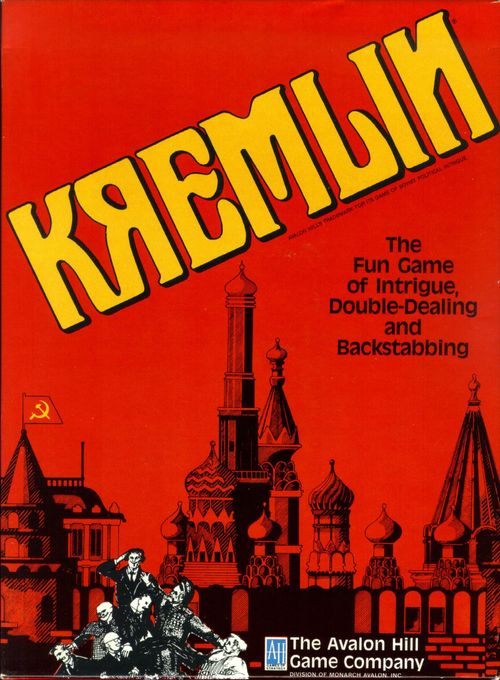
Kremlin
Kremlin Rulebook
The Avalon Hill Game Company, 2nd Edition
Table of Contents
Table of Contents
Contents
- one playing board
- one Basic Game rules folder
- one Advanced Game rules folder
- 26 Politician cards
- 34 Intrigue cards (used only in the Advanced Game)
- one Influence Points Pad
- one sheet of die-cut playing pieces
- one 20-sided die
The Gameboard
The gameboard has 13 slots for the placement of various Politicians in descending order of rank and importance from top to bottom and left to right. Only the top eight slots represent voting members of the Politburo and are listed in the order of their Rank and voting order:
Top Slot
- Party Chief
1st Level Slots 2. KGB Head 3. Foreign Minister 4. Defense Minister
2nd Level Slots 5. Ideology Chief 6. Industry Minister 7. Economy Minister 8. Sport Minister
The Politburo is composed of three levels; the Party Chief slot with a Purge Number of 18, three 1st Level slots (KGB, Foreign Minister, Defense Minister) with a Purge Number of 14, and four 2nd Level slots (Ideology Chief, Industry, Economy and Sport Ministers) with a Purge Number of 10. Below the Politburo are five slots representing Candidates for promotion to the Politburo with a Purge Number of 6. The area at the bottom is reserved for the People—a collective breeding ground of Party members waiting for promotion.
The bottom of each Politburo slot is color-coded to match the sequence of play printed on the board. The color of the banner beneath each Politburo slot identifies the phase(s) in which that member can be active. The color-coded alpha-numeric code on the left side of each Politburo banner lists the alternate powers of that Politburo slot; e.g., the code "3A" on the Foreign Minister banner means that he is the first alternate (A) to perform the Spy Investigation duties in Phase 3. The color-coded information to the right of each slot summarizes what that Politician may do in that phase. All information on the board printed on a white background refers only to Advanced Game rules and should be ignored during the Basic Game.
The Politicians
Each Politician card (except for "Nestor Aparatschik" who starts each game as the sick Party Chief and cannot be controlled by any player) contains the Politician's name, a letter in the upper left hand corner for easy identification and a number from 50 to 80 in the upper right hand corner representing the starting age of that Politician. The Strength (+) and Weakness (−) information beneath each Politician's name is not used in the Basic Game. The humorous summary printed on the back of each Politician's card is for flavor only and unnecessary for play of the game.
The Markers
Each player represents one of the factions listed at the lower right corner of the board which are vying for power. The strength of each faction is measured in terms of written and/or declared Influence Points (hereafter referred to as IP). Declared IP are represented by the colored number markers bearing the symbol of that faction. Other game markers are shown below:
- Age Stress Points (SP) — colored number markers
- Cure — marks a Politician taking the cure at the Sanatorium
- Triple Suspicion (used only in the REVOLUTION variant)
- Sick — one Red Cross marker
- Ill — two Red Cross markers
- Suspicion / Double Suspicion (used only in the REVOLUTION variant)
How to Win
The first player controlling one or more Politicians who wave a total of three times from the rostrum at the October Parade wins. If no player has won at the end of ten turns (years), the player controlling the Party Chief at the end of the fifth phase of turn 11 wins. The game can also be won by controlling the highest active Politician if there are insufficient Politicians left to fill the Politburo (see 6.4) at the end of any Replacement Phase.
Prepare to Play
Give each player an Influence Point sheet, a pen, and all the Influence markers of one faction. Place the "Nestor Aparatschik" Politician card in the Party Chief slot with a Red Cross marker. Shuffle the 25 remaining Politicians and deal 12 of them face up in random order into the remaining Politburo and Candidate slots of the board. The four oldest of the 13 remaining Politicians are displayed in the People box and the remainder are kept offboard beneath the People box displayed in order of their age. Each player then secretly records on his Influence Sheet (in the Influence Points column) the number of IP he has allocated to ten of the 26 listed Politicians. None can be allocated to "Nestor". He must write a "10" in the row of the Politician he most wants to control, a "9" in the row of another, an "8" in the row of a third, and so on until he has written each of the numbers from 1 to 10 once each and has thereby secretly committed all of his IP to ten of the 26 Politicians.
Once everyone has finished recording his IP, players are free to declare as many or as few of their written IP as they wish in an attempt to control the actions of their Politicians by placing the numbered IP markers of their faction on their declared Politicians. For reasons which will become obvious as you learn the game, it is unwise to declare many IP at the outset and foolish to declare IP on any Politician not currently in one of the eight Politburo slots.
Declaring Influence
Players may declare all or part of their IP at any time and in any order by placing appropriately numbered IP markers of their faction on the Politician(s) of their choice. Players may never declare more IP on a Politician than they have previously recorded for that Politician on their Influence Sheet. The player currently displaying the most declared IP on a Politician controls him and decides what actions he will take. Should two or more players both have the most declared IP on a Politician, control of that Politician belongs to the player who placed his current declared total first. Should such placement be simultaneous, then the player rolling highest on a tie resolution dice roll is given control and his marker is placed on top of the loser's to mark his status as the holder of undisputed control.
Although IP can be declared at any time, they cannot be used to rescind any action once dice have been rolled to resolve it or another action has taken place (such as the vote of the next ranking Politburo member being cast or the next action of that or subsequent phases). If changed control of a Politician occurs after a Purge attempt, Spy Investigation, or Funeral Commission nomination is announced, those actions are considered to have never been declared provided the new controller makes such a declaration before any dice are cast or the next vote is taken. Proper game etiquette in these procedures is to allow a sufficient pause (say five seconds) between each declared action or vote and the following vote or dice roll to allow other players the opportunity to assume control of the Politburo member taking the action.
EXAMPLE: The KGB Head, currently controlled by Blue, is under Investigation. Red is currently in control of Foreign Minister Palavrian with four declared IP and votes guilty. However, Blue has five IP recorded on his Influence Sheet for Palavrian and declares them all now in an effort to control the Foreign Minister for this vote. If he is successful he may change Palavrian's vote to "Innocent". However, once the next Politburo member (the Defense Minister) announces his vote, Palavrian's current vote stands—it may not be changed.
Inactive Politicians
Politicians in the Sanatorium are inactive. They may neither vote nor take actions. Any action initiative which would otherwise be available to them passes to the next active Politician according to the color-coded order of succession beneath each Politburo slot for that phase. A Politician without declared IP is not considered inactive.
EXAMPLE: The KGB Head is at the Sanatorium. The option to initiate a Purge in Phase 2 passes to the Ideology Chief (2A). Should he too be at the Sanatorium (or his position be vacant), the option would pass to the Party Chief (2B), and then to the Industry Minister (2C) if necessary. If all four Politicians are inactive (or their slots vacant), the Purge Phase ends with no action taken.
Sequence of Play
The game is played in ten yearly turns (although it can end earlier), each of which is composed of eight separate phases resolved in the following order:
1. The Cure Phase
A Politician with one Red Cross marker on his card is considered Sick; if he has two Red Cross markers he is considered Ill. All Politburo members in poor health in voting order succession are asked if they will voluntarily go to or return from the Sanatorium. Those who opt for the Sanatorium remain in their Politburo slot but are marked with a Cure marker. Politicians with no declared IP never go to the Sanatorium. A Politician who opts to go to the Sanatorium must remain there throughout the year and may remove his Cure marker only during the Cure Phase of the following year. A Politician at the Sanatorium who is no longer in poor health must remove the Cure marker during the next Cure Phase.
1.1 AGING: Aging does not occur automatically with the passage of each Game Year. Instead, during this phase, the Party Chief automatically ages one year regardless of his health and whether or not he has gone to the Sanatorium. All other Politburo members—including the Party Chief—age one year for each Red Cross (•) on their card if they have not gone to the Sanatorium. In addition, Politicians age one year if marked with a "?" marker—regardless of whether or not they go to the Sanatorium. Aging is indicated by the application of Stress Points (hereafter referred to as SP) in the form of number markers placed over the Politician's printed age to reflect his new age. Only the eight current Politburo members are subject to aging.
1.2 SANATORIUM EFFECTS: The health of Politicians who go to the Sanatorium is more likely to improve than those who remain at work. However, those who go to the Sanatorium are more vulnerable to Purges and Investigations and may not vote while there. Politicians in the Sanatorium retain their Politburo posts and can be promoted, demoted, or shifted within the same level in abstentia, but are considered inactive.
1.3 JUNIOR MEMBERS: Politicians at the Candidate and People levels neither age nor get sick. However, it is possible for Politburo members with poor health or who have aged to be removed from the Politburo. Those Politicians retain their current age and health status (as opposed to their printed age) at the lower levels. Sick/Ill Politicians at the lower levels may not go to the Sanatorium, but are not required to make a Health dice roll during the Health Phase (see 4).
2. The Purge Phase
The Head of the KGB may attempt to Purge by naming any Politician in the Politburo or Candidate levels and rolling the die. If he rolls greater than or equal to (>) the Purge Number for that level, the Purge is successful, the victim is sent to Siberia, and the KGB Head ages one SP. He may attempt another Purge or end the phase as he chooses. If he rolls less than (<) the required Purge Number, the victim is unaffected, the KGB Head ages three SP, and the Purge Phase ends. The purging player must add +3 to his dice roll if the victim is at the Sanatorium.
2.1 ORDER OF SUCCESSION: If the KGB Head declines to conduct a Purge, the phase ends. However, if he is inactive (i.e., at the Sanatorium) or the position is vacant, the option to conduct a Purge passes to the Ideology Chief (2A). Should he be inactive, it would pass to the Party Chief (2B), and then to the Industry Minister (2C). As soon as the first active Politician with the Purge power declines the opportunity, the Purge Phase is over.
2.2 SIBERIA: Whenever a Politician is sent to Siberia he retains any accumulated SP and health problems. No Cures are conducted in Siberia. However, all "?" and IP markers are removed. All players with declared IP on that Politician must subtract them from the total they allocated to that Politician and mark their Influence Sheet accordingly. Politicians sent to Siberia should be displayed offboard to the right of Siberia.
3. Spy Investigation Phase
The Defense Minister may call a Trial to resolve one Spy Investigation case per year against any Politburo member already under a "?" marker. A Trial is resolved by vote of all active Politburo members. Votes are declared individually in voting order. The victim is considered guilty until proven innocent. Two "Innocent" votes are required for acquittal regardless of the number of Politburo members voting. As the accused retains his vote (unless inactive), it is advantageous to accuse an inactive Politician who cannot vote in his own defense. A Politician with no declared IP on him does not vote except in his own defense. If the accusation is successful, the victim is sent to Siberia (see 2.2). If the accusation fails, the "?" marker is removed from the accused, and the Defense Minister ages three SP.
3.1 CONDEMNATION: Instead of bringing a suspect to Trial, the Defense Minister (or any Politburo member acting in his stead if inactive or vacant) may condemn any one Candidate without recourse to vote but in so doing receives two SP. The condemned Candidate is sent to Siberia with all of the consequences of rule 2.2. He need not have been under a "?" marker previously.
3.2 INVESTIGATIONS: Whether or not a Trial is resolved, the Defense Minister may then investigate as many Politburo members as he wishes by placing a "?" marker on those Politicians and aging himself one SP for each investigation. He cannot investigate any Politician just acquitted by Trial during that same turn.
3.3 CLOSING INVESTIGATIONS: The current Defense Minister (or another Politburo member acting in his stead if the Defense Minister is inactive or vacant) can close Investigations by removing "?" markers at a cost of one SP each.
3.4 ORDER OF SUCCESSION: If the Defense Minister declines to take any action, the phase ends. However, if the Defense Minister is inactive or vacant, the option passes to the Foreign Minister (3A). Should he be inactive or vacant, it would pass to the KGB Head (3B), followed by the Party Chief (3C), and the Industry Minister (3D). Should any active Politician with the power to take an action decline the opportunity, the phase ends.
4. Health Phase
All members of the Politburo must make a die roll on the Health Table. Those who have remained at work use the "At Work" Table; those who have gone to the Sanatorium use the "Taking Cure at Sanatorium" Table. The die roll is cross-referenced with the individual's current age to determine the result. Any Politician who receives his third Red Cross (•••) dies and is buried with due honors and ceremony within the Kremlin Wall.
5. Funeral Commission Phase
This phase is resolved only if the post of Party Chief is vacant. If so, the Foreign Minister must nominate a successor other than himself from the ranks of the 1st Level. The nominee may be inactive. Should there be no other Politician on the 1st Level, he may nominate one from the 2nd Level. Should no other Politburo member be available, he automatically raises himself to Party Chief. The Foreign Minister's nominee must be confirmed by vote of the active Politburo. The Foreign Minister cannot vote against his own nominee, nor can the nominee vote against himself. Three negative votes (regardless of the number voting) defeats the nomination and ages the Foreign Minister one SP. If his first nominee fails, the Foreign Minister must nominate another Politburo member from among those who voted "no" for the first nominee. If this nominee also fails, the Foreign Minister ages another SP and automatically becomes Party Chief himself. If the Foreign Minister has no declared IP, he automatically nominates the oldest eligible Politician.
5.1 ORDER OF SUCCESSION: A Politician may not decline the opportunity to nominate a successor. However, if the Foreign Minister is vacant or inactive, the nomination passes to the Ideology Chief (5A), followed by the KGB Head (5B), Industry Minister (5C), Economy Minister (5D), Sport Minister (5E), and Defense Minister (5F).
6. Replacement Phase
The Party Chief may now freely shift Politicians (both active and inactive) to new Politburo slots of his choice within their current Level at no cost to himself.
6.1 PROMOTIONS/DEMOTIONS: The Party Chief, having finished all shifts within current Politburo levels he cares to declare, may now promote and demote as many or as few active or inactive Politicians as he wishes but he ages one SP for each promotion or demotion he declares. His promotions/demotions are limited to one step (i.e., he may not promote a Candidate to a 1st Level post nor could he drop a 2nd Level Minister beneath the rank of Candidate). The Party Chief cannot demote himself.
EXAMPLE: The Party Chief wishes to demote a 2nd Level Politician to Candidate but because there are currently no vacancies at the Candidate Level, he must also either promote a Candidate to 2nd Level or demote a Candidate to the People in order to open a vacancy at the Candidate Level into which to demote the 2nd Level Minister.
6.11 PROGRESS BY AGE: After having promoted and demoted all the Politicians he cares to, the Party Chief announces he is finished. Each still-vacant 1st Level post is then filled in order of succession by promoting the oldest member of the 2nd Level. If there are no 2nd Level Politicians, the oldest candidate is promoted to the vacancy. If there are no Candidates, the oldest Politician from the People ascends all the way to the 1st Level vacancy. No SP are inflicted for automatic progression by age.
6.2 1ST LEVEL PROMOTIONS: The KGB Head (6A) may now promote as many Candidates as he wishes to vacancies in the 2nd Level Politburo and as many Politicians as he wishes from the People to vacancies in the Candidates. Each promotion ages the KGB Head one SP. He may not demote Politicians nor may he shift their positions within their current level. He may promote each Politician only one level during this phase. If inactive or unwilling to sponsor more promotions, the opportunity to sponsor any remaining promotions passes to the Foreign Minister (6B) and then to the Defense Minister (6C).
6.21 PROGRESS BY AGE: After having promoted all the Politicians they care to, the 1st Level Politburo members announce they are finished. Each still-vacant 2nd Level post is then filled in order of succession by promoting the oldest Candidate. If there are no Candidates, the oldest Politician from the People ascends to the 2nd Level vacancy. No SP are inflicted for automatic progressions.
6.3 2ND LEVEL PROMOTIONS: The Ideology Chief (6D) may now promote as many Politicians as he wishes to any vacancies in the Candidates at the cost of aging one SP for each promotion he sponsors. If inactive or not caring to sponsor any more promotions, the opportunity to sponsor any remaining promotions passes to the Industry (6E), Economy (6F), and Sport Ministers (6G) in turn.
6.31 PROGRESS BY AGE: After having promoted all the Politicians they care to, the 2nd Level Ministers announce they are finished. Each still-vacant Candidate slot is then filled automatically by raising the oldest Politician from the People.
6.4 GAME END: If due to a lack of eight living Politicians outside Siberia, it is impossible to fill the eight Politburo posts by the end of Phase 6, the game ends with the player controlling the highest ranking active Politburo member the winner.
6.5 RULE OF THE OLD: When determining Progress by Age, a Politician's age is the total of his printed age plus any SP he has accumulated represented by the age markers covering his printed age. If two or more Politicians have the same age, the one with the highest printed age progresses.
Although a Politburo member may promote a Politician only one level per Phase, that Politician may be promoted several times during that phase by different Politburo members and/or be progressed several levels at once by default due to the Progress by Age rule.
7. Rehabilitation Phase
Each Politburo member in voting order is given the opportunity to rehabilitate as many occupants of Siberia as he wishes. Each Politician he releases from Siberia causes the sponsoring Politburo member to age five SP. Released Politicians are returned to the People complete with any aging or health problems they took to Siberia. All undeclared IP on that returning Politician remain unaltered.
8. Parade Phase
Unless in the Sanatorium taking the Cure, the Party Chief must "stand on the rostrum at the October Parade". If he is healthy he automatically "waves" throughout the Parade. However if he is Sick (+), he ages one SP and must roll greater than or equal to (>=) 7 in order to "wave" throughout the Parade. If he is Ill (++), he ages two SP and must roll greater than or equal to (>) 14 in order to "wave" throughout the Parade. If he "waves" throughout the Parade, the controlling player places his faction marker in that year of the Tally Track. The first player to have three of his faction markers in the Tally Track wins the game. If no one waves, place a Sick (+) marker in that year to mark the passage of a turn without a wave.
Retirement
Any Politician who reaches the age of 96 retires from public life at the end of the current phase and is removed from play. Having reached the age of 96 that Politician may initiate no actions that will age him further before he is removed.
STOP! You have read all that is necessary to play the Basic Game. Play it before proceeding to the Advanced Game rules.
The Swiss Version
The original version of the game which won accolades in Europe has an entirely different feel although it has almost the same rules as the Basic Game with the following modifications:
HOW TO WIN: The game ends when one Party Chief waves three times regardless of who controlled him during those waves. The winner is the player who controls the Party Chief at game end. However, if one or more other players have the same number or more IP recorded for that Politician they win and the player actually controlling the Party Chief loses.
AGING: Aging during the Cure Phase for any reason or combination of reasons is limited to a maximum of one SP per turn.
SIBERIA: Politicians sent to Siberia do not lose their declared IP.
Please try both versions and inform us of your preferences.
Advanced Game Rules
Players may choose to omit any of the Advanced Game rules they dislike, but for optimum results we suggest using all of them.
A. Prepare to Play
Proceed as in the Basic Game with the following exceptions:
Shuffle the Intrigue cards, deal three face down to each player, and place the rest off to one side. Players should inspect their Intrigue cards before recording any IP on their Influence Sheet.
If there are four or more players, IP may be allocated to the sick Party Chief "Nestor Aparatschik" in addition to any of the other Politicians.
B. Resolving Influence Point Ties
Rather than allowing the player who declared his current IP total first to control a Politician when several players have the same number of declared IP on that Politician, any other player(s) with declared IP on that Politician may attempt to break the tie by declaring his support for one of the tied players in the amount of one-tenth of his current declared IP on that Politician. Should this fail to break the tie, the tie is resolved as in the Basic Game in favor of the player who declared his current total of IP first. This tie-breaking procedure is in effect until another player manages to tie the current controller or a new tie results from a higher declaration of IP. Should a new tie be declared, all players are free to vote their declared IP again. Once resolved, a tie victor cannot be unseated by a third party merely withdrawing or increasing his support in favor of another player. A new tie situation would have to occur to create a new tie resolution opportunity.
EXAMPLE: Green has six declared IP on KGB Head Strychnin. Blue now also declares six IP on him. Black has two and Yellow has one declared IP on Strychnin also and they both offer their support to Blue in exchange for later favors which will break the tie in favor of Blue (6.3 to 6). However, Brown is distressed by that prospect and now declares three IP on Strychnin also and offers to support Green, thus restoring the tie (6.3 to 6.3). Consequently, with no one willing or able to declare more IP on Strychnin, this tie is resolved in favor of Green who placed his own six declared IP on Strychnin before Blue. Green will control Strychnin until someone else declares six or more IP on him.
If play of an Intrigue card forces a player to lose declared IP on a Politician thereby causing an IP tie, the player who did not just lose IP is considered to have placed his current total of declared IP first for purposes of breaking the tie.
C. Strengths (+) and Weaknesses (−)
Beneath each Politician's name are two color-coded names of Politburo slots which represent his Strength (+) and Weakness (−). A Politician who is in his strong slot ages slower than normal and one who is in his weak slot ages faster than normal. In addition, a Politician in his strong slot may subtract 2 from any Purge die roll vs him. A Politician in his weak slot must add 2 to any Purge die roll vs him. Consequently, players will often try to maneuver their own Politicians to their strong slots and opposing Politicians to their weak slots.
Politicians occupying a Politburo slot identified as their Weakness age one year during the Cure Phase even if in the Sanatorium. The normal aging process is retarded one year if occupying a Politburo post identified as the Politician's Strength, but in no case can he grow younger. He can only age or remain the same.
EXAMPLE: Nikotin is the Party Chief and is Ill. He will age three years during Phase 1 (one for being Party Chief and two for being Ill). Bungaloff is Sick but because he occupies his position of Strength as Minister of Sport he will not age. Strychnin is Ill and under a "?" marker while occupying his position of Weakness as Industry Minister but because he is also taking the Cure at the Sanatorium he ages only two years (due to Suspicion and Weakness-related job stress).
D. Intrigue Cards
Each player can have a maximum of three Intrigue cards at any one time and must reveal the number of cards he has if asked. With the exception of the Blackmail cards (which remain in the hand of the player they are first offered to as a bribe) and the red cards (with lasting effects which are placed on the affected Politician as long as they are valid), all played or discarded Intrigue cards are returned to the bottom of the Intrigue deck. Players are free to play an Intrigue card whenever they like unless the card specifies other conditions for its use. Players may discard Intrigue cards anytime unless they are being blackmailed or bribed (see E). Players may draw cards in excess of the three card limit provided they immediately discard the excess cards of their choice after inspection.
FIRST PURGES: If an Intrigue card is required to be played at the start of a Phase, it may be played even after an action is announced (such as a Purge attempt) in an effort to cancel that Action provided no dice have yet been rolled or votes announced. However, only one such card may be played per phase—the one played first. If two or more players declare their card play simultaneously, decide who was first with a dice roll.
31. OLYMPIC BOYCOTT of Moscow Games. The first Purge attempt must be versus the Sport Minister. Increase any Purge dice roll versus him by +3. If no Purge attempt is made by the KGB Head, the Ideology Chief may attempt it, and if successful may then attempt to Purge KGB and add +3 to that Purge dice roll as well. Play at start of any Purge Phase.
EXAMPLE: It is the start of the Purge Phase. The KGB Head announces a Purge attempt vs the Economy Minister who is controlled by Blue. Blue, in an attempt to foil this Purge, plays his Olympic Boycott Intrigue card requiring that the first Purge attempt of any made in that phase must be vs the Sport Minister. The KGB Head must now cancel his Purge attempt vs the Economy Minister to Purge the Sport Minister or pass. If he passes, according to the Olympic Boycott card, the Purge Phase does not end; the Ideology Chief (2A) may attempt it or pass. If the Ideology Chief is inactive or vacant, the Party Chief (2B) [or if inactive, the Industry Minister, 2C] may attempt it, but if the Ideology Chief is active and passes, the phase ends. Regardless of the outcome, no other "first Purge attempt" Intrigue cards may be played during that phase.
RANDOM RECIPIENTS: Some Intrigue cards require that the faction they affect be determined randomly. In such cases, take a faction marker from each player numbered as shown on the board and place it in a cup. The player then randomly draws the faction marker to be affected from the cup. If a random amount is also needed, another random draw is made from among the six faction markers to determine a number from 1 to 6.
Some Intrigue cards cancel some of the effects of other cards; e.g., the OLYMPIC BOYCOTT +3 and OLYMPIC WIN −3 modifiers negate each other. Notes can be made on the Influence Sheet of those Politicians involved in Blackmail.
E. Bribes & Deals
A player may always opt to privately reveal one or more of his Intrigue cards to another player in an attempt to bribe him—usually to cancel an announced Purge, Spy Investigation, or demotion of one of his Politicians. While passing the card(s) to his opponent, the player proposes the terms of the bribe (e.g., promotion of a certain Politician to the KGB slot). If the terms are acceptable, the recipient may keep the Intrigue card(s) but must honor the terms of the agreement. If he declines, the Intrigue card(s) must be returned to their owner.
Players are not allowed to show blackmail or bribe cards to other non-involved players, although they are free to "tell stories" about them—none of which have to be true. The binding aspect of a bribe never lasts beyond the current phase. Any longer term promises are just that—promises; they can be honored or not at the bribed player's discretion. Such side negotiations are termed "deals" and may be freely negotiated and entered into at any time with or without the exchange of Intrigue cards, but are never binding. Promises can be made and gifts exchanged, but once the current phase ends, fulfillment of any deal is up to the whim of the bribed player.
Players may not give another player permanent use of their IP. If a bribe convinces a player to cancel a Purge, Spy Investigation, or vote before it is resolved, he is considered never to have announced that action/vote. If a player already has three Intrigue cards when offered a Bribe, he may accept the Bribe by returning one or more of his own Intrigue cards to the briber as "change" in order to stay within the three card limit. A player may not discard or play an Intrigue card while being blackmailed or bribed to avoid this payment. Therefore, a player who "blackmails" an opponent who already has three Intrigue cards will not only get the benefit of the blackmail, but be the recipient of another Intrigue card of the victim's choice in return due to this three-card limit rule.
Players may not give another player permanent use of their IP. If a bribe convinces a player to cancel a Purge, Spy Investigation, or vote before it is resolved, he is considered never to have announced that action/vote. If a player already has three Intrigue cards when offered a Bribe, he may accept the Bribe by returning one or more of his own Intrigue cards to the briber as "change" in order to stay within the three card limit. A player may not discard or play an Intrigue card while being blackmailed or bribed to avoid this payment. Therefore, a player who "blackmails" an opponent who already has three Intrigue cards will not only get the benefit of the blackmail, but be the recipient of another Intrigue card of the victim's choice in return due to this three-card limit rule.
F. Increasing Influence
During the course of play, players have three scheduled opportunities to increase their written IP on any Politician(s) of their choice (including those they previously did not influence). These opportunities come at the end of the 3rd, 6th, and 9th turns as indicated on the Tally Track. Each player in clockwise order around the table (starting with the player to the left of the player currently controlling the highest ranking active Politburo member) has the option of publicly declaring a total of two or less additional IP on the Politician(s) of his choice (whether previously influenced or not). When declaring, he records the new written total of IP for that Politician in the proper Year column of his Influence Sheet and changes (or adds) his IP marker on the declared Politician(s) by an amount at least equal to the IP total he has declared. He may put both IP on one Politician, or split them between two Politicians, or he may opt not to declare one or any IP.
CARD OPTION: For each of his two new IP he does not use, the player is entitled to draw one Intrigue card instead. However, he must place any new IP he will claim before drawing any cards.
10+: The first player to declare 11 IP on a Politician places his "10+" marker on that Politician and has undisputed control of him for the rest of the game, unless he is sent to Siberia. Any declared IP on that Politician by other players are removed from his card, although they still retain those IP on their Influence Sheet for later use should that Politician become "re-educated" in Siberia.
G. Three Player Version
When only three players are available, allow them to record initial IP on an 11th Politician in the amount of "10+", but do not allow any IP to be placed on "Nestor Aparatschik" until the end of the third turn.
H. Variations
Play of KREMLIN can be varied by assigning the Politicians to their starting positions strictly on the basis of their printed age: card B to KGB Head, card C to Foreign Minister, etc. Another version is to allow players to allocate their 55 total IP on any number of Politicians—not just ten—in any increments they wish.
Recommended Reading
All KREMLIN players are urged to order Vol. 25, No. 1 of THE GENERAL (available approximately December 1988) which will include a complete illustrated sample game with commentary by the game's developer and prime playtesters. This issue is available separately for $4.40 postpaid ($7.80 Canada and Mexico, $10.40 overseas) or much more economically in the form of a regular subscription. See the GENERAL ad elsewhere in this folder.
Revolution
If you've enjoyed our lampoon of the contemporary Soviet leadership, you'll want to expand your horizons with our deck of historical variant cards depicting caricatures of such fun guys as Joseph Stalin, Leon Trotsky, and old Vladimir Lenin himself. In all, 26 new politicians crawl out of the darkest pages of Communist history to purge, plot, and power their way to the top. And if you need help to get them in trouble, we've included a complete set of new Intrigue cards (including a blank one so you can devise your own) to twist their devious little minds. Now you too can take off your shoe and pound the rostrum proclaiming "We will bury you!". Or, if you prefer, just send old Nikita on an all-expenses paid skiing vacation to the far east. Even if adding the historical characters doesn't appeal to you, the REVOLUTION variant cards will greatly enhance your play of the contemporary game through the added possibilities and randomness it creates with an enlarged, combined Intrigue deck.
The REVOLUTION variant cards are available for $8.00 plus 10% postage (20% for Canada/Mexico and 30% overseas) from The Avalon Hill Game Company, 4517 Harford Rd, Baltimore, MD 21214. Those living outside of Maryland and ordering by major credit card, can get even faster service by calling Toll Free 1-800-638-9292. Maryland residents may call 301-254-9200.