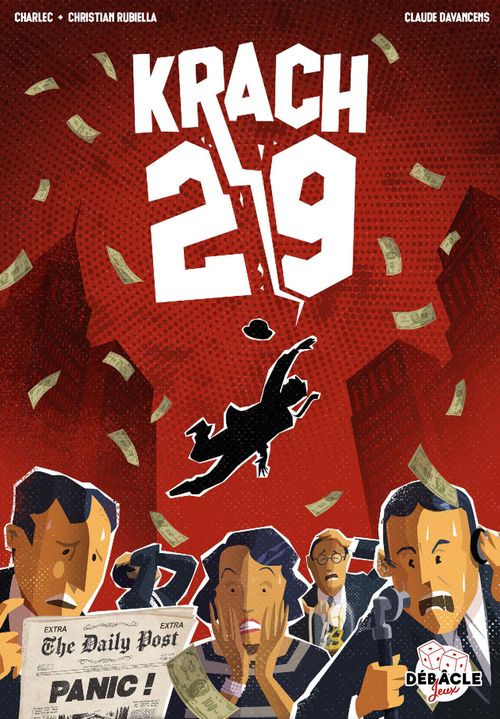
Krach 29
Krach 29 Rulebook
Table of Contents
Table of Contents
Goal of the Game
The players take on the roles of famous traders of the 1920s. In the middle of the stock market crash, millions of dollars go up in smoke, and you must lose as little as possible!
To do so, they must frantically exchange their company shares, which lose value furiously over the four days of the 1929 financial crash, and succeed in concluding the best Sales.
After 4 rounds, the player who has lost the fewest millions of dollars is declared the winner.
"Your guide (or not?)" — The printed aside, in the voice of the guide character Nono: "Hello, you recognise me: call me Nono. I don't usually give advice, I sell it. Especially to winners like you. In short, if you hope to grasp the right spirit, trust me, but don't expect more, since it's free!"
Components
- 3 price boards and their wooden stands
- 66 Action cards
- 8 Trader cards
- 8 Sale Offer cards (double-sided; cards 01 and 02 change according to the number of players)
- 9 Profit cards
- 9 Loss cards
- 12 Contract tokens
- a loss register (score pad)
- 1 felt-tip pen
- 1 pencil
The Action cards. Each card shows two company shares, to be sold in a lot as quickly as possible.
The Sale Offers. One is placed per player (with a maximum of 8). They are double-sided: cards 01 and 02 change depending on the number of players. Follow the indications at the bottom right of these cards, and take care to use the correct side!
Setup
"I invest in companies so wonderful that they can be run by an idiot. Because sooner or later, that will happen." — Warren Buffett
-
Place the three price boards on one side of the table, where all players can see them well.
-
Initial markdown. Draw two Action cards.
- The first one lowers the price of the two companies it shows by −5: draw a line from the top (0) down to the −5 line of the price track.
- The second one lowers the price of the two companies it shows by −2.
- All other prices start at 0.
-
Each trader then chooses a character and places their Trader card in front of them, then chooses one of the 12 Contract tokens.
Nono's tip: "Being bound by a contract on the stock market is like trying to swim with a ball and chain on your foot!"
-
Then reshuffle all the Action cards (including the two used for the initial markdown). Place them in a single draw pile in the middle of the table, in front of the price boards.
-
Sale Offers. They occupy the centre of the table. There must be as many as there are traders.
- Start by placing the one numbered 01, and place the following ones beneath it, in ascending order, until as many have been placed as there are players.
-
Profits and Losses. Place the Profit card (+15) and the Loss card (−15) side by side, to the left of the Sale Offers.
- Shuffle the 8 other Profit cards and place three of them, face down, on top of the +15 card. Do the same with the Loss cards and the −15 card.
- The other cards are not used; return them to the box.
Game Overview
The game is played over 4 rounds, which represent the 4 days of the October 1929 stock market crash.
- One player is named the transcriber. They are responsible for recording the markdowns on the price boards whenever necessary: during initial markdowns, during markdown phases, or when a Profit or Loss card requires it.
- One player is named the Session chairman (Président de séance). They are responsible for opening the exchange phase by declaring "The stock exchange is open!" They must also note on the loss register (the score pad) the development of each player's losses throughout the game.
Each day, each trader plays the following 5 phases:
- Distribution
- Exchanges
- Sales
- Markdowns
- Losses
Phase 1: Distribution
"A speculator is a man who observes the future and acts before it arrives." — Bernard Baruch
The Action cards are shuffled (including the two used for the initial markdown during setup) before being dealt to the players according to the table below.
| Day | Cards dealt per player |
|---|---|
| 1st day | 5 cards |
| 2nd day | 6 cards |
| 3rd day | 7 cards |
| 4th day | 8 cards |
Note: reshuffle all the Action cards at the start of each day.
"Trading volume increases with pressure!" (printed in the Distribution box)
The cards are dealt to the traders face down. These cards represent their share portfolio. Traders may not look at them before the start of the next phase.
Phase 2: Exchanges
"Risk comes from not knowing what you are doing." — Warren Buffett
At the start of this phase, the traders simultaneously look at their Action cards and may immediately begin exchanging (and even conclude their Sale if they wish, see the next phase).
Their objective is to gather within their hand as many shares of the same company as possible, whichever company it is.
Frenzy in the room! Exchanges take place in chaos and discord. All players may propose exchanges at the same time, and as many times as they like. There is no turn order and no limit on exchanges, but there is one rule to observe:
Action cards are always exchanged one-for-one (1 card for 1 other card, 2 for 2, 3 for 3, and so on), so that all players keep the same number of cards in hand.
Example: Christian is looking to make a Sale of US Steel shares; he has two in hand. He offers his remaining cards in exchange: "Who wants 3? 3!" Benjamin makes the exchange with him, while Charles exchanges 2 cards with Marine. Christian, not entirely satisfied, exchanges 2 of the cards Benjamin just gave him once more. Now he has 4 US Steel shares, and he thinks that is enough! He sells, and his exchange phase stops. The others carry on.
Traders may make as many exchanges as they like, but they may conclude only one Sale (see the next phase), ideally as quickly as possible and with as full a lot as possible.
A trader's exchange phase ends as soon as they conclude their Sale.
Nono's advice: "Sell as quickly as possible!" — and, as a counter-advice from Nono: "Take your time before selling!"
Phase 3: Sales
"The future looks bright." — Thomas W. Lamont, 19 October 1929
As soon as a trader considers that they have a sufficient collection of shares of the same company (with a minimum of 2 cards), they may conclude their Sale: they gather those cards into a pile and place it on the first available (highest) Sale Offer.
They then form their portfolio: they lay all the remaining cards from their hand in front of them, face up.
The exchanges continue for the other traders until the last one has concluded their Sale.
Note: once their Sale is concluded, a trader may no longer change their cards (those of their Sale as well as those of their portfolio in front of them).
Contract tokens. If a trader concludes a Sale of shares of the same company as their Contract token, they may add their token to the Sale by placing it on their pile of cards. This token behaves as an additional Action.
Info: after the losses are recorded at the end of the day, the trader takes a Contract token of their choice from the supply.
Exceptional Sale. If a trader manages to conclude a Sale made up of at least 5 cards and the matching Contract token, they get rid of that Contract token permanently! They will have no token for the rest of the game.
Profits and Losses. Once all traders have concluded a Sale, the phase ends.
The first trader to have concluded a Sale draws a Profit card, and the last trader to have concluded a Sale draws a Loss card.
Each Profit or Loss card drawn is kept face up. It must be played at the next occurrence of the phase indicated on the card, after which it is discarded.
Note: a Profit card may be voluntarily discarded without being activated.
Phase 4: Markdowns
"Finance is the art of passing money from hand to hand until it has disappeared." — Robert Sarnoff, director of RCA
It is time to observe the consequences of the Sales concluded during the day, and then to record the resulting markdowns for all the prices!
For each Sale, record the markdowns on the price boards: count the number of cards used to conclude the Sale, and reduce the price of that share by the same amount (draw a line from its current value down to the new value).
Note: only the shares of the company concerned by the Sale are taken into account! The second shares printed on the cards are ignored.
Example: Christian's Sale concerns US Steel, whose price is at −8. He concluded a Sale of 3 cards, plus his US Steel Contract token, which makes a total of 4 shares. The markdown is therefore M$4, and the price of US Steel goes from −8 to −12 (−8 − 4).
Markdowns are applied from the top of the Sale Offers downwards (starting with the one numbered 01, then 02, and so on).
Special Sale Offers
Multiplier Sale Offers (×2 or ×3). The markdown equals the number of cards in the Sale multiplied by this multiplier.
Fixed-value Sale Offers (1 or 2). The markdown is only this fixed value. Ignore the number of shares and even any Contract token when calculating the markdown.
Note: regardless of the Sale Offer, an Exceptional Sale (see page 6) is always possible.
Nono's advice: "My only true advice: beware! A bank run would be fatal! It must be avoided at all costs! WE ARE TALKING ABOUT OUR HEADS HERE!"
The bank run. After the markdowns have been recorded, if a company's share price reaches −30, the banking system collapses and all players immediately lose the game!
Phase 5: Losses
"Losses on the stock market can teach us not to cling too much to temporal things. Money comes and goes, but wisdom remains." — Alexander Elder
After the markdowns have been applied, each trader increases their losses (their score, as a negative number).
For each share in their portfolio (the cards kept in front of them), each trader adds to their losses the current price of that share. Each card shows two shares; this time both generate losses!
Example: Benjamin has kept two Action cards in front of him: one United Aircraft / US Steel and one United Aircraft / Kodak. The price of United Aircraft is −8, that of US Steel is −12, and that of Kodak is −5. He therefore loses 33 million dollars (−8 − 12, −8 − 5).
Contract tokens. Those who still have their Contract token in front of them must treat it as one additional share of that company, and add its price once more to their losses!
Conversely, those who no longer have a Contract token must draw one from the supply, unless they have concluded an Exceptional Sale.
Nono's advice: "You have lost a lot? It's not the end of the world. Not even of anything much; it isn't even your money! Bare your teeth and get back in there!"
Following days
For each following day, repeat the 5 phases, dealing one more Action card than on the previous day (see the table in Phase 1).
The game ends after the fourth day, unless a bank run has occurred first!
Note: the last day does not use the conventional Profit and Loss cards. Instead, the first player to conclude a Sale receives a Profit card granting +M$15, and the last player to conclude a Sale receives a Loss card imposing −M$15.
End of Game
After counting the losses of the fourth and final day, Profit and Loss cards included, the trader with the smallest losses is declared the winner!
Only the trader who lost the least avoids the great leap!
Nono's conclusion: "Don't forget that the real losers are everywhere except inside Wall Street! Here there has always been — and always will be — only winners!"
Clarifications
Exchanges. During exchanges, it may seem wise to announce which shares you are looking for and which you are offering. However, besides slowing you down, such details give crucial clues to your opponents.
Sales. The cards making up a Sale may be played face down, at each player's discretion.
However, if a mistake was made in the choice of cards played (a card that does not show the Sale's Action), the player takes that card back into their portfolio.
Profits and Losses. Take care to apply Profit and Loss cards at the phase indicated. They may modify your Sale, the Sale Offer, a markdown, or even how you exchange in the next Exchange phase.
If you do not use a Profit or Loss card at the indicated phase, you must discard it.
The bank run. This is a phenomenon much feared in the banking world. It is the moment when customers who have lost confidence in the solvency of their bank rush to the counter to withdraw their savings. Literally, the race to the bank, a bank run or a rush to the tellers, it is a phenomenon of panic which, paradoxically, is often self-fulfilling. It is the number of customers, growing through imitation, that makes the bank insolvent.
"The stock market is designed to transfer money from the pockets of the impatient to the pockets of the patient." — Warren Buffett
Historical Background: From the Game to Reality
The 1929 crash took place from Thursday 24 October to Tuesday 29 October on the New York Stock Exchange.
This unprecedented stock market crisis plunged the American economy into deep recession and unemployment. It quickly reached the rest of the world, notably Europe. Poverty exploded almost everywhere, to the point of remaining in memory as the Great Depression.
According to some historians, the rise of nationalisms that would lead, a few years later, to the Second World War was partly attributable to this economic crisis. Indeed, the withdrawal of capital and the devaluations destabilised many political regimes, allowing fascist leaders to come to power in some countries.
Economists agree that the American economy would not regain its prosperity until the Second World War.
The image of the trader who throws himself out of a window after his financial ruin is associated with the stock market crash. However, this is a myth: no document shows that a financial official ever came to that extremity.
On the other hand, the working classes suffered far more from this recession. A very realistic portrayal of this misery was given by Steinbeck in The Grapes of Wrath.
Image caption: the crowd, worried in the streets of New York during the 1929 crisis.
Designers' Note
We chose names for the characters that evoke financiers who actually took part in this financial crisis. At the time, the world of finance was almost exclusively male.
We are fiercely attached to parity, but if there were very few women, would it honour them to invent some who would have helped sink the world into poverty and war?
We nevertheless hope that there will be as many female players as male players who enjoy Krach 29.
Note: the credits page, copyright line, illustration and photo credits have been omitted from this transcription.
Phase Summary (Reminder Sheet)
A day unfolds as follows:
-
Distribution: the day's Action cards are dealt to the players, face down.
-
Exchanges: frenzy and chaos around the table! Exchange as many cards as you like, with whomever you like, in whatever order you like, and collect a maximum of shares of the same company. One rule: cards are exchanged one for one.
-
Sales: when a player judges that they have an acceptable compromise between the shares in their Sale and the shares remaining in their portfolio, they place their Sale on the next available Sale Offer. The first trader to conclude a Sale draws a Profit card. The last to conclude a Sale draws a Loss card.
-
Markdowns: share falls are carried over to the price boards. Sale markdowns are applied from top to bottom (starting with the one numbered 01, then 02, and so on). If a price reaches −30, a bank run occurs, immediately ending the game!
-
Losses: traders accumulate their losses. Each share (two per card!) still in front of a trader inflicts its price as a loss. A Contract token of the same company counts as one additional share. Unless they have concluded an Exceptional Sale, a trader must take a Contract token of their choice after having used one.
"There is nothing new on Wall Street or in stock speculation. What happened in the past will happen again, and again. It is because human nature does not change, and because human emotion, firmly embedded in human nature, always stands in the way of human intelligence. Of that, I am sure." — Jesse Livermore