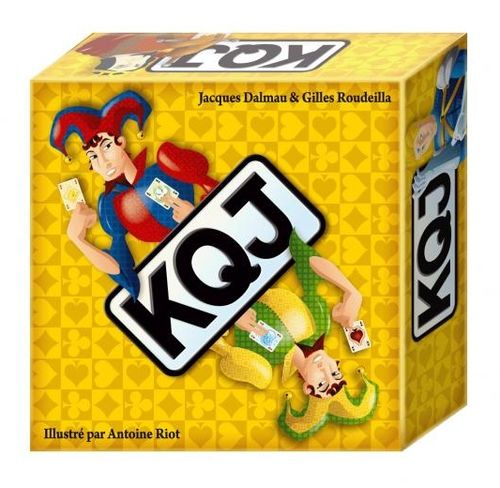
KQJ
KQJ Rulebook
Table of Contents
Table of Contents
Box Contents
This box contains the booklet you are holding, in which you will find the rules of KQJ and (on the other side) those of 9 traditional card games, plus 72 high-quality cards with original artwork (60 playing cards and 12 KQJ reference cards).
Rules of KQJ
The rules that follow are for 6 players with 2 teams. The rules for 3, 4 and 5 players, or for 6 players with 3 teams, are described in the Variants section.
Principles
KQJ is a game of "Tricks" played over several Rounds. A Round is the dealing of a "Hand" of cards to each player and the playing out of all the Tricks until the Hand is exhausted. A Trick is a set of cards made up of one card from each player; it is won by whoever plays the master card. The "Master" card of a Trick is the highest card of the suit led, or of the Trump suit if any Trump was played. Each card in a Trick has a value: added to the others, it determines the winner of the Round.
Before the game begins, the players must agree on certain points of the rules. For example, they may choose which variant(s) to play, or the conditions for ending the game.
Objective (Choose One)
- A Score to reach (1000 points, for example): the team that passes this score wins!
- A Number of Rounds to play: once this number is reached, the team with the best score wins!
- A Time limit: the team with the best score when time runs out wins!
Setup
Give 2 different reference cards to each player. Set aside the "2", "3" and Joker cards (into the box).
Forming the teams: take from the deck a Jack (J), a Queen (Q), a King (K), a Hero (H), a 10 and an Ace (A). Shuffle these cards and deal one to each player, face down. After revealing their card, each player takes a seat around the table in the order of the cards, clockwise. The players who received the cards "10, K and J" form the 1st team, the others form the 2nd team. Each player therefore sits between two players of the other team. Players on the same team are "Partners". Then shuffle these 6 cards back into the deck.
You will always play clockwise.
Start of a Round
The Deal: whoever received the Jack (J) during team formation is the 1st Dealer. The Dealer shuffles the deck if desired, then has it cut by the player to their right. Starting with the player to their left (the Opener), going clockwise, the Dealer gives each player 3 face-down cards, then 2 more face-down cards. Once each player has 5 face-down cards in front of them, the Dealer turns over the 1st card of the remaining deck (the Turned Card). Each player may then pick up their cards and look at them.
The Contract: each team must score more points than the opposing team. On their turn, each player may "Take": choose the Trump suit based on the cards in their hand!
During the 1st round of bidding, starting with the Opener, each player may:
- Say "Pass" to hand the decision to the next player,
- Or Take by choosing the suit of the Turned Card as Trump. For example, "Spades" if the Turned Card is a Spade.
If all players Pass, there is a 2nd round of bidding, during which each player may then:
- Say "Pass" once again,
- Or Take by choosing Trump in any suit of their choice (even the suit of the Turned Card).
If everyone passes twice, the Round is closed. The Opener becomes the Dealer...
However, if a player Takes, they become the Declarer, their team is the contracting team, and the opposing team is the defending team.
End of the Deal: as soon as a player Takes, the Dealer gives them the Turned Card. The Dealer then deals, once, 3 face-down cards to each player, except to the Declarer, who receives only 2 (since they already took the Turned Card). At the end of the Deal, each player must have 8 cards in hand; otherwise the Dealer collects the cards and starts the Deal over (a Misdeal).
Playing Tricks
The Opener leads the 1st Trick by placing one card from their hand, face up, in the center of the table. Then, in turn, each player must play exactly one of their cards, face up. Whoever leads may play any card from their hand; the suit of that card is the "led" suit. The other players follow these rules:
- When you hold the led suit: you must Follow suit (play a card of the led suit) and, if Trump was led, if possible, Overtake (play a card of higher rank).
- When you do not hold the led suit and a Partner is currently "Master": you may Discard (play any card of your choice), or, to become "Master" yourself, you may Trump (play a Trump card), or even Overtrump (Trump while playing higher) if someone has already trumped.
- When you do not hold the led suit and the opposing team is currently "Master": if you can become "Master", you must Trump or Overtrump; if you cannot become "Master", you may Discard.
3 principles for determining the "Master" card:
- Trump beats the plain suits.
- Among suits of the same rank, the led suit wins.
- Within the same suit, the higher-ranked card wins.
Once a Trick is complete, whoever played the Master card wins it, places it face down in front of them, and leads the next Trick. When players have no cards left in hand, the Round ends (see "End of a Round" below).
A player may Lay Down (play all their remaining cards at once). Laying Down is allowed if that player will win all the remaining Tricks regardless of the order in which they play their cards.
Trick examples: Alice, Céline and Elodie play against Benjamin, David and Fabien. Fabien deals. Benjamin Takes with Hearts as Trump. Alice leads with her Ace of Clubs. In that same suit, Benjamin has only the 4 of Clubs; he is forced to play it. The others Follow suit: Alice wins the 1st Trick.
Alice leads the 2nd Trick with her 10 of Clubs. Benjamin has no more Clubs, so he Trumps: 6 of Hearts. Céline must Trump too. She Overtrumps: Hero of Hearts. David should also Trump, but he only has the 5 of Hearts, so he cannot Overtake Céline's Hero. He Discards the 4 of Spades. Elodie has no more Clubs; she could Overtrump with the 7 of Hearts, but her Partner Céline is already Master, so she Discards the 10 of Spades. Fabien has the Hero of Clubs, so he must Follow suit. Céline therefore wins the 2nd Trick with the Hero of Hearts. She leads the 3rd Trick.
Bonuses
A Bonus is an event, announced or not, that corresponds to a certain number of points that the team adds to its Trick points: Bonuses help fulfill the Contract.
- Last Trick: 10 points always awarded to the team that wins the last Trick.
- Slam: 154 points awarded to a team if it wins all the Tricks.
- KQ: 20 points awarded to the team of the player announcing "KQ" during the Round. To validate it: a player must hold the King (K) and Queen (Q) of Trump in hand; these cards must be played in that order (King then Queen); the player must say "K" while playing the King and "KQ" while playing the Queen.
- KQJ: 50 points awarded to the team of the player saying "KQJ". To validate it: a player must hold the King (K), Queen (Q) and Jack (J) of Trump in hand; these cards must be played in that order (King, Queen, then Jack); the player must say "K" while playing the King, "KQ" while playing the Queen, and finally "KQJ" while playing the Jack. The KQ does not score points when there is also a KQJ.
End of a Round
Scoring the points: once the last Trick is collected, a player adds up the value of the cards in the tricks won by the defending team (the team opposed to the Declarer), not forgetting the Last Trick bonus if applicable. The sum of all the cards plus the Last Trick comes to 246 points. So by subtraction, you obtain the points scored by the contracting team (see the reference card). Then add, if applicable, the KQ or KQJ to the score of the team concerned. The team with the most points at this point fulfills the Contract and wins the Round!
In the case of a "Slam": 246 points plus the 154-point bonus (i.e. 400 points), plus KQ or KQJ if applicable!
Recording the points: only the team that fulfills the Contract records its points, rounded to the nearest ten: totals ending between 1 and 4 are rounded down to the ten below (154 becomes 150); totals ending between 5 and 9 are rounded up to the ten above (155 becomes 160). Take a pen and paper: add the points recorded to the previous scores.
New Deal: for the following Round, the Opener (to the left of the Dealer) becomes the Dealer.
Premiums
A Premium is a number of points obtained under certain conditions, which players add to their recorded points. Premiums do not count toward fulfilling the Contract.
Dispute: in case of a tie (123 points, 133 points if KQ, or 148 points if KQJ), there is a Dispute and no team scores. A Dispute creates a "Dispute Premium" for the following Round, equal to the rounded value of the tied score (i.e. 120 points, 130 points if KQ, or 150 points if KQJ). It will be added to the score of whichever team wins the following Round. If there is a Dispute again, the 1st Premium is lost.
End of the Game
Generally, a game of KQJ is played to a score of 1000 points. As soon as a team reaches or exceeds 1000 points at the end of a Round, the game ends: that team wins the game! However, at the start of the game, players may choose another victory condition:
- By Score: a different score to reach,
- By Number of Rounds: after which the best score wins,
- By Time: at the end of which the best score wins.
Variants
6 Players With 3 Teams
Setup: the 3 teams are now made up of 2 Partners each. Proceed as for 2 teams. Partners are "A and K", "J and H" and "Q and 10". Partners on the same team sit opposite each other, with a player from each of the other 2 teams as neighbors.
The Contract: the Declarer's team must score more points than the best of the other 2 teams (the defending teams).
Scoring the points: count the points in the tricks of each defending team (see the reference card).
Recording the points: if the contracting team's score is higher than that of each of the other 2 teams, the Contract is "Made" and the contracting team records the rounded value of its points. If at least one defending team has a higher score than the contracting team, the Contract is "Down", and each defending team records the rounded value of its own points. In case of a tie between the contracting team and the best defending team, there is a "Dispute" and no team records points (see "Premiums" above).
Count Premiums: these special Premiums depend on the number and raw value of a team's Tricks before Bonuses. If a team scores 20 points or less while winning at least one Trick, the other 2 teams each record a Premium of 20 points. If a single team wins no Trick at all, the other 2 teams each record a Premium of 60 points.
5 Players
Setup: a game of KQJ for 5 is played individually, but each Round is played 3 against 2. At the start of the game, draw at random among the 5 following cards: Jack, Queen, King, Hero and 10. Each player takes their seat as indicated by the card drawn.
At the start of each Round, in order to determine the teams, the Dealer draws at random with a "3" card and the four "2" cards (kept aside in the box). The 2 players designated by the "3" and the "2" of the same suit form a team; the other 3 players form the other team. These 5 cards are then set aside for the following Round.
The Deal: the Dealer deals each player 3 face-down cards, twice. During each round of dealing (between two players, or at the end), the Dealer places one face-down card in the center of the table to form a 2-card Kitty. After placing the Turned Card face up, they reveal the Kitty.
If a player Takes, the Dealer finishes dealing: 3 face-down cards per player (the Declarer receiving only 2), and one face-down card for the Kitty whenever desired (but not last). At the end of the Deal, each player checks that they have 9 cards. Finally, the Kitty's 3rd card is revealed. The player who drew the "3" before the Deal adds the Kitty to their hand, then discards 3 cards of their choice (the Discard), face down. The Discard is counted with the Tricks of the team that wins the Last Trick.
Recording the points: since Partners are random, record for each player's score the points that their team won.
4 Players
Setup: a game of KQJ for 4 is played 2 against 2. At the start of the game, to determine the teams and each player's seat, players draw at random among the 4 following cards: Jack, Queen, King and Hero. Each player takes their seat as indicated below. Those who drew the 2 cards "K and J" play against those who drew "H and Q". This way, Partners on the same team sit opposite each other.
The Deal: the Dealer deals each player: on the 1st round, 2 face-down cards; on the 2nd round, 3 face-down cards; and on the 3rd round, 2 face-down cards.
If a player Takes, the Dealer finishes dealing: on the 4th round, 3 face-down cards (2 to the Declarer), and on the 5th round, 2 face-down cards. At the end of the Deal, each player checks that they have 12 cards in hand. The Round then proceeds with the same rules as for 6 players with 2 teams.
3 Players
Setup: a game of KQJ for 3 is played individually, but each Round is played 2 against 1: the Declarer against the other 2 players, who become Partners. At the start of the game, to determine each player's seat, players draw at random among the 3 following cards: Jack, Queen and King. Each player takes their seat as indicated.
The Deal: the Dealer deals each player: on the 1st round, 3 face-down cards; on the 2nd round, 4 Mute cards (face down and not taken into hand), which each player lays out in front of them in a row, side by side; on the 3rd round, 2 face-down cards; and on the 4th round, 4 face-up cards, placed one by one on top of the Mute cards.
If a player Takes, the Dealer finishes dealing: on the 5th round, 3 face-down cards (2 to the Declarer). At the end of the Deal, each player checks that they have 8 cards in hand and, in front of them, 4 Mute cards under 4 face-up cards. Before the 1st Trick, the Declarer must exchange, one at a time, 2 of their face-up cards with one face-up card from each of the other players.
Playing Tricks: each player collects their own Tricks! The face-up cards are playable just like the cards in hand. However, you may not play a Mute card without having first played the face-up card sitting on top of it. Once the face-up card is played and the Trick collected, you turn over the Mute card beneath it!
Scoring the points: count the points in the Tricks of each defending player (see the reference card). Here, each player has their own Bonuses.
Recording the points: the contracting player must score more points than the opposing team. If the Contract is "Made", the contracting player records the rounded value of their combined points. If the Contract is "Down", the players of the defending team each record the rounded value of their own points. In case of a tie between the teams, there is a "Dispute" and no player records points.
Count Premiums: special Premiums that depend on the number and raw value of each player's Tricks at the end of the Round, before Bonuses. If a player scores 20 points or less while winning at least one Trick, the other 2 players each record a Premium of 20 points. If a single player wins no Trick at all, the other 2 players each record a Premium of 60 points.
Random Partners (for 4 and 6 players)
This variant allows for new strategies to gain an edge. A game of KQJ with "Random Partners" is played individually. At the start of the game, each player's seat is determined by the seating draw and remains the same for the whole game. At the start of each Round, in order to determine their Partner(s), players draw at random among the "3" and "2" cards of 2 or 3 suits (as many cards as there are players):
- For 2 teams, the players who draw a "3" are Partners.
- For 3 teams (6 players only), those who draw cards of the same suit are Partners.
Recording the points: record for each player's score the points that their team won.
All-Trump/No-Trump
Highly recommended, this variant increases the possible Declarations. Normally, Trump is one of the 4 suits. Here, each player may instead decide that:
- All suits are Trump: "ALL-TRUMP",
- No suit is Trump: "NO-TRUMP".
When a Round is played "All-Trump" or "No-Trump", all suits are of equal rank. When a Round is played "All-Trump", there are 4 possible KQ or KQJ. In "All-Trump" and "No-Trump", card values are modified (see the table below or the reference card).
Combinations
Surprises and twists (see the reference card).
Sequences: a run of several cards of the same suit, in the order: Ace, Hero, King, Queen, Jack, 10, 9, 8, 7, 6, 5, 4.
- The Tierce – 3 cards: 20 points,
- The Quarte – 4 cards: 50 points,
- The Quinte – 5 cards: 100 points,
- The Sixte – 6 cards: 200 points.
Four of a Kinds: 4 cards of the same rank.
- Four 9s: 270 points,
- Four 8s: 220 points,
- Four 7s: 140 points,
- Four Aces, four 10s, four Heroes, four Kings, four Queens, or four Jacks: 100 points,
- Four 6s, four 5s, or four 4s: 0 points.
Some Four of a Kinds also have an associated effect. These effects apply at the end of the 2nd Trick, in the order they are announced:
- Four Heroes: forces whoever announces it to look at another player's hand,
- Four 6s: cancels the value of all Combinations in the current Round,
- Four 5s: cancels and closes the current Round,
- Four 4s: forces whoever announces it to exchange their entire hand with another player, including the points of any Combinations already validated.
A Combination is announced by its name. For example, a player holding the 10, 9, 8 and 7 of Spades declares: "Quarte"... Each player validates their Combinations during the 2nd Trick, just before playing their card. They announce their Combinations and show them at the same time. To form Combinations, a player may only use their own cards. The card played during the 1st Trick may still be counted.
A single card may be used simultaneously in a Sequence and in a Four of a Kind. However, it may only be used in one Sequence at a time.
Combinations may be counted in 2 ways (to be decided at the start of the game):
- Combinations as Bonuses: Sequences and Four of a Kinds are treated as Bonuses, the same way as the "KQ", the "KQJ", the "Last Trick" and the "Slam". A player who announces a Combination adds the associated points to their team's Trick points: this helps fulfill the Contract.
- Combinations as Premiums: Sequences and Four of a Kinds are treated as Premiums, the same way as the "Dispute Premium". The Combinations announced by all players are added together to form a single Premium won by the winners of the Round.
Bidding
More tension in the game. To play with Bidding, keep all the specifics tied to the chosen variants and to the number of players and teams.
The Deal: the Dealer deals out the entire deck according to the particular rules for the number of players, but without the intermediate Turned Card.
The Contract: starting with the Opener and going in turn, each player may:
- Say "Pass" to hand the decision to the next player,
- Or Bid (or Overbid if there has already been a 1st bid) by declaring a Contract they commit to fulfilling. They always first announce an "Amount" of points (a multiple of 10), then "Slam" (optional), followed by the Trump suit they choose. For example, "150 Spades" or "400 Slam Diamonds".
If no Contract is announced during the 1st round of bidding, the Round is closed. The 1st bid must be at least 120 points (except for 6 players with 3 teams: minimum 80 points). In case of an overbid, the new Amount announced must be higher than the previous one. A player may overbid when it is their turn again, even if they had previously "passed".
"Slam" is an optional declaration: the player who announces it commits to winning every Trick (with the help of their Partners). Once "Slam" is announced, bidding stops.
If, after a player's bid, all others have passed, that player becomes the Declarer and bidding stops.
When a Contract is announced, if an opposing player believes it will not be achievable, they may "Double" it by saying: "Doubled". In response, if they wish, any player of the contracting team may "Redouble" by saying: "Redoubled". Bidding stops if there is a Double or Redouble.
The Declarer's team must fulfill its Contract, that is, reach at least the Amount announced, and win every Trick if "Slam" was announced.
Recording the points: if the Contract is "Made", the contracting team records the Amount of the Contract (even if it scored more points than that Amount). If the Contract is "Down", the defending team (or teams) records the Amount of the Contract. In case of a Double, the Amount is doubled. In case of a Redouble, it is quadrupled.
Glossary
- Lay Down: play all one's remaining cards at once.
- Contract: a commitment to win a certain number of points in one's Tricks, generally more than the opposing team.
- Double: announce that the opponent's Contract will go Down (Bidding variant only).
- Trump (to): play a Trump card.
- Face-down (card): turned face down.
- Face-up (card): turned face up.
- Down (Contract): not fulfilled. Synonym: Chuté.
- Discard: play any card of one's choice.
- Defend: play against the contracting team.
- Led (suit): the suit of the 1st card of a Trick.
- Deal: the distribution of the cards.
- Dealer: the player who deals.
- Take (to): to declare the Contract / choose Trump.
- Declarer: the player who Takes.
- Made (Contract): fulfilled.
- Follow suit: play a card of the led suit.
- Hand: the set of cards in hand.
- Overtake: play a card of higher rank within the same suit.
- Mute (card): face-down and not taken into hand (3-player game only).
- Opener: the player to the left of the Dealer, who leads the 1st Trick.
- Trick: a set of cards made up of one card from each player.
- Take: to commit to fulfilling the chosen Contract.
- Rank: the hierarchy of the cards (see the reference card).
- Turned Card: the card revealed during the Deal that determines Trump for the 1st round of bidding (without the Bidding variant only).
- Suit: Spades, Hearts, Diamonds or Clubs. Synonym: Color.
- Undertrump: to Trump without Overtaking. Synonym: Duck.
- Redouble: as a player of the contracting team, announce that the Doubled Contract will be Made (Bidding variant only).
- Overtrump: to Trump while Overtaking.
- Value: the number of points a card is worth when scoring.