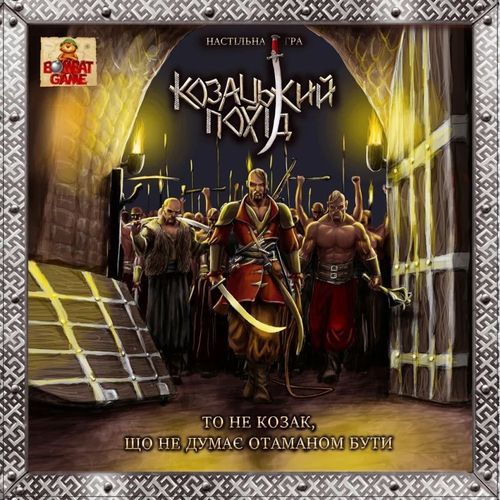
Козацький похід
Козацький похід Rulebook
Table of Contents
Table of Contents
What Is in the Box
- Hint boards (планшети-підказки): contain information about the sequence of a turn and a description of the possible actions in the game.
- Campaign markers (фішки походів): red markers that show the advance of the Cossack army on the map.
- Hetman figure (фішка гетьмана): marks the Hetman in office.
- Bag (мішечок): for storing components.
- Gold (золоті): the Hetman pays gold as a reward for carrying out his orders, and kurin atamans pay fines for disobedience.
- Stamps (печатки): players mark the cities and settlements they have taken with them.
- Black campaign markers (чорні фішки походів): markers that block the advance of campaigns in the direction shown.
- Game board (ігрове поле): a map of Ukraine in the time of the Zaporizhian Cossacks, with marked cities (large orange stamps with crosses), settlements (small yellow stamps with a trident) and the roads between them (chains of empty circles that connect them).
- Action cards (карти дій): cards of the Hetman's orders and cards of disobedience, which players use to create events that take place in the game.
- Additional task cards (карти додаткових завдань): cards of cities and settlements that must be captured, or of other achievements, for which Cossack support points are counted.
- Hetman cards (карти гетьманів): cards with the main tasks for the players; completing them brings the most points.
About the Game
Only a leader who has the greatest authority among the Cossacks can unite the Ukrainian lands. To win that authority, one must show oneself both a brave warrior and a skilled commander and, most importantly, have under one's control the largest number of cities and settlements whose inhabitants recognize one's authority.
The specific tasks that a player must complete during the game are defined by the Hetman cards and the additional task cards. Completing these tasks brings the player Cossack support points. Whoever has the most of them becomes the winner.
The Hetman card contains the Hetman's name, carved on a sabre at the top of the card; the task to be completed (shown at the bottom of the card); and the number of Cossack support points the player receives for completing the task.
Additional task cards come in two types:
- Achievement cards (карти досягнень): like Hetman cards, they have a name, the content of the task and the number of Cossack support points the player receives for completing it. Unlike Hetman cards, these tasks do not require the capture of specific cities.
- City cards (карти міст): they contain the name of a city or settlement and the number of Cossack support points the player receives on condition that they control this city at the moment the game ends. If a player captured the city during the game but later lost control of it, the points are not counted.
To complete their tasks, players initiate various game events: campaigns, raids, uprisings and so on. As a result, Cossack regiments move, Hetmans change, cities and settlements are captured and lost, and much else happens. Game events are created by the players with the help of action cards.
Action cards are in turn divided into order cards (карти наказів) and disobedience cards (карти непокори).
Order cards are played by the Hetman. At any moment only one of the players is the Hetman; the remaining players are kurin atamans, who have a choice: either carry out the Hetman's order, or reveal disobedience by playing the corresponding disobedience card.
Order cards carry the corresponding symbol: a mace (булава) carved on the sabre. A card without this symbol is a disobedience card. At the bottom of both kinds of action card (order and disobedience) there is a list:
- on an order card, the list of orders the Hetman gives, each with the payment in gold that the Hetman must pay the ataman if the ataman carries out that order;
- on a disobedience card, the list of manifestations of disobedience the kurin ataman shows, each with the price in gold that the ataman must pay the Hetman as a fine for the disobedience.
The card name is shown on the banner at the top of the card.
Order cards such as March (Похід) or Raid (Набіг) allow the Hetman to move Cossack detachments in the direction of this or that city or settlement. Their advance on the map is marked by campaign markers.
If, as a result of carrying out an order, the Cossacks enter a settlement, it passes under the authority of the incumbent Hetman, who marks this by placing the corresponding stamp on the map. But disobedience cards, which kurin atamans may play, can prevent the Hetman from achieving their goal, or turn the execution of the Hetman's order to the benefit of one of the particularly inventive kurins.
Cards may be played singly or in combinations. Players may also agree with one another and form situational alliances, if they consider that their interests partly coincide.
Thus, by playing the appropriate cards, players step by step approach their goals, defined by the task cards. As soon as one of the players runs out of campaign markers, the game is stopped, the points are counted and the winner is determined.
Setup
-
Lay out the game board. Place the black campaign markers on the game logo in its lower left corner.
-
Give each player:
- 15 campaign markers;
- 5 Hetman stamps of one colour;
- 7 gold.
Put the rest of the components in the bag.
-
Shuffle the deck of action cards and deal 4 cards to each player. Place the rest of the deck face down next to the game board.
-
Separate the Hetman cards, the achievement cards and the city cards into three separate decks. Shuffle each of these 3 decks separately and deal to each player:
- 1 Hetman card;
- 1 achievement card;
- 2 city and settlement cards.
Before the start of the game, each player must choose 2 of the additional task cards they have received (achievement cards and city cards) that they want to keep and complete during the game. The player discards the extra additional task card face down.
Thus each player keeps 1 Hetman card and 2 additional task cards in any combination (that is, 2 city cards, or 1 city card and 1 achievement card, or 2 achievement cards). All remaining Hetman and additional task cards, including the discarded ones, are returned to the box.
Note: if a player keeps two cards with the same task, for example the Nalyvaiko Hetman card and the Iasi (Ясси) city card, then the player can score points for only one of these tasks, namely the one that brings more points.
- Choose the Hetman. Before the start of the game the Hetman is chosen by agreement between the players. If the players cannot agree, the Hetman is the oldest player. The Hetman places the corresponding figure in front of them.
- Place the hint boards next to the playing field.
Course of the Game
The game is divided into rounds. During one round, the players in turn, starting with the Hetman in office, perform their game actions. A round ends when all players have performed their game actions.
Dealing and Carrying Out Orders
At the start of a new round, the Hetman must choose and carry out one of two actions:
- Voluntarily renounce the Hetman's mace and pass power to another player according to the rules for changing the Hetman.
- Play a Hetman order card, which will take effect throughout the whole round.
If at the start of the round the Hetman has no order cards in hand, they must immediately renounce the mace.
When giving an order, the Hetman plays an order card and chooses which of the orders listed on that card to give to the kurin atamans. During the round the Hetman must pay the indicated number of gold to every kurin ataman who carries out the Hetman's order. The payment to each ataman must be given immediately after that ataman has carried out the order.
If the Hetman's supply of gold becomes smaller than what is needed to pay the reward to the next ataman, the Hetman must immediately renounce the mace.
The Hetman plays only one order card, except when playing cards that allow several cards to be played (for example, the card Passionate Speech — Палка промова). However, when playing several cards, the Hetman must pay for the execution of each of their orders, unless the cards themselves stipulate otherwise. For example, after playing Passionate Speech and then the card March (Похід), the Hetman must pay the kurin atamans for both the first card and the second.
The Hetman may not draw action cards from the deck and may not replace them, except when a played order card gives them this right, for example the card Increase the Register (Збільшити реєстр).
After the Hetman's order, each kurin ataman must carry out one of the following actions:
- Carry out the Hetman's order, receive the payment for it, and take 1 action card from the deck (if the ataman has fewer than 6 action cards in hand).
- Play a disobedience card and carry out the chosen action from its list, paying the Hetman the fine for disobedience indicated on the card.
If several atamans have played disobedience cards that contradict one another, the card played last is in effect.
Kurin atamans may hold at most 6 action cards in hand. The Hetman may hold an unlimited number. But as soon as the Hetman loses power, they must immediately discard excess action cards of their choice, keeping 6 cards in hand.
If a kurin ataman has no action cards in hand, they have no choice and are obliged to carry out the Hetman's orders. If the Hetman's order requires the kurin ataman to do something with action cards in hand (for example the card Punishment — Покарання), then that ataman does not receive gold from the Hetman, but after failing to carry out the order they may take 1 action card from the deck.
After the round ends, each kurin ataman, both the one who carried out the Hetman's order and the one who revealed disobedience, has the right to discard 1 action card from hand to the discard pile and take 1 new card from the action deck in its place.
If the action card deck runs out, the players shuffle the discard pile and form a new action deck from it.
After the round ends, the right to act passes to the Hetman in office, who begins a new round.
To quickly recall the order of play, the players may use the hint boards.
Cossack Campaigns
The campaigns of the Zaporizhian army are shown on the game board by the red campaign markers. Campaign markers are placed on the map, removed from it, or moved by the players who carry out the Hetman's order or the corresponding action of a disobedience card. The first campaign starts from the Zaporizhian Sich; a campaign marker is not placed on the Sich itself.
When playing the order card March (Похід) or Raid (Набіг), the Hetman must tell the kurin atamans which marker the campaign starts from, and name in turn the cities and settlements through which it is planned to pass.
- If the Hetman did not indicate an exact route, so that the kurin ataman has a choice between several options, the ataman may place the campaign markers at their own discretion, so as not to violate the conditions of the Hetman's order.
- If the starting point of the campaign is not indicated, the campaign is considered to start from the Sich. If all routes from the Sich are already occupied by markers, it starts from the marker located nearest to the Sich.
Campaign markers may be placed only by continuing a previously laid route, so that there are no gaps in it. The absence of a campaign marker on the Sich is not considered a gap.
As soon as one of the kurin atamans has placed a campaign marker on a city or settlement, it is considered captured by the player who is the incumbent Hetman. On a captured city or settlement, the Hetman places their stamp instead of the campaign marker, and places the removed red marker on the board next to the black markers.
Diagram captions: (1) The 1st ataman placed a campaign marker on the field, continuing the existing route from Chyhyryn to Pereiaslav. (2) The 2nd ataman placed a campaign marker directly on Pereiaslav, and the Hetman replaced it with their stamp. (3) The 3rd ataman, since the Hetman did not specify where to move after Pereiaslav, may place their campaign marker along the route to Novhorod-Siverskyi, Ovruch, Berdychiv or Orlyk.
Example: The Hetman announced the order March from Chyhyryn to Pereiaslav. Several atamans in turn carried out the order and reached Pereiaslav, capturing the city for the Hetman's benefit. The next kurin ataman, provided Pereiaslav is already captured, may place campaign markers at their own discretion, and the Hetman must pay them for this action as for a carried-out order.
Campaign markers may be removed from the map only when this does not result in a break in the laid route.
If, while removing campaign markers, the players reach a captured city or settlement and have the right to continue removing markers, they remove the Hetman's stamp from that city or settlement instead of a marker and return it to the player to whom it belonged. The player who removed the stamp at the same time takes for themselves a red campaign marker from those placed next to the black ones. The city or settlement is then considered free and may be captured again by any player.
Example: Pereiaslav is captured and the Cossacks have already advanced further in the directions of Berdychiv and Ovruch. The Hetman plays the card March and gives the order: "We return to the Sich via Pereiaslav." This order is carried out by 3 kurin atamans. Two of them, in turn, remove from the board the markers placed in the direction of Ovruch and Berdychiv, and the third removes from the board the stamp that stood on Pereiaslav.
Diagram captions: (1) The 1st ataman removes the marker on the road to Berdychiv. (2) The 2nd ataman removes the marker on the road to Ovruch. (3) The 3rd ataman removes the stamp of the former Hetman from Pereiaslav.
Black campaign markers are placed on the map only by means of a special disobedience card. A road on which a black campaign marker has been placed is considered blocked. After such a marker, no red campaign markers may be placed until it is removed.
Black campaign markers follow the same rules as red ones, with two exceptions:
- when a black marker is removed from the field, it is returned to the logo;
- black campaign markers cannot be placed on a city or settlement.
Change of Hetman
A change of Hetman occurs when:
- the Hetman has voluntarily renounced the mace;
- the Hetman has no order cards in hand, or the gold has run out;
- a kurin ataman has played the corresponding disobedience card.
The Hetman who voluntarily renounces power passes the Hetman figure to the other player with the largest amount of gold. If several players have the same amount of gold, the figure passes to the next of these players in turn order.
If the change of Hetman happens at the start of a round, the new Hetman begins a new round.
If the change of Hetman happens after the former Hetman has already given their order, the players must finish the round that has started. However, the new Hetman may give another order by placing a new order card, which takes effect until the end of this round. Gold for the execution of the old order is paid by the new Hetman, and the cities and settlements that are captured belong to them.
The player to whom the Hetman has passed power may renounce it immediately.
If, after passing through the round, the Hetman figure has returned to the same Hetman, all players draw 1 additional action card, and players who already hold the maximum number of action cards in hand replace 1 card. After this, the game continues under the usual rules.
Scoring
The player who runs out of campaign markers announces this to all participants, and the game continues until the end of the current round. If, after the round ends, the player again has campaign markers, the game continues. If not, the game ends and the players count their points.
A player who did not warn the other participants about having no campaign markers receives a penalty campaign marker from the Hetman, and the game continues.
To count the points scored, players reveal their task cards and count the points for those that were successfully completed.
Additional points are counted as follows:
- +5 points to each player who has no campaign markers left at the end of the game;
- +5 points for each captured settlement (yellow stamp with a trident);
- +10 points for each captured city (orange stamp with a cross);
- −1 point for each campaign marker left in hand (except when the player holds the card Unbowed — Нескорений).
Note: the rulebook's "About the Game" section says that as soon as a player runs out of campaign markers, the game is stopped; this Scoring section says the game continues until the end of the current round. Both statements are transcribed as printed.
The player who has scored the most points wins.
If the number of points is equal, it is a wonderful opportunity to play again!