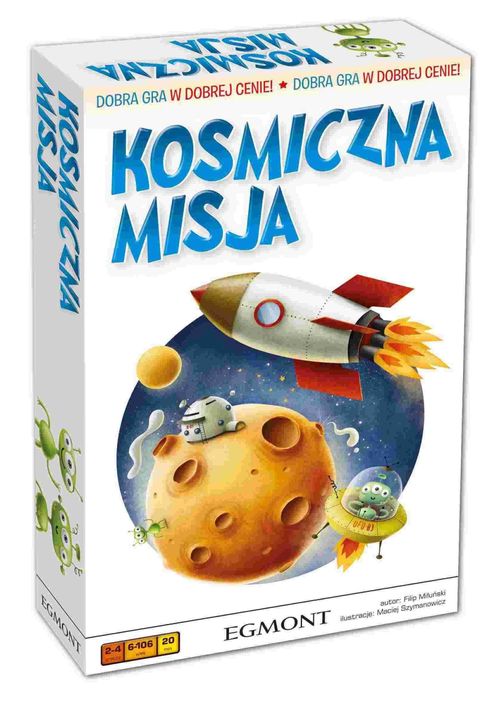
Kosmiczna misja
Kosmiczna misja Rulebook
Table of Contents
Table of Contents
Components
- 45 planet squares (with planet fragments, space stations and aliens)
- 1 die
- Rules
Setup
A. Shuffle the planet squares and place them face down in the middle of the table. This is the supply.
B. Take the top 3 squares from the supply and place them face up next to the supply. This is the space row.
C. Place the die next to them.
Goal of the Game
During the game, players open planets and build space stations on them. The winner is the player who builds more space stations on fully open planets.
Game Turn
The youngest player begins, and play proceeds clockwise. Each player's turn consists of several phases:
- Roll the die.
- Take a planet square from the space row: a) open a new planet, or b) open the next fragment of a planet.
- Refill the space row.
After completing these phases, the player passes the turn to the next player.
In the very first round of the game there is no die-roll phase. Players immediately open a new planet.
1. Rolling the Die
The result of the die roll shows how many cosmonauts the player has on the current turn. Cosmonauts are needed to open the next fragments of planets.
2. Taking a Planet Square from the Space Row
The player takes 1 square of their choice from the space row. With this square the player may perform one of two actions:
2a. Opening a New Planet
The player places the taken square in front of themselves as the first fragment of a new planet. This action requires no cosmonauts (the die result is not used).
2b. Opening the Next Planet Fragment
The player adds the taken square to one of their already open planets. Two conditions must be met:
-
The number of the player's cosmonauts (the die result) must be greater than the number of space stations on the chosen planet. Only whole space stations are counted, not half-stations. Stations on the new square are not counted when counting the stations on the chosen planet.
Example: There is 1 space station on this planet. To add a new square to the planet, the player needs at least 2 cosmonauts (the die result must be 2 or more).
-
The new square must continue the fragments and half-stations that are already there.
Example: Correct (✓) and incorrect (×) cases of adding a square to a planet.
A planet cannot have more than 4 fragments. Fully open planets remain lying in front of the players until the end of the game.
- A player does not take a square from the space row only if they can neither add a square to any of their already open planets nor open a new planet. In that case the player does not take a square, and may (but does not have to) return one square from one of their planets to the box.
- If on their turn a player can add a new square to one of their planets or open a new one, they must take a square from the space row (declining is not allowed).
- A player cannot have more than two incompletely open planets. Only after fully opening one of them (that is, laying out all 4 of its squares) can the player start opening the next one.
3. Refilling the Space Row
The player places a new square from the supply into the vacated place in the space row, so that the space row again holds 3 squares. If the player did not take a square from the space row, they do not add a fourth square to it.
If there are no more squares left in the supply, the players add nothing to the space row.
Aliens
Aliens help players build space stations on planets. Each alien replaces 1 cosmonaut. In other words, if there is 1 alien on a planet, the player may roll 1 less than required on the die. If there are more aliens, the die may show even less.
Example: There are 2 space stations and 1 alien on this planet. To add a new square to the planet, the player needs to roll only 2 (without the alien they would have to roll 3 or more).
End of the Game
The game ends when no squares remain in the space row.
Players count the number of space stations on their fully open planets. The player with the most space stations wins. If the number of stations is equal, the contenders share the victory.
Example: At the end of the game, the player has three fully open planets on which they built 11 space stations in total. Stations on planets that are not fully open are not counted.
Game Example
a) On the first turn Petr took a square from the space row and placed it in front of himself, starting to open the first planet. b) At the end of the turn he refilled the space row with a new square from the supply.
a) On his next turn Petr rolled the die and got 3. That means Petr has 3 cosmonauts available on the current turn, which is enough to add a new fragment to the open planet (since the planet has only 1 space station). b) At the end of the turn Petr refills the space row.
a) New turn. Petr rolls the die and gets 2 — he has only 2 cosmonauts. That is not enough to add a new square to the existing planet, since that would require at least 4 cosmonauts. Petr is forced to open a new planet. He takes a square from the space row and places it in front of himself, next to the first planet. b) The turn ends with refilling the space row.
a) On one of the following turns Petr rolls a 3 on the die. This result would allow adding a new square to the second planet, but there are no suitable squares in the space row. Petr also cannot open a new planet, since he already has two incompletely open planets. He does not take a new square, but he gets the option to remove one of his planet's fragments to the box, which he does.