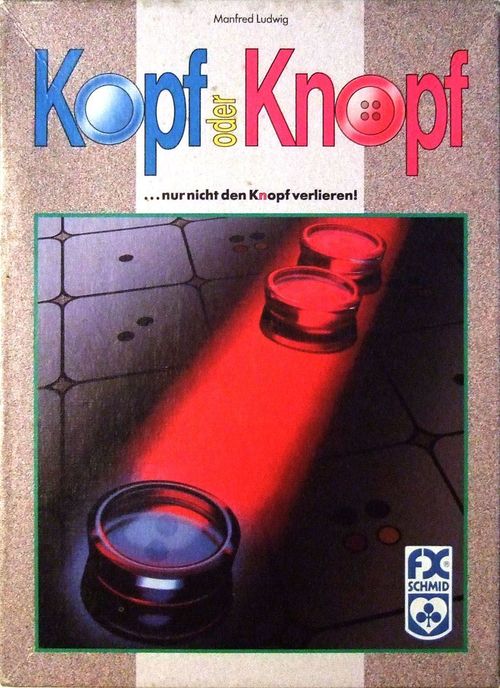
Kopf oder Knopf
Kopf oder Knopf Rulebook
Table of Contents
Table of Contents
Components
- 1 game board
- 14 red button playing pieces
- 14 blue button playing pieces
Setup
- The players place their buttons on the board in the order red/blue-red/blue, on the second row of fields in from the outside, running all the way around the board. The coloured dots on the edge of the board serve as a guide for filling the corner fields.
Turn Order
- Red begins and moves one of his buttons. Blue moves next, then red again, and so on. Moves always alternate, and every move is made with a button.
- There is absolute compulsion to move (Zugzwang): when it is a player's turn he must move one of his buttons, even if that move is unfavourable for him.
Move Distance
- The move distance of a button is determined by the see-through holes of the field the button is standing on.
- Fields with 1–3 holes give a fixed move distance equal to the number of holes.
- The coloured fields with 4 holes give a variable move distance of 1–4 fields.
Possible Moves of the Three-Button
- Direction of movement is free: a button may move horizontally, vertically or diagonally onto a free field in the chosen direction.
- A button may jump over both its own and the opponent's buttons on the way.
Diagram: a button standing in the centre of the board, with arrows showing every direction in which it can move, and the distances available in each direction.
Forbidden Multi-Combination
- More than two of one player's own buttons may never stand in an unbroken combination. That means the fields they stand on may not touch each other, either at the edges or at the corners.
- The diagram shows examples of such forbidden multi-combinations.
- If a player sees such a multi-combination, the opponent may, at the beginning of his turn, take any one button of that combination off the board.
Aim of All Moves
- The aim of every move is to create a threat (Bedrohung), or to escape one.
Capturing Rules
- Only a two-button combination (Zweier-Kombination) may attack. This is two buttons of the same player standing directly next to each other horizontally, vertically or diagonally. Such a combination threatens the opponent's buttons that lie within its reach (Schlagreichweite).
- The reach of such a two-button combination is determined by the sum of the holes of both buttons. It applies horizontally, vertically or diagonally, depending on the position of the combination, and in both directions.
Diagram captions, as printed:
- "The reach of A and C is sufficient; that of B is too short."
- "A cannot capture, because one of its own buttons stands in the way. At B and D the reach is too short. C threatens in both directions, and E can capture D's single-hole button."
Attack
- An attack consists of three phases: 1. the active threat, 2. the reaction, 3. the capture.
- The active threat arises when a player builds a two-button combination, through which he threatens opponent buttons.
- The reaction: on the following turn, the opponent has the chance to pull one of his threatened buttons out of the danger zone.
- A passive threat can also arise when the opponent himself moves one of his buttons into the danger zone of the other player's buttons. The other player may then capture immediately.
- The moment of capture is immediately before the attacker's move, i.e. before he moves one of his buttons. If at that moment one or more of his two-button combinations threaten, the attacker may remove all directly threatened opposing buttons.
- Only the nearest opposing button may be captured in each of the two directions. Further buttons within reach are (for the time being) safe. The fields between such a two-button combination and the threatened opposing buttons must be free of the attacker's own buttons; otherwise no capture is possible.
- A capture is made purely by remote effect, without moving one's own button.
- After capturing, the player makes his normal move with one of his buttons. A further capture is possible only at the beginning of his next turn.
Example Move Sequence
As printed on the rules sheet:
- The opponent has a forbidden multi-combination of three buttons: you may remove one of these buttons.
- Two of the opponent's buttons are additionally threatened by one of your two-button combinations: you may remove both.
- Now make your move with one of your own buttons.
Tactics
- Building up threats should sensibly be done so that several of the opponent's buttons get into the danger zone at the same time. This is achieved by a simultaneous threat in both directions (Example A). It can also succeed in one direction (Example B), since only one stone can be removed from the danger zone at a time.
Diagram: two example positions, labelled A and B, showing a simultaneous double threat and a single-direction threat.
End of the Game
- The game ends as soon as one player has managed to take 10 of his opponent's buttons in total. That player wins the game.
- Tip for a shorter game: simply reduce the goal to capturing 8 of the opponent's stones.