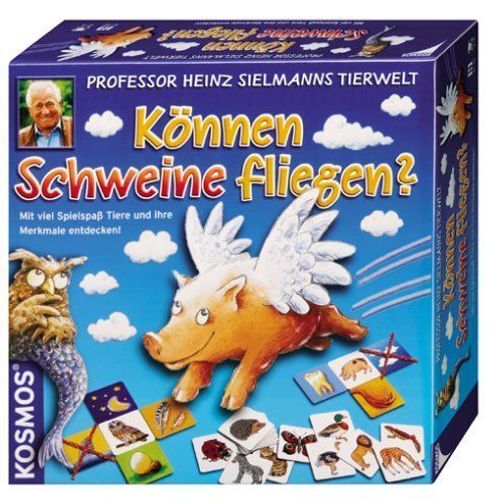
Können Schweine fliegen?
Können Schweine fliegen? Rulebook
Table of Contents
Table of Contents
Components
- 16 tokens (four of each colour)
- Scoring track (in two parts)
- 4 pigs
- 24 trait cards
- 60 animal cards
Object of the Game
In this game you will learn about various animals, one in each round. The player who reacts to the appearance of the animal before the others and is first to place a token on the correct trait card can advance his pig further along the scoring track. The winner is the player whose pig is furthest along after 5 rounds.
For Parents
So that your child learns as much as possible, help him in the first game. It is best if you or one of the older children acts as "playing coach". Before the game, please introduce the children to the animal traits. Do not skimp on explanations, answer questions, share your knowledge. Read more about the traits on p. 6.
For those who want to know more about animals, we recommend looking at p. 15, which contains many interesting, sometimes gripping facts. Even if you have no doubts about your own knowledge, please study the animal traits and do not hesitate to use the information section of the rules.
The game is based on the latest scientific knowledge. Of course, the wording is simplified and the definitions smoothed so that everything is understandable to children. In particularly difficult cases the description is split into two parts: you give the children the additional information only if necessary. It does not count towards the general score. However, if you want to reward the children for deeper knowledge, do not deduct points from those who cannot solve the task of increased difficulty.
Hello, Dear Children
In our game there are 24 cards with animal traits (for example, fur or flight). Before the first game, ask your parents or older siblings to tell you about them. If you are already familiar with the game, it is enough to discuss the animals' traits once more all together. On p. 10 you will find descriptions of the animals and can check that you are right.
Example: Horse. Four legs, fur, hooves, mane, teeth, herbivore, tail.
Take Note
The animal world has far more traits and peculiarities than our game. For example, we offer you only one fur card, while in nature you will hardly find two identical kinds of fur: the coats of different animals differ in density, length and colour. But for such an abundance of traits we would have had to make a gigantic box, and it would not fit into any shop.
Before the Game Begins
Before the first game carefully punch the cardboard pieces out of the sheets.
Before each game
Lay out all the trait cards on the table picture-up in any order in a circle. It is important that the players can see them well and can reach every card.
- Turn the animal cards picture-down, shuffle them and put them in a stack next to the circle of trait cards.
- Assemble the scoring track and put it next to the circle of trait cards.
- Each player chooses a pig and puts it on the first (unnumbered) cloud of the scoring track, takes the four tokens of the colour of his pig and puts them on the table in front of him. If fewer than four people are playing, put the extra pigs and extra tokens back in the box.
- When setting up the field, make sure that no one will knock over the stack of animal cards or the pigs when reaching for the far trait cards.
- Keep the solutions section ready, and off we go!
So, We Begin!
In each round one animal is the centre of attention. The oldest player takes any card from the stack of animals, turns it picture-up and puts it in the centre of the circle of trait cards.
All players quickly recall which traits belong to the revealed animal. Do not forget: the picture on a trait card does not necessarily match how the trait is shown on the animal card - what matters is that the animal really has that trait.
If a player thinks he knows which traits the animal has, he lays his four tokens on trait cards. In each round every player must try to lay out all four of his tokens on trait cards. Only one token may lie on each trait card.
If two players want to put a token on the same trait card, the winner is the one who places the token first. His opponent may not leave a token on an occupied trait card.
The round ends when all players have placed their tokens or no longer want to lay tokens on trait cards.
Now open the rules on the page with the solutions and check which traits were named correctly and which were mistaken. Check each token in turn. If a token is placed correctly, i.e. the animal does have this trait, the owner of the token moves his pig to the next space of the scoring track. For each incorrectly named trait the pig moves back one space (but a pig cannot be moved back further than the starting cloud).
Example
Lyosha lays an animal card on the field. It is a hedgehog. Vanya remembers that a hedgehog has 4 legs, has teeth and fur, so he places one token each on the trait cards with the pictures of 4 legs, teeth and fur. Lyosha thinks a hedgehog must have a tail, and he occupies this card with his token. Maxim was once bitten by a hedgehog, so he knows the hedgehog has teeth, but Vanya has already taken the card with the picture of teeth. Misha puts a token on the hedgehog being a herbivore. After that all four admit that they cannot recall any other traits of the hedgehog, and the round ends.
In the solutions section the players look for the description of the hedgehog to understand who was right. Lyosha's pig flies to the next cloud: the hedgehog does have a tail! Vanya guessed three traits correctly, and his pig flies three clouds forward. Maxim's pig stays where it is, since he did not lay out tokens. But Misha's pig flies back: the hedgehog eats not only plants but also insects, for example. Misha moves his pig one cloud back.
The players could not remember that the hedgehog is a spiny nocturnal animal that hibernates in winter.
After the points have been counted and the pigs moved, the players remove their tokens from the trait cards and put them in front of themselves again. A new round begins when all players have all their tokens back. The trait cards stay in play until the end of the game.
When all tokens have been returned to their owners, remove the animal card from the centre of the field. Close the solutions section, but do not put it far away: soon it will be needed again.
After that a new round begins. The right to reveal a new animal passes clockwise from the previous revealer.
End of the Game
After five rounds - in other words, when five animal cards have been revealed - the game ends. The winner is the player whose pig has flown furthest along the scoring track. If several players have moved their pigs equally far, you can play one more round or share the victory.
Example
(Illustration of the scoring track.) The owner of the yellow pig wins.
Game Variants
For children aged 3 to 5 and for introductory games
Variant for 2-4 players. The game proceeds as described above, but the participants act not all together but in turn. The first round is begun by the youngest player. He lays out his tokens, after which the turn passes clockwise. When all players have laid out their tokens (or pass), the counting of points begins. After the round ends, the right of the first move passes clockwise.
Variant for 1-5 players
There will be no winner in this game. The oldest player chooses two trait cards and lays them picture-up in the centre of the table, leaving about 20 cm between them. The other trait cards are not needed. Then the players reveal animal cards one at a time and lay them out relative to the trait cards.
- If the animal has only one of the traits, place its card next to the card of this trait (on the left or right).
- If the animal has both traits, place its card between the trait cards.
- If the animal has neither of these traits, set its card aside.
Trait Cards
Legs (2 legs / 4 legs / 6 legs)
These are the parts of an animal's body needed to stand in place and to walk. Some animals, for example squirrels, can help themselves with their front limbs while eating, but these are still considered legs, not arms. Only the front limbs of the great primates - gorillas, chimpanzees and so on - are called arms.
Most vertebrates have two or four legs. Insects - beetles, wasps, butterflies and flies - have 6 legs. In rare kinds of butterflies the two front legs are quite small: they help the butterfly clean itself.
Spiders and other arachnids have 8 legs, for example ticks. But the record for the number of legs is held by tropical millipedes, which can have up to 600 little legs. And there are also legless animals - snakes, fish and so on.
Eggs
Not only hens lay eggs: this is the way all birds and many other animals reproduce. The eggs of different animals differ in colour, size and strength of the shell. But both the microscopic eggs of insects and the giant eggs of ostriches are capsules in which embryos develop. When the time comes, the young (chick, little ant, little tortoise) breaks through the shell from inside and comes into the world. In some kinds of lizards and sharks the young hatch from eggs while still inside the mother's body, and only then are released into the wild. There are animals that include both egg-laying and live-bearing species. For example, some sharks lay eggs, while white sharks bear their young live. Among mammals (animals that feed their offspring with milk) there are only two egg-laying representatives - the platypus and the echidna.
Feathers
Feathers are found only in birds. A feather consists of a horny substance. The shaft of a feather is hollow inside, which makes the feather lighter - otherwise the plumage would be too heavy for flight. Plumage not only helps birds fly (flight feathers) but also protects them from cold, wind and water (down feathers).
Fur
This is the hairy covering of mammals, protecting them from cold, wind and water. Fur can be short or long, one-coloured or patterned, thick or sparse, soft and prickly. A cat's coat, a fox's pelt, pig bristles - we call all of this fur. Fur can cover the whole body of an animal or only some parts of it: for example, a hedgehog has spines on its back and fur on its belly and head.
Special case: in some animals fur has disappeared as a result of evolution or has survived in peculiar forms (at the tip of the tail, in the ears, etc.). The best-known example is the rhinoceros. The horn on its nose is hardened fur.
Scales
Scales are a special form of skin covering of some animals, resembling in appearance the tiles on the roof of a house. Most fish have scales, but, for example, seahorses do not have them. In fish the scales cover the whole body, and in birds only the lower part of the legs. The wings of butterflies are covered with scales, but you cannot make them out without a microscope.
Flight
Almost all birds and insects can fly. With the help of wings they move over great distances through the air without touching the ground. People used to think that wings are enough to fly. This is not true! If an animal is too heavy or its wings are too small, it will not be able to rise into the air. So there are flightless birds - penguins, kiwis, ostriches.
Special case: ants usually cannot fly, but in the breeding season wings may appear in some of them.
Fins
Fins and flippers help aquatic animals move under water. Without fins, fish, whales, seals and many other inhabitants of rivers and seas would be less adapted to survival. There are, of course, penguins, magnificent polar swimmers, which develop considerable speed in the water with the help not of fins but of wings, but this is an exception to the rule.
Claws
The sharp horny growths at the ends of the toes of a number of animals are called claws. They help animals move in difficult conditions (along trees or ice, for example), hunt, and take food. Humanlike apes such as gorillas have no claws, and their nails are like a human's.
Special case: even insects and arachnids are endowed with tiny claws, but not horny ones - chitinous ones. Such claws are found on the ant, fly, ladybird, earwig, butterfly, spider, wasp and tick.
Hooves
A hoof is a thick and strong horny growth on the lower part of an animal's foot, where a human has toes and nails. Horses or zebras have, for example, not one but two hooves on each foot, like two toes. Giraffes, deer, cows, pigs and goats are considered hoofed.
Special case: rhinoceroses, camels, hippopotamuses and some other animals are classed as hoofed, although in fact they no longer have real hooves: in the process of evolution only small growths remained from the hooves, and the animals themselves rest on hardened skin.
Sensors
Animals have sensors - for example, the antennae on the head, which help them find their way in space. Sensors either replace some sense organs or supplement them. This is how animals adapt to their environment.
Horns
Horns are bony formations on an animal's head. As a rule an animal has two horns, with the exception of the rhinoceros bird, which has only one horn. Horns are a remarkable weapon, strong and often sharp. Almost all animals keep their horns throughout their whole life, but deer shed their horns every year and grow new ones.
Mane
A mane is long hair on the head and neck of an animal, often differing in colour from the rest of the fur. Lions and horses are the best-known owners of manes.
Nocturnal Animals
Animals that sleep by day and are active at dusk or at night are considered nocturnal. Such animals leave practically all their activity for the night - hunting, caring for their young and so on.
Special case: this trait is rather blurred, since there are many animals that lead a nocturnal way of life but do not shun sunlight either. That is why we did not record the hippopotamus, cat, lion, spider and mollusc as nocturnal animals.
Beak
Birds have no teeth. To take food they use strong beaks, able to crush seeds, nuts and the shells of insects. Beaks also help birds build nests and clean their plumage. Many millions of years ago there existed dinosaurs with beaks. But to this day a beak has been kept only by birds and a few other animals (platypus, turtle, octopus).
Teeth
Teeth are hard bony formations in the mouth of a vertebrate, covered with hard protective enamel. Teeth hold and grind food. Teeth are kept in animals for quite a long time, until they break or fall out from disease or old age. But, for example, sharks have nothing to fear: their teeth are renewed with incredible speed, constantly keeping their strength and sharpness.
Teeth are present in almost all mammals, with the exception of whales and the echidna.
Special case: platypus young hatch with three small teeth but lose them right after birth. Snails and sea urchins have something like teeth, but they are invertebrates, and these teeth are not made of bone.
Herbivores
There are animals that eat only plants - that is, they do not feed on insects and other animals. Their diet consists of fruit, roots, shoots, grass, leaves and seeds. Of course, even herbivores sometimes swallow small insects; this happens by accident. Often the young know from birth what they can eat, while some, for example baby gorillas, learn from their parents.
Special case: the edible sea urchin eats plants and sea urchins of other species that are classed as herbivores.
Tail
The continuation of an animal's body is the tail. It can be short or long, straight or curled, thin or thick. In beasts and fish it is a continuation of the backbone, in birds a part of the plumage, in crustaceans a part of the shell.
Africans
Some kinds of animals can be met in Europe only in captivity - in circuses or zoos - because their natural habitat is another part of the world, for example Africa. This trait does not describe exclusively African animals: camels and lions live in Asia as well, but we endow them with the trait "Africans".
Hibernation, Winter Sleep, Torpor
In many countries winter is cold, and local animals lack food at that time of year. Migratory birds fly away to warm lands for the winter and return in spring. And there are also those that hibernate - a state of prolonged sleep when the body spends less energy and allows it to survive the hungry period.
Hibernation. Some animals manage to accumulate enough energy in the body before winter to sleep through the whole cold season until spring itself. Thus, sealing their burrows against frost, hedgehogs and flying squirrels (bats) spend the winter.
Winter sleep. Other animals, such as squirrels, try to accumulate as much food as possible before winter comes. With the cold they fall asleep but from time to time get up to refresh themselves.
Torpor. In humans and many animals body temperature practically does not change. But there are cold-blooded animals whose body temperature changes depending on the surroundings. These are spiders, insects, frogs, lizards. In winter they become numb, losing the ability to move. But with the return of warmth they come to life. Numbed animals do not go hungry, since they have no need of food.
Wings
Wings are present in all birds and many insects, such as beetles, wasps, butterflies and flies. Wings come in the most varied forms and proportions. In insects the wings are often thin, small and transparent. In birds the wings are covered with special feathers, and their span can reach three and a half metres (albatross). The wings of bats are made of skin.
Special case: ants usually have no wings, but in the breeding season they appear in some of them.
Endangered Species
A multitude of species of animals that inhabited the Earth have died out for various reasons. Human interference, destroying the habitats of wild animals, aggravated the situation. And still more animals could have vanished from the face of the Earth if in the 20th century people had not taken up the rescue of dying-out species. Reserves and national parks all over the world hold back the threat of species extinction by creating optimal conditions for the growth of animal populations.
Special case: for a number of animals in our game this trait can be assigned only with a stretch. Some species of sloth are not yet classed as endangered, others are on the verge of extinction. The population of plains zebras is still large, whereas most other species of striped horses are already under threat of extinction. The same applies to giraffes, penguins, platypuses and Nile crocodiles.
Note: the trait "Endangered species" may depend on the state and public point of view on the state of affairs in the wildlife of the region. In the game we adhere to the criteria adopted in the countries of Central Europe (Germany, Austria, Switzerland) over the last 20 years.
Shell
Some animals have armour that protects them from attacks and injuries. The horny shell of the tortoise is especially well known. Crocodiles and seahorses are protected by shells. Chitinous armour is found in almost every insect. The shells of snails, mussels and other molluscs also perform a protective function. Fish scales are too thin to provide reliable protection and are not classed as shells.
Solutions
Note: in the printed rulebook the traits of each animal are shown as a grid of trait-card pictures. They are rendered here as the names of the trait cards. Animal names are given as printed (with the species in brackets).
- Shark (white): scales, fins, teeth, tail, endangered species
- Butterfly (peacock butterfly): 6 legs, eggs, scales, flight, sensors, herbivore, hibernation/torpor, wings, shell
- Hippopotamus: 4 legs, teeth, herbivore, tail, Africans, endangered species
- Squirrel: 4 legs, fur, claws, teeth, tail, hibernation/winter sleep
- Ladybird: 6 legs, eggs, flight, sensors, hibernation/torpor, wings, shell
- Camel (dromedary): 4 legs, fur, mane, teeth, herbivore, tail, Africans
- Cheetah: 4 legs, fur, claws, teeth, tail, Africans, endangered species
- Gnu (blue wildebeest): 4 legs, fur, hooves, horns, mane, teeth, herbivore, tail, Africans
- Gorilla: 2 legs, fur, teeth, herbivore, Africans, endangered species
- Raccoon: 4 legs, fur, claws, nocturnal, teeth, tail
- Hedgehog (European): 4 legs, fur, claws, nocturnal, teeth, tail, hibernation/winter sleep
- Toad: 4 legs, eggs, nocturnal, hibernation/torpor, endangered species
- Giraffe: 4 legs, fur, hooves, horns, mane, teeth, herbivore, tail, Africans
Want to Know More About Animals?
Shark (white)
The white shark is found in many warm seas, in particular the Mediterranean. At up to 5 m in length it is one of the largest predators on Earth. The white shark eats fish, squid, crabs, seals, seabirds and young whales. Its teeth, arranged in three rows, triangular and sharp as razors, deal with any prey. Incidentally, if a tooth breaks, it is very quickly replaced by another, so you will never meet a toothless white shark. Although the white shark is classed as a fish, it does not spawn. The female carries the eggs inside her and then releases into the wild the already hatched young sharks.
Butterfly (peacock butterfly)
The peacock butterfly is one of the brightest and most widespread butterflies in Europe. Moreover, it is among the first to emerge after wintering. The tiny scales on the wings form a fanciful pattern which to a human looks like a drawing of peacock feathers; in fact these "eyes" are needed by the butterfly not for beauty at all. They frighten off birds and other predators, who take the small butterfly for a much larger and possibly dangerous animal. The beautiful butterflies emerge from black hairy caterpillars that feed on the leaves of plants, for example nettles.
Hippopotamus
The ancient Greeks called the hippopotamus the "river horse" - hippopotamus. It is assumed that the reason was the animal's voice, similar to a horse's neigh. The hippopotamus spends most of its time in the water and comes ashore only at night for a few hours to refresh itself. It feeds on grass, and only coastal or land grass, and never eats algae. In a day an adult animal eats on average 40 kilograms of grass. Between the toes of the hippopotamus's feet there are leathery webs - they help it graze in the water and keep a firmer hold on muddy or sandy banks.
Squirrel
The squirrel lives in forests. It nimbly runs up tree trunks and fearlessly leaps from branch to branch. At a height unreachable for many predators the squirrel makes a drey, where it rests at night and shelters from winter frosts. Near the tree where the squirrel has settled, dozens of caches appear, where the little animal stores supplies for the winter - nuts, acorns, cones. When spring comes, the old supplies are running out, and new nuts are still far off, the squirrel raids birds' nests and treats itself to eggs.
Ladybird
Ladybirds and their blue-grey-yellow larvae feed on aphids and are therefore especially popular with gardeners. One individual can eat up to 600 pests a day. More than 70 different kinds of ladybird live near us. The red-black or yellow-black colouring shows birds and other insect-eaters that the ladybird tastes bitter. Contrary to a common misconception, the spots on a ladybird's wings say nothing about the insect's age. They show which species it belongs to. In winter ladybirds spend the time in shelters protected from frost, often even in human dwellings.
Camel (dromedary)
The dromedary is a one-humped camel. Camels are wonderfully adapted to life in the desert and arid regions. For a whole week they can walk with a load without water, on a meagre diet of dry desert plants. The fact that the camel's body heats up very slowly also helps in the desert. The dromedary begins to sweat - and very little at that - when its body temperature rises to 40 degrees. Wild dromedaries no longer remain in nature, but in North Africa, Asia and Australia camels serve as pack animals.
Gorilla
The gorilla is the largest humanlike ape on our planet. Gorillas live in the equatorial forests of West Africa (there is a special subspecies - the mountain gorilla). They live in large families: a male leader, several females and offspring. Males turn grey with age - the hide on their backs becomes silvery. Gorillas have no tail, unlike the primates of other species, for example the chimpanzee. Gorillas spend the night in nests in trees, and by day spend time on the ground. Gorillas are vegetarians: they eat leaves, grass and fruit.
Cheetah
One of the fastest beasts. In pursuit of a gazelle or a hartebeest it develops a speed of up to 110 kilometres an hour. But if the decisive spring does not succeed, the cheetah breaks off the chase and waits for new prey. The cheetah lives in the African savannah south of the Sahara desert. It has many enemies - even adults often die in clashes with lions, leopards and hyenas. Incidentally, unlike other cats, cheetahs cannot retract their claws.
Raccoon
The raccoon originally lived only in North America, but until recently it has also settled in Europe. Raccoons feed on mice, snails, worms, insect larvae, crustaceans, fish, fruit and nuts. Because the raccoon has underdeveloped salivary glands, it is forced to moisten its food. From the side it seems that it washes its prey: this is precisely why the most widespread species received the name "washer" (in Russian, "poloskun").
Gnu (blue wildebeest)
The striped (seen from the back) or white-bearded (seen from the front) gnu inhabits the savannah south of the Sahara. Huge herds of these animals roam the expanses of the savannah in the dry season, and with the beginning of the rainy season scatter wherever their eyes look - every herd has plenty of females with offspring and several males. Unlike most herbivorous inhabitants of the savannah, the gnu prefers to feed on short grass, and therefore they are the first to come to lands that have suffered from steppe fires.
Hedgehog (European)
When twilight thickens over the forest, the little hedgehog goes out to hunt. Insects, spiders, birds' eggs - everything small that lies near the ground becomes food for the hedgehog. Its keen nose unerringly picks up where and what can be had to eat. When attacked by a predator the hedgehog instantly rolls into a ball with its spines outward. When winter comes, the hedgehog goes into hibernation, having insulated its lair with moss and leaves. Its body temperature falls radically, and its heart slows down.
Toad
The fearsome warty toad is known to us as a helper of witches and their favourite dish. But these are all prejudices. Every spring the toad returns to the pond where it grew up from a tadpole, in order to continue its kind. The toad hangs strings of spawn (about 5000 eggs) on the shore plants, after which it returns to the forests and fields, where it spends its time in an eager hunt for earthworms, slugs, spiders, flies and other insects. For the winter the toad falls into suspended animation: its body temperature drops and all life processes practically stop. And in spring, with the first warmth, the toad thaws and hurries to make up for lost time.
Giraffe
Giraffes live in African forests and savannahs. They are the tallest land animals thanks to their long neck. Every giraffe has a unique pattern of dark spots on its hide. Because of its great weight and thin legs the giraffe prefers to move calmly and only over firm ground. The giraffe feeds on plant food. Males pick leaves from the upper branches of trees, females eat greenery growing at body level - so by how a giraffe eats one can determine its sex. To drink, the giraffe has to spread its legs wide and bend its neck.
Plains Zebra
Zebras are striped horses that live on the expanses of the African savannah. Like horses and donkeys they belong to the odd-toed ungulates. Zebras are herd animals, although their groups cannot be compared in numbers with herds of gnu. Incidentally, small families of antelopes, giraffes and even ostriches often join zebras in the daily trek across the savannah in search of lush pasture. The zebra's most terrible enemy is the lion. After man, of course. Originally the striped horse was spread over the whole of Africa, but even before the onset of the Middle Ages man exterminated zebras in North Africa. And even now all three surviving species of zebra are threatened with extinction.
Snake (royal python)
The royal python lives in the tropical regions of West and Central Africa. It received its second name - ball python - because in particularly dangerous moments it curls into a tight ball with its head inside. By day the python rests, at night it hunts, eating rodents and birds. Younger and lighter pythons look for prey in the branches of trees, while old heavy members of the community move along the ground. The python swims excellently. Despite its royal title, among pythons this is the smallest species (up to two metres long). Lacking architectural talent, pythons use other animals' dwellings to raise their young - rat burrows, for example.
Carp
The carp lives in the muddy calm waters of broad European rivers. By day it combs the silt, raking out molluscs, worms and small crustaceans - for its omnivorousness and rapid weight gain the carp is compared with the pig. The carp spends the winter in a pit on the river bottom under a thick covering of silt.
Whale (humpback)
Humpbacks reach 14 metres in length - not a record among whales. But humpbacks are found in all the oceans of the Earth. They like to stay not far from shore, and in many coastal countries the time of the summer run is especially popular with tourists who come specially to see the whales. The run is the period when humpbacks feed intensively on krill and small fish, creating reserves of fat: the layer under the skin helps them in winter and during migration, when they have to go hungry. Humpback whales can swim very fast. And the humpbacks were also made famous by their loud songs.
Tick
Ticks have eight legs, like all arachnids. From March to October the tick season begins in meadows, forests, parks and gardens. It hides in grass and low bushes, and then jumps onto an animal or person passing by. The tick finds a place on the victim's body where the skin is thinner, after which it begins to suck blood. It becomes sated in 5-14 days, after which it detaches from the victim, falls to the ground and does not worry about food for a long time. The tick can transmit extremely dangerous diseases, so try to avoid its bites.
Koala
The koala lives in the eucalyptus groves of Australia. This clumsy animal spends most of its time in a tree: it either sleeps or chews eucalyptus leaves - the koala eats nothing else. In a day it eats up to 400 grams of leaves. Very rarely - and most often at night - the koala comes down from the tree, but only in order to make its way to the next one, to settle in a fork of branches, cling with strong claws to something reliable and doze until tomorrow. Australians are forced to protect the koala - the animal itself cannot cope with this.
Goat (domestic)
Goats are very undemanding domestic animals. Even where there is nothing left for horses or cows to graze, a goat will find itself food. But after it plant life in the region disappears. That is why goats are kept in arid regions of our planet, where plants do not particularly participate in creating local ecosystems. Goats feel excellent in mountainous country, like their close relatives, the mountain goats. Most goats, regardless of sex, have a beard, but powerful horns are a sign of a male.
Ibex (Alpine ibex)
The ibex lives in the Alps on the border of forest and ice. The curved horns of the male reach a metre in length. They are put to use in the mating season, which falls in winter for ibexes, when males fight each other for dominance over the herd. Ibexes are superb climbers; it costs them nothing to climb to the top of the steepest mountain. There are known cases when ibexes climbed practically sheer walls. Ibexes spend most of their time searching for plant food.
Cow (domestic)
Man domesticated the cow 11,000 years ago in the Near East. All over the world cows, buffaloes and oxen live beside man: they not only serve as a source of meat and milk - in developing countries oxen are still used as draught and pack animals. Man has long been breeding special breeds of large horned cattle. Cows are herbivores. They have a very interesting digestive process: grass from the pasture enters a special compartment of the stomach - the rumen. Here it is softened under the action of stomach enzymes and returns to the animal's mouth. The cow chews this cud and only then sends it further along the gullet.
Cat (domestic)
Man domesticated the cat in Ancient Egypt 4500 years ago. All this time cats have helped people protect stored food supplies from mice and rats. Cats can retract and extend their claws. You have probably seen how a cat's eyes shine in the dark. This happens because the back wall of the eye reflects light like a mirror, and even the weakest light passes through a multitude of light-sensitive cells. That is why a cat sees in the dark much better than a human. In this game the domestic cat is not considered a nocturnal animal, since people often disturb their pets' sleep by day.
Crocodile (Nile)
The Nile crocodile is the second-largest crocodile on Earth: its body length can reach 6 metres. It lives in different corners of Africa and is even found in Madagascar. In rivers, lakes and other freshwater bodies crocodiles lie in wait for prey: they eat fish and catch waterfowl, with varying success they attack animals that have come to the watering place. In the breeding season females lay eggs in the coastal sand. When after three months the young break out into the wild, the mother gathers the offspring in her mouth and returns to the water. So she can be sure that hungry land-dwellers will not get at the little ones.
Rabbit (wild)
The spread of rabbits across Europe began from the Iberian (Pyrenean) peninsula. First - more than 2000 years ago - the Romans brought wild rabbits from the eastern provinces to Italy, and from there the prolific rodents scattered across the whole of Europe. Unlike hares, rabbits live in families in branched burrow complexes with a huge number of exits. The rabbit feeds on grass, buds and shoots.
Mole
The mole is an underground dweller. On the surface its short paws are practically useless, but under the ground it has no equal. Powerful paws turned outward, with claws, dig into the earth like the bucket of an excavator, helping the mole in hunting and building. The mole digs for itself real catacombs with a multitude of rooms, storerooms and corridors. Here it lives, raises its offspring, catches earthworms, raids the underground nests of insects and people's gardens. Unlike small insectivores and rodents, moles do not hibernate, although of course their activity falls in winter - you cannot rummage much in frozen ground. However, with the approach of cold weather the mole zealously, even selflessly, prepares: it insulates the main chambers of its underground palace and collects huge supplies of food. So that the worms do not spoil, it does not kill them but paralyses them by biting through their heads. In the storerooms of such an underground lord several hundred worms may lie - and no wonder: in a day the mole must eat a volume of food approximately equal to its own weight. Worse still, without food the mole will not last even a day. With its underground way of life the mole sees almost nothing - it merely tells light from darkness. Smell and sensitive whiskers help it hunt and communicate with its fellows.
Lion
In the past lions lived in Africa and Asia; today they survive only south of the Sahara and in some regions of India. Lions are the only cats that live in families with offspring - prides. The core of a pride is the females with their young. Every day a lion needs about 6 kilograms of meat, so every evening the pride goes out to hunt. Zebras, antelopes and hartebeests become the victims of the lions' hunger.
Sloth (two-toed)
Two-toed sloths live in the selva - this is what the South American jungle is called. Most of the time the sloth hangs on tree branches and sleeps, regardless of the weather. Sometimes it wakes up, and if there are enough leaves around, it eats and falls asleep again. When the food runs out, the sloth slowly descends from the tree and crawls over to the next one. On the front paws of the sloth there are only two toes. In the course of evolution they have grown together and are now good for little except holding the body in a hanging position.
Bat (common pipistrelle)
The pipistrelle is the smallest but also the most widespread bat in Europe. The pipistrelle leads a nocturnal way of life and rests by day. For a dwelling the pipistrelle chooses the most varied places - from a hollow in a tree to an attic. When night falls, the pipistrelle sets off in search of moths and other insects. Darkness is no hindrance to it: the pipistrelle constantly emits a cry that the human ear cannot catch, and orients itself masterfully in space by the echo. Like all bats, pipistrelles are protected.
Horse (domestic)
50 million years ago the ancestors of horses were small forest animals that nibbled leaves from low bushes. However, over time they evolved into mighty, beautiful, stately animals, whose toes on the feet first grew stronger and then ossified altogether, turning into hooves. Herds of wild horses roamed along and across the steppes until the people who appeared on Earth decided to tame them. Horses became faithful helpers of Eurasians in labour and war, but wild individuals in natural conditions have almost not remained. The vanishing remnant of the "last of the Mohicans" - Przewalski's horses - is under international protection and is being restored with difficulty by the efforts of many zoos.
Robin
Robins live in forests, parks and gardens. You should not be deceived by the fact that it looks like a sweet fluffy ball with bright plumage and big eyes: to a human the robin is, of course, harmless, but among themselves these birds fight so that feathers fly. Sometimes in such battles robins receive serious injuries and even perish. The robin settles in a nest hidden among tree roots, in bushes, in thick undergrowth. In spring and summer it catches insects and spiders, in autumn it also picks up various fruits, and for the winter it flies away to warm lands.
Sea Urchin (edible)
Sea urchins are found in all seas. The body of a sea urchin is, depending on the species, covered with spines to one degree or another. Since sea urchins are desired prey for many marine animals, they hide among seaweed, stones and wreckage. The urchin has a so-called "Aristotle's lantern" - jaws with which it gnaws algae, cracks the shells of molluscs, helps itself move along the bottom and is even able to bore a shelter in stone! Many sea urchins are herbivores. But there are species that eat molluscs, starfish and even other sea urchins.
Seahorse
This is a small bony fish living in tropical and subtropical seas. The swim bladder is located in its body along the whole body and is divided in two: the upper part is larger, and therefore in the water the seahorse holds itself vertically! Seahorses lead a sedentary way of life, clinging with their flexible tails to algae. They are so inedible that only some crabs and people eat them... Seahorses themselves feed on small crustaceans and fish fry. It is interesting that the female spawns into a special pouch on the male's body, and he then carries the offspring for five weeks.
Ant (red wood ant)
Ants are ubiquitous insects: they are absent only in Antarctica. In Europe the largest ant is the red wood ant. These insects live in large colonies: in one nest-anthill half a million individuals may live. Under the ground they dig out chambers for raising offspring and storing food supplies, and above they heap up a huge (by their standards) mound of pieces of bark, needles and twigs in order to protect the underground city from bad weather and enemies. In the depths of the nest queens lay eggs, workers look after the young, clean the chambers, extend the nest, while on the surface soldiers protect the anthill from uninvited guests and foragers drag from all around provisions (plant sap, seeds, insects) and building materials. The red ant belongs to protected species of animals.
Fly (housefly)
Who among you has not chased annoying flies around the kitchen? They are so apt to land on your neck or on your food! But such is their nature: they gather drops of nutrient liquids, and if the food is too hard they moisten it with saliva and only then eat it. Then they find something rotting - a heap of compost, for example, or a dead animal - and lay eggs there. When the larvae hatch from the eggs, they will have something to refresh themselves with. Flies have six legs, which are arranged so that it walks without problems on any firm surface - whether on glass or on the ceiling.
Rhinoceros (black)
This herbivorous giant can weigh up to 1.6 tonnes. Its whole day is taken up with the search for food, which would not be the easiest matter with the rhinoceros's poor eyesight, but, fortunately, it has excellent hearing. Usually rhinoceroses of different families calmly share watering places and pastures, but in the mating period males fight furiously with each other, and then, it happens, with the "lady of the heart" too. The black rhinoceros has two horns, consisting of the same protein as the hair on its body: the front one reaches a length of up to 1 metre and rises on the nose, the back one grows from the frontal part of the skull. The rhinoceros has few natural enemies - who can cope with such a monster that at the slightest sign of danger throws its whole mass at the source of the threat at a speed of up to 45 kilometres an hour? However, man has done everything so that the four remaining species of rhinoceros are on the verge of extinction.
Deer (red deer)
The red deer is one of the largest animals of the European forest (body length up to two and a half metres, height about one and a half metres). The male needs such a build simply - otherwise how would he carry on his head up to 15 kilograms of antlers? Antlers grow in males constantly, until the end of winter. Then the temporary crowns are shed, but not for long. By the onset of the mating season in early autumn the male can already show off his branching antlers before the female and cross them with a rival. Red deer males are loners: only during the rut do they gather into their harem from two to twenty females. The rest of the time the female with her young lives for several years in a separate herd. Practically the whole daylight hours the deer graze, eating grass, nuts, mushrooms - practically any plant food it can find. In most European countries the red deer is under protection and is kept in reserves and enclosures.
Lobster (European)
With a body length of up to 70 centimetres the European lobster is the largest crustacean in the seas of Europe. It even lives in the North Sea, and its catching is developed off the coasts of Great Britain. Lobsters' burrows can be found at a depth of 4 to 30 metres. The lobster leads a nocturnal way of life. Its front claws are different: one large and blunt breaks the shells of molluscs, while the small one with sharp edges helps to dismember the prey. The female lobster spawns eggs (up to 100,000 eggs a year) and carries them with her - sometimes for a whole year. Only then do small lobsters finally appear from the eggs. They rise to the surface of the water and begin to devour plankton. In a month such a youngster moults three times, shedding its shells that have become too tight, and only after this do they go down to the bottom, where they become adult lobsters.
Wasp (common)
The black-yellow colouring of the wasp's body warns everyone that it is dangerous to get involved with it. And indeed, its sting is very painful. Adult wasps feed on the sweet juices of plants and fruits, but the larvae need more serious food - the meat of worms, insects, larger animals. Wasps live in colonies that grow by autumn to several thousand individuals. However, with the onset of winter most wasps perish: only young queens remain alive, which spend the winter in hibernation and in spring begin the creation of a new community. Despite the fact that wasps, bees and hornets can stand up for themselves, they depend strongly on the state of the environment, and therefore many species of these insects are threatened with extinction in connection with the worsening ecological situation in the area of their habitat.
Octopus (common)
In Europe the common octopus lives off the shores of the Mediterranean Sea and the North Atlantic. The sac-like body together with the eight tentacles reaches 1 metre. On its tentacles are powerful suckers that allow it to attach itself securely to underwater rocks. The octopus can change its skin colour in a matter of seconds, blending in with the surrounding environment. The octopus is a predator: it catches fish, crustaceans and molluscs, gnawing through shells and carapaces with powerful jaws resembling a beak. Octopuses have as many as three hearts. The common octopus is not classed as an endangered species.
Pangolin (steppe pangolin)
The pangolin is a small animal reminiscent of a mixture of an armadillo and an anteater, but not related to them in any way. It lives in the savannah south of the Sahara. Its body is covered with strong dark-brown armour of pointed scales, and in case of danger it curls into a ball, covering its soft hairy belly. This ball can be unrolled only by strong predators - for example, large cats. By day the pangolin rests in an underground burrow or a hollow tree, and at dusk goes out to find food. With its mighty claws it breaks open anthills and termite mounds, after which it begins to work with its long sticky tongue, feasting on insects. Incidentally, its saliva contains an aromatic substance that attracts ants from the depths of the ravaged nest. The pangolin swallows its prey whole, because, unlike most mammals, it has no teeth.
Spider
The spider's day begins with it resuming the weaving of its web - a silken thread joins the branches of a bush, reinforces a corner, braids the railings of a bridge. In these artfully woven nets the spider catches flies and other flying insects. The victim stuck to the web struggles, and the spider understands that the trap has worked. Then it comes to the prey, injects into its body a paralysing substance mixed with digestive juices and wraps it in a dense cocoon of the same web, strong and sticky. In this "savanna" the fly's body dissolves, and after some time the returned spider has only to open the cocoon and drink.
Penguin (king)
The king penguin is the second-largest penguin after the emperor. The height of an adult male often reaches 1 metre. Colonies of king penguins are formed on subantarctic islands; the penguin's diet consists of small fish, squid and krill. Since the penguin is a bird, its wings are not called flippers, although it uses them only for swimming, and cannot fly. Clumsy on land, in the water the penguin is transformed: it dives to a depth of up to 600 metres, spends up to ten minutes under water, swims several tens of kilometres during a hunt! Penguins do not build nests - there is little building material in Antarctica, and the laid egg is carried by the parents in turn between their feet.
Parrot (grey)
The grey parrot (jaco) is one of the largest parrots in the world; it lives in Africa and is represented in practically all zoos. In natural conditions grey parrots have survived in the tropical forests of Africa. The main food of these birds is fruit, seeds and flowers. To make up for the shortage of minerals in the body the grey parrot regularly eats clay. These timid birds live in pairs or small groups. They communicate with one another by piercing cries and loud whistling. Grey parrots are very intelligent birds: they learn human speech excellently and can distinguish colours and shapes.
Hornbill
The hornbill, an inhabitant of Southern Africa and South-East Asia, owes its name to the hollow bony growth on its large curved beak. The beak and the powerful neck of these birds are brightly coloured. In spite of this, the bird keeps secretive and tries not to show itself to human eyes more than necessary - the wondrous beaks have often become ceremonial objects in the religions of local peoples. The unusual appearance is not the strangest thing about the hornbill. When the female lays eggs in a hollow of a tree, the male walls her up there, leaving only a small slit through which the beak barely passes. For a couple of months, until the chicks hatch and grow strong, the male brings food to the female and the offspring.
Cowfish (longhorn cowfish)
The cowfish is so named because in appearance it resembles a cow. Moreover, it has two growths on its head which resemble horns: that is why it is called the longhorn cowfish. This fish lives in the warm tropical waters of the Indian and Pacific oceans. The cowfish's body is protected by strong armour of hexagonal scales. Unlike most other fish, the longhorn cowfish has no gills: it gets oxygen by swallowing water and driving it under pressure through a special system of vessels. The cowfish feeds on small crustaceans, worms and other invertebrates, which it finds on the sandy bottom of coral seas. It can blow, to drive the sand off its prey. It is also worth noting that the longhorn cowfish is poisonous.
Salamander
The salamander is a lizard-like inhabitant of forests of the temperate climate zone. Like newts, salamanders belong to the tailed amphibians. During the day the salamander hides in its lair and only at night goes out to hunt snails, worms and other small animals. Salamanders are partly live-bearing: the female lays eggs in a special compartment of her body and only after eight months releases into the wild the already hatched and slightly stronger offspring. The black-yellow colouring warns predators that salamanders are poisonous. The poison is produced in numerous glands under the smooth skin: the salamander has no scales.
Pig (domestic)
The domestic pig descends from the wild boar, domesticated by our ancestors more than 9000 years ago. Today there are many different breeds of pig all over the world. Pigs are omnivorous: they can eat both plant and animal food. You all know that "a pig will find dirt". However, one must understand that pigs wallow in mud to get rid of parasites and lower their body temperature. And you will not believe it: pigs belong to the order of even-toed ungulates, like deer and giraffes. And hippopotamuses.
Dog (dachshund)
The dog is the oldest domestic animal. For 10,000 years it has lived beside man. All dogs - from the tiny chihuahua to the gigantic Great Dane - descended from wolves. Then people took the initiative from nature and themselves created a multitude of different breeds, from working to decorative. The Shetland sheepdog (collie) helps to herd sheep, the Irish setter excellently follows an animal's trail, the golden retriever is trained to bring the hunter a shot bird. And dachshunds, however funny and clumsy they may seem, are also hunting dogs: they help to drag foxes and badgers out of burrows.
Elephant (African)
The African elephant is the largest land animal: the height of an adult male can reach 4 metres, weight - 6 tonnes, tusk length - 3.5 m, tusk weight - about 120 kg. Not least because of the tusks the existence of African elephants is under threat - for many years European hunters exterminated them. Attempts to tame African elephants were abandoned long ago: unlike their Indian relatives, African elephants do not wish to part with freedom in order to work for man. Elephants are social animals, they live in large families. A family is formed by several females with offspring, while males band together in separate groups. An adult elephant has no natural enemies, and in ancient times elephants calmly lived to seventy years.
Owl (tawny)
The most widespread owl in the European middle zone is considered to be the tawny owl. This forest dweller has adapted excellently to life in the urban landscape, having taken a liking to parks and cemeteries. Owing to the structure of the eye the tawny owl sees almost nothing by day, as, incidentally, do other owls. But with the onset of dusk it goes out hunting: small rodents, birds, frogs and beetles become the huntress's victims. The tawny owl's plumage is so perfect that in flight the owl does not make the slightest noise, while itself reacting keenly to the faint squeak of its prey!
Ostrich (African)
The African ostrich is the largest and heaviest bird of the present day. With a height of up to 2.5 metres and a weight of 135 kg it is no wonder that the ostrich does not fly. It lives in the African savannah south of the Sahara. Its plant diet contains enough water, so you will not meet an ostrich at a watering place, and it is not tied to bodies of water. Ostriches live in small groups. In the breeding season the females lay eggs in a dug hole more than half a metre deep and leave them in the care of the father. He incubates the chicks, but not too diligently: often the eggs are left unattended by day.
Seal (ringed seal)
The ringed seal, which lives in the Arctic Ocean, was so named for the special pattern on its fur, made up of light rings with a dark border. It is worth noting that the offspring of the ringed seal, as in many polar seals, is born with a white coat: at first the pups spend their time on the ice, and this colouring is meant to hide them from predators. Ringed seals are loners. They feed on fish and crustaceans. Underwater hunting is the seal's calling: the duration of a dive reaches 45 minutes, the depth - 90 metres.
Snail
Snails live... well, wherever they do not live. In vineyards, in forests, parks, gardens. In winter they sleep in a safe shelter, and in the summer heat they seek salvation in cool, damp places. For rest or in case of danger the snail draws its body into the shell. On the snail's head there is a pair of special sensors - little horns. They help the snail assess the situation and look for food. Instead of teeth the snail has a radula - a peculiar grater that grinds food.
Oyster (mussel)
Mussels are bivalve molluscs that live in huge colonies in the coastal waters of warm seas all over the world. By special sticky threads the mussel attaches itself to underwater rocks, corals and even to the shells of other oysters and spends its whole life in one place. Opening its valves, the mussel filters oxygen and particles of nutrients from the passing mass of sea water, and its body gradually grows. When at low tide the sea recedes, the mussel, finding itself in the air, tightly closes its valves, but for a person who wants to feast on oysters this is no obstacle.
Duck (mallard)
A duck can be seen on almost every body of water. The mallard is the most widespread species of wild duck, on the basis of which the main breeds of domestic duck arose. In Europe the mallard more often than other birds becomes the target of hunters. The female mallard (the "selezen" is the male) is easily told from the male by the bright dark-green plumage of the head and neck. With the onset of cold, mallards fly away to warm lands and return in spring to their favourite bodies of water in the middle zone. In coastal thickets of reed and sedge ducks build nests and lay eggs. The ducklings that hatch can swim from the moment of birth.
Platypus
The platypus lives in Australia. You would be hard put to find a stranger beast! It and the echidna are the only mammals in the world that lay eggs. An aquatic animal, it does not see, does not hear and does not perceive smells under water, orienting itself by the weak electric fields created by its prey. A duck's beak, a beaver's tail, a hamster's protective cheek pouches, ten chromosomes against two in all other mammals - what more does one need to meet old age with dignity? It is inedible, and people have not found a use for its body parts. On the hind legs of male platypuses there are spurs with which they fight rivals in the mating season. So, through these spurs the platypus is able to inject a powerful poison which kills a dingo and provides a person with a couple of months of painful memories. It leads a nocturnal way of life, feeds on worms, insect larvae, more rarely on water plants and molluscs. Instead of teeth it has horny plates. Such is the wonder of nature...
Earwig
The earwig is a six-legged insect. Under its hard shell two small wings are hidden, and earwigs of some species can fly. Earwigs do not like light and hide by day in dark shelters. At night they go out in search of food: their diet includes aphids, small caterpillars, insects, leaves, flowers and fruits of plants. At the end of the earwig's abdomen there are "pincers" with which it fights off enemies and kills bees.
Turtle (hawksbill)
Hawksbills are among the most widespread sea turtles. A hawksbill can be met off the coasts of England, in the Sea of Japan or in the waters of New Zealand, but in order to continue the species the turtles return to the sandy beaches of the subtropics. Each turtle digs a nest for eggs in the sand on the same beach where it was once born itself. The turtle feeds on bottom invertebrates (crabs, squid, sea urchins, sea cucumbers and starfish). For a long time sea turtles were an object of close attention for hunters, so that their numbers in the seas of our planet have been critically reduced.
Lizard (sand lizard)
The sand lizard lives where there is a lot of sun and places to shelter from predators. In mountains, rocks, on the sea shore here and there sand lizards dart about. Warming themselves in the southern sun after a cold night, lizards easily catch insects and spiders, and eat snails and worms. Sometimes two lizards even fight each other over prey, but they do no serious damage to one another.