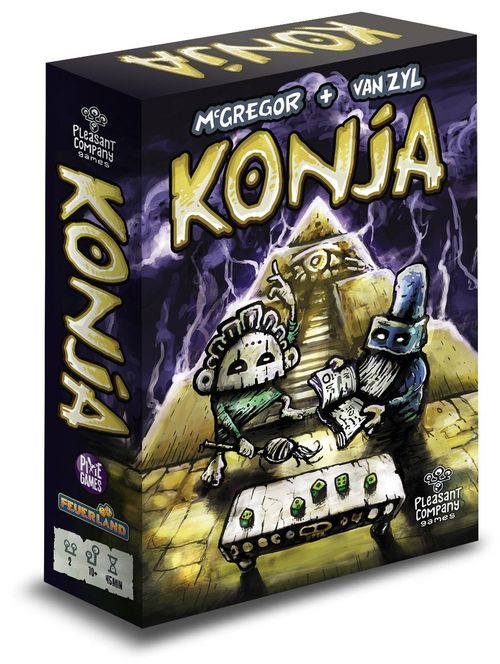
Konja
Konja Rulebook
Table of Contents
Table of Contents
Components
- 18 Relic cards
- 22 Spell cards
- 5 green dice
- 2 red dice
- 2 violet dice
- 2 white Action dice
- 27 Cloud tokens
- 5 Idols
- 5 Ancestor tiles
- 1 Summoning Pyramid
- 27 Gold tokens
- 18 Magick tokens
- 18 Power tokens
- 1 Spirit token
- 1 First Player marker
- 1 rulebook, 1 overview sheet
Setup
- Place the Summoning Pyramid and the 5 Ancestor tiles in the middle of the play area.
- Place the Spirit token on the tile of the Spirit Ancestor.
- Each player receives: three Spell cards; two tokens of each resource: Gold, Magick and Power; the Relic cards Fie-Ah, Ooodoo and At!
- Place the 5 Idols next to the Ancestors.
- Divide the Cloud tokens into piles of 3, 5, and 7 points.
- The player who most recently stood in pouring rain begins the game; that player receives the First Player marker, the five green dice, and the two white Action dice. Now Konja can begin!
- Shuffle the Relic cards to form a Relic deck. Lay out three Relic cards face-up in a row to form the Offering.
- Place the remaining Magick, Power, and Gold tokens, along with the violet and red dice, within reach of both players.
- Shuffle the Spell cards to form a Spell deck.
Turn Structure
Each round in Konja proceeds in three phases. One player carries out all three phases before the next player takes their turn. The three phases are: Ancestors, Bones, and Collection.
Ancestors — In the Ancestors phase, the active player places an Idol on a free Ancestor tile and thereby receives that Ancestor's Favour for this round. Both players also receive that Ancestor's Blessing. Favour and Blessing grant bonus actions: gaining resource tokens, exchanging Gold tokens for Relics or Clouds, learning new Spells, or recharging spent Relic cards.
Bones — In the Bones phase, the active player rolls five green dice and two white Action dice, and forms dice combinations from them with the help of Relic and Spell cards — single high numbers, pairs, three or more dice showing the same number, or three or more dice in a consecutive sequence.
Collection — In the Collection phase, the other player may attack the active player's dice pool. The active player then exchanges their final dice combination, according to the Summoning Pyramid, for Power, Magick, Gold, or Cloud tokens. Finally, any unused Action die showing a resource symbol may be exchanged for a matching resource token.
Ancestors
- (If every Ancestor tile has an Idol on it, remove all Idols.)
- The active player takes an Idol and places it on an Ancestor tile.
- The active player receives the Ancestor's Favour.
- Both players receive the Ancestor's Blessing.
Every turn begins with the active player asking for the Favour and Blessing of an Ancestor by placing an Idol on that Ancestor's tile. The active player receives the Ancestor's Favour. Both players then receive the Ancestor's Blessing.
The Ancestors become angry if one of them receives more attention than the others. For this reason, you cannot receive the Favour of an Ancestor if there is already an Idol on its tile. As soon as every Ancestor tile has an Idol on it, remove all the Idols at the start of a turn.
Spirit Ancestor
This Ancestor recharges Relic cards. Relic cards become spent once they have been used, and may not be used again until they have been recharged.
Favour: The active player takes the Spirit token (even if the other player currently holds it). You may spend the token at any point during your turn to recharge one of your Relic cards.
Blessing: Each player recharges all of their Relic cards.
Resource Ancestor
This Ancestor grants resource tokens.
Favour: The active player chooses one resource type: Magick, Power, or Gold.
Blessing: Each player receives two resource tokens of the chosen type.
Spell Ancestor
This Ancestor grants new Spell cards.
Favour: The active player may discard any number of Spell cards.
Blessing: Starting with the active player, each player who holds no more than two Spell cards in hand may draw Spell cards until they hold three cards in hand.
Merchant Ancestor
This Ancestor grants Relics when Gold tokens are sacrificed to it.
Favour: The active player may sacrifice Relics. Discard any number of Relic cards and receive their exchange value in Gold tokens (shown in the top right-hand corner).
Blessing: Starting with the active player, each player may first sacrifice one Gold token to remove a Relic from the Offering and deal a new Relic in its place. They may then spend Gold tokens equal to the cost (shown in the top right-hand corner) of a Relic to take that Relic from the Offering into their own play area, dealing a new Relic to the Offering in its place.
A player may not hold more than five Relics. If you ever hold more than five Relics, you must immediately discard one.
Rain Ancestor
This Ancestor summons Clouds when Gold tokens are sacrificed to it.
Favour: The active player may sacrifice Gold tokens to upgrade a Cloud they have already summoned (flip it to its reverse side). Upgraded Clouds are worth more points. It costs 2 Gold to flip a 3-point Cloud to its 4-point side, 1 Gold to flip a 5-point Cloud to its 6-point side, and 1 Gold to flip a 7-point Cloud to its 9-point side.
Blessing: Starting with the active player, each player may sacrifice Gold to summon a Cloud. A larger sacrifice of Gold results in a more valuable Cloud: 5 Gold for a 3-point Cloud, 8 Gold for a 5-point Cloud, and 11 Gold for a 7-point Cloud.
Note: If the active player summons a Cloud as part of the Blessing, they cannot immediately upgrade it, since the Blessing is carried out only after the Favour.
Bones
- The active player rolls five green dice and two white Action dice.
- You may play Spell and Relic cards in any order, using the appropriate combination of Action dice, Power tokens, and Magick tokens.
Green Dice
These six-sided dice show the numbers 1 to 6. They are used to form combinations of pairs, runs, three-(or-more)-of-a-kind, and single high numbers. These dice earn players resources and Clouds.
Action Dice
These special dice are blank on three sides. The other three sides each show one resource: Magick, Gold, or Power. Their main purpose is to activate players' Relic cards. At the end of a player's turn, an unused Action die showing a resource may be exchanged for a matching resource token.
Spells
Spells are cards with immediate effects, played by spending Magick tokens equal to their cost (shown in the top left-hand corner of the card). The Spell card's effect is carried out immediately, after which the card is discarded.
Each player begins the game with three Spell cards in hand and can refill their hand through the Spell Ancestor. The only two ways to get rid of an unwanted Spell card without having to play it are using the Favour of the Spell Ancestor or playing the Chaac! Spell card.
Unless the card text says otherwise, a Spell card's effect is carried out only by the active player, during their Bones phase.
Relics
Relic cards grant effects that can be used again and again.
Relic cards with the exhaustion symbol become spent once used (turn them 90 degrees to show this). Spent Relic cards may not be used again until they are recharged by the Spirit Ancestor's Blessing or the Spirit token.
Relic cards with the Action die symbol additionally require an Action die to carry out their effect (place the spent Action die on the card to show this).
Violet Dice
Players gain violet dice through Relics and Spells. Even card effects do not allow violet dice to be rerolled.
Collection
- The opposing player may roll red Attack dice to attack the active player's pool of number dice.
- Dice combinations may be used, according to the Summoning Pyramid, to gain resource and Cloud tokens.
- Any unused Action die showing a resource may be used to gain a matching resource token.
Red Dice
The opponent may roll red Attack dice to attack the active player's dice pool. A red die that beats one of the active player's dice (shows a higher number) may be used to remove that die and replace it with the red die. If a red die is not used in this way after being rolled, it is ignored.
Summoning Pyramid
Dice combinations may be exchanged to gain resource tokens and to summon Clouds. The Summoning Pyramid shows the dice combinations required:
- A single die showing a 4 or higher may be exchanged for one Power token. These tokens are needed to strengthen the effects of Relic cards.
- A pair may be exchanged for two Magick tokens. These tokens are needed to activate Spell cards from your hand.
- Three or more dice in a consecutive sequence (e.g. showing 3, 4, and 5) may be exchanged for that same number of Gold tokens. These tokens are sacrificed to the Ancestors to gain Relic cards or Clouds.
- Three dice showing the same number may be exchanged for a 3-point Cloud.
- Four dice showing the same number may be exchanged for a 5-point Cloud.
- Five dice showing the same number may be exchanged for a 7-point Cloud.
White Dice
Finally, any unused Action die showing a resource symbol may be exchanged for a matching resource token.
End of Game
If a player holds Cloud tokens worth at least 21 points at the end of their turn, the final round is played. Continue the game until both players have taken the same number of turns. The player with the most points wins.
Variants
Shayka — Red Dice Variant
You may agree to play a non-confrontational game without attacks from the red Attack dice. As a further variant, the red dice may instead be activated by the active player on their own turn. The active player may likewise roll the red dice and replace a die showing a lower number in their own dice pool with a red die. If you play with this variant, both players must use the red dice in the same way.
At the start of the game, flip the Oodoo Relic to its Shayka side to show this.
Bigga Storm — Long Game
You may choose to play a longer game. For a longer game (over 60 minutes), it is recommended to play until a player has accumulated at least 30 or more Cloud points at the end of a round.