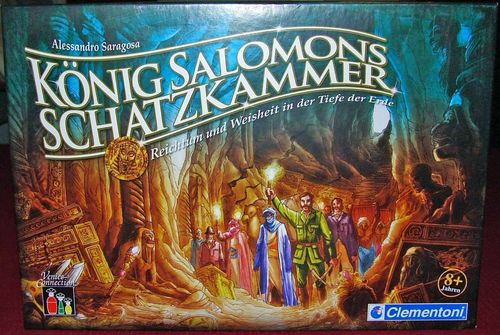
König Salomons Schatzkammer
König Salomons Schatzkammer Rulebook
Table of Contents
Table of Contents
Content
- 1 plastic board, representing the mythical King Solomon's mines; the spaces are the quarries where the players dig.
- 32 digging cards, numbered 1 to 32; the cards represent digging areas and have an orientation that you recognize putting the arrow in the same directions as the mine's entrance on the board (the stairway).
- 40 coins
- 5 screens; inside each screen there is a summary of some rules: the powers of the magic objects, the symbols on the parchments, the bonuses.
- 144 tiles (36 with a back and the remaining with another one) that the players dig; they represent:
- 55 treasures (yellow background), worth 1 to 5.
- 34 curses (black background): African Masks (worth 1), Jade Scorpions (worth 2) and Mummies (worth 3).
- 38 Knowledge Parchments (white background): there are 4 kind of parchments, distinguished by 4 different symbols.
- 17 magic objects (light blue background); there are 4 kind of objects, each with a different power: Queen Sheba's Mirror, Samson's hair amulet, flying carpet, Solomon's seal.
- The rules
Preparation
-
Put all the tiles face down on the table, divide them accordingly with the back and mix separately the 2 groups. First you arrange the bigger group (white back): you pile up randomly 3 of these tiles at a time and place each pile face up in a quarry of the board. Then you add randomly one tile of the smaller group (grey back) face up in each quarry of the board. At the end you have 4 tiles face up in each quarry.
-
Each player is given a screen, which he opens before him: here he can keep all his stuff secretly.
-
Each player is given 10 coins (8 if you play in 5).
-
Shuffle the digging cards and distribute face down:
- playing in 2: 12 cards each
- playing in 3: 8 cards each
- playing in 4: 6 cards each
- playing in 5: 5 cards each
The remaining cards are discarded from the game, keeping them face down. We strongly suggest to always keep your cards in the correct orientation!
The game
The game consists in as many turns as the digging cards distributed to the players (12 turns in 2, 8 turns in 3 and so on). Each turn has 2 phases:
- the choice of the digging card
- the digging
1) The choice of the digging card
Each player chooses secretly one of his digging cards and put it face down beside the board. When all the players are ready, the cards are turned face up. The numbers on the cards determine the playing order in the following digging phase: the player with the lowest number will play first, the one with the second lowest number will play second and so on.
2) The digging
Digging means taking the topmost tiles from the quarries on the board accordingly with the shape shown on the digging card; as there are 4 tiles piled up in each quarry, you can dig in one of the 4 different levels.
You dig in turn, starting from the player who entered the card with the lowest number and then going up with the numbers. When in turn, you dig, respecting the following rules:
- you dig accordingly with the shape shown on the card (which has to be correctly oriented); this shape can be anywhere on the board: in other words you can dig any group of tiles which form on the board the same shape represented on the card;
- all the tiles you take have to be at the same level;
- you must take all the tiles included in your shape.
You are not forced to dig; if you can't dig (for example you can't find on the board a group of tiles with the correct shape at the same level) or if you don't want to dig (for example you think it is not convenient for you), simply you don't dig and discard your card.
Attention: you can never dig in an empty quarry, so an empty quarry can never be part of a digging area.
Moving the tiles before digging
Before digging you are allowed to make some movements, in order to realize a more convenient digging area. Each movement consists in taking the topmost tile of a quarry and move it atop an adjacent quarry (vertically, horizontally or diagonally); a tile can be moved to the same level or to a lower level, but can never be moved to an higher level (never move uphill!)
You can make as many movements as you like, with the same tile or with different tiles, but each movement has to be paid at the end of the turn (see "Paying movements and curses"). When you finish your movements, if you like, you can dig, that is you indicate to your opponents the area you are about to dig (a number of quarries matching the figure on the digging card) and collect the topmost tile in each of these quarry.
Figure note: the central tile could be moved on the spaces indicated by the arrows. It cannot be moved on the other spaces because it's not allowed to move uphill. Note that you can move at the same level (A) or in a lower level (B) or even on a empty quarry (C).
The tiles
The tiles you collect are seen by all the players (they are all face up), but as soon as you put them behind your screen, nobody will see them again. Let's see the meaning of the different tiles, so you can decide which ones you prefer to dig.
Treasure-tiles. All these tiles have a yellow background and represent treasures, which are worth 1 to 5 coins (accordingly with the number on the tile). In other words the treasures are "money", as well as the coins you get at the beginning of the game; for example a treasure worth 3 corresponds to 3 coins. During the game you can spend your money for payments (see "Paying movements and curses") and at the end of the game all your money (treasure and coins you still have), will be counted as victory points.
Curse-tiles. All these tiles have a black background and represent curses it happens to meet while you are digging. And the curses cause accidents, escapes of diggers and other problems which cost you money to be solved; in other words when you collect a curse-tile you have to pay for it accordingly with the value written on the tile (see "Paying movements and curses"). These tiles are kept behind your screen as well as the other tiles (see "End of the game").
Parchment-tiles. All these tiles have a white background and represent 4 different parchments, with 4 different symbols; the single tile is worth nothing, but if you have the whole collection of the 4 parchments with 4 different symbols, you reach the knowledge (see "End of the game").
Magic-tiles. All these tiles have a light-blue background and represent the magic objects, which are legendary and very precious and give to the owners strong advantages. When in turn, a player can spend a magic tile (collected in a previous turn) to perform a special actions, which normally is not allowed; the used tile is then discarded. The following are the 4 magic objects and the respective powers:
- Queen Sheba's Mirror: using this tile you are allowed to orient the digging card as you prefer.
- Example: in the first illustration there is a possible digging area matching the digging card. It's not really a good area because it includes only a parchment and 3 curses. Using the mirror, you are allowed to orient the digging card as you prefer; for example you can choose the much better digging area indicated in the second illustration.
- Flying carpet: using this tile you are allowed to dig in different levels (but accordingly with the shape of the digging area and never in an empty quarry).
- Example: starting from the situation of the previous example, entering the flying carpet instead of the Queen Sheba's mirror, it is possible to dig tiles from different levels. The red-stricken area is an example of a good digging area composed by tiles in different levels.
- Solomon's seal: using this tile you are allowed not to respect the digging shape; in other words, you can use any shape you like with the same number of quarries represented in your digging card; all the quarries have to be connected (either vertically or horizontally or diagonally) and obviously have to be in the same level.
- Example: it's your turn, you have the card number 32 and the situation of the board is the one in the figure. There aren't 6 tiles at the same level matching the card's shape, so if you want to dig you would be forced to make lot of expensive movements. If you have the Solomon's seal, and you play it, you can modify the shape of your card as you like. For example you could dig the 6 tiles as in the figure, collecting 4 different parchments, a 5 points treasure and a Sheba's mirror.
- Samson's hair amulet: using this tile you are protected against the curses, so you don't have to pay for the curses you are digging in that very turn.
You are also allowed to spend 2 or more magic tiles in the same turn, combining the powers; for example you use both the Samson's hair necklace and the Flying carpet, you can dig in different levels and not to pay for the curse tiles you are collecting as well.
Paying movements and curses
After digging, the player in turn has to pay the movements he eventually did before digging and the curses he eventually collected (Important: movements have to be paid even if after the movements the player decided not to dig). The player adds up the number of movements he accomplished and the value of the collected curses (that is, the number - 1 to 3 - written on the tile); the total has to be paid using treasures and or coins; you can't dig if you have not enough coins/treasures to pay but you can also pay with the just dig treasures. If you pay with a tile with a bigger value, you can take back the change (in coins or smaller tiles). All the tiles (and coins) you use for payments are discarded beside the board, as well as the used digging cards.
Example: the player in turn has the digging card number 15. He would like to collect parchment β and δ, therefore he decided to make 3 movements in order to prepare a digging area with tiles at the same level. He moves as shown in the first figure obtaining the result shown in the second one. The first movement was lucky because the tile under the moved one is a 5 points treasure, the other movement isn't so lucky because a 2 points scorpion is revealed. Anyway the player decides to dig in any case. He collects the 5 tiles, stricken in red, 2 treasures, 2 parchments and a Jade Scorpion. Now he has to pay his digging, 3 points for the movements and 2 for the scorpion, 5 points in total.
Illegal moves: If you move the tiles and dig and then you realize you don't have enough treasures/coins to pay, this is illegal. In this case you pay nothing, but the tiles you've collected are randomly distributed to your opponents (you put the tiles face down and they pick one randomly and then they show to everybody). If there are more tile than opponents, the redundant ones are discarded; if there are more opponents than tiles, you add the lacking tiles choosing among the ones you've collected in the previous turns.
End of the game
When all the distributed digging cards have been used, the game is over and you add up:
- the number of your coins;
- the value of your treasure tiles;
- 10 points for each collection of 4 different parchment-tiles, if you have any;
- the bonus for the biggest curse-tiles collection. Those damned objects have in fact a great archeological value, so at the end of the game the player who has the biggest collection will get an huge 24 victory points bonus and the player who has the second biggest collection will get a 12 victory points bonus. To measure the collection you simply add up the values written on your curse-tiles; in case of a tie you share the bonus. Exception: if the second biggest collection doesn't reach half of the value of the biggest one, it doesn't get the 12 points bonus. For example if the first is worth 29 and the second 13, the player with the first gets 24 victory points and the player with the second gets nothing.
- the bonus for the magic-tiles collection. The magical objects are very powerful so you are tempted to use them, but on the other hand these tiles have a great archeological value as well: at the end of the game the player who has more Magic-tiles will get a 16 victory points bonus and the player who has the second biggest number of tiles will get a 8 victory points bonus (providing he has at least half of the tiles of the first one). In case of a tie you share the bonus.
The total corresponds to your victory points; the player with more victory points is the winner.
Final score example
The bonus for the best magical objects collections goes to Bruno who kept 5 tiles. Bruno gets therefore 16 victory points. Anna has the second best collection but she gets no points because her collections is composed by only 2 tiles that is less than half of the 5 of Bruno. This means the 8 points for the second best collection of magical objects is not assigned.
The bonus for the best curses' collection is given to Carlo and Davide. Carlo has a total value of 16, Davide has the same value. They are in a tie (even if the number of tiles is different), so they share the bonuses for the first and the second best collection, 24+12=36, that is 18 points to Carlo and 18 to Davide. (The source text says "Bruno" here, an evident slip; the score table gives the 18 to Davide.)
Anna gets also 20 points because she has 2 complete collections of parchments, She has 4 tiles of a kind and 3 of another one, but they count nothing because only the complete set of 4 different tiles is worth 10 points. Bruno gets also 20 points, he has exactly 2 tiles of each kind. No points for Carlo, and only 10 points for Davide who collected a lot of useless parchment tiles.
Let's see now the final score:
| Player | Magical objects | Curses | Coins | Treasures | Parchments | Total score |
|---|---|---|---|---|---|---|
| Anna | 0 | 0 | 3 | 31 | 20 | 54 |
| Bruno | 16 | 0 | 9 | 36 | 20 | 81 |
| Carlo | 0 | 18 | 2 | 8 | 0 | 28 |
| Davide | 0 | 18 |
The winner is...... Bruno!