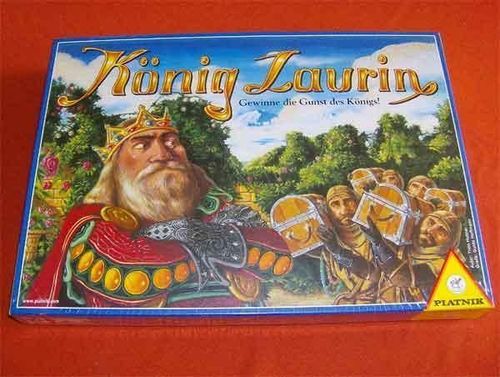
König Laurin
König Laurin Rulebook
Table of Contents
Table of Contents
Object of the Game
The game board shows the splendid garden in which King Laurin resides. The players slip into the roles of dwarves who vie for the favour of their ruler with the most valuable gifts, with the goal of buying their freedom in this way. The player who succeeds best in steering the king close to his dwarves laden with treasures can hand over the most gifts and wins the game.
Components
- 1 game board
- 1 King Laurin (figure)
- 1 king's crown (start player marker)
- 1 obstacle
- 30 movement cards, in movement values 1, 2 and 3 (5 horizontal and 5 vertical for each value)
- 54 treasure cards, in values 1, 2 and 3 (18 of each)
- 24 spell cards, 4 cards each in 6 kinds
- 30 dwarves (double-sided: light front, dark back) in 5 player colours, 6 dwarves per colour: values 1/1 (3x), 3/2 (2x), 5/3 (1x)
- 5 counting stones in the 5 player colours
- 5 colour markers in the 5 player colours
- 5 overview cards (double-sided, with round and spell overview)
- 1 rules sheet
On the board, the light green points are the dwarf fields (Zwergenfelder) and the dark green points are the king's fields (Königsfelder). The numbered row along the bottom edge (1–16) is the scoring track (Wertungsleiste). The board is numbered around its outer edge from 1 to 50.
Setup
The game board is laid out in the middle of the table. The King Laurin figure is placed on the dark green circle in the centre of the garden.
Movement cards, treasure cards and spell cards are shuffled separately and laid out as three face-down draw piles next to the board. During play, played cards go onto three separate discard piles, sorted by type, next to the board. If a draw pile runs out during the game, the corresponding discard pile is shuffled and used as the new face-down draw pile.
Each player receives an overview card, chooses a player colour and places the colour marker in that colour in front of them as identification. They then place their counting stone on the corresponding start field of the scoring track (Zählleiste) and receive the 6 dwarves of their colour. The obstacle is placed beside the board.
With 5 players, each player receives only 5 dwarves: each player sets aside their 1/1 dwarf, which stays out of the game.
The youngest player is the start player in the first round and receives the king's crown.
Course of Play
The game is played over several rounds. After each round, the start player passes clockwise.
Sequence of a Round
Each round consists of 6 phases, always carried out in the same order:
- Deal treasure cards
- Buy spell cards
- Deal movement cards
- Place dwarves
- Move dwarves
- Bid king's moves
Explanation of the Phases
1. Deal Treasure Cards
At the beginning of each round, starting with the start player and going clockwise, each player draws 3 treasure cards face down from the corresponding draw pile and takes them into hand. At the start of the game (the first round), each player instead receives 4 treasure cards as starting capital.
2. Buy Spell Cards
The start player draws as many spell cards from the corresponding draw pile as there are participating players and lays them face up next to the board.
Beginning with the start player and going clockwise, each player may now decide whether to acquire one of the face-up spell cards or to forgo a purchase. The price of a card, in treasure cards, is shown in the upper left corner. If a player pays with higher-value treasure cards than the price, they receive no change back in treasure cards. Spell cards left over at the end of the phase are placed on the corresponding discard pile.
Examples:
- Michael is up and has 2 treasure cards of value 3 in hand. He wants the face-up Mix-up Spell (Verwechslungszauber), which costs 2 treasures. Michael must give up a 3 and overpay.
- Claudia has 3 treasure cards of value 2 in hand and is speculating on the Magic Haste (Magische Hast), which costs 3. If she wants that spell card, she must pay with two cards of value 2.
3. Deal Movement Cards
The start player takes from the face-down movement card draw pile as many movement cards as there are participating players. They look at the cards and give each player, including themselves, one card. Each player places their movement card face up in front of them.
Same directions: If the start player draws movement cards that show exclusively vertical or exclusively horizontal king moves, they place these on the movement card discard pile and draw again.
Meaning of the symbols on movement cards:
- The point value, which may not be exceeded when placing dwarves.
- The maximum number of dwarves that may be moved.
- The direction and number of fields the king moves.
Note: The king's move shown on a movement card is not necessarily carried out by the player who holds that card. The king's moves are bid for separately later with treasure cards (see phase 6).
Movement directions: a horizontal move is West–East (waagrecht); a vertical move is North–South (senkrecht).
4. Place Dwarves
According to the number in the upper section of their movement card, each player, beginning with the start player and going clockwise, may place dwarves from their supply, front side (light) up, on any free light green fields of the garden. The number on the movement card is the maximum number of points that may be used when placing dwarves; the points shown on the front of the dwarves are counted. A player may also forgo placing dwarves entirely.
Example: Claudia's movement card shows a "7" in the upper section. She may place, for example:
- (1) dwarves 1, 3, 3 = 7 points, or
- (2) dwarves 5, 1, 1 = 7 points, but also
- (3) dwarves 1, 1, 3 = 5 points.
5. Move Dwarves
Beginning with the start player, each player may take at most as many of their own dwarves from the game board as are shown in the middle section of their movement card, and place them again, with the same side up, on empty fields. A player may also forgo moving dwarves.
Example: Claudia may take up to 2 of her own dwarves from the board and place them anew.
6. Bid King's Moves
The king's moves shown on the movement cards are now bid for, and the king is moved accordingly. After each move of the king, the dwarves adjacent to the king are scored.
Auction: The right to select and carry out one of the king's moves is auctioned. Only one bidding round is played per auction. The start player begins and places the treasure cards they wish to bid face down in front of them. If they do not wish to play any cards, they pass. Clockwise, the other players bid in the same way or pass. The bid cards are then revealed.
Whoever can show the highest number of treasures must choose one of the face-up king's moves and determine in which of the two possible directions the king moves. If the king would move beyond the edge of the board in one of the two directions, the player has the choice of either choosing the other direction or letting the card expire. If they let it expire, it is immediately placed on the discard pile and no scoring takes place.
In principle, it is permitted during the auction to bid fewer treasure cards than the players before. How many treasure cards a player holds in hand or bids face down must always be clearly visible to the others.
Returning bid treasure cards: Whoever wins an auction loses all the treasure cards they played into it. The other players may take back half of their bid cards (rounded down). They may choose which cards they take back.
| Cards bid | 1 | 2 | 3 | 4 | 5 | 6 | 7 | ... |
|---|---|---|---|---|---|---|---|---|
| Cards taken back | 0 | 1 | 1 | 2 | 2 | 3 | 3 | ... |
Tie: If several players have bid the highest number of treasures, the one of them who played the most treasure cards wins. If this does not decide it, the highest bidder sitting nearest clockwise to the start player wins (or the start player themselves, if they are among the highest bidders).
No bid: If no player bids any treasure cards in an auction, the start player gets the right to choose and carry out a king's move. If they forgo it, the next player clockwise has the option to choose a move; if that player forgoes it too, their left-hand neighbour may, and so on. If no player wants to carry out a king's move, all the movement cards still face up expire at once and the round ends immediately.
Scoring: After each king's move, the counting stones of the players on the scoring track are moved forward. For each dwarf that now lies directly next to the king, a player receives as many points as the visible side of that dwarf shows. Note: after the king has moved, players may, through the use of spell cards, still influence the final position of the king or the scoring itself; see "The Spell Cards".
Example: All dwarves on the four red-marked fields lie directly next to the king and are scored.
Dwarves that have been scored in this way and have their front side up are turned over, so that the back with the lower value is visible. Dwarves whose back is already up are removed from the game board and returned to their owners. They may be placed again, front side up, in subsequent rounds.
The movement card just played goes to the corresponding discard pile. As long as at least two movement cards are still face up in front of the players, further auctions follow in the same way.
Last movement card: The last king's move of a round is not bid on. The player in front of whom the movement card lies decides whether they want to carry out the move. If they do not carry it out, no scoring takes place either. The last movement card goes to the discard pile in any case.
Example of an auction phase with 3 players: Michael (red), Claudia (blue) and Susanne (yellow) are playing. Michael is the current start player and always bids first. The situation directly after the bid treasure cards are revealed is described each time.
1st auction: Michael has bid the treasure cards 3/3. Claudia has passed. Susanne has played 1/1/3. Michael, with the highest bid of 6 treasures, wins the auction and gives back all the treasure cards he bid. Susanne may take back one of her cards; she chooses the card with the highest value, the 3.
Michael may now choose one of the face-up king's moves. He chooses the move on Claudia's card and moves the king 2 fields up. He then places Claudia's movement card on the discard pile.
Scoring: Michael has two dwarves on directly adjacent fields: one showing its front with value 5, and one showing its back with value 2. Michael receives 7 points. He turns the dwarf showing 5 over and returns the dwarf showing 2 to his supply. Claudia receives 4 points for her two adjacent dwarves with fronts 1 and 3, and turns these over.
2nd auction: Michael has passed, because he speculates that Claudia will move the king in the same direction he would. Claudia has bid 3/3. Susanne has played a 2 and the 3 she had taken back in the 1st auction, hoping to outbid Claudia's two cards.
Claudia wins the auction, chooses the move on Michael's card and moves the king 1 field to the left. She then places Michael's movement card on the discard pile.
Scoring: Claudia receives 6 points and Michael 3. Claudia turns her dwarf with front 5 over to its back, and takes the dwarf showing back 1 into her supply. Michael takes back his dwarf showing back 3.
Last movement card: Susanne cannot gain any more points with the movement card lying in front of her and therefore forgoes the move. She places the card on the discard pile, and no scoring takes place.
End of the Round
Once the last movement card has been placed on the discard pile, the current round ends. Players may keep their remaining treasure cards and spell cards. The king and the dwarves remain on their fields. The next player clockwise receives the king's crown and becomes the new start player.
End of the Game
As soon as a player's counting stone on the scoring track reaches or passes 25 points with 5 players, 30 points with 4 players, or 35 points with 3 players, the current round is still played to its end, and then the game ends. The player with the highest point total has bought their dwarves' freedom and wins the game. In case of a tie, the player who first reached this point total wins.
The Spell Cards
Rules for Playing Spell Cards
- Whoever plays a spell card first may also carry out their action first.
- During each king's move, each of the spell cards C, D, E and F may be played at most once.
- Played spell cards always go to the discard pile.
Meaning of the Spell Cards
A) Magic Bind (Magischer Bann) — Price: 2 treasures
A player may not place or move dwarves.
This card may be played when a player wants to place dwarves in phase 4, or move dwarves in phase 5, and specifically before that player has moved any dwarves. The affected player may then not carry out their move in that phase.
B) Exchange Spell (Wechselzauber) — Price: 2 treasures
Exchange two dwarves of any players.
With this card, during phase 4 ("place dwarves") and phase 5 ("move dwarves"), it is permitted to exchange two dwarves of any players on the game board with each other.
C) Magic Haste (Magische Hast) — Price: 3 treasures
King Laurin moves one field further.
This card may be played after a valid king's move. No scoring takes place at first. Instead, the player who played this spell card may move the king one more field in any direction, and then scoring takes place. After the successful use of this card (that is, if no "counter spell" (Gegenzauber) was played), no "Dwarf Uprising" (Zwergenaufstand) may be played in the same king's move.
D) Dwarf Uprising (Zwergenaufstand) — Price: 3 treasures
King Laurin is forced onto a detour.
This card may be played after a valid king's move. No scoring takes place at first. The king is returned to its starting field. At a point on the path the king has just taken, an obstacle is placed, which forces the king to turn at a right angle; the player who places the obstacle decides in which direction. However, the king must first be moved at least one field in the original direction. Accordingly, this card may not be played on king's moves of movement value 1.
Example: Susanne has made a horizontal king's move of length 2 to the right. Michael plays a Dwarf Uprising. He places the obstacle and, after the king has moved one field to the right, turns the king one field up.
Diagram key: yellow = the field the king would originally have moved to; blue bar = obstacle; red = the field the king is diverted to.
E) Magic Fog (Magischer Nebel) — Price: 2 treasures
A player's dwarves are not taken into account in scoring.
This card may be played after a valid king's move. The player who plays this card may choose one player who is excluded from the immediately following scoring. That player then receives no points in this scoring for the dwarves adjacent to the king, and those dwarves are accordingly not turned over either.
After the successful use of this card (no counter spell was played), no further Magic Haste or Dwarf Uprising spell may be played in the same king's move.
F) Counter Spell (Gegenzauber) — Price: 3 treasures
The most recently played spell card loses its effect.
Whoever plays this card cancels the spell card played immediately before it. The action of that card may then not be carried out, but it still goes to the discard pile. In the same king's move, no further spell card of this kind may be played either.