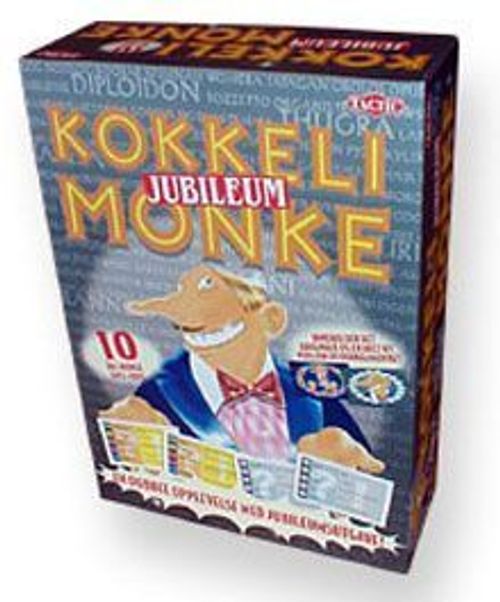
Kokkelimonke Jubileum
Kokkelimonke Jubileum Rulebook
Table of Contents
Table of Contents
- Quick Summary
- Setup
- First Half of the Round: Forward with the Explanations!
- Second Half of the Round: Time to Guess Which Explanation Is Correct!
- Points and Moving Pieces
- The Spinner
- New Round
- Exceptions to the Rules Above
- Comments and Advice for Super-Bluffers
- "Good" Definitions
- "Nearly Correct"
- Yawn! Boring Explanations!
- Uncertainties About the Meaning of Words
- Variants of Kokkelimonke
- Who Wins Kokkelimonke?
- Sample Cards
Quick Summary
- Choose one of the players to lead the game.
- The player draws a card, chooses a category, and reads aloud the word that the category indicates.
- All players write down an explanation, which sounds as credible as possible, on a slip of paper.
- If you know what the word means, write the correct answer.
- The leader writes down the correct explanation (which is printed on the card). Then all the explanations are collected (including the correct one), the slips are shuffled, and the explanations are read aloud.
- Then each player in turn says which explanation they believe is correct.
- The leader notes who guesses what on the slips.
- Points are awarded, and the game pieces are moved forward.
- If a player lands on a space with an arrow, they spin the spinner and move their piece either forward or backward.
- The player to the left of the leader becomes the new leader for the next round.
- Now a new category is chosen by looking at which space the new leader stands on. The symbol indicates the category.
- Continue until a player reaches the goal.
Setup
Preparation: Prepare for a word war!
Choose whether you will play with the yellow/orange cards or the red/green cards. Both sets of cards have five different categories.
Place the board on the table with the correct side facing up (this depends on which version you want to play). Place the cards you are playing with on the table, face down. Deal a stack of slips to each player. Everyone must have something to write with. Set the box of cards so that everyone can reach it. Each player chooses a game piece and places it on the START space. Choose who will be the leader in the first round.
Caption on the setup illustrations: the START space also works as the goal space.
First Half of the Round: Forward with the Explanations!
The leader takes the first card from the box and decides which category to use and what is to be explained. He/she reads aloud the word in the chosen category. Depending on the category chosen, the players answer questions within the following categories:
- Word (ORD)
- Persons (PERSONER)
- Film (FILM)
- Law (LOVEN)
- Initials and Abbreviations (INITIALER & FORKORTELSER)
- Technique and Abbreviations (TEKNIKK OG FORKORTELSER)
- Fictional Figures (FIKTIVE FIGURER)
- Medicine and Phobias (MEDISIN OG FOBIER)
- Food and Drink (MAT OG DRIKKE)
- Foreign Words and Expressions (UTENLANDSKE ORD OG UTTRYKK)
The other players write the assignment on a slip, then write their explanation on the same slip, with their initials at the bottom. If one knows the correct answer, they write it instead of inventing an explanation. The leader writes the correct answer on a slip.
The leader collects the slips and checks that all the answers are legible. He/she shuffles the slips and reads them aloud. The correct explanation is read out, mixed in among the others. If one of the players has delivered a correct, or nearly correct, explanation, it is set aside without being read aloud. This player does not take part in the second half of the round, but receives their points immediately.
Second Half of the Round: Time to Guess Which Explanation Is Correct!
Now the players take turns saying which explanation they believe is correct. The leader writes the players' initials in the points box on the slip with the explanation. The player to the left of the leader begins, and several players may choose the same explanation.
Points and Moving Pieces
The most sovereign explanations are rewarded!
- The player who delivered the correct explanation gets 2 points.
- Each player who chose the correct answer gets 1 point.
- Each player gets 1 point for each of the other players who chose his/her false explanation.
- If no players chose the correct explanation, or answered correctly, the leader gets 2 points.
When the points have been calculated, the pieces are moved as many steps as the points indicate. The order is as follows: first the leader moves his/her piece, and then the others move clockwise (med solen) until all players have moved their pieces.
The Spinner
When a player comes to a space with an arrow, he/she spins the spinner and moves their piece the number of spaces the spinner points to (+ = forward, – = backward). If the piece comes to yet another space with an arrow, the player does not get to spin the spinner again; instead, the turn passes to the player to the left of the leader, who starts a new round.
New Round
The player to the left of the leader becomes the new leader in the next round and begins by drawing a new card. (Except if a round is interrupted because of several correct answers or several identical explanations; then the old leader draws a new card.) Now the category is chosen, which is the one shown on the space where the new leader has his/her piece. If he/she stands on the VELG FRITT (CHOOSE FREELY) space, the leader may choose the category of the question.
Caption on the illustration: VELG FRITT-ruten (the CHOOSE FREELY space).
Exceptions to the Rules Above
- A player who has written an answer that is correct, or nearly correct, immediately gets their 2 points. The piece is moved at once, before the others guess at the explanations.
- If more than one player has delivered a correct explanation, the round is interrupted and a new card is drawn. The players with the correct answer get to move 2 points.
- If several players deliver identical WRONG explanations, the round is also interrupted. The players with the correct answer get to move 2 points.
Comments and Advice for Super-Bluffers
A player may guess their "own" suggestion, if he/she wants to be extra sly. In this way he/she can lure other players into choosing this alternative. He/she does not get points for their own choice. One may not reveal which answer one has given.
"Good" Definitions
Our goal has been to achieve as much variety as possible in the explanations of the words, from simple synonyms to long expositions. There are also standard explanations, such as "old word for...", "other name for the flower...". This applies to all the categories. We have tried to avoid overly extensive explanations, but some are quite complicated, as many players will want to meet the challenge by "explaining" these.
Feel free to be colourful in your explanations, e.g. "an old Hungarian measure for wet goods, corresponds to 0.42 l", "casual home for homeless people, with free overnight stay – the designation is outdated".
"Nearly Correct"
What is "nearly correct"? Example: "Hungarian measures". We do not know whether there is any word that fits this explanation, since we made it up ourselves; but explanations that should be treated as equal are, for example, unit of measure, Hungarian unit of measure, and measure corresponding to nearly half a litre.
Use common sense when judging. It is better to award points once too many than once too few, as overly strict judging will reduce the enjoyment of the game.
Yawn! Boring Explanations!
Explanations must be detailed, and must not contain broad concepts that allow for a range of different interpretations.
Uncertainties About the Meaning of Words
In a game like this it is very difficult to avoid the odd discussion. The respective words, persons, things and films may have more meanings than the ones we have described as the correct ones. To avoid discussions about this, only "our" definition will be considered the correct one.
Variants of Kokkelimonke
When only three or four players take part, the leader may invent a false explanation in addition to the correct one. This gives the leader the opportunity to be more involved in the game, and increases the range of choices.
If you wish, you can introduce style points. When you have calculated the ordinary points, you may vote for the most amusing, most hopeless, or most untrue explanation in the round. The winner gets one additional point.
Who Wins Kokkelimonke?
The winner is the one who first reaches the goal. We congratulate! If several players reach the goal in the same round, the winner is the first to reach the space.
Sample Cards
The rulebook's example pages show the following cards, given as question and answer:
- Hva er plimsoller? (What are plimsolls?) — Gammelt skip som ikke er sjødyktig (An old ship that is not seaworthy)
- Hvem er Astrild? (Who is Astrild?) — Kjærlighetsguden i svensk poesi fra 1600- og 1700-tallet (The god of love in Swedish poetry of the 1600s and 1700s)
- Hva er oesophagusvaricer? (What are oesophageal varices?) — Åreknuter i spiserøret (Varicose veins in the oesophagus)
- Hva er morning glory? (What is morning glory?) — En slags spinattype (A kind of spinach)
- Hva betyr sepik på estisk? (What does "sepik" mean in Estonian?) — Kneippbrød (Kneipp bread)
- Poncett — Pose fylt med kullstøv, eller pulverisert pimpestein, brukt ved poncering (A bag filled with coal dust, or powdered pumice, used in poncing)
- Robert Peary — Den første personen som har nådd Nordpolen (The first person to reach the North Pole)
- Out of Rosenheim / Bagdad Café — En ferm tysk kvinne utvikler et unikt vennskap med en irritabel, svart truckstop-eier i Arizona-ørkenen. (A capable German woman develops a unique friendship with an irritable, black truck-stop owner in the Arizona desert.)
- J.F.K. — John F. Kennedy
- Barnepensjon betales når et medlem etterlater ... — seg barn under 18 år, herunder også adoptivbarn (Child pension is paid when a member leaves behind children under 18 years of age, including adopted children.)