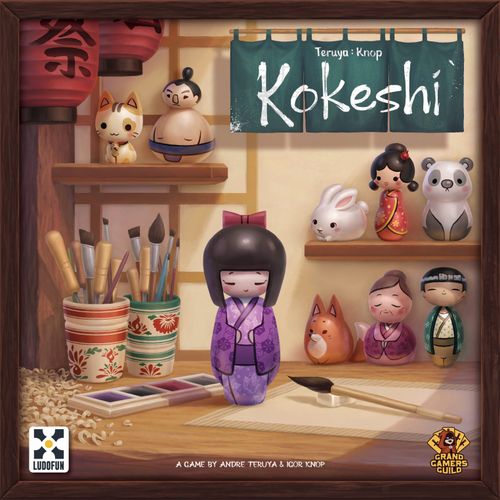
Kokeshi
Kokeshi Rulebook
Table of Contents
Table of Contents
Components
- 4 artisan workshop boards
- 1 board of happiness (front and back)
- 10x starting pieces (2 of each color, with white center bar)
- 15 quality recognition pieces (5 types with 3 scores each)
- 50 normal game pieces (10 different types in 5 colors: purple, pink, yellow, green, dark blue)
- 1 cloth bag
- 20 player discs in 4 colors (green, red, blue, yellow)
- 20 Kokeshi Meeples (4 sets of 5 types: Princess, Batchan, Fisherman, Samurai, Sumotori)
Game Objective
The objective of the game in Kokeshi is to have more happiness points, by improving the technique in the practice of making Kokeshi dolls and Kokeshi animals.
Happiness points are earned in a variety of ways, whether through quality recognition pieces, or through creating Kokeshi animals, or even through continuous practice and focused on the specialization of a particular kokeshi.
At the end of the game, whoever has the most happiness points will be the winner, but regardless, we want everyone to finish the game happier than started.
Setup
- Take the happiness board and choose which side you will play on (the side with a score that only increases or the side that score increases and decreases according to the level). Place the board with that side up in the center of the table;
- Separate and take the 15 quality recognition pieces and place them in the space reserved for them on the happiness board.
- Each player takes an artisan workshop board of a color of their choice and 5 player discs of the same color. The color of the artisan workshop board is represented in the illustration of the tool holder on its lower left side. (The basic side shows this Kokeshi on the left side.)
- Each player places a disk of their color on the starting space of the score track on the happiness board. The remaining discs are placed next to each of the animal tracks on that same board.
- Each player takes a set of 5 kokeshi, one of each type (Princess, Batchan, Fisherman, Samurai and Sumotori). Kokeshi must be placed on the starting spaces of their respective skill tracks on the players' artisan workshop boards.
- Separate the 10 starting pieces (with a white central bar) and randomly distribute 2 of them to each player. Each player places the initial pieces received on any spaces of their choice on the first row of their workshop board, respecting the placement rules (see section "Placing Pieces on the Board"). The starting pieces are placed on the first row of the tracks.
- The remaining starting pieces must be placed randomly on the animal tracks of the happiness board, as follows (according to the number of players): setup for 2 players, setup for 3 players, setup for 4 players.
- Place the 50 regular game pieces into the cloth bag.
- Randomly pick 4 pieces from the bag and place them face up in the center of the table, within reach of everyone, forming the pieces offer (from where players will take pieces during the game to place on their boards).
- The player who most recently visited Japan takes the first player marker, or chooses randomly.
You're ready to play Kokeshi!
How to Play
Clockwise from the starting player, each player takes a turn until the end-of-game condition is met.
During his turn, the player performs the following actions in order:
- Advance a Kokeshi doll on one of the skill tracks on your workshop board;
- Activate the effects of the piece on which the Kokeshi doll stopped;
- Activate cascading effects resulting from the movements performed, resolving one effect before resolving the next;
- Place the pieces acquired during the turn on the respective track of your workshop board;
- Pass the turn to the player on your left.
The pieces offer must always contain 4 pieces. Whenever a tile is purchased from the offer, the player who bought it must randomly draw a new tile from the bag and replenish the offer.
See below how each of the actions works:
1. Advance a Kokeshi
The current player chooses one of his Kokeshi to move up 1 space on the track it is on. To do this, simply move the Kokeshi meeple to the next available space on the same track.
- If there is no game piece in the space where the Kokeshi goes (the space is empty), move the Kokeshi back to the starting space of the track (the pre-printed space on the board). Then, the player in turn draws a new tile from the piece offer (see section "Putting tiles on the board") or if she is at the required minimum level, she can choose to buy a quality recognition tile.
- If in the space reached by the Kokeshi meeple there is a normal piece, activate the effects of that piece and end the movement of the Kokeshi in that space (see section "Activating Effects").
- If there is a quality recognition tile in the space reached by Kokeshi, advance the same Kokeshi meeple 1 more space up, activating other effects if it reaches a normal game tile (see sections "Activating Effects" and "Quality Recognition").
- If there is no space above available (when it is at the upper edge of the board), the Kokeshi will return to the starting space of the track, (the pre-printed space) and the player gains 3 happiness points (marking directly on the track of the happiness board).
Example 1: If the player chooses to advance the Princess, Fisherman, or the Samurai, her movement will end on an empty space (A) and Kokeshi will return to the starting space. Then that player must buy a normal game piece from the piece offer. If it's at the minimum required level, she can buy a quality recognition piece instead.
2. Activating Effects
When the Kokeshi meeple goes to a game tile, that tile's effects are activated. If the tile has 2 effects separated by a slash, resolve only 1 of its effects of your choice, placing the Kokeshi on the side of the resolved effect.
There are 10 different types of game pieces (in addition to the quality recognition pieces) with different actions, in the 5 colors of the Kokeshi, and their effects are explained below (changing according to the Kokeshi):
- Advance the Princess Kokeshi OR Advance the Batcham Kokeshi
- Advance a Kokeshi from any track to the left of this tile OR Advance the Princess Kokeshi
- Advance the Princess Kokeshi OR Advance an Kokeshi from any track to the right of this tile
- Advance the Princess Kokeshi OR Advance any Kokeshi two spaces (but only activate the second space)
- Advance any Kokeshi one space OR Advance one of the discs one space on the Animals track
- Draw a tile from the offer to place on any of your tracks OR Advance any Kokeshi one space
- Advance the Princess Kokeshi AND draws a tile from the offer to place on this track (see the "Placing tiles on the board" section)
- Advance the Kokeshi of Princess AND Advance one disc one space in the track of the animal represented in the piece
Example 2 - Activate Effects: If the player prefers to move the Batchan or the Sumotori, the Kokeshi will end up in a space that has a game piece. In the case of Batchan, if the player activates the "B" effect, it will generate the movement of the Samurai piece to the "B1" space. If the Batchan goes to the "C" space, the Princess will move to the "C1" space. In the case of moving Sumotori by activating the "D" effects, it will make the Fisherman move to the "D1" space. If Sumotori activates the "E" effects, it will make Sumotori himself move one more space, now going to "E1".
3. Activate Cascade Effects
When advancing a Kokeshi to a piece, it is possible to trigger a cascading effect, that is, an effect that results in new activations and moves.
Before starting a new action activation of a new tile, the player must first finish the activations of the current tile that result in new Kokeshi moves. That is, it is not possible for there to be more than 2 pieces being activated at the same time. Always resolve an action completely before starting another.
Example 3: the Princess advances to the green piece (A) and activates the action that makes her move again, now going to the yellow piece (B) activating the action that makes a Kokeshi movement of your choice. The player decides to move the Princess again (C) which lands on a quality recognition tile (D) (this tile was placed at the allowed level - level 3) moving the Princess again (E) to the upper edge of the board. With that, the Princess returns to the initial space (F) and the player gains 3 happiness points, marking it on the happiness board (G).
4. Putting Tiles on Game Board
Whenever a player activates an effect that makes her draw a new tile, she must choose one of the tiles available in the pieces offer and reserve it at the bottom of the same track that activated the effect, below the preprinted tile. If the purchased tile's track is complete (7 tiles), ignore this effect and do not draw a new tile for that track.
After resolving all the effects of her turn and before passing the turn, the player adds each of the reserved pieces to one of her tracks, respecting the following conditions:
- The reserved tile on a track must be placed on that same track;
- The reserved tile next to the board can be placed on any of the player's tracks, at the player's choice;
- If there is an option to place more than one piece on the same track, the player will choose the order;
- It is possible to combine reserved pieces next to the board with pieces reserved for a specific track;
- A tile cannot be added to a completed track (a track with 7 tiles already placed);
- If a tile is placed orthogonally adjacent to another tile of the same color (including pre-printed tiles), at the end of the game the player will lose 3 happiness points for each tile pair in this condition (a tile can belong to more than one pair);
Also, if the player advances with one of his discs onto one of the starting pieces available on the happiness board, he will gain that piece and will reserve it next to his workshop board. At the end of his turn, he will place the tile obtained on a track of his choice, following the tile placement rules (see the section "Placing tiles on the board").
Example 4: The blue player advances his disc on the Cat track, reaching a tile. He then takes that tile and sets it aside next to his workshop board to put it on a track at the end of his turn. If he advances one more space on the Cat track, he will gain one quality recognition on this track, just like he did on the Fox track.
5. Pass
After resolving all the effects of her turn and after placing all the separate pieces on her board, the player passes the turn to the player to her left.
Quality Recognition
The player obtains quality recognition in 2 possible ways:
- Buying quality recognition pieces; or
- Crossing the red center line with your disc on one of the animal tracks on the happiness board.
When a Kokeshi advances on a workshop board track and reaches an empty space, it returns to the starting (preprinted) space on the track. The player then chooses between purchasing a new piece from the pieces offer for that track OR buying a Kokeshi Quality Recognition piece for that same track.
To purchase and place a quality recognition piece, in addition to the restrictions of a regular pieces, the following conditions also apply:
- The purchased piece must be from the same type of Kokeshi as the destination track;
- The piece must be positioned on the track at a height equal to or greater than the level indicated on the piece (1, 2 or 3);
- Each track can only have one quality recognition piece, but it can continue to be extended normally after being recognized.
IMPORTANT: There is a dispute to be recognized in Kokeshi dolls: for each type, the last player will not be able to obtain the recognition piece. In a 3-player game, discard the third remaining tile when the second is drawn. In a 2-player game, discard the remaining two tiles when the first one is drawn.
Each quality recognition piece, in addition to being worth the points indicated at the end of the game (5, 8, or 11), has the effect of advancing the Kokeshi represented in its illustration. Quality recognition tiles can only be placed on certain spaces on the board, according to the level displayed on the tile itself (this is the minimum level of placement on the board, shown alongside the additional happiness points earned at the end of the game).
Another way to get recognition for quality is through perfecting your techniques in creating animal kokeshi. If any player discs cross the center red line on one of the animal tracks, that player will immediately gain quality recognition on that track.
Game End
The game will end when a player has his Kokeshi quality recognized 5 times (or 4 times in a 4-player game). This can be through any combination of quality recon pieces and recognitions gained from animal tracks. The game will also end if at some point it becomes necessary to replace the pieces in the pieces offer, but there are not enough pieces to do so.
When one of the game end conditions is met, players end the current round and then play one more full round.
If the game ends because there were not enough pieces to replace the pieces offer, the players finish playing the last round normally with the pieces still available. After the last round, each player calculates their final score, as exemplified on the next page.
Scoring
At the end of the game, each player calculates his score as follows:
- On each track on his workshop board, the player earns 3, 5, or 7 points if his pieces have reached the heights corresponding to those values. These points are NOT cumulative on the same track;
- Each quality recognition tile on the player's workshop board is worth the points indicated on it (5, 8, or 11);
- On each of the animal tracks on the happiness board, the player earns points according to the position of his disc. The value of each space on the track is indicated at the top of the board;
- For each animal track in which the player ended up with his disc ahead of the others, he will gain 3 additional points. If two or more disks occupy the same space, they must be stacked in order of arrival. The lowest disk is the one that arrived first and that will earn these points;
- The player loses 3 points for each pair of pieces of the same color orthogonally adjacent to each other on his workshop board (this includes the pre-printed pieces);
Add up to the marker points during the game. The player with the most points will be the winner. In case of a tie, the player with the most points in the animal track levels wins. If the tie remains, the player with the highest sum of kokeshi levels on the workshop board wins. If there is still a tie, the last player in turn order wins.
Score Example: In this example, the red player's score is: Animal Track 39 points, Victory on the Animal Track 6 points, Kokeshi Tracks 15 points, Quality Recognition Pieces 16 points, Pairs of Adjacent Pieces of the Same Color -9 points, Points during the game 2 points. TOTAL = 39+6+15+16-9+2 = 69 points.
Solo
To play Kokeshi in solo mode, use a artisan's workshop board to simulate a fictional opponent and do the normal setup for 2 players, placing the fictional player's starting pieces on the same color track as the corresponding piece.
Whenever you draw a new tile, also buy a unique tile from the bag and place it on the dummy player's board, on the same track you activated. However, if the fictional player's track level allows a quality recognition piece and that tile is still available, instead of purchasing from the bag, place a quality recognition tile on the dummy player's track.
The fictional player pieces are never activated. Whenever you or the dummy player buys a tile that has a specific animal, advance the dummy player's disc on that animal's track.
Unlike the dummy player, you can only acquire Quality Recognition parts from the second Quality Recognition level on each track.
At the end of the game, only for the fictional player, the happiness points for adjacencies between pieces of the same color will not be deducted.
The other rules follow as in the regular game.