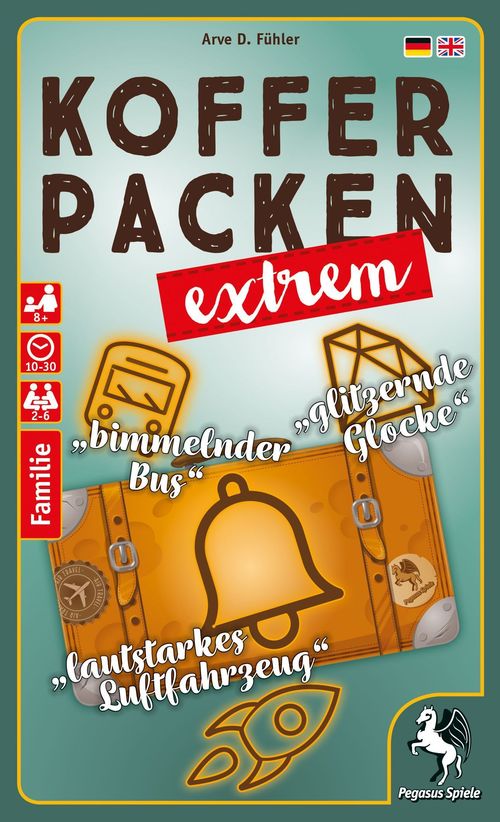
Kofferpacken extrem
Kofferpacken extrem Rulebook
Table of Contents
Table of Contents
Components
- 66 object cards (double-sided)
- 22 letter cards (double-sided)
- 6 "Pass" cards
Object cards and letter cards are double-sided; the letter cards have a coloured side and a black-and-white side. The rulebook text does not state the point value of each letter card.
Setup
- Lay out 36 random object cards in a 6x6 grid in the middle of the table. The remaining object cards can be returned to the box, as they are not needed.
- Shuffle the letter cards and lay out 6 of them in a row, coloured side up. The remaining letter cards form a draw pile. Place this pile sideways next to the row of letter cards for a better overview.
- Keep the 6 "Pass" cards ready.
- The player whose birthday was most recent is named the starting player and may begin the game.
Object of the Game
Whoever can remember all the packed items when packing the suitcase, and at the same time takes along items worth points on the trip, wins this creative memory game.
Gameplay
The starting player begins. Then you play clockwise. When it is your turn, first repeat, in the correct order, what your fellow travellers have packed into the suitcase so far. (The starting player skips this step.) You should name the items without much hesitation; otherwise the other players have the right to give you a "Pass" card. This also happens if you could not repeat an item completely and correctly (see "Pass" cards on page 4).
Then you must think of 1 item from the object cards on display that you want to take along. The following rules apply:
-
You must choose 2 object cards. You may not turn the cards over; use only the sides that are face up.
-
One card describes the item, so it is used as a descriptive word (adjective). The picture on the card should match the chosen adjective. More on choosing a suitable item on page 5.
-
The other card defines the item, so you use the card as a noun. Here too, the picture should match the chosen item. In addition, the choice of the two cards should be made fairly quickly (about 60 seconds). Otherwise the other players have the right to give you a "Pass" card. You then cannot lay out an item in this turn.
-
At least 1 of the two chosen terms must begin with the letter of a face-up letter card. Take this letter card as well. Then refill the row of letter cards to 6.
-
Say aloud what you want to pack into the suitcase. Then place the two object cards on top of each other, with the letter card on top of them. Make a separate pile for each packed item. If both terms begin with the letter on the card, place the card coloured side up; otherwise place it black-and-white side up.
Example: Nicole is the starting player. Since nobody has packed an item yet, she cannot repeat anything. Now she chooses the cards "Arrow" and "Car" and the letter card "R". Then she says aloud: "I am packing my suitcase and taking along: A fast racing car." She lays out the two object cards and places the letter card on them with the coloured side up. Now it is Chris's turn. He repeats: "I am packing my suitcase and taking along: A fast racing car," and then chooses 2 object cards from the display and uses 1 of the face-up letter cards.
"Pass" Cards
When it is your turn and you make a mistake while repeating the items packed so far, or you cannot think of an item, you must take a "Pass" card. In addition, you may not pack a new item, and the next player takes their turn.
If you cannot think of an item when thinking up one, and the other players have already waited a reasonable time (about 50 seconds), they may put you under a little pressure and slowly count down from 10 to 0. If you do not manage to pack an item into the suitcase within that time, you must take a "Pass" card, and the next player takes their turn.
End of the Game
As soon as one of you would have to take a second "Pass" card, or only 2 object cards are still on display, the game ends. Each player adds up the point values of their letter cards. Whoever has reached the most points is declared the winner. In case of a tie, the player whose letter comes first in the alphabet wins.
Simpler Variant
Lay out your card combinations face up: place the two object cards and the letter card on top of each other so that the pictures can be seen. This makes it somewhat easier to remember the correct combinations.
Rules for Inventing Items
The game lives on witty and unusual word combinations and on imagination. The items and combinations should therefore not be judged too narrowly or pedantically. However, the terms should always remain understandable.
In general:
- The illustrations on the cards may be interpreted freely, associatively and creatively, as long as a comprehensible connection to the picture can be made.
- Imaginary items may be invented. They are valid unless another player vetoes them. Otherwise another term must be found.
- Compound terms may be used.
- More than 2 individual words may be used if they are in a clear and unambiguous connection and make sense.
- Coined words are permitted if they stay within a reasonable scope and meet the criteria above.
Example: This picture could be interpreted as the following objects: forest, tree, grove, clearing, wood, forest stand, fir, pine, spruce, conifer, Christmas tree, conifer tree, pine needle, deciduous tree, oak, birch, foliage, and so on.
Or as the following adjectives: wooden, natural, grown, Christmas-like, resinous, prickly, fragrant, green, triangular, fir-shaped, needle-like, and so on.
And this picture could stand for: palette, paint, coloured, colourful, artist's palette, paint mixing board, paint splashes, artist's tool, artistic, blue, red, green, creative, painting, and so on.
A combination of these two cards could therefore be, for example:
- a black-shimmering false cypress
- a spruce-green spectrum of colour
- a colourful spruce grove
- a blue blue fir
Be creative!