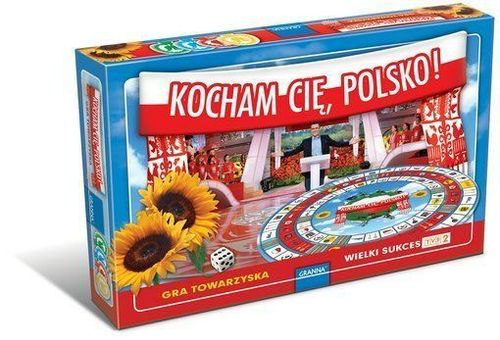
Kocham Cię, Polsko!
Kocham Cię, Polsko! Rulebook
Table of Contents
Table of Contents
Components
- Board
- 90 cards
- 4 pawns
- 4 pawn stands
- 32 tokens
- 4 bridges (kładki)
- 1 hourglass (klepsydra)
- 1 die
- Rulebook
Goal
The winner is the player who collects 6 tokens and is the first to reach the field with the KOCHAM CIĘ, POLSKO! fan scarf.
In truth, in this game the most important thing is not to win, but simply to play and to spend time together in a fantastic way!
Setup
Board and Pawns
Unfold the board. Place the pawns in the plastic stands. Let each player choose the colour of their pawn. In the corners of the board, on the coloured cut-outs, place as many pawns as there are players or teams taking part in the game. The game can be played by 2, 3 or 4 people or teams. Therefore, wherever these rules say "player", it means a single player or a team, depending on the situation.
Warning! If children take part in the game, make sure that every team includes an adult.
Hourglass Tokens
Before each player, place two hourglass tokens (żetony z klepsydrą).
Cards
Sort the cards and place them in two piles beside the board: one pile of green cards and one pile of blue cards. (Always lay the cards blue side up and red side down.)
Question cards: the blue side of these cards shows the questions; the red side shows the answers to those questions.
Category Icons
What do the pictograms printed on the cards mean?
- [Red-and-white flag pictogram] Questions in this category concern Polish history, nature, geography and tradition, as well as the biographies of great Poles.
- [Football pictogram] In the sport category you will find questions about great sportsmen, unforgettable records and great spectacles.
- [Clapperboard pictogram] Polish film school, unforgettable scenes, great actors and wonderful films: everything you will find in this category.
- [Cutlery pictogram] Polish cuisine does not have one face, the same for everyone. Many influences of neighbouring countries' cuisines are present in it, and today, given migration and the rapid flow of information, influences of even very distant flavours are visible. Regional tradition is also strong. Therefore this category may serve as an inspiration for conversations about the Polish table and as a place for exchanging culinary experiences.
- [Letters pictogram] In this category there are two kinds of commands: spell out (przeliteruj) and finish the proverb (dokończ przysłowie).
- Spell out. Prepare a sheet of paper and something to write with. It will be easier to judge whether the player spelled the word correctly when another player writes down his answer.
- Finish the proverb. Proverbs are the wisdom of nations, but when they are passed on orally, their wording often changes. Sometimes a player's good answer may differ from the one on the card. The answer that will count is the one that keeps the sense of the proverb.
- [Microphone pictogram] On the blue side of the card is the instruction for which song you must sing. On the answer side you will find a fragment of that song. Be brave! Remember that anyone can sing, as Jerzy Stuhr used to sing.
Answers to questions: some answers have explanations or elaborations printed in brackets, in smaller type. These are not information that the player must give while answering. The player receives a token when they give the content written in larger letters.
Green cards: each side of a green card has 10 tasks. The cards contain names of Polish cities, names of famous Poles, animals found in Poland and plants growing in Poland. During the game these cards are used for the charades game (kalambury).
Tokens
Place beside the board as many tokens of one kind as there are players. During the game you must collect 6 tokens.
Hourglass, Die and Bridges
Place the hourglass, the die and the bridges beside the board.
Course of the Game
Establishing the Order
Each player rolls the die. The player who rolls the most pips begins the game (if there is a tie, the tied players roll again). That player places their pawn on the START field. From then on, starting with this player, all players take their turns in turn, clockwise.
Turn
The first player rolls the die and may move in either direction, by as many fields as the die shows. The player stops on a field marked with a category pictogram. The player to the right draws one blue card from the deck and reads the question marked with that same category pictogram. (The printed rules show these pictograms only as icons; the category is the one shown on the field where the player stopped.) If the player answers the question correctly, they receive the token of that category.
If this player lands again on a field with the same category pictogram, they no longer need to answer a question from that category.
If the player does not give a correct answer, then the next time they land on a field with that category pictogram, they receive a question from that category. The card from which the question was asked is set aside on a separate pile.
Hourglass Rescue
Each player has two hourglass tokens at their disposal. When the player lands on the clapperboard (film) field, and they know that their knowledge of film is modest, they may use the chance and exchange the question for the tasks on a green card.
If you play in teams, the player must set the 60-second hourglass. The player begins presenting the tasks from the card, e.g. describes each city in turn, until the team guesses which city is meant. If the player sees that the players are not answering, they may then move on to the next city.
The task counts as completed when, within 60 seconds, the team guesses 5 cities.
Performing the task is different when individual players play, rather than teams. In that case, within one minute the player must say 3 sentences about each of 5 cities on the card. The order of the cities on the card does not matter.
When the player succeeds, they return one hourglass token to the supply and take from the supply the token of the film (clapperboard) category.
The player must remember that from now on they may exchange only one more category.
Bridges (Kładki)
During the game a player moves from START, which is on the largest ring, through the middle ring to the smallest ring. Moving from one ring to the next is possible only if the player has obtained a bridge (kładka). A bridge is obtained by stopping exactly on a field with a bridge. After moving to another ring, the player must return the bridge to the supply, and it must be obtained again the next time. Therefore, when planning your moves, you must also take this element of the game into account.
Note! It is not possible to stop on a field on which another player is already standing. If a player is blocked by other players on all sides, that player cannot make any move.
End of the Game
If you have collected 6 tokens, made sure that the other players also had a good time, and were the first to reach the KOCHAM CIĘ, POLSKO! fan scarf, you are the winner!