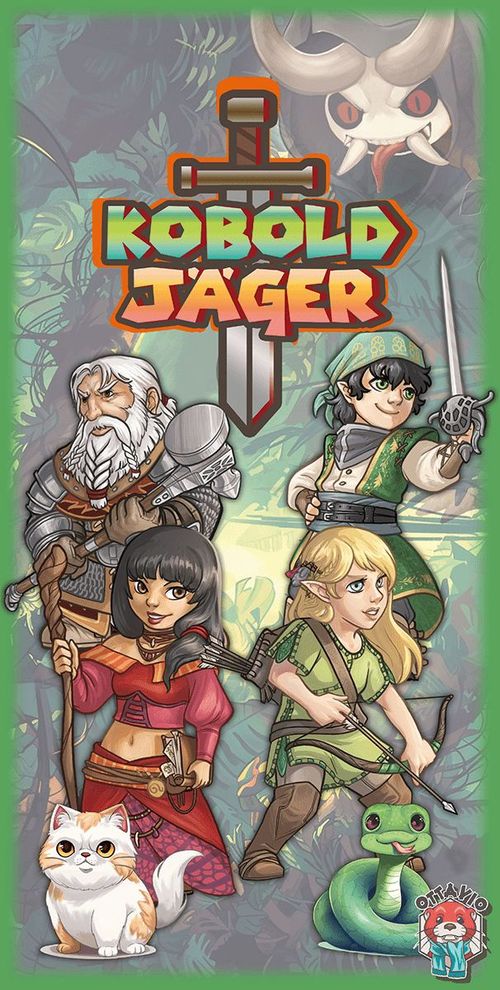
Koboldjäger
Koboldjäger Rulebook
Table of Contents
Table of Contents
Chapter 0: Carpet Fringes (Learning Adventure)
Becoming a kobold hunter takes a good measure of heroism, of course!
How does one actually become a kobold hunter? Well, a pinch of heroism is definitely part of it!
Each player first chooses a hero. The heroes to choose from are:
- Arbosch - the strong dwarf
- Carolan - the cunning thief
- Layariel - the nimble elf
- Mirhiban - the clever sorceress
Each hero comes with:
- 1 matching hero board, showing the most important information and the life point track.
- 1 hero marker showing the hero's picture. Place it on the 20 of your life point track.
- 11 action cards. Each player takes the three starting cards into hand and places the remaining cards as a face-down stack in front of them. This is your hero deck.
All cards of Mirhiban have this card back.
1) The Table Centre
Place the following in the centre of the table:
- The action board, with room for the further cards.
- The stamina cards. They form the shared stamina pile.
- As many fate cards as there are players.
- The dice.
2) The Check
A check lets your heroes prove how heroic they really are.
The check is the most important part of this game, so it is essential that you understand how it works.
To make a check, take a die and roll it. Try to roll as high as possible: the higher the number, the better for your hero.
Your hero also contributes to success through their skill value. Since the hero's best skill is the one being tested, you add the "+3" shown next to it. This means you may add +3 to your die result.
Example: Arbosch has a +3 in his best skill, Crafts. Arbosch's player rolls a 5. Very good! She adds the +3 to the rolled 5 and reaches a total of 8.
Each hero rolls in turn, and then you compare your totals. The results table is your guide: compare your total with the number ranges on the left side of the table to find out where your hero lands.
-
If your total is 6 or higher, your hero has a success.
-
If your total is 5 or lower, your hero has a failure.
-
6+ Success: By Phex, that knocks you off your feet! You are a natural talent. Take one fate card from the centre of the table.
-
1-5 Failure: Hm, unfortunately that did not go well. Next time it will surely be better!
Congratulations! You now know how a check works, and your heroes have made their first check. You will meet checks like this again and again in your adventures.
3) Fate Cards
The path of a hero is very strenuous and demanding, but the twelve gods of Aventuria accompany you on your journey and stand by you helpfully.
Some of you will probably have received a fate card. So what do you do with it now?
If you have a fate card, you may use it at any time to re-roll any die roll, including a roll made by another player or by an opponent. After that, return the fate card to the centre of the table.
You receive fate cards whenever the adventure tells you to, or whenever a player defeats an opponent.
If you are supposed to receive a fate card but none remain in the centre of the table, you get nothing. So it does not pay to hoard fate cards. You have to spend them too!
4) The Brawl
Look for the adventure cards named "Carpet Fringes". The name is printed at the bottom of the card. Place the cards you found in the centre of the table. For the beginning you only need the leader "Carpet Ghost".
You always start a brawl with the cards that have the word "Starting card" (Startkarte) in the top right corner. These cards are your hand cards. Shuffle the remaining action cards of your heroes and place them as a face-down stack, the hero deck, in front of you.
At the beginning of a brawl, each of you draws 2 stamina cards from the shared stamina pile and places them in front of you.
Before play can begin, choose one of you as the starting player. This player receives the starting player card. In this introductory adventure, this should be the eldest or most experienced of you, so that the others can learn from their example.
5) Round Start
Your heroes now begin their first round.
Tip: In this first brawl, it is best to play with open hand cards, so the experienced players can help you.
At the start of the brawl, these cards are in front of Mirhiban.
6) Round Sequence
The starting player goes first and may carry out, in any order, as many of the actions listed here as they like:
- Play out action cards (see step 7).
- Activate action cards (see step 8).
The player keeps carrying out actions until they no longer wish to, or until all their cards are exhausted and all their stamina has been used up.
After that, the player to the left of them takes their turn, and so on until every player has had one turn. Then your opponents act, which we explain in step 10.
7) Playing Out Action Cards
To play out action cards, you must always pay the cost of the card with the stamina in front of you. The cost of a card is shown in the circle in the top left (e.g. 1).
To pay stamina, turn the corresponding number of your stamina cards on their side. This is called exhausting and is shown with the exhaust symbol. Exhausted cards cannot be used again in the current round!
After paying the cost, place the action card in front of you. This shows that the card is now in play from then on.
Example: Mirhiban's card "Ignifaxius" has a 1 in a circle in the top left. It therefore costs 1 stamina to bring this card into play. As shown in the illustration, the player turns one stamina card on its side and then places the card "Ignifaxius" face up in front of her.
8) Activating Action Cards
You may activate your played cards at any time while it is your turn. Carry out the effect shown on the card.
Some cards have the exhaust symbol at the bottom of the card text. This means that you may use the card once per round by turning it on its side. The card is thereby exhausted. You may then use the game effect printed on the card.
9) Attacking Opponents
It is a brawl, so now you may thrash your opponents!
To do so, you must first activate an action card that allows you an attack, for example "Ignifaxius" of Mirhiban. Its card text reads:
Exhaust: Attack: Die +1 Damage.
To activate it, the player exhausts the card and may then carry out the card's effect. The die symbol means that she determines the damage with a die roll, and she may then add the bonus that follows it.
Example: Mirhiban's player has Ignifaxius in play and wants to attack with it. She exhausts the card "Ignifaxius" and then rolls one die, getting a 3. She adds the +1 bonus. The total is therefore a 4.
The damage symbol stands for "damage". The total result rolled is therefore the damage dealt to the opponent.
Next, choose an opponent (leader or minion) as the target of the attack. If this opponent has a 1 or higher next to their armour symbol on their card, they wear thick armour that absorbs part of the damage. Reduce the damage by the armour value of the opponent.
The card "Ignifaxius" is exhausted.
Mirhiban rolls a 3.
The remaining damage is placed on the opponent's card as damage markers.
Example: Mirhiban deals 4 damage and chooses the "Carpet Ghost" as the target. It has an armour value of 2 on its card, so the 4 damage is reduced by 2 and 2 remain. Carolan's player therefore places two damage markers on the leader's card.
Some cards cause heroes or opponents to lose life instead of receiving damage. When someone loses life, it cannot be reduced by armour. The points are subtracted directly.
As soon as the damage on an opponent's card equals or exceeds the opponent's life point value (heart symbol), you have defeated that opponent. Place the opponent's card aside. The hero who defeated the opponent always receives a fate card as a reward.
Carry out your turns in order and fight your first round against the Carpet Ghost. When everyone has had a turn once, return here and read on to see how the opponent can act.
10) Opponent Actions
When the last hero has finished their turn, the opponents now take their turns.
You quickly realise that the ghost cannot simply be chased away. Fortunately, Kawif has an old magic lamp at his stall. If you guess the correct spell, or find the note with it among the clutter of the market stall, you can trap the ghost. Unfortunately, the ghost now also summons a minion to help it.
Shuffle the stack of minion cards face down. You can recognise minion cards because they are printed sideways. Draw a random card from it and place the minion next to the leader.
The leader always carries out its actions first, after the heroes. Then the minions carry out theirs, one after another from left to right.
Minion cards.
Damage markers are placed on the opponent.
A leader has as many actions as there are heroes taking part in the game. Each minion, on the other hand, always has exactly one action.
One player rolls one die for each action of an opponent, and then you look up the result in the action table on the opponent's card.
Example: The players roll a 4 for the minion "Charlatan Woman". The action table of the minion has the entry "4-5: Nothing: waves the magic wand." This means that this opponent does nothing this round. Lucky!
For each opponent action, it is shown which hero the opponent targets:
- "A hero of choice": One of the heroes must volunteer as the target. If no one volunteers, a random hero is determined. A hero may also volunteer for whom the action has no effect. For example, if the opponent makes a hero of choice discard a hand card and remove it, a hero with no hand cards left may volunteer. Then the opponent's action has no effect.
- "The starting player": The hero of the current starting player is the target.
- "All heroes": Every hero is the target.
If the opponent's action is an attack, you roll the damage exactly as for the heroes. The player then reduces the life points of their hero by the damage. To do this, they move the markers on the hero's life point track.
If a hero's life points drop to 0, they are immediately stunned and can no longer take part in the brawl. However, some card effects can restore life points to them, and as soon as their life points are above 0 again, they take part normally once more.
If all heroes are stunned, you lose the brawl. The game then immediately continues in the adventure text at "Defeat".
Now carry out the actions of the leader "Carpet Ghost" and its minion before you continue with the next section.
11) The Time Scale
Now look for the time cards numbered 5 to 1 and form a draw stack from them, with the numbers ascending so that the 5 lies on top. Decide whether you want to play the difficulty "Beginner" or "Pro", depending on how strong you feel. Look at the first time scale card, number 5, and carry out the effect of the difficulty you chose.
Note: The effects for the "Beginner" and "Pro" difficulties are referred to on the time-scale cards, but their text is not part of the rules text in the source document and is not reproduced here.
From now on, at the end of each round, once all heroes and opponents have carried out their actions, draw the next card from the time stack.
For all further brawls you should lay out the time stack at the very start and choose a difficulty.
12) Hero Action
During a brawl, not only is there fighting. Your heroes may also perform cool actions that help them in the brawl. These cool actions are called hero actions. In the current brawl the hero action is "The Spell". At the beginning, place twice as many markers on each hero action as there are players taking part. Place the hero action "The Spell" in the centre of the table and place on it twice as many markers as there are players.
Hero actions are strenuous for the heroes!
Whenever your hero is to carry out a hero action, you must first exhaust 1 stamina card. In addition, each hero may carry out a hero action only once per round!
A hero action always involves a check against a skill named in the card text. As explained in step 2, the player rolls one die and adds the skill value of their hero to the result. If the total of the check for a hero action is at least 6, it has succeeded and you may take one adventure marker from the card. With a result of 5 or less, nothing changes.
At the bottom of the card text of a hero action, it is explained what happens when no adventure markers (crossed-swords symbol) remain on the hero action.
As soon as a player removes the last adventure marker, the game effect named there applies immediately. From the next round on, you can also carry out the hero action "The Spell".
The adventure markers are placed on this card.
The hero action card "The Spell":
- "In all this confusion you must also find the spell! Or do you even guess it?"
- Check: Wildnisleben (wilderness life) (search for the spell) or Wissen (knowledge) (riddle) [part of the card text is obscured in the scan].
- "If no adventure markers remain on the card and the Carpet Ghost is defeated, you have won."
13) The Next Round Begins
The first round is over and the next one begins.
At the start of each round, the player holding the starting player card passes it to the player on their left. This player is the new starting player for the new round.
In addition, each of you carries out the following steps:
- Ready all your exhausted cards. Turn the cards that are on their side upright again. The cards no longer count as exhausted, and you may use them normally again until they are exhausted again.
- Draw 2 action cards from your hero deck and take them into hand.
- Draw 1 stamina card from the shared stamina pile and place it in front of you.
As before, the starting player now begins their turn, then the other players clockwise, then the opponents, and so on.
14) Victory?
To win a brawl, you must fulfil the condition that the adventure text tells you. In this brawl, for example, you must defeat the Carpet Ghost and find the spell to win the brawl. Read on below once this has happened. Until then, play one round after another, repeating steps 6 to 14.
15) Victory or Defeat
If all your heroes are stunned, you suffer a defeat and must continue reading under "Defeat". If, on the other hand, you find the spell and defeat the Carpet Ghost, you may read on under "Victory".
Defeat:
The wild rug takes you in a stranglehold. In time your friend, the dishevelled master wizard Siebenpfeiff, arrives and puts an end to the ghostly mischief. But you are rather worn out and must recover first.
Return your heroes to the state they had at the very beginning of the adventure and try again straight away!
Victory:
You beat the carpet until it collapses groaning to the floor. The evil ghost emerges from the carpet, and you quickly banish it with the words "Subito Geisterbann, gefangen bist du von nun an!" into the magic lamp, so it can cause no more trouble. Off with the creature into your secret kobold hunter hideout under the barn on Aunt Alrike's farm. You all did a great job together!
You may play this learning adventure as often as you like if you want to practise the rules again.
You have completed your first adventure!
Reset your life points to the maximum, return the stamina cards and fate cards to the centre of the table, take the starting cards into hand and shuffle your hero deck. Follow these steps in future at the start of each new adventure. Continue with your next adventure, "Alrik's Liberation", in the adventure booklet.