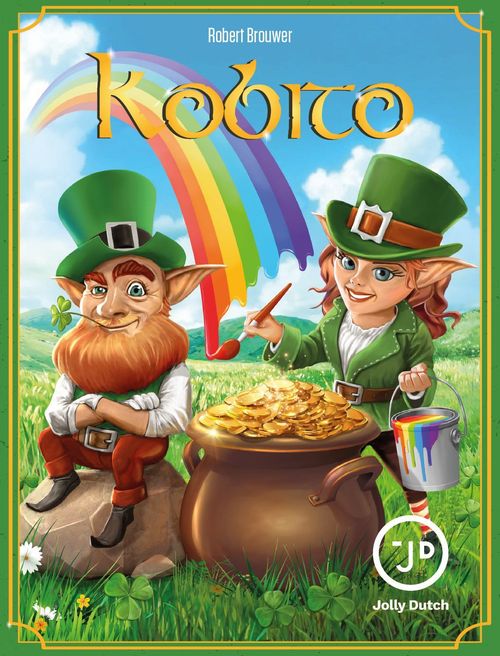
Kobito
Kobito Rulebook
Table of Contents
Table of Contents
Components
- Gold cards (18x)
- Rainbow cards (84x)
- Kobito cards (5x)
- Replacement cards (3x)
Setup
- Shuffle the rainbow, kobito and replacement cards together into a (face down) rainbow draw deck.
- Shuffle the gold cards and place the three top cards face up in the middle of the table. The remaining cards form a (face down) gold draw deck.
- Place one card from the rainbow draw deck face up next to each of the gold cards, this is the starting card for its rainbow. Note that this card may not be a kobito or replacement card. If it is one of those, shuffle that card back into the deck and draw a new starting card.
- Pick a dealer. Have the dealer give every player five cards from the rainbow draw deck.
- The player left of the dealer starts the game. After that, play continues clockwise.
Player Turns
In their turn, players must play at least a certain amount of cards from their hand: one plus one card per rainbow in their personal studio. They can play more than this number. Each player can have a maximum of four rainbows in their personal studio. Should a player have all four, they would be obliged to play five cards from their hand in their next turn. Players refill their hand to five cards at the end of their turn.
Example: three rainbows in the personal studio at the start of a player's turn means they have to play at least four cards from their hand.
Rainbow Rules
Players can connect one or more cards from their own hand to any rainbow (in the middle of the table or in a studio). Whenever cards are added to a rainbow, these rules must be followed:
- The rainbow must remain an unbroken sequence.
- It is possible to connect rainbow cards to both sides of a rainbow.
- The 12 and 1 are consecutive numbers.
- A rainbow next to a pot of gold may not become longer than needed.
- It is not allowed to take cards back into a player's hand, except kobito cards.
If a player is not be able to play at least the amount of rainbow cards they are obliged to use from their hand, they must place the cards they can't play onto a personal score pile. This is also where they keep their won gold cards. Every rainbow card in the personal score pile subtracts three points from the player's score at the end of the game.
Personal Studio
Players can start new rainbows in their personal studio at any moment during their turn.
- To start a new rainbow in their personal studio, a player must play at least two consecutive rainbow cards from their own hand.
- Rainbows within the personal studio cannot – as long as they remain in the personal studio – be combined with each other or connected with each other.
Connecting to Gold Cards
Players can – at any time in their turns – connect cards from their hand and cards from their personal studio to rainbows next to a gold card, as long as the rainbow rules are followed. When connecting to rainbows next to gold cards, these rules apply:
- If a player only uses part of a rainbow from their personal studio, they can only use cards from the outer edges of the rainbow. They then also need to ensure that the remaining rainbow in their personal studio still follows the rainbow rules and consists of at least two rainbow cards.
- It is not allowed to take cards from the middle of a rainbow in a personal studio if that results in splitting the rainbow into two or more rainbows.
- Players may distribute all cards from one personal rainbow among multiple gold card rainbows.
- It is not allowed to connect more cards to a rainbow next to a gold card, than the required number of cards indicated by the gold card.
- Note that moving cards from the personal rainbows to the gold rainbows does not count as playing cards from hand.
Kobito Cards
Kobito cards can be used as jokers; they can represent any rainbow card. Players cannot play a kobito card to create a situation where it's not clear what number it represents. In their turn, players can exchange a kobito card anywhere on the table for a rainbow card from their hand if this is the exact number the kobito card represents. Since this is an exchange, it does not count towards the minimum number of cards a player has to play in their turn. This exchange is the only case where a player can interact with another's personal studio.
Replacement Cards
Replacement cards can never be played by themselves; they always must be combined with a rainbow card. If a player has a rainbow card in their hand that is the exact same number as a rainbow card anywhere on the table, they may place the replacement card on top of the rainbow card on the table, with the rainbow card from their hand on top again. This does not count as changing the rainbow in any way, it is simply a way to let players play more cards from their hand to avoid penalties and/or draw more cards via replacement.
Gold Cards
A player wins a gold card by ensuring the attached rainbow is exactly the correct length. The winning player moves the card to their personal score pile. The completed rainbow is discarded to a discard pile next to the rainbow draw deck.
A new gold card is drawn and turned face up on the spot that opened up. A new starting rainbow card is drawn and turned face up next to the new gold card, (again redrawing and reshuffling in case of a kobito or replacement card).
Should the rainbow draw deck run out, shuffle the discard pile into a new rainbow draw deck.
Game Ending
The game ends as soon as there are only two gold cards available to win (so when the gold draw deck is empty and one more gold card is won).
All players add up the points from their gold cards and subtract three points per rainbow card in their personal score pile. The player with the most points wins.