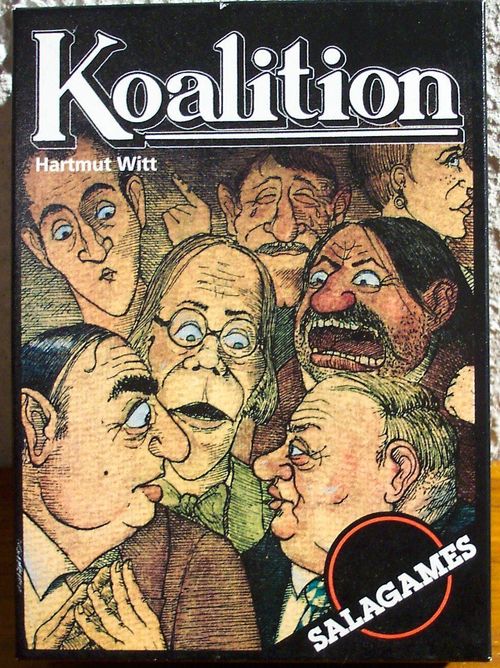
Koalition
Koalition Rulebook
Table of Contents
Table of Contents
Components
- 60 politician cards
- 5 joker cards
- 20 action cards
- 15 country cards
- 10 overview cards (double-sided)
- 1 scoring pad
- 1 rules sheet
The overview card lists the different parties with their number of politicians and their respective vote value. Below it are the 5 joker cards and the 20 action cards. The other side lists the 15 EU countries with the number of politicians each player-manager may field in the election in that country.
The country cards show, for each country, the number of politicians each political manager may deploy in the election in that country and which extra bonus the "chairmen" of the participating parties receive.
The election country currently being played lies face up in the middle of the table. The other cards lie face down in a stack.
The politician cards show the name and the associated party of the candidate and his vote value. The symbols at the bottom indicate with which parties coalitions may be formed.
Joker cards are only played as a politician in a normal round of the election in a country. A joker is simply a politician that the player plays of their choice. So they are not extra. A joker is not an action card.
When such an election candidate is played, the player must declare their party choice. That choice is kept for the rest of the elections in this country.
Action Cards
Action cards are played against or for any politician, at random (only the white vest card is played for a politician). When a player plays a politician, an action card may also be added to it (on any politician). If this is the case, an action round has started and everyone may only join in with an action card. Passing is of course allowed. If no more action cards are played, the next player (after the one who led with the first action card) continues by playing a politician card. Every player must lay a politician.
a. Doubling of votes (double cards, 1 per party): If this card is laid on any politician, the votes of the party to which that politician belongs are doubled at the end of the election. Note: in the contest for the party chairmanship, submitted double votes do not count. These are party votes after all (the chairman becomes the player with the most candidate votes).
b. Removing the party chairman (skull cards): A player may remove a party chairman: they lay a card on an arbitrary candidate (for example, the one who currently has the most votes). That politician is silenced. He drops out entirely and his votes disappear. The politician who now has the highest vote value climbs to the highest party post. He may in turn be removed in the same way. Note: repeatedly playing the removal card on the same candidate is allowed. The party chairman can after all be placed back in his chair with the white vest card. A skull card may also be placed on an egg card.
c. Resignation (fried egg cards): An elected politician (who lies on the table) may be forced to give up his mandate: he is half covered with this action card. His votes are not lost, however. He is still part of the party but must, for dark reasons, withdraw (for a while). Note: such an omelette can be placed on a politician only once per election (per country).
d. Party scandal (sausage cards): A player may entangle a party in a dirty scandal, which costs it half of its votes in this country's election (the number of votes for this party is halved at the end in this country). To make clear which party is meant, this card is laid next to the party chairman who is in power at that moment. Note: this can happen to each party only once in each election.
e. Whitewashing (white vest card): A forced resignation, withdrawal or party scandal can be whitewashed with this card and dismissed as a nasty smear campaign. The negative consequences are deflected. The accused may refer to their pure souls and clean consciences. This card counters the fried egg, skull and sausage cards. They are placed on top of them and everything is as it was before.
Object of the Game
The player-manager who, in at most 15 European country elections, has acquired the most influence and bonus points has won the game for power.
Each politician (each card) earns one influence point for its player-manager, provided that, at the end of the elections, the politician belongs to a party of the coalition. Of course, the governing parties must win more votes than the opposition parties.
Influence points (the number of politician cards of a coalition party) are therefore usually divided among several manager-players. More important, however, are the bonus points: at the end of the election in a country, it is determined who has the most party votes, and that player becomes chairman (chair). If the chairman belongs to the strongest coalition party, the player receives a greater bonus for this chairmanship than when it concerns a chairman of the second or of an even smaller participating coalition party. This is stated on every country card. In a larger country, the chairman of the strongest party weighs more heavily than in a smaller country, with a greater bonus for the player concerned as a result.
The bonus points are thus graded from 1 to 4 according to the size of the country and the strength of the party, and they decide the game.
The number of politicians that may be played per election is limited for each manager, per country, to a minimum of 2 and a maximum of 4 (also stated on the country card).
The action cards that manipulate the election and power struggle, however, are unlimited. Each manager may (indeed) play an action card at will, of course only if they still have one in their hand.
Game Setup
Each political manager receives an overview card.
The politician cards are shuffled carefully and dealt among the player-managers according to the table below. The same is done with the 25 joker and action cards.
The remaining cards are kept face down.
The country cards are shuffled well and likewise placed face down in a stack to one side.
| Number of players | 3 | 4 | 5 | 6 | 7* | 8 | 9* | 10 |
|---|---|---|---|---|---|---|---|---|
| Politician cards | 20 | 15 | 12 | 10 | 9 | 7 | 7 | 6 |
| Action cards incl. joker | 8 | 6 | 5 | 4 | 3 | 3 | 2 | 2 |
| Minimum number of rounds | 3 | 3 | 4 | 5 |
* Hint on the distribution table: with 7 or 9 players, one can play with 63 politician cards if the 3 lowest joker cards (each of value 5) are added. The 2 remaining joker cards then stay out of the game.
Start of the Game
Who begins is determined as follows: anyone who likes to be in charge and wants to decide how everything happens puts themselves forward as candidate for the election of the game leader. The vote is taken by raising hands. Whoever is elected becomes chairman of the EU elections (game leader).
The game leader makes sure that the election result is correctly recorded on the scoring pad. He also appoints the starting player for the first country election. He turns over the top country card and reads out how many candidates each player may field in this election and what the value of the chairman's bonus is.
The player who obtains the most power points (influence cards of politicians + party-chairman bonuses) at the end of this election opens the next country election and plays first. If 2 players have an equal number of points, all power points gained up to that point are added up per player. The player with the most power points always opens the next country election.
Course of Play
After the starting player has turned over the country card, he plays a politician card and lays it in front of himself on the table so that all managers can see who his candidate is. Then the others, clockwise, each lay a candidate in front of themselves on the table.
However, after his candidate has been moved forward, each manager may play an action card, on any politician lying on the table. If this happens, play continues with action cards only (passing is also allowed). If nobody plays any more action cards, the next player (the one next to the player who played the first action card) continues by laying a politician card on the table. The others follow, with or without an action card. When an action card is played, only action responses are made until a unanimous pass. Then the next politician is laid on the table, and so on until each player has the prescribed number of politicians lying on the table (for politicians, passing is not allowed).
Once the action cards that one wishes to play are also lying on the table, the voting round in this country is over. The votes are counted and recorded on the scoring pad, the work of the game leader.
Election Result
The EU election chairman (game leader) takes action. He counts the votes of each party. All other political managers act as witnesses at the count. The chairman records everything on the scoring pad in the section for the relevant country (upper table).
After the count of all party votes, it is checked whether there is an absolute majority (namely 1 vote more than half of the votes, rounded).
If a party obtains the absolute majority, which rarely happens, it forms the government alone and coalition talks are unnecessary.
The Party Chairman
If, however, 2 or more votes short of a government, coalition talks must be held with the party chairmen who are in office at that moment. The player who has the highest number of votes for a party lying on the table in front of him acts as chairman of that party, provided that he is not involved in some doom scenario (e.g. a skull card) and has not been knocked off his throne.
In case of a tie, the single politician card with the highest votes decides.
Very exceptionally, if the cards are equally divided and two players stand equally for the highest office, the party is split into two camps. Both party cliques may now negotiate for the coalition independently of each other, but each brings only half of the party votes. For the party bonus they are counted as 2 small parties if they would join the coalition. If there is another player who has a politician lying from the split party, he himself determines which party (part) he joins.
Example for the party chairman (page 9):
A is chairman of Green and speaks for 6 votes. B is chairman of nobody (E has a higher individual card of Yellow). C is chairman of Rose and speaks for 19 votes. D is chairman of Black and speaks for 18 votes. E is chairman of Yellow and Red and speaks for 18 votes for Yellow and for 4 votes for Red.
The Government
Each party chairman reviews the booking and tries to persuade other chairmen into tasty government coalitions, in order to gain as large a share (power points) as possible. Getting as much of the power cake as possible in this country is the message.
In these coalition talks it is not permitted to give away the power points lawfully acquired or to receive extra ones in order to reach a deal.
Note: no more parties may be included in the coalition than are needed for the absolute majority.
To seal the government, the party chairmen symbolically shake hands.
Power Points
The chairman of the elections repeats the government agreement aloud, calculates the resulting power points (politician cards and party-chairman bonuses) obtained in this country election and records everything in the scoring pad, in the fields provided (due to the limited space and the many subsequent entries in the same field, tally marks are recommended).
Example of the distribution of power points (page 11):
An election was held in Denmark: Chairman bonus of the strongest party: 2 points Chairman bonus of the next party: 1 point Each participating party of the coalition: 1 point
Coalition: Rose and Yellow with 56 votes.
Players involved: A with 10 votes of Rose gets 1 power point for Rose. B with 14 votes of Yellow (party chairman) gets 3 power points for Yellow. C with 13 votes of Rose (party chairman) gets 4 power points for Rose. E with 9 votes of Yellow and 10 of Rose gets 1 power point for Yellow and 1 power point for Rose.
Political manager D is not involved in the coalition and goes home empty-handed.
New Elections
If no coalition is formed, new elections must be called.
Each player takes their politician cards back into hand. The joker and action cards that were played go onto the pile beside the game and can no longer be played.
New Round - Next Election
All cards played are set aside face down; politician and action cards are, where possible, separated, which makes the next dealing easier.
As long as everyone still has at least 2 politician cards in hand, a next country card is revealed. The hand cards are played for the next country election as before. Of course, you still know who becomes starting player; if not, look it up under "Start of the Game".
If the remaining hand cards are no longer sufficient (for a country, for example, 4 politicians can be deployed per player and each still has 2 politician cards in hand), then all cards are collected, shuffled well and dealt again as indicated in the table.
European Bonus
In addition to the 15 EU country elections, there is also an extra bonus at European level, which cannot be obtained directly but is calculated by the election chairman on the basis of the coalitions formed:
- The total number of power points obtained by all parties per player: in the lower table, add all points horizontally. This sum is recorded on the right in the small value table under "Sum".
- The Europe share of each party: in the lower table, add vertically the points each party has obtained in all countries. The sum is recorded at the bottom under "Europe share".
- The strongest party in Europe receives 7 extra bonus points, the second strongest 6, the third strongest 5, and so on. The weakest party finally receives 1 bonus point. In case of a tie, the parties receive the same bonus. Note all of this under "Party bonus".
- The political manager with the most power points gained within each party receives the EU bonus points: add them up and write them in the relevant "Bonus" field.
- The sum of the power and bonus points gives the final score.
Example of a final tally (page 13):
The sum of the votes for each party separately gives the Europe share. From this the party bonus points are distributed:
- Conservatives (hat): 7 points
- Socialists (rose): 6 points
- Communists (nut) and Christian Party (cross): 2 points each
- Greens (leaf) and Liberals (lemon): 5 points each
- Fascists (fist): 3 points
The party chairmen at European level at that moment were circled. Among the Liberals there are 2 chairmen, who must therefore share the 5 bonus points: both receive 2 points.
2 examples of the calculation of the total score:
Player A: 8+5+2+4+3+2 = 24 / party bonus 2+2 (5/2) = 4 / total 24+4 = 28 power points
Player C: 4+15+2+3 = 24 / party bonus 7+3 = 10 / total 24+10 = 34 power points
Game Length
Depending on the number of players, a game takes 80-180 minutes. 5-6 political managers need about 2 hours to become the most powerful in Europe.
If this is considered too long, especially with many players (7-10), one can finish sooner, after 12, 10 or 8 countries (decided in advance). Thanks to the varied selection of countries, the most imaginable election wishes can be fulfilled.
Playing Differently
Leaving out all action cards halves the length of play. "Coalition" then becomes a somewhat different game. Even so, it can also become exciting and fun. Which cards each player receives depends on chance, but the outcome is not entirely determined by it. Try it and let us know.
The country cards can also be sorted into 3 groups according to the distribution table (the country group of 4 politicians, of 3 and of 2). A packet of 3 countries is then assembled each time with one large, one small and one smaller country (in random order). This ensures that the number of hand cards fits exactly the country being played. This is mainly of interest to political strategists who like to play their puppet candidates strategically.