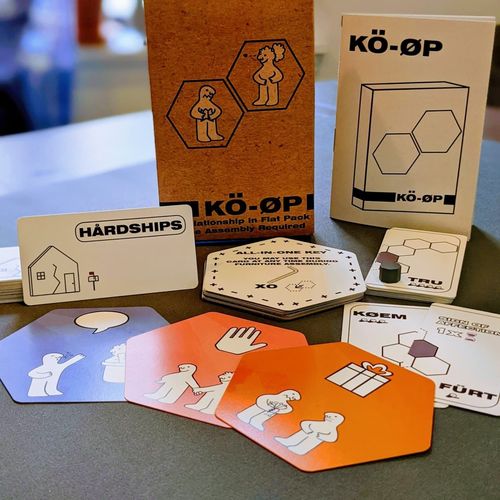
KÖ-ØP
KÖ-ØP Rulebook
Table of Contents
Table of Contents
Components
- x15 Manual Pages (cards)
- x15 Needs (cards)
- x10 Hardships (cards)
- x5 Love Language Dials
- x2 All-In-One Key (cards)
- x3 Random Bag of Parts (cards)
- x1 Knolling card
- x20 Communication cards (hex-shaped)
- x2 Guide cards
Setup
- Place the 5 Love Language Dials on the table and set all Dials to 0.
- Place the 2 All-In-One Key cards and the 3 Random Bag of Parts cards on the table.
- Place the Knolling card between the Partners on the table.
- Shuffle the remaining hex-shaped cards and set the pile with the Love Language side face down to form the Communication deck.
- Shuffle the Manual Page cards, Needs cards, and Hardship cards into 3 separate decks.
Overview
The overview diagram shows five steps: 1. Define the Relationship, 2. Picking Out Furniture, 3. Assemble Furniture, 4. Customer Satisfaction, and 5. Heart to Heart. Steps 2 to 4 are marked as "One Round, repeat 3x."
1. Define the Relationship
Reveal the top Hardship card from the deck. This is the only Hardship card you will use this game. You may return the rest to the box.
Each Hardship card represents a challenge you and your Partner are currently facing in your relationship. It also modifies the game or your Needs cards in some way.
Deal each Partner 2 Needs cards and have them secretly choose 1 to keep face down in front of them. These are the only Needs cards you will use this game. You may return the rest to the box.
Needs cards represent your personal needs, which must be met for you to feel satisfied in your relationship. During the Heart to Heart each satisfied Needs card will add 2 Meatballs to your final score.
2. Picking Out Furniture
To decide which furniture piece to get, each Partner draws 2 cards from the Manual Pages deck, chooses 1 of those cards, and discards the other.
Some Manual Page cards have additional rules that happen when you choose the card. For example, Sign of Affection immediately scores 1 Love Language, which is added to its corresponding Love Language Dial.
Each successfully assembled Manual Page is worth between 0-5 Meatballs. Meatballs are shown just below the name of the Manual Page card.
Example: These partners have chosen to build the KØEMFÜRT, which immediately scores 1 Quality Time and is worth 4 Meatballs if correctly assembled.
Chosen Manual Pages are placed together on the table to create your furniture's assembly instructions for this round.
Your goal now is to build this exact shape out of Communication cards.
3. Assemble Furniture
The Partner whose Manual Page card is on the left should now turn the Knolling card so that Steps 1 and 3 are facing them.
Each Partner should deal 3 cards from the Communication deck onto each of their Steps so that there are 4 stacks of 3 cards on the table.
Taking turns, starting with Step 1, Partners will take a stack of Communication cards and hold them so that only their Partner can see the Love Languages on the back side.
It is important that you never see the back of the cards you are holding. That information is only for your Partner.
Expressing Needs
On your turn, your Partner attempts to communicate their Needs to you by performing 1 of the following actions:
- Point at 1 Hex card in your Partner's hand and express what type of Love Language it is.
- Tell your Partner how many of 1 type of Love Language they are holding.
- Flip over and reveal the Love Language of one of the Hex cards played on a previous turn.
Once your Partner has expressed their needs, you may play as many of the Communication cards from your hand as you would like to build your furniture. It is possible to play all or even none of the cards from your hand.
The first Communication card played each round is represented by the grey hex on your Manual Pages. Mark this card with the Center token to make it easy to remember.
Once you are done playing cards, discard any Communication cards left in your hand. It is now your Partner's turn.
After the cards from all 4 steps have been played or discarded, Furniture Assembly for this round ends.
Note printed in the rulebook: When expressing needs, it is important to remember that where possible, you should avoid directly mentioning your rocky relationship. You're just trying to get this flimsy furniture built and bringing up your current Hardships won't help.
Example: if this is your partner's hand and you need Quality Time:
- Instead of saying: "This card is QUALITY TIME, which I need more of or I will leave you."
- Try pointing to the card and saying: "This new couch is so comfortable, we might spend a lot of QUALITY TIME together on it."
Playing Communication Cards
Communication cards have two sets of rules that limit how they can be assembled into your furniture: Borders and Connections.
Borders
White Borders can be placed adjacent to any other White Border. However, this does not count as a Connection.
Black Borders have either a peg (+) or a socket (-) symbol, and can only fit next to another Black Border with the opposite symbol on it.
Examples printed in the rulebook:
- Not allowed (shown with a red cross): Matching symbols cannot fit together (1). A Black and White Border cannot fit together (2 & 3). This furniture will fall apart.
- Allowed (shown with a check mark): All of these borders fit together. Connections are formed where both borders have symbols (1, 2, & 3).
Connection Requirements
Every Communication card also requires a certain number of Connections at the end of the round to stop your furniture from falling apart.
A Connection is formed wherever a border with a symbol meets a border with the opposite symbol.
Example: a card showing "X2" needs 2 Connections.
You do not need to meet a Communication card's Connection requirements when it is played. However, you must meet those needs before the end of Furniture Assembly or else your furniture will fall apart.
Note printed in the rulebook: Having trouble forming a connection? If you ever get stuck you can always grab our patented All-In-One Key. The All-In-One Key can be placed on any border, connects to any symbol, and requires no connections itself!
You'll find that ease of use and quick assembly are well worth the cost of any Compromises you may need to make later on.
Note printed in the rulebook: Some cards, like Compromise, will reduce the number of a Love Language you have. No Love Language Dial can ever be reduced below 0. If they are, your furniture is left unassembled by the ensuing argument. You score 0 Meatballs this game.
Compromise card (as printed in the rulebook illustration): "After scoring all other Communication cards, each player secretly chooses a Love Language dial. Count to 3, then point to reveal your choices. Reduce the chosen dials by 1. If both players pick the same dial, only reduce it once." Return this card to the box.
4. Customer Satisfaction
At the start of Customer Satisfaction, Partners first check if they have successfully built their furniture by creating the exact shape on the Manual Pages, and followed all the rules for Borders and Connections.
If anything is incorrect, you have failed to build your furniture this Round. You score no Love Languages or Meatballs from cards this Round. Discard the current Manual Page cards, reshuffle the Communication Deck, and begin the next Round.
If you did assemble your furniture correctly, flip over all the Communication cards on the table and add 1 to each Love Language Dial for every one of its symbols revealed. Resolve any Compromises you have in play, then reshuffle the Communication deck and move to the next Round.
Completed Manual Page cards should remain on the table so you can score them at the end of the game.
Note printed in the rulebook: Not getting what you need? We send a bag of assorted random parts you probably won't ever use with every flat-pack kit, just in case!
During Customer Satisfaction either partner may take 1 of these cards to try and dig up Love Languages they need. Be careful though, digging around too much does tend to bring up personal baggage.
5. Heart to Heart
The game ends after you and your Partner have attempted to assemble your third pair of Manual Pages.
Both Partners reveal their Needs cards and attempt to satisfy them.
To satisfy a Needs card, subtract its symbols from the Love Language Dials. Then put the completed Needs card with the completed Manual Pages. Remember to apply the Hardship card modifier before subtracting from the Dials.
If there are not enough Love Language symbols to complete your Needs card you are not satisfied in this relationship, read the bottom of your card aloud to your Partner.
You score no Meatballs from an incomplete Needs card.
Finally, tally up all Meatballs from completed Needs cards, completed Manual Pages, and any Personal Baggage cards you played. Then, head over to the cafeteria for a final assessment on the next page.
Printed in the rulebook: "Wait, so did we break up at the end of the game?" As a warning label on furniture assembly instructions, we believe we are uniquely unqualified to answer that question. Many people spend their entire lives in unsatisfying relationships. In the end, you'll have to decide for yourself when you've given enough of yourself to a Partner.
Cafeteria
Head over to the cafeteria for a final assessment, using the Meatballs tallied in Heart to Heart. The assessment table as printed:
- Fragile (0-6 Meatballs): These pieces don't even look like they belong together. Likely to fall apart at the slightest pressure.
- Temporary (7-13 Meatballs): Like dorm room furniture. Fun to have around the house in your early 20's, but not something you're committed to keeping.
- Comfortable (14-20 Meatballs): Despite fond memories, this piece may no longer fit your lifestyle. What at first you found charming, is now stifling.
- Built to Last (21-29 Meatballs): Available only through limited warranty. Terms and conditions apply. Customer satisfaction may vary. (Printed with an asterisk on the card.)
- Lifetime Guarantee (30 Meatballs): Not what you initially came here for, but what you needed all along.
Card Notes
Needs card (example shown in the rulebook): The example Needs card shows three rows, each marked x2, with Physical Touch, Words of Affirmation and Acts of Service symbols. Its bottom text reads, "Read aloud if you cannot satisfy your Needs card: We've sêtteled for each öther."
Hardship card (example shown in the rulebook): "It's Long Distance. Once a month? We can make that work. Double the number of Quality Time symbols on all Needs cards."
Love Language icons: the five Love Language Dials carry these symbols: hand = Physical Touch; gift = Gifts; speech bubble = Words of Affirmation; wrench = Acts of Service; hourglass = Quality Time.
Guide cards ("Assemble Hex Cards"): When assembling your furniture keep the following rules in mind.
- Borders: Only Borders of the same color can be placed together. Borders with symbols can only be placed next to Borders with the opposite symbol.
- Connections: Connections are formed where 2 Borders with symbols meet. Connection needs are checked during Customer Satisfaction.
All-In-One Key card: You may use this card at any time during Furniture Assembly. It can be placed on any border, connects to any symbol, and requires no connections itself (X0).
Random Bag of Parts card: You may take this card at any time during Customer Satisfaction. When you do, add 1 to any Love Language Dial. Then, turn this card over.