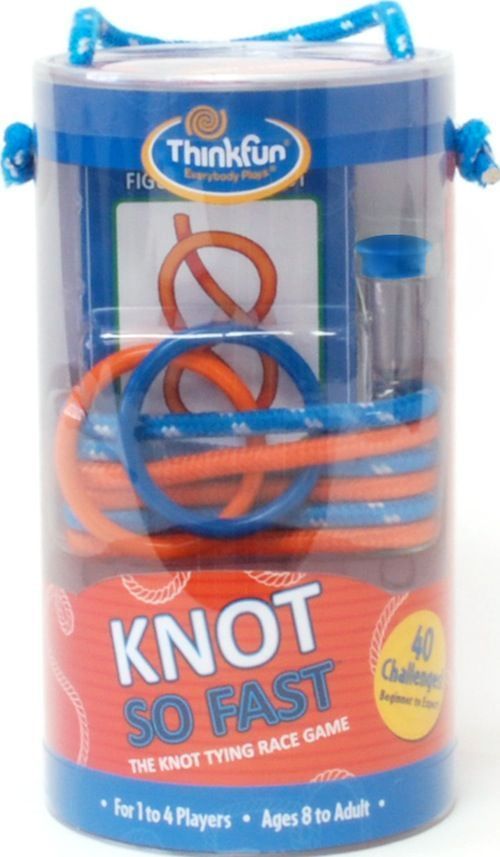
Knot So Fast
Knot So Fast Rulebook
Table of Contents
Table of Contents
Components
- Tug-o'-War Scorekeeper
- 4 Ropes: 2 blue and 2 orange
- 4 Rings: 2 blue and 2 orange
- Deck of 40 Challenge Cards
- 30-Second Timer
You will need pencil and paper to keep score in Non-Team Play (not included).
Team Play (2 or 4 players)
If you have 3 players, refer to "NON-TEAM Play" rules.
Goal
The first team to pull the Tug-o'-War Scorekeeper all the way to its team's side WINS!
Setup
- Divide into two teams: the Blue Team and the Orange Team. Give each member of the Blue Team a BLUE rope and an orange ring. Give each member of the Orange Team an ORANGE rope and a blue ring.
- Place the deck of challenges within easy reach of all players. The first few times you play Knot So Fast, we recommend playing the challenges in numerical order (from Beginner to Expert). Once you're familiar with the game, you may want to shuffle the deck and play the challenges in random order, or choose a small group of cards and play only those until you master them.
- Place the Tug-o'-War Scorekeeper between the two teams and set the Tug-o'-War rope to the middle. (Diagram label: 4 notches on each side.)
To Play
- Draw the top challenge from the deck, and place it in the Tug-o'-War Scorekeeper. Make sure the blue knot illustration is facing the Blue Team.
- All players race to tie the knot pictured on the challenge card. Teammates can verbally help one another to solve a challenge, but they may not manipulate one another's ropes.
- The first team to finish (the Calling Team) calls out "Finished!" and flips the 30-second timer. To finish, all players on a team must have completed their knots. Once the timer has been flipped, players on the Calling Team can no longer make adjustments to their knots.
- The Opposing Team now has 30 seconds to finish tying their knots.
- When the 30 seconds are up, both teams check one another's knots. A team calls out "Knot So Fast!" if they think the other team has tied one or both of their knots incorrectly, and then inspects the knots for accuracy. (Diagram labels: Correct; wrong; wrong.)
- Score the round. (See "Team Play Scoring" below.)
- Use the Scorekeeper by pulling the Tug-o'-War rope gently towards you until you hear a click. Then, adjust the rope to the correct marking. One click per point!
- Draw the top card from the deck to begin the next round.
- Play continues until one team pulls the Tug-o'-War Scorekeeper all the way to its side and wins the game!
Team Play Scoring
The Calling Team Receives:
- 2 points: if both of the Calling Team's knots are correct and the Opposing Team cannot complete its knots in the extra 30 seconds.
- 1 point: if both of the Calling Team's knots are correct and the Opposing Team is able to complete both of its knots in the extra 30 seconds.
- 0 points: if the Opposing Team finds that either of the Calling Team's knots are tied incorrectly.
The Opposing Team Receives:
- 2 points: if either of the Calling Team's knots are incorrect, regardless of whether the Opposing Team's knots are correct. (This is a penalty against the Calling Team for calling "Finished!" incorrectly.)
- 0 points: if the Calling Team's knots are both correct.
NON-TEAM Play (2, 3 or 4 players)
Goal
The first player to score 8 points is the WINNER!
Setup
- Place the deck of challenge cards within easy reach of all players.
- Place the Tug-o'-War Scorekeeper so that all players can easily see the challenge card displayed.
- Each player takes a rope and a ring (opposite colored rope from ring). The players take a seat, where they can clearly see the challenge card.
- You will need pencil and paper to keep score (not included).
To Play
-
Draw the top challenge from the deck and place it in the Tug-o'-War Scorekeeper.
(Note: If some players have more knot-tying experience than others, use the "Level the Playing Field" rules in the Play Variations section.)
-
Players race to tie the knot pictured on the challenge card.
-
The first player to finish tying the knot (the Calling Player) calls "Finished!" and flips the 30-second timer. The other players then have 30 seconds to try to complete their knots.
-
When the 30 seconds are up, players should check the Calling Player's knot to make sure it is correct. A player calls out "Knot So Fast!" if he/she thinks the Calling Player has tied the knot incorrectly.
-
Score the round. (See "Non-Team Play Scoring" below.)
-
A new card is drawn to begin the next round.
-
The first player to get 8 points wins the game!
Non-Team Play Scoring
The Calling Player Receives:
- 2 points: if the Calling Player's knot is correct and Opposing Players cannot complete their knots in the extra 30 seconds.
- 1 point: if the Calling Player's knot is correct and at least one other player is able to complete the knot in the 30 seconds.
- 0 points: if an Opposing Player finds that the Calling Player's knot is tied incorrectly.
The Opposing Players Receive:
- 2 points: if the Calling Player's knot is incorrect, regardless of whether the Opposing Players' knots are correct. All Opposing Players will get these points. (This is a penalty against the Calling Player for calling "Finished!" incorrectly.)
- 0 points: if the Calling Player's knot is correctly tied.
Knot So Fast Play Variations
If you are finding that one player wins all the time or the game is lasting too long, you may want to try some of the following game play variations.
Short Game
When teams are evenly matched, Knot So Fast games can last a long time, with teams pulling the Tug-o'-War rope back and forth in the middle. If you want to specify exactly how long the game will last, make a rule to play with a set number of challenge cards. The team that leads when the last card is played is the winner.
Level the Playing Field
Some players are naturally better, or have more experience, at tying knots than others. To level the playing field, have each team or player use their own challenge cards rather than having everyone competing to tie the same knot. Split into teams, make an assessment of relative strengths, then divide the challenge cards into two sets: easier challenges for the weaker team and harder for the stronger team.
Include only challenge cards that you want to play, you don't need to use the entire deck. When you play, put both challenge cards into the Tug-o'-War Scorekeeper back to back so that each team can see its selected challenge. All other rules stay the same.
Number of Challenges Selected
You may select as many or as few challenge cards as you wish for a given game. Some players prefer to play with only a few knots and to tie them again and again, while others like to be surprised with a new challenge each round. A great way to practice and master a knot is to choose only 4 or 5 challenges that are rotated throughout a single game. You will be surprised at how much faster you'll get at tying each knot!
Practice, Practice, Practice
Don't wait for a friend to play Knot So Fast with you! Playing through the challenges on your own will give you a leg up when you're playing competitively. Once you're familiar with all of the knots, use the timer to see if you can master them in 30 seconds or less!
Number of Times to Play Each Challenge
If you've read this far, you probably already know the answer to this! When you play Knot So Fast, you are practicing how to tie a wide variety of knots drawn from all the major knot categories. So play Knot So Fast as much as you can; you should play each challenge LOTS of times!
Notes about Knots
Knots may be the earliest tools invented by humans. We created knots using plant fibers to help make clothes and to hunt using spears and arrows; early sailors were masters at knot tying, (they needed to be to survive.) Virtually all knots were invented by people using reasoning and craftsmanship to create a new tool that could be deployed to perform a specific task.
When you play Knot So Fast, you are affirming a very human drive. You are using your hands together with your brain to create a tool. It's really fun, and it's really powerful!
Knots Categorized by Function
We have chosen the Knot So Fast challenges from five major categories. To identify which category a knot belongs to, look on the challenge card for the icon.
Stopper Knots
Stopper knots are usually used to stop a rope from slipping through a hole. They are also used to prevent the strands at the end of a rope from fraying, to weight a rope or to provide a handhold. They are usually tied at the end of a rope, although some can be tied in the middle.
Bindings
Binding knots are used to keep a rope from slipping or releasing its hold too easily, such as when tying up parcels. Avoid using a binding knot to join two lengths of rope or to tie a rope to an object, since the knot is likely to come undone under strain.
Bends
A bend is used to join two lengths of rope together, lengthening the principal rope. For most bends, the ropes need to be of equal thickness to tie a secure knot. A few bends are suitable for joining ropes of different thickness. A good bend can be easily untied, even after being put under considerable strain.
Hitches
A hitch is used to tie a rope to an object, often a pole or a ring. Some hitches are designed to be tied quickly and hold tight, particularly those used by sailors, while others can be untied with a brief tug on one end.
Loops
Looped knots create a loop that may be tied to another object or line. A loop may be dropped loosely over an object to fix a rope in place, tied around a person's waist or wrist, or threaded through a ring or an eye of a hook. Loops can also be linked together to join two ropes that are substantially different in thickness. Some loops are fixed in place, while others are designed to slip and change size.
Decorative Knots
Knots can be attractive and decorative in addition to being useful. Decorative knots often exhibit symmetric patterns which make them visually appealing.