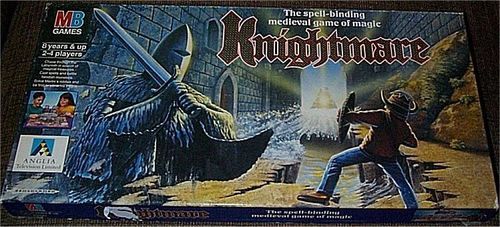
Knightmare
Knightmare Rulebook
Table of Contents
Table of Contents
Preamble
In a medieval, disturbing and mysterious atmosphere, the future Knights must show cunning and intelligence to complete their mission: reach the throne located at the centre of the labyrinth, armed with a treasure.
The characters move through the different rooms of the labyrinth, overcoming the obstacles lying along their path, crossing delicate passages and fighting strange creatures.
If they fail during a stage, they will be sent to the Dungeon and will be dispossessed of their belongings. The character who emerges victorious from the final trial and reaches the Throne of Merlin will attain the supreme rank of Knight of the Labyrinth.
Contents of the Game
- 1 game board representing a labyrinth.
- 56 cards.
- 4 plastic stands.
- 1 pre-cut sheet containing: 12 "Object" tokens, 40 "Helmet" tokens, 4 figures, 1 die, 1 Book of Riddles.
- 1 castle (moulded), 1 pre-cut castle sheet.
Object of the Game
To be the first player to reach the Throne of Merlin.
Setting Up the Game
- Detach the tokens and assemble the game pawns by fixing the figures onto the plastic stands.
- Place the game board between the players.
- Carefully detach the walls of the Castle from the pre-cut sheet.
- Fold the walls along the grooves and fit them into the base so that they stand upright.
- Shuffle the 56 cards and place them face down in the left compartment of the base of the Castle. The cards are kept standing up at an angle of 45 degrees.
- Place the 40 "Helmet" tokens in the right compartment of the base of the Castle.
- Place the 12 "Object" tokens in the rooms bearing the corresponding symbols.
- Each player places their game pawn in one of the two rooms where Iselle is found (rooms surrounded in yellow).
- Each player takes 2 "Helmet" tokens and one "Object" token from one of the 4 rooms at the corners of the game board.
- The players roll the die. The player who obtains the highest number begins the game.
The Game
The players move through the labyrinth trying to collect the following elements, which will allow them to reach the Throne of Merlin:
- One of the 4 objects shown at the corners of the Chamber of Merlin: the Book of Spells, the Magic Wand, the Ring or the Crown.
- A number of "Helmets" sufficient to access the Throne located at the centre of the Chamber of Merlin.
I. Movement of the Characters
-
To move, roll the die, then refer to the grid of numbers on the side of the room where you are located. Example: you rolled a 2 on the die. The number 2 shown on the grid of your room is surrounded in red: you will move to any room of your choice, marked in red.
-
For strategic reasons, you may modify the number obtained on the die by playing one or more "Helmet" tokens. This allows you to add or subtract one point per Helmet from the number obtained on the die. Example: the player has rolled a 2 on the die. If they play one "Helmet" token, they may act as if they had rolled "1" or "3". (The "Helmet" is then replaced in the right compartment.)
Remarks:
a) Two players cannot be in the same room at the same time, except:
- in the Dungeon (room surrounded in black);
- in the Chamber of Merlin (at the centre of the board);
- in the Rooms of Iselle at the start of the game (rooms surrounded in yellow).
b) If the room indicated by the die roll is occupied, you must play a "Helmet" token to modify the number obtained. If you have none, you lose your turn.
II. The Cards
When you enter a new room, you draw a card and follow its instructions. Exception: you do not draw a card when you are in the Chamber of Merlin (see paragraph IV – THE CHALLENGE OF MERLIN).
Used cards are then placed face up beside the board, unless the card indicates otherwise.
When all the cards have been used, take the pile beside the game board, shuffle the cards again and place them in the left compartment of the base of the Castle.
A) "Challenge" cards
When you draw a "Challenge" card, you must immediately fight the occupant of the room where you are located. The occupant is shown in the upper right corner of the room.
-
In all combats, your strength is "3", increased by the number of points obtained with your die roll, plus possibly 1 point per "Helmet" played before rolling the die. For example: you choose to play 1 "Helmet", then you roll the die and obtain "2". Your score for this combat is therefore 3 + 1 + 2 = 6.
-
The strength of the character you are fighting is equal to the number written in the yellow shield, increased by the number obtained by the die roll of the player to your left.
The player who obtains the higher number wins the combat:
- if you win, you may take either a "Helmet" or the object which is in the room;
- if you lose, you are sent to the Dungeon (see below);
- in case of a tie, you are not sent to the Dungeon, but you may not take either a "Helmet" or an object.
B) "Spell" cards
There are 8 types of "spells". When you draw a "Spell" card, you immediately receive a "Helmet", but you may not cast your spell before the next turn or turns.
Remarks:
- You may cast a spell at any time during your turn.
- Certain spells may be used during another player's turn (for example, to defend yourself).
- Once used, the cards are placed face up beside the board.
III. The Dungeon
The Dungeon is a dark and inhospitable room (surrounded in black) to which unlucky or careless players are sent.
You are sent to the Dungeon in one of the following cases:
- you lose a combat;
- you cannot obey the instructions of a "PRESENT" card;
- you fall into a "TRAP";
- you suffer the "IMPRISONMENT SPELL".
(The last 3 cases refer to cards.)
You must then return to the corresponding rooms all the objects you had collected, but you keep your "Helmets".
If you go to the Dungeon voluntarily, you keep your objects but you may not draw a card. On the other hand, you may cast a spell.
To leave the Dungeon, you must obtain 4 or more on the die. You may also use your "Helmets" to increase your score.
IV. The Challenge of Merlin
When you are in the Chamber of Merlin, you do not draw cards, but you may cast spells.
When you are in possession of one of the 4 objects (the Ring, the Book of Spells, the Magic Wand or the Crown), you may attempt the Challenge of Merlin.
At the start of your turn, you place yourself in the corner of the Chamber of Merlin bearing the corresponding object (it is not necessary to obtain the same colour). To reach the Throne at the centre of the room, you must build a bridge using your "Helmets" by correctly answering a series of questions. For each correct answer, you may place a "Helmet" on the game board.
The questions and the corresponding answers are found in the Book of Riddles and are divided into 4 parts: each player therefore corresponds to one question part and one answer part. The first player to reach the Chamber of Merlin answers the questions of Part 1, the 2nd player the questions of Part 2, and so on.
The player to your right chooses the questions from your Part of the Book of Riddles and reads them to you one by one. They check your answers in the corresponding answer part:
-
If you answer the first question correctly, you place your first "Helmet". You may then choose to answer a new question or to stop there for this turn. As long as you answer correctly, you may continue to play until you have reached the Throne. At the end of your turn, you advance your pawn to the last token placed.
-
If you do not answer correctly, your turn is over. You lose all the "Helmets" placed on the board during this turn. Your pawn remains on the room it occupied at the start of this turn.
If you realise that you do not have enough "Helmets" to reach the Throne of Merlin, you may announce at the start of a turn that you abandon the Challenge. You then return immediately to one of the Rooms of Iselle and draw a card. You lose all your "Helmets" as well as the object you possessed. This object is put back in its initial location. The "Helmets" already placed on the board are removed from the board. You may renew your Challenge attempt provided you possess one of the 4 objects shown in the Chamber and sufficient "Helmets".
V. The Winner
The first player to reach the Throne of Merlin wins the game.
The Book of Riddles (Livre des Énigmes)
The Book of Riddles is a separate booklet of the game. It is referred to by the rules above for the Challenge of Merlin. The booklet's introduction reads:
To reach the Throne of Merlin and become Knight of the Labyrinth, you must answer several questions. For each correct answer, you gain the right to place a "Helmet" and you get a little closer to your goal.
The questions and the corresponding answers are divided into 4 parts: each player corresponds to one question part and one answer part. The first player to reach the Chamber of Merlin answers the questions of Part 1, the 2nd player the questions of Part 2, and so on.
The player to your right chooses the questions from your Part of the Book of Riddles and reads them to you one by one. They check your answers in the corresponding answer part. Remember that some questions have several correct answers.
Part 1 — Questions for Player no. 1
- What are the two moments of the year when the length of the day is equal to that of the night called?
- How far from the Earth is the Sun?
- What is the symbolic animal of France?
- Which character of mythology turned men to stone with a single glance?
- Where is the Parthenon?
- What other name is given to quicksilver?
- What were slaves called in Sparta, in ancient Greece?
- How many sides does a heptagon have?
- What is agoraphobia?
- What is the name of the Greek god of War?
- What is the ancestor of the game of tennis?
- From what origin does the word "video" come?
- What are the "Précieuses Ridicules"?
- Who said "veni, vidi, vici"?
- What is the Latin motto of the city of Paris?
- How many wings does a butterfly have?
- In which direction does the Earth turn? East to West or West to East?
- Among the 7 wonders of the world, that is to say the seven most remarkable works of Antiquity, cite 4.
- How old is the Earth?
- What is the name of the European satellite launcher?
- In Guadeloupe there is a volcano famous for its eruptions, the last dating from 1976. What is its name?
- Which Italian city was completely buried, along with its inhabitants, under the ashes thrown up by Vesuvius?
- In Greek mythology, what is the name of the mythical animal that guards the gates of Hell?
Answers to Part 1
- The equinoxes
- 150 million kilometres
- The rooster
- Medusa
- Athens
- Mercury
- The helots
- Seven
- The fear of crowds
- Ares
- The game of "jeu de paume"
- It is the first person of the verb "to see" (videre) in Latin
- A play by Molière
- Caesar, when he conquered Gaul
- "Fluctuat nec mergitur" (it floats but does not sink)
- Four
- From West to East
- The pyramids of Egypt; the Hanging Gardens of Babylon; the gold and ivory statue of Zeus Olympios; the Temple of Artemis at Ephesus; the Mausoleum at Halicarnassus; the Colossus of Rhodes; the Lighthouse of Alexandria
- 4.5 billion years
- Ariane
- La Soufrière
- Pompeii
- Cerberus (a monstrous dog with three heads)
- Columbia, Challenger, Discovery, Atlantis
- Spanish
- The last one
- The ECU (European Currency Unit)
Part 2 — Questions for Player no. 2
- Who was waiting for Ulysses while weaving tapestry, and spent her time unpicking at night what she had woven by day?
- Which deity invented the reed flute?
- What is the largest mountain range in France?
- What is the moment when a snake changes its skin called?
- What kind of burying beetle buries the corpses of small animals?
- What is the name of the trap that a spider spins to catch its prey?
- When it is not yellow, what colour is the lemon?
- What does the expression "avoir le sang bleu" mean?
- Who invented printing?
- How many pawns does each player have in chess?
- What was the ring of knights, called a "chevalière", used for?
- What is the name of the magic book of sorcerers?
- What is the alloy of copper and tin called?
- Hercules accomplished twelve fabulous labours. Can you cite two?
- Among these animals, which one is not a mammal? The whale, the boa, the goat
- How is the President of the Republic elected in France?
- Of the sabre or the sword, which one is a thrusting weapon?
- In a suit of armour, a gauntlet protects the hand. What is the part called that protects the foot?
- What is the name of the god of war among the Romans?
- Charade: — It is not tall — It is not handsome, but it is indispensable to witches. What is it?
- If the tiara belongs to the pope, to whom does the mitre belong?
Answers to Part 2
- Penelope
- (The flute of) Pan
- The Alps
- The moult
- The necrophorus (burying beetle)
- A web
- Green
- To be of noble birth
- Gutenberg
- Eight
- To seal a letter or to authenticate the signature on a sealed letter
- A grimoire
- Bronze
- Kill the Nemean lion; kill the Lernaean Hydra; capture the Erymanthian boar; catch the golden-hoofed hind; drive away the Stymphalian birds from Lake Stymphalus; clean the stables of Augeas; capture the Minotaur; seize the mares of Diomedes; kill the queen of the Amazons; capture the oxen of Geryon; seize the golden apples of the Hesperides; capture Cerberus, the guardian of the underworld
- The boa
- By universal suffrage
- The sword
- The sabaton
- Mars
- The broom (Bas Laid, "low and ugly")
- To the bishop
- 90°
- They are palindromes: words that read the same from left to right and from right to left without changing meaning
- On the moon
- Troy
- Osiris
Part 3 — Questions for Player no. 3
- There are several small peoples of spirits that bear different names. Cite two.
- In the tale of the Thousand and One Nights, from what object do the genies emerge?
- In which city was Joan of Arc burned in 1431?
- What is a watering place with greenery in the desert called?
- A couple of ogres has seven daughters, and each of these daughters has one brother. How many people are there in this family?
- On nights of full moon, into what do some men transform?
- If the goat is associated with the cabbage, what is associated with cheese?
- In France there is a famous viaduct called the "Garabit viaduct". By whom was it built?
- I am said to have a viper's tongue. Am I a gossip or a severe critic?
- Teeth are classified into four different categories. Cite at least two.
- Is the mammoth an animal of the secondary or the tertiary era?
- What was the writing of the Egyptians called?
- What is the name of the plant capable of curing memory loss and even madness?
- Charles the Bold was duke of which region of France: Picardy or Burgundy?
- Which tribunal condemned heretics, that is to say those who did not follow the dogmas of the Church?
- Following the Reformation of Luther and Calvin, another religion appeared. Which one?
- Which Gaulish chief was defeated at Alesia and came to lay down his arms at Caesar's feet?
- Who was the god of Olympus in Greek mythology?
- What is the name of the science of coats of arms?
- In which country is the city of Baghdad located?
Answers to Part 3
- Elves, Farfadets, Korrigans, Djinns, Poulpiquets, Etrits, Gnomes
- A lamp
- Rouen
- An oasis
- Ten people
- Werewolves
- The pear
- Gustave Eiffel
- A gossip (médisant)
- Incisors, canines, premolars, molars
- The Tertiary era
- Hieroglyphs
- Hellebore
- Burgundy
- The Inquisition
- Protestantism
- Vercingetorix
- Zeus
- The science of heraldry
- Iraq
- "Not to live long"
- Mummies
- A unicorn
- Fable
- A butterfly
- Clovis
- The yeti
- The Vikings
- Drakkars
- The Black Death
- Caravels
Part 4 — Questions for Player no. 4
- If wine remains the favourite drink of the French, what was the favourite drink of the gods of Olympus?
- What is the passage from death to life called?
- Which animal once asked the Little Prince to tame it?
- Which science has as its object the description and explanation of the natural and human aspects of the Earth's surface?
- Where does Tartarin, the great lion hunter, come from?
- Who wrote "Lettres de mon moulin" (Letters from My Windmill)?
- Which barbarians led by Attila invaded Roman Gaul?
- How many thieves are there in the story of Ali Baba?
- In which country is Gulliver a giant?
- What are the imaginary creatures that are half-woman, half-fish called?
- What is the name of the great Venetian traveller who crossed Asia, stayed sixteen years with the Great Khan, and brought back, among other things, fireworks to Italy?
- Several letters can be removed from me without changing me. Who am I?
- What are the trees in a pine grove called?
- What is the name of the great knight who distinguished himself during the Hundred Years' War in the fourteenth century?
- Who is the author of the Odyssey and the Iliad?
- Of the Loire or the Seine, which river is the longer?
- What is the name of the sword that knights wielded with both hands?
- What is the name of the son of Pantagruel?
- Puss in Boots and Sleeping Beauty are heroes from the tales of which author?
- How long did Sleeping Beauty wait for the Prince Charming?
Answers to Part 4
- Nectar
- Resurrection
- A fox
- Geography
- Tarascon
- Alphonse Daudet
- The Huns
- Forty
- Lilliput
- Sirens
- Marco Polo
- The postman (le facteur)
- Pines
- Du Guesclin
- Homer
- The Loire
- The espadon (two-handed sword)
- Gargantua
- Charles Perrault
- 100 years
- True
- Africa, Oceania, America, Asia, Europe
- A solar eclipse
- Marsilia
- Pisa
- Samson
- A portable firearm
- Ice
- The Parthenon
- The flea
- The Suez Canal