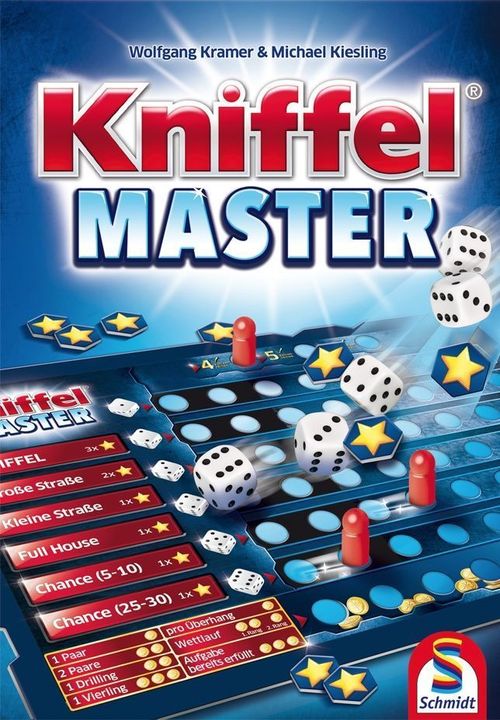
Kniffel Master
Kniffel Master Rulebook
Table of Contents
Table of Contents
- Spielmaterial
- Spielziel
- Spielvorbereitung
- Spielablauf
- 1. Eine Aufgabe erfüllen (Fulfil a task)
- 2. Das Ergebnis für 1 oder 2 Zahlenreihen verwenden (Use the result for 1 or 2 number rows)
- 3. Das Ergebnis in der Münzreihe verwenden (Use the result in the coin row)
- 4. Das Ergebnis in einer Zahlen- und in der Münzreihe verwenden (Use the result in a number row and in the coin row)
- Überhang in einer Zahlenreihe (Overhang in a number row)
- Wettlauf (Race)
- Spielende (End of the game)
- Hinweis (Note)
Spielmaterial
- 5 dice
- 4 player sheets ("Ablagen")
- 16 point markers (4 per colour)
- 64 stars
Before the first game, punch out the stars from the punch-out boards and carefully remove all the circles from the 4 player sheets. The circles are not needed for the game.
Spielziel
Players roll up to three times each round and try to achieve the listed combinations. Depending on the results, players move their point markers forward on their player sheets. As soon as a point marker reaches the end of a horizontal row, or a task is fulfilled, the player receives a star and places it on his player sheet. The first player to collect 15 stars triggers the end of the game. The player with the most stars wins the game.
Spielvorbereitung
Each player receives 1 player sheet and 4 point markers of the same colour, which he places next to his player sheet. The stars are placed where everyone can reach them. The youngest player takes the 5 dice and starts the game.
Spielablauf
Each player takes one turn per round with the dice. In his turn, the player may roll up to three times. The 1st roll is made with all 5 dice. After that, before his 2nd and 3rd roll, the player decides freely how many dice he wants to roll. He leaves the dice he wants to keep in front of him and rolls only those he does not like. In this way he can try to improve his result with the 2nd and 3rd attempt. He may also forgo one or both additional rolls, or re-roll dice that he set aside earlier. After the 3rd roll at the latest, the player must use the result.
He then carries out one of 4 possible actions:
- Fulfil a task.
- Use the result for 1 or 2 number rows.
- Use the result in the coin row.
- Use the result in one number row and in the coin row.
After the player has completed his turn, he passes the dice to the next player clockwise.
1. Eine Aufgabe erfüllen (Fulfil a task)
The player must have rolled the matching result to fulfil a task after 3 rolls:
- Kniffel: 5 identical numbers.
- Full-House: 3 identical numbers and 2 other identical numbers.
- Kleine Straße (small straight): a sequence of 4 consecutive numbers. The 5th die may show any number.
- Große Straße (large straight): a sequence of 5 consecutive numbers.
- Chance (5-10): the sum of all 5 dice is between 5 and 10.
- Chance (25-30): the sum of all 5 dice is between 25 and 30.
(The printed rules show an example set of dice for each task.)
For this, the player takes 1 star, except for "Große Straße" (2 stars) and "KNIFFEL" (3 stars). He places the star on the matching spot on the left side of his player sheet.
EXAMPLE 1: Rüdiger has rolled the result shown in the illustration (five dice). This fulfils the task "Chance (5-10)", because the dice total 8. Rüdiger takes 1 star and places it on the left side of his player sheet next to "Chance (5-10)".
2. Das Ergebnis für 1 oder 2 Zahlenreihen verwenden (Use the result for 1 or 2 number rows)
If a player has rolled 2 or more identical numbers, he may place his point marker on the corresponding number row (if not already done) and move it to the right by the number of dice showing that number.
EXAMPLE 2: Melanie has rolled the result shown in the illustration. She moves the point marker of the row for the first number 2 spaces to the right, and the point marker of the row for the second number 2 spaces to the right. She cannot move the point marker of the row for the third number, because she rolled that number only once.
Once a player moves his point marker onto the 8th and last space of a number row, he receives 1 star for it and places this star to the right of the player sheet at that row. He then removes the point marker and places it next to his player sheet. It stays there until the player needs it again for a new number row. A number row that has been completed with a star cannot be used for the rest of the game.
As soon as a player has completed his 4th number row with 1 star, he places the point marker on the "4 Zahlenreihen" (4 number rows) field at the upper edge of the board and places 1 additional star above this field. This point marker is not needed for the rest of the game. As soon as the player completes his 5th and later his 6th number row, he places the second and later the third point marker on the fields provided for them, and places one additional star each time.
IMPORTANT: During the game, at most 3 point markers can be in use on number rows at the same time. Before a new number row can be started, one of the 3 started rows must first be completed.
3. Das Ergebnis in der Münzreihe verwenden (Use the result in the coin row)
If a player has rolled 1 pair, 2 pairs, 1 three-of-a-kind or 1 four-of-a-kind, he may decide to use the result in the coin row. Next to the coin row is shown by how many spaces the player may move the point marker in the coin row to the right:
- 1 pair: 1 coin.
- 2 pairs: 2 coins.
- 1 three-of-a-kind (Drilling): 2 coins.
- 1 four-of-a-kind (Vierling): 3 coins.
The printed table also lists these options for the coin row:
- Per overhang (pro Überhang): 1 coin per unused identical die (see "Überhang in einer Zahlenreihe" below).
- Race (Wettlauf): 2 coins for first place, 1 coin for second place (see "Wettlauf" below).
- Task already fulfilled (Aufgabe bereits erfüllt): 3 coins.
1 coin corresponds to 1 space on the coin row.
It is also possible to score a task that has already been fulfilled, where 1 star already lies next to it, again, and thereby receive 3 coins to move the point marker 3 spaces forward.
When the point marker is moved onto the 8th and last space of the coin row for the first time, 1 star is placed at the end of the row, on the lower side of the player sheet.
If the player receives more coins than he can show on the coin row, the point marker is moved again from the beginning of the row. From now on, the point marker only needs to move 7 spaces until the coin row is completed again and another star can be placed. After that, the coin row is only 6 spaces long, then 5 spaces, and finally 4 spaces.
EXAMPLE 3: Rüdiger has rolled the result shown in the illustration. He has already completed the number row for one number and another number row. Because he rolled only 1 die of a number, he cannot use the result in that number row. He also cannot use it as "Chance (25-30)", because he already has a star for it. He therefore uses the result for the coin row. For the option "Aufgabe bereits erfüllt" (task already fulfilled), Rüdiger receives 3 coins, i.e. 3 moves on the coin row. He first moves the point marker 2 spaces in the coin row to the right, which completes the coin row, and places a star on the player sheet. The point marker is placed next to the player sheet. To make the remaining 3rd move, Rüdiger immediately places the point marker back in the coin row on the first space (= 3rd move). Rüdiger could also have scored the result as "2 Paare" (2 pairs), but then he would have moved only 2 spaces forward.
4. Das Ergebnis in einer Zahlen- und in der Münzreihe verwenden (Use the result in a number row and in the coin row)
A player may also use his dice roll to move the point markers in a number row and in the coin row.
EXAMPLE 4: Yasmin has rolled the result shown in the illustration. Yasmin decides to use the two dice showing the first number in the number row, and moves the point marker 2 spaces to the right. She uses the 2 dice showing the second number as 1 pair in the coin row. For this she receives 1 coin, i.e. 1 move. She moves the point marker in the coin row 1 space to the right, which completes the coin row for the second time, and places another star.
Überhang in einer Zahlenreihe (Overhang in a number row)
If more identical numbers are rolled than are needed to complete a number row, the unused identical numbers may be used as an overhang in the coin row. For each unused die, the player moves the point marker of the coin row 1 space further. (Per overhang: 1 coin.)
EXAMPLE 5: Carsten has rolled the result shown in the illustration. Carsten uses the 4 dice showing the number in the number row. He moves the point marker 1 space to the right, which completes the row, and places a star on the player sheet. The 3 unused dice showing the same number may be used by Carsten as overhang in the coin row, and he moves the point marker 3 spaces to the right.
Note: the printed example refers to 4 dice in the number row and 3 unused dice, while the illustration shows 5 dice. Transcribed as printed.
Wettlauf (Race)
The player who first fulfils a particular task or completes a number row may move his point marker an additional 2 spaces on the coin row to the right. The player who fulfils a particular task or completes a number row second may move his point marker an additional 1 space on the coin row to the right.
EXAMPLE 6: If Carsten in the previous example first completes the number row, he may additionally move the point marker 2 spaces to the right on the coin row. If he manages it only second, he may still additionally move the point marker 1 space to the right.
Spielende (End of the game)
As soon as a player has placed 15 stars on his player sheet, the last round begins. The game continues until the player to the right of the starting player has had one more turn. The game then ends. The player who has collected the most stars wins the game.
Hinweis (Note)
The order in which the dice are placed on the number rows is arbitrary. For example, a number row can be completed with part of the dice result, and, if necessary, the point marker freed up this way can be used again right away in a new number row.