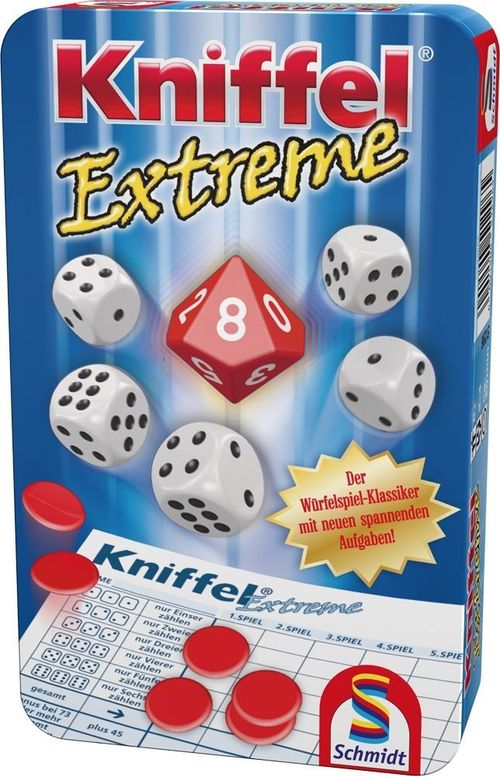
Kniffel Extreme
Kniffel Extreme Rulebook
Table of Contents
Table of Contents
Components
- 6 dice (five 6-sided dice and one 10-sided die)
- 1 pencil
- 1 Kniffel Extreme pad
- 1 rulebook
- 12 chips
- 1 dice tower
Object of the Game
Each round, players must fill in one of their 22 boxes. They should try to roll high sums or high-scoring combinations such as pairs, straights, full house and others, but – when it gets extremely tricky – sometimes a zero is unfortunately part of it... So it pays to roll "cleverly" in order to score the most points at the end.
Note for Kniffel experts: To make getting started easier, all deviations from the classic Kniffel rules are marked in red.
Setup
Each player receives 3 game chips and a Kniffel Extreme sheet, on which they write their name. A starting player is determined.
Gameplay
Beginning with the starting player, players take turns rolling in clockwise order. On a turn, a player may roll up to three times. The first roll is made with all six dice. The ten-sided die is rolled exactly like all the other dice. Players should of course plan for the special nature of this die (different probabilities, and numbers above 6 as well as the 0). The dice are thrown into the top of the dice tower.
After the 1st roll, the player decides how many dice to roll for the 2nd and 3rd attempts. They leave the dice they want to keep in front of them and roll only the ones they "don't like". In this way they can try to improve their result with the 2nd and 3rd attempts. Dice that have been set aside may be picked up again when re-rolling. Extra rolls may always be skipped. At the latest after the third roll, the player must enter the result on their sheet (exception: by handing in a chip, they may roll a fourth time, see below).
If the roll fulfils no condition for a box that is still open, the player must "strike" any box of their choice (= enter a zero).
Scoring
The Kniffel Extreme sheet is divided into an upper and a lower section. The upper section has the boxes for Ones, Twos, Threes, Fours, Fives and Sixes. If a player decides to score their roll here, they enter the sum of the matching numbers in the corresponding box.
Bonus
To receive the bonus of 45 points, the sum of the points in the entire upper section must be at least 73.
Lower Section
The lower section has the boxes for the special rolls:
- Three of a Kind (Dreierpasch): At least three of the same number. All pips of the roll are added up. = sum of all dice
- Two Pairs (Zwei Paare): Two different pairs of numbers. All pips of the roll are added up. = sum of all dice
- Four of a Kind (Viererpasch): At least four of the same number. All pips of the roll are added up. = sum of all dice
- Three Pairs (Drei Paare): Three different pairs of numbers. No matter which pairs are rolled, three pairs score a flat 35 points. = 35 points
- Two Triples (Zwei Dreier): Two different triplets of numbers. Two triples score a flat 45 points. = 45 points
- Large Full House (Großes Full House): Four of the same number and two of another, same number. A Large Full House scores a flat 45 points. = 45 points
- Large Straight (Große Straße): A sequence of five consecutive numbers. The sixth die may show any number (e.g. 2, 3, 4, 5, 6, 3). A Large Straight scores a flat 40 points. = 40 points
- Kniffel: 5 of the same number. A Kniffel scores 50 points. = 50 points
- 10 or Less (10 oder weniger): The sum of all pips may total at most 10 points. 10 or less scores a flat 40 points. = 40 points
- Full House: Three of the same number and two of another, same number (e.g. three Fours and two Threes). A Full House scores a flat 25 points. = 25 points
- Small Straight (Kleine Straße): A sequence of four consecutive numbers. The other two dice may show any number (e.g. 1, 2, 3, 4, 3, 9). A Small Straight scores a flat 30 points. = 30 points
Example
Nina has rolled three Fives and three Sixes. She now has the following options for recording the roll:
- Upper section, box "Fives" = 15 points.
- Upper section, box "Sixes" = 18 points.
- Lower section, box "Three of a Kind" = 33 points.
- Lower section, box "Two Pairs" = 33 points.
- Lower section, box "Two Triples" = 45 points.
- Lower section, box "Full House" = 25 points.
- Lower section, box "33 or More" = 40 points.
- Lower section, box "Chance" = 33 points.
- Lower section, box "Super Chance" = 66 points.
Note: There are no bonus points for a second Kniffel or Kniffel Extreme.
Chips
With the help of a chip, players have the option of rolling a fourth time. A player may use only one chip per turn.
End of the Game
The game ends as soon as the last box of the last player has been filled in. Now all points are added up (do not forget the bonus). The player with the most points is the winner.