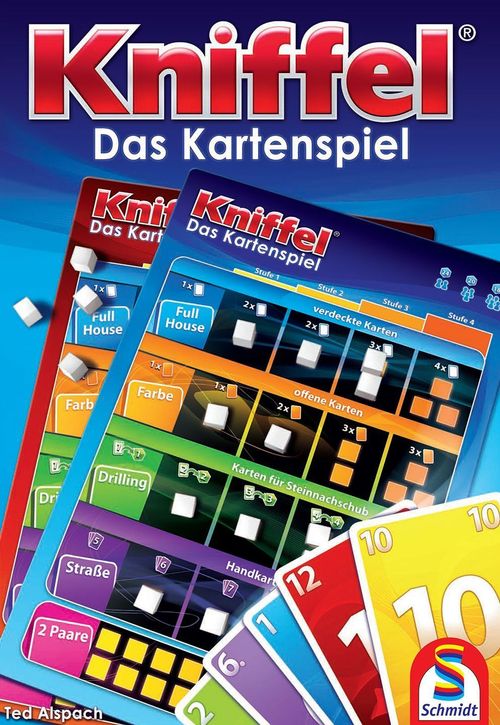
Kniffel: Das Kartenspiel
Kniffel: Das Kartenspiel Rulebook
Table of Contents
Table of Contents
Game Material
65 cards (the numbers 1–13 in 5 colours), 4 player boards, 72 tokens, 1 rulebook.
Object of the Game
Players collect cards in order to play certain card combinations. By playing these combinations, players place tokens on their player board, which also improves their individual action options in the game. The first player to get rid of all their tokens wins the game.
Setup
Each player receives a player board and places it in front of them with the blue side facing up. Each player also receives the following number of tokens, which they place above their board as their personal reserve:
- 2 players: 24 tokens each
- 3 players: 20 tokens each
- 4 players: 18 tokens each
Surplus tokens are returned to the game box.
From their personal reserve, each player takes 3 tokens into their active play area below the player board (see illustration). In addition, each player may place 3 tokens from their personal reserve on spaces of their board. When placing tokens in the various rows, players must always start with the front spaces (= lowest level). It is permitted to place 2 tokens in one row.
A starting player is determined. They shuffle the cards thoroughly and deal 3 cards face down to each player. Then 4 cards are placed face up in the centre of the table as the open display, and the rest of the cards are placed nearby as a face-down draw pile.
Turn Sequence
The starting player begins, and play then proceeds clockwise.
On their turn, the active player chooses exactly 1 of the following 3 possible actions:
-
A Draw cards
or
-
B Play cards and place tokens
or
-
C Discard cards and move tokens from the personal reserve into the active play area
As the levels on their player boards fill with tokens over the course of the game, players improve their action options.
Action A: Draw Cards
The active player must draw as many cards from the draw pile as the filled level of the Full House row indicates. Afterwards, they also draw cards from the open display according to the filled level of their Colour row.
If drawing causes the player to exceed the hand limit (see the description of the Straight), the player must discard excess cards at the end of their turn until the hand limit is reached. Discarded cards are placed face up on the discard pile.
Before the next player takes their turn, the open display is refilled to 4 cards. If the draw pile is exhausted, the discard pile is shuffled and used as the new draw pile.
Note: If no level has yet been filled in the Full House, Colour and Straight rows, the player may draw 1 card from the face-down pile and 1 card from the open display, and at the end of the turn may hold 5 cards in hand.
Action B: Play Cards and Place Tokens
If the active player has a possible card combination in hand, they may play it. In their turn, a player may play only 1 combination. After playing it, the player places 1–3 tokens from their active play area on the next free level of the corresponding row. Once placed, tokens remain on the space where they were put until the end of the game.
The played cards are then placed face up on the discard pile.
Placing the tokens: On spaces of level 3, exactly 2 tokens must always be placed in one turn; on level 4, exactly 3 tokens must always be placed. These tokens must always be placed at the same time. If a player does not have enough tokens in their active play area to fill the spaces at the same time, they may not play that card combination. It is not possible to fill a 2-space with only one token, or a 3-space with 1 or 2 tokens.
Example: Nina plays a Straight (2-3-4-5-6) this round. She must now place 2 tokens on the free spaces of the next level in the Straight row. She takes these tokens from her active play area. As a result, her hand limit increases from 7 to 8 cards.
Card Combinations
Full House (5 cards of any colour, consisting of a three of a kind and a pair, e.g. 5-5-5-9-9) If a player holds a three of a kind and a pair in hand, they may play them and must then place 1–3 tokens on the next free level of the Full House row. The last level filled with tokens indicates how many cards the player may draw from the face-down pile from the next round onward.
Colour (5 arbitrary cards of the same colour, e.g. 2-4-7-8-10 in blue) If a player holds 5 cards of one colour in hand, they may play them and must then place 1–3 tokens on the next free level of the Colour row. The last level filled with tokens indicates how many cards the player may draw from the open display from the next round onward.
Three of a kind (3 cards of any colour with the same value, e.g. 9-9-9) If a player holds 3 cards with the same value in hand, they may play them and must then place 1–3 tokens on the next free level of the Three-of-a-kind row. The last level filled with tokens indicates the maximum number of cards the player may discard in order to move tokens from their personal reserve into their active play area (see Action C). For each card, the player may move one token. It is permitted to exchange fewer than the maximum number of cards.
Straight (5 consecutive cards of any colour, e.g. 6-7-8-9-10) If a player holds 5 consecutive cards (of any colour) in hand, they may play them and must then place 1–3 tokens on the next free level of the Straight row. The last level filled with tokens indicates the maximum number of cards the player may hold in hand at the end of their turn.
Note: The "1" is the lowest card and the "13" is the highest card. A straight "12-13-1-2-3" may not be scored.
Two pairs (4 cards of any colour consisting of 2 pairs, e.g. 4-4-8-8) If a player holds 2 pairs in hand, they may play them and must place 2 tokens in the "Two pairs" row. Placing tokens in this row gives the player no further advantage. On the other hand, they can thereby place 2 tokens on the player board at the same time.
Four of a kind (4 cards of any colour with the same value, e.g. 5-5-5-5) If a player holds 4 cards with the same value in hand, they may play them and must then, as with "Two pairs", simultaneously place 2 tokens in the "Two pairs" row. However, they may take the tokens wholly or partly from their personal reserve. Any remaining tokens are taken, if necessary, from the active play area.
Kniffel (5 cards of any colour with the same value, e.g. 7-7-7-7-7) If a player holds 5 cards with the same value in hand, they may play them and take tokens wholly or partly from their personal reserve, and with them fill all spaces of the next free level in any one row. Any remaining tokens are taken, if necessary, from the active play area. If they wish to place their tokens in the "Two pairs" row, they may fill the 2 following columns (i.e. place 4 tokens), but must take at least 1 token from their active play area.
Special Rule for the End of the Game
Unlike during play, when placing the last token it is possible to place it on a level that requires more than one token, even if not all spaces of the level are filled as a result. Thus a player who has only one token left may still play a card combination for a level that requires two or three tokens.
Action C: Discard Cards and Move Tokens into the Active Play Area
The active player may exchange any cards for tokens, receiving one token per card. The maximum number of cards that may be exchanged is set by the Three-of-a-kind row. At the start of the game (level 0), this is limited to one card for one token. The tokens are then moved from the personal reserve into the active play area. The discarded cards are then placed face up on the discard pile. It is permitted to exchange fewer than the maximum number of cards.
Printed heading note: the heading of this action in the original German rulebook reads "Karten ablegen und Würfel aus der persönlichen Reserve in die aktive Spielzone holen" ("Würfel" = dice). The body text and the game components make clear that the intended word is "Steine" (tokens); the heading is rendered here as "tokens".
End of the Game
The game ends when a player has been able to place all of their tokens on their player board. The current round is then played to its end. If during this round another player also manages to place all of the tokens on their board, the winner is the player among them with the most cards remaining in hand. If this also results in a tie, there are several winners.
Variants
Want it simpler?
Then play so that players may draw cards in every round (A) and then perform one further action, B (play cards and place tokens) or C (discard cards and move tokens from the personal reserve into the active play area).
Want it trickier?
Then play the basic rules with the following changes or additions:
- Play once with the red side of the player board. On this side there is one more level, so you need a little longer to reach the spaces on which you can place several tokens at the same time.
- Each player receives 30 tokens with 2 players, 24 tokens with 3 players, and 18 tokens with 4 players.
- Before the start of the game, each player may place only 2 tokens from their personal reserve. These tokens are placed in reverse player order, beginning with the player to the right of the starting player, on the board. Placement is carried out in turn. After placing, no two of these tokens may have been placed on the same spaces.
- The hand limit also determines the limit on tokens in each player's active play area. If a player has a hand limit of 5, they may not have more than 5 tokens in their active play area.
- The special rule for the end of the game is suspended. That means players must take care not to block themselves, e.g. by having only one token left while only free levels that require more than one token remain. In this case the game is lost for that player.