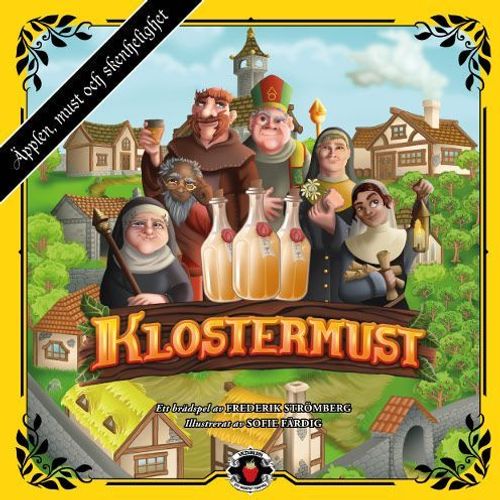
Klostermust
Klostermust Rulebook
Table of Contents
Table of Contents
- Game Contents
- Setup
- How to Play
- Action Strength, Sins and Scoring
- The Actions
- Rise with the rooster (number X)
- Put on the hair shirt (number X)
- Make apple must (number 1)
- Harvest apples (number 3)
- Confess (number 2)
- Recruit a volunteer (number 4)
- Steal from the monastery (number 5)
- Steal from the village (number 6)
- Carry out a sabotage (number 7)
- Ask for a boon (number 8)
- Make a plan (number 9)
- Characters
- Variants and Advanced Rules
Game Contents
- 12 Action tiles:
- 1 – Make apple must
- 2 – Confess
- 3 – Harvest apples
- 4 – Recruit a volunteer
- 5 – Steal from the monastery
- 6 – Steal from the village
- 7 – Carry out a sabotage
- 8 – Ask for a boon
- 9 – Make a plan
- 10 – Receive a blessing
- X – Rise with the rooster
- X – Put on the hair shirt
- 1 Game board
- 1 Day marker (yellow cylinder)
- 30 Sins (black plastic pieces)
- 9 Harvest cards
- 6 Sin table cards
- 36 Apple cards (12 green, 12 red, 12 yellow)
- 5 Character cards
- 5 Figures with stands
- 35 Dice (seven dice in each player colour)
Extra components for variants
- 3 Action tiles:
- 1b – Make a little apple must
- 2b – Confess a little
- 3b – Harvest a few apples
- 12 Forecast cards (the alternative scoring system replaces the Harvest cards)
Setup
From the book: if you want to play something other than the basic game, read the variants under "Variants and Advanced Rules" (page 13), since they change how the game is set up.
Preparations
- Place the day marker (14) on day 1 on the day track (15) above the top of the game board (13).
- Take out the Sins (black plastic pieces) (16) and place them in a pile next to the game board.
- Shuffle the Harvest cards (17) and the Sin table cards (18), and place each in its own face-down pile next to the game board.
- Place the Apple cards (19) in three face-up piles, sorted by colour, next to the game board. Apple side up, must side down.
- Each player chooses one Apple card before the game starts.
- For each player, choose or draw one Character card (20) together with the matching Figure (21) and seven Dice (22) in the matching colour. Place the Character card with the ability side up (more information on pages 11–12).
- Each player keeps four of their seven dice. The other three are set aside for now and are used later if you increase your action strength.
- Place your figures on space 4 of the action strength track (23), marked "starting level" (startnivå).
- Choose a starting player: the player who most recently ate an apple decides. The starting player takes the action tile Stig upp med tuppen (Rise with the rooster, number X). This shows who the current starting player is.
- Place the remaining action tiles (1–12) on their places on the game board (13). Look at the icons on each action so that the right tile is on the right place.
- If this is your first game, read through all the action tiles (1–12).
- Now you are ready to play!
Setup example: at the start of the game each player must have in front of them 1 Character card, 4 dice and 1 Apple card. The example on page 4 shows the player Helmer, who has an orange colour on the Character card, figure and dice. Helmer has also had the turn to be the one who starts with the start tile Stig upp med tuppen.
Game board
The game board shows the Action strength track (Handlingskraft) on its left side, numbered from 7 at the top down to 0 at the bottom. Level 4 is marked as the starting level (Startnivå, 23). The levels below it read:
- Level 3, 2 and 1 – Rest (Vila): Forgo one die (Avstå en), move to level 4.
- Level 0 – You must rest! (Du måste vila!): Stand over the day, move to level 4.
The day track runs across the top of the board: Day 2, Day 3, Day 4, Day 5 (the Bishop's courier arrives), Day 6 (Finaldag, marked as the final day), and finally the Bishop's arrival (Biskopen anländer).
How to Play
Klostermust is played over six rounds, corresponding to the six days that remain until the Bishop arrives. Each day consists of three phases – Opening, Bidding and Action effects – plus the event for the New day.
1. Opening
This phase concerns rolling your dice and possibly improving them, so that you have as good dice as possible before the bidding.
- Take your dice back from the game board. Not done on day 1.
- Check your action strength (see page 7) to see how many dice you may use this day. Day 1 is always four dice, since you start at level 4 on the action strength track.
- Roll your dice. All players roll at the same time.
- Place your dice face up in front of you.
- Carry out the action effects for tiles 7–10 in the correct order. Not done on day 1.
2. Bidding
This phase concerns placing dice on the actions on the game board in an attempt to make the highest bid and win one or more action tiles.
- The player who has the tile Rise with the rooster (X) starts acting. Thereafter turn order follows clockwise.
- On your turn, take one die, or several dice of equal value, from your dice and place them on an action you want to win.
- Place dice in free dice spaces on your chosen action. Always start placing from the left. If an action has no free dice spaces, you cannot choose to place there.
- Dice spaces: Different actions have different numbers of dice spaces. The number of available spaces also varies depending on how many players are in the game. The light dice spaces on the left are always available, while the transparent spaces with numbers are used depending on the number of players (for example "3+" when you are three players).
- If you have the highest bid on an action, take its tile immediately and place it in front of you. Either you take the tile from its place on the board or, if you have outbid someone, you take the tile from that player.
- You may bid on the same action as another player, provided there are free dice spaces based on the number of players.
- Of two equal bids, the first one counts as the highest. To outbid, you must place higher dice than the existing bid.
- If you have dice of the same value (a pair, a triple and so on), you may place them together and make a higher bid than with single dice. If the dice do not have the same value, you can never place them on the same turn.
- A pair is always higher than a single die, a triple is higher than a pair, and so on.
- Dice of the same value that were placed on different turns can never be counted together as a pair, a triple and so on.
- Outbid dice stay where they are with no other effect than that they are in the way.
- During bidding, your dice end up on the game board. You are finished when your dice are used up, or when you choose to pass because you do not want to or cannot do anything more. Skip over any player who has no dice left, and continue in turn order until everyone is finished.
Example. The example shows the dice spaces for Harvest apples. There are four players at the table, which means the action has five free spaces (the one on the far right is only used in a five-player game). Kai places a pair of fives on the action and takes the action tile (A). Winnibald has a pair of fives and a pair of sixes. He places the sixes so that he can outbid Kai, and therefore takes the action tile from Kai (B). The next day it is Helmer who starts, by placing a pair of threes on Harvest apples and taking the tile (A). Kai was outbid the previous day and really wants apples, so Kai places a triple of twos and takes the tile from Helmer (B).
3. Action effects
This phase concerns returning the action tiles won during bidding and carrying out their effects. Read more about the actions on pages 8–10.
- Each action can only give its effect once per day. It is always the player who won the action tile in the bidding who receives the action's effect.
- Place the won action tile back on its place on the game board and carry out that action's effect immediately. The effect is described on the tile itself.
- Action effects are always carried out in order. Begin with number 1, then number 2, and so on up to number 6. Then it is a new day (move the day marker). Actions 7–10 are carried out during the next day's Opening phase.
- Note that the two actions numbered X are not carried out in this way. Instead they have a lasting effect for the player who holds the tile.
4. New day – the day track
When you have completed one full day (Opening, Bidding, and Action effects 1–6), move the day marker one step forward on the day track.
- Days 1–4: Nothing special happens.
- Day 5: The Bishop's courier arrives. Draw one sin table card at random and place it face up next to the game board.
- Day 6, Final day: Turn all action tiles marked with a star so that they give points instead of their normal effect.
- Day 7: The Bishop arrives at the monastery and the game ends. Draw one Harvest card and count points.
See page 7 for information on points.
Action Strength, Sins and Scoring
Action strength and resting
The dice are your action strength, and you use them to win and carry out the game's various actions. The meter on the side of the game board shows your action strength and determines how many of your seven dice you should use each day.
If you have fewer than four in action strength, you can rest (vila dig) during the bidding phase to get back up to level four. On your turn, place one of your dice on the action strength meter and move your figure to level 4. Resting replaces bidding on an action for that turn. Resting only takes one turn, and if you still have dice left you may continue bidding as normal on your next turn in turn order. Even if you move your figure directly to level 4, you only roll your new dice in the next Opening phase.
To rise above level 4 in action strength you need the action Recruit a volunteer. You also increase your action strength if another player steals must or apples from you with Steal from the monastery.
Note that level 7 is the maximum for action strength. If you are at level 7, it is pointless to recruit a volunteer, and other players can steal from you without your action strength increasing.
Sins
Three different actions in the game cause sins: Steal from the monastery, Steal from the village and Carry out a sabotage. If you carry out any of these, take the correct number of sins (black plastic pieces) from the pile and place them on your Character card. A sin has no effect during the game, but it causes minus points at the end of the game according to the sin table (revealed on day 5).
The actions Confess and Put on the hair shirt give you the opportunity to settle your sins.
Scoring and who wins
The winner is the player with the most points when the Bishop arrives. The points correspond to making an impressive impression on the Bishop and thereby being chosen as the apple squire.
There are four things in the game that can give you points:
- apple cards
- must cards
- points for tiles
- plus or minus points from the current sin table
Apple cards are worth 0–2 points, and must cards are worth 2–4 points. The value of the apples and must is unknown until the end of the game, since the Bishop needs to taste them to decide which kind of apples and must were the most delicious of the season. This is handled by drawing a random Harvest card at scoring and placing it face up next to the game board. The Bishop's decision on the value of the apples and must is then revealed.
Tile points (poängbrickor) are always worth 1 point. These are only available during the final day (day 6), when you turn all action tiles marked with a star so that they give points instead of their normal effect.
The sin table (syndtabellen) is unknown until day 5, but it is revealed when the courier arrives with a written sermon from the Bishop. At the start of day 5 you draw a random sin table card and place it face up next to the game board. It shows how many minus points the sins cause, and whether there are bonus points for the player who is completely free of sins.
Each player adds up their points: apple cards + must cards + tile points, +/- sin table. If players are tied, the winner is the one who comes first in turn order. The action tile Rise with the rooster decides turn order.
The Actions
The game board has twelve different actions, each with its own action tile. Each action tile has a place on the game board with the same symbol as the tile.
When you have the highest bid on an action, take its tile and place it in front of you. When you return the tile, you carry out its effect. It is voluntary to waive all or part of an action's effects when you return the tile. Negative effects are not voluntary; these are described in the respective action.
All action tiles have a heading, an ordering number, a symbol and a description of the effect. The example below shows Recruit a volunteer, number 4: its symbol is a plus and a die, and its effect is +1 in action strength. Some tiles must be turned over on the last day, and are then marked with a star (★), which means "Last round – turn to the other side".
Rise with the rooster (number X)
You gather strength today to get up early in the coming days. You will start acting the following days, as long as no one takes the tile from you by bidding on the action.
The tile also gives you the option to change the value of one of your dice by minus 1. For example, a four can be changed to a three, which increases the chance of making a pair or a triple. If you choose to do this, it is done at any time you like during the Opening phase.
Rise with the rooster has no ordering number, and its effects apply for as long as you hold the tile. Note that the tile is never placed on the game board. It is given to a player at the start, and afterwards it only changes hands between players.
Put on the hair shirt (number X)
You fetch the hair shirt from the laundry or from another player, since you sense that its wonderful effect means that no more sins can take hold in your conscience. The hair shirt means that you do not take any new sins. However, you keep any earlier sins.
Put on the hair shirt has no ordering number, and its effect applies for as long as you hold the tile – that is, until someone else bids on the action on the game board and takes it over.
Make apple must (number 1)
You work in the monastery's brewery, pressing and mashing your apples into delicious apple must. You get to turn two of your apple cards into must cards. You must have apple cards in order to turn them into must cards.
Harvest apples (number 3)
You harvest from the monastery's apple orchard and take two free apple cards from the three piles of apple varieties. There are twelve apple cards of each kind, which means there can be a shortage if there are many players.
Confess (number 2)
You confess to lighten your heart and get rid of two of your sins. You return the confessed sins to the right. You can never confess in advance; if you have no sins, nothing happens.
Recruit a volunteer (number 4)
You go to the nearby village and recruit a volunteer to help you with your chores. You increase your action strength by +1. Move your figure one step up on the action strength track, which gives you an extra die.
Steal from the monastery (number 5)
You sneak up at night to steal apples or must from someone in the monastery. It is both tiring and sinful, but it may make the difference between profit and loss when the Bishop arrives.
Choose a player to steal from. Choose whether you steal two apple cards or one must card. Count how many apple cards and must cards that player has before the theft. This determines the number of sins you take:
- two sins if you steal from a player with more cards than you
- three sins if you steal from a player with the same number of cards as you
- four sins if you steal from a player with fewer cards than you
You get -1 in action strength. The player you stole from gets +1 in action strength.
If you forgo the action, the effect is -1 in action strength and 1 sin.
Steal from the village (number 6)
You sneak into the village at night to steal apples or must from someone in the village. It is tiring and sinful, but it may be necessary to have enough must when the Bishop arrives.
Choose two apple cards or one must card from the piles of apple cards. You get -1 in action strength and two sins.
If you forgo the action, the effect is -1 in action strength and 1 sin.
Carry out a sabotage (number 7)
You plan a sabotage to gain an advantage. The next day you are allowed to swap the value of one of your dice for the value of one of another player's dice.
You get 1 sin. This applies even if you forgo the action's effect.
Ask for a boon (number 8)
You pray for a divine intervention. The next day you may choose to re-roll one of your dice. It may turn out better, but also worse. Only God knows.
Make a plan (number 9)
You think up a plan to act more cleverly. The next day you may change two of your dice to fives. This means you are guaranteed at least one pair of fives if you want.
Receive a blessing (number 10)
You visit the monastery's abbot and receive a blessing. The next day you may change one of your dice to a one, a two or a three. The action significantly increases the chance of pairs and triples.
Characters
Klostermust has five characters to choose from. Decide whether the Character cards are drawn at random or whether each player may choose. Each Character card has a colour, and the figure and dice in the same colour belong to it. Each character has a unique one-time ability. If you want a simpler game, you may play without the one-time abilities.
Abilities
The Character cards have two sides: the character and the one-time ability (engångsförmågan). At the start, the Character cards lie with the side showing the ability face up.
If you use your ability during the game, turn the card over to show that you have used it up.
The description of each ability is in two parts: when you may use your ability, and the effect of the ability.
Vilmina
Vilmina has two alternative abilities. Both are used up once you have used one of them.
- a: Secret contact (Hemlig kontakt) – may be played at any time. You may get rid of two sins.
- b: Discipline and zeal (Disciplin och nit) – played just before bidding starts. You get to take your own turn before the ordinary turn order begins.
Kai
The biggest goes first (Störst går först). Played when you place dice on an action. You may increase the value by +1 for some or all of the dice you place. You may also place dice even if there are no free dice spaces.
Helmer
Mystic drink (Mystisk dryckeslägel). Played at the start of the Opening phase, before you roll the day's dice. You get two extra dice this day (you do not move up in action strength), but you must take two sins, unless you have the hair shirt.
Gertrude
God empowers (God vigör). Played at any time during the Opening phase. You may change all ones to sixes, all twos to fives, and all threes to fours.
Winnibald
When one knows everyone in the village (När man känner alla i byn). Played when you place dice on Recruit a volunteer. This day you may change all the dice you place on that action to fives.
Variants and Advanced Rules
The rules described so far are the basic rules. The following are possible rule variants to expand or vary the play experience.
More Tasters (4–5 player variant)
Mustigare med fler – 4–5 player mode. This variant is recommended especially when there are four or five players. It means that the first three actions (Make apple must, Confess and Harvest apples) each have two versions: one for the normal reward (1st place) and one for a weaker reward (2nd place). The tiles for this purpose are in the game box and are marked with this symbol and text:
Tile for 4–5 players. The highest bidder takes the normal tile. The next highest bidder takes this one, which is a weaker version.
To use this variant, during setup place double action tiles for the first three actions: put the normal (1st place) tile on top and the weaker (2nd place) tile underneath.
Now there is a 1st place and a 2nd place for these actions, so that the player with the highest bid makes the stronger action, and the player with the next highest bid makes a weaker version of the same action.
- The player who bids first on any of these actions takes up both tiles and places them in front of them. If no other player places dice on the action, that player has both the 1st and 2nd place and is allowed to carry out both effects, for example three must bottles, or confessing three sins on a single day.
- When the action effects are carried out, the 2nd place tile acts first and then the 1st place tile.
The Corrupt Courier
Den korrupta kuriren – not compatible with the forecast cards. This variant gives you a chance to look at the Harvest card a little before the game ends. In the basic rules a Harvest card is drawn when the Bishop arrives on day 7. When playing with The Corrupt Courier, you instead draw a random Harvest card at the start of day 5, at the same time as you draw a sin table card.
Draw the Harvest card secretly and place it face down next to the game board. The Harvest card now becomes an extra action possibility, but without dice spaces or an action tile. The action means that your character seeks out and bribes the courier to get information about the Bishop's preferences.
- On your turn, you may choose to place one die on the hidden Harvest card instead of placing dice on a normal action.
- You then pick up the card and look at it in secret, and then place it back in its place. The action gives you one sin.
- You may bribe the courier as many times as you want to look at the Harvest card, even the same player again. The price is always the same: place a die of your choice and take one sin.
The Gossiping Courier
Den skvallrande kuriren – a simpler variant of The Corrupt Courier. You draw the Harvest card face up on day 5, in the same way as the sin table card.
Forecast cards
Prognoskort – an alternative scoring system. When you set up the game, do not use the Harvest cards. Instead, take out the forecast cards. It is these that determine how much the must is worth at the end of the game. With the forecast cards, only the must varies in points (between 2 and 4 points). Apples are always worth 1 point.
At the start, shuffle the twelve forecast cards and place them face down next to the game board. Then turn the top card face up and place it face up next to the game board. Each player then takes one apple card of their choice as usual during setup.
Each day, along with moving the day marker forward, a forecast card is drawn. Forecast cards contain conditions about the quality of the different must types. This is represented by a number of flask symbols, 0–3 in each colour (Fredstörne, Kryngel and Murbräkke). Place each new forecast card with a little overlap, so that the flask symbols follow a row and are easy to count.
When the Bishop arrives on day 7, you have six forecast cards lying on the table. Roll a die to decide which of the six cards is a false forecast, and remove that card from the row. Five cards remain. From these five, count how many flask symbols there are of each must type:
- 0–4 symbols give must worth 2 points
- 5–7 symbols give must worth 3 points
- 8 or more symbols give must worth 4 points
The example shows the forecast cards turned over day by day and placed with overlap. On day 6 there are six cards lying on the table. On day 7 you decide which card is a false forecast by a die roll. The roll shows a two, which means the card in position two in the row is removed. The must symbols in each colour row are then summed. The result in the example is shown below the cards. (The card texts in the example are not legible enough at print resolution to be transcribed.)
Legend from the example: green 8 flasks = 4 points; red 4 flasks = 2 points; yellow 6 flasks = 3 points.
Safer Forecasts
Säkrare prognoser – a build-up to the forecast-card scoring system. This build-up gives you greater power to steer which five forecast cards are valid at the end and determine the value of the apple must. You do everything as usual under the forecast-card rules, with the difference that forecast cards can now be interacted with.
From day 1 (when a card is face up), on your turn you may place one die on any forecast card instead of placing a bid on an action. You then choose whether to confirm (bekräfta) or deny (dementera) the current forecast.
- When you confirm a forecast, you make it more likely that exactly that forecast card will be one of the five valid cards at the end. When you have placed your die on the card, take one black plastic piece (sin marker) from the pile and place it on the card. The marker has nothing to do with sins at this point; it only shows that the forecast has been confirmed.
- When you deny a forecast, you may exchange it for a new forecast card. When you have placed your die on the card, it is replaced by the top card from the pile. Then shuffle the removed card into the pile. You may also deny a forecast that was previously confirmed. The effect is then instead that you remove one marker from the current card.
On the seventh day, when the Bishop arrives, roll a die to decide which of the six forecast cards is false (according to the forecast-card rules). If the die shows a card with a marker, you remove the marker instead of the card. Then roll the die again.
The protection of the markers gives forecast cards a greater chance of remaining among the five final valid cards that decide the must's value.
You may confirm and deny as much as you like. The cost is always one die for each interaction with the forecast cards.