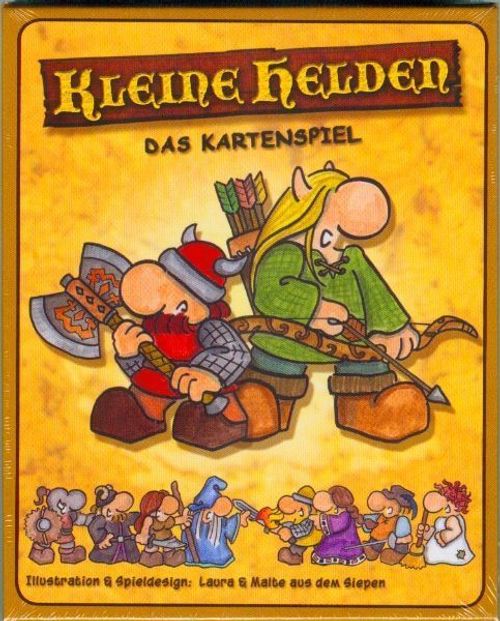
Kleine Helden
Kleine Helden Rulebook
Table of Contents
Table of Contents
- Spielinhalt (Contents)
- Spielziel (Goal of the Game)
- Spielvorbereitungen (Setup)
- Spielablauf (Course of Play)
- Das Ausstatten (Equipping)
- Kampf (Combat)
- Wirken eines allgemeinen Zaubers (Casting a General Spell)
- Karte ziehen (Drawing a Card)
- Taktik (grün) und Zaubertränke (blau) (Tactics (green) and Potions (blue))
- Weiteres aus dem Reich der Kleinen Helden (More from the Realm of the Little Heroes)
- Spielende (End of the Game)
- Ein paar Tipps am Ende (A Few Tips at the End)
- Die Symbole (The Symbols)
Spielinhalt (Contents)
162 playing cards (16 hero cards, 51 equipment cards, 40 magic cards, 50 tactics cards, 5 symbol cards), a six-sided die, this rulebook.
Spielziel (Goal of the Game)
You lead a group of humble but extremely aggressive fantasy heroes. Your task is to equip them with weapons, armour, spells and magic potions. Thus equipped, you send them into battle, where the heroes of your fellow players are already waiting. You win if at least one hero of your group is the last one left alive.
Spielvorbereitungen (Setup)
Die Heldenkarten (The Hero Cards)
The 16 hero cards (golden back) are sorted out and formed into two stacks of 8 magic and 8 non-magic heroes each; both are then shuffled. Each player in turn draws one hero card from each stack. The remaining heroes are then shuffled together again and form a card stack to the side.
Optional rule: Players do not distinguish between magic and non-magic heroes at the start, but draw their two heroes from a single stack containing all 16 hero cards.
Each hero has certain base values for fights and spells, shown by the symbols at the bottom of the card. In dealing with certain weapons or spells the hero is especially specialised; the corresponding bonuses are also printed on the card.
All heroes begin with 15 life points. The current value, which will probably be reduced over the course of the game, can be shown with dice, glass stones or coins – or whatever else your creativity brings.
Optional rule: For shorter fights or for games with more participants we recommend reducing the starting life points to 12 or even 10.
The symbols are explained at the end of this rulebook. In addition, the game contains an overview card with all symbols for every player.
Card diagram (hero card): magic / non-magic; specialisations of the hero; base values (armour, magic resistance, magic, parry, attack).
Card diagram (equipment card): one-handed or two-handed weapon; category; bonuses; rules text. Card diagram (magic card): category; rules text; bonuses and cooldown time. Card diagram (tactics card): category; rules text; effects.
Die Unterstützungskarten (The Support Cards)
The support cards form three card stacks: equipment cards (red), magic cards (blue) and tactics cards (green). All three stacks are shuffled and placed within easy reach of all players. Each card stack receives its own discard pile during the game. If a card stack is empty, the cards of the corresponding discard pile are shuffled and immediately put back into play.
The players now draw four support cards. With red equipment cards and blue magic cards they may equip their heroes immediately before the game starts (see Das Ausstatten).
Green tactics cards and blue potion cards the players take into their hand, as well as equipment and magic cards that are not laid out.
ACHTUNG: All cards are always drawn first, before they may be looked at.
Spielablauf (Course of Play)
Now it begins. The smallest player starts. All players take their turns one after another, clockwise.
At the start of a turn, each player draws two support cards of their choice, which they take into their hand. Then, for each of their own heroes, they may perform one action. After that their turn ends.
The following count as one action:
- equipping a hero with any number of equipment and magic cards
- attacking an opposing hero (with weapons or attack spells)
- casting a general spell (also conjurations)
- drawing one more support card
ACHTUNG: The following are not actions:
- playing a manoeuvre
- playing an event
- drinking a potion
- exchanging three hand cards for one support card
- buying a new hero
These activities are therefore possible in addition to an action or reaction (see the text of the respective card). Events, however, can only be played during one's own turn.
In addition, during an opponent's turn each hero of a player has one reaction, unless the player has the right card ready.
Reactions are:
- parrying a magic or non-magic attack
- casting a defensive spell
A hero thus cannot ward off two attacks from the same group.
Das Ausstatten (Equipping)
A player can equip their own heroes during their turn with any number of equipment and magic cards. In doing so they may take at most two already laid-out cards back into their hand.
Ausrüstung (rot) (Equipment, red)
Among the equipment cards are:
- Weapons. These can be used for non-magic attacks and parries.
- Shields. With shields, non-magic attacks can be parried.
- Armour. The more different body parts are protected by armour, the fewer damage points a hero loses through attacks.
- Artefacts. Some artefacts can also be used as weapons, some as armour.
Weapon cards can be slid to the right under the respective hero card, armour cards to the left, so that the symbols can still be read. Whoever has enough room on the table can of course lay the cards out next to each other as usual.
Each equipment card has certain values (see the symbols on the card), which are added to the base values of the hero card.
Magie (blau) (Magic, blue)
Among the magic cards are:
- Spells. There are attack spells (recognisable by the blood-drop symbol at the bottom right), defensive magic, and general spells (recognisable by the magic symbol at the bottom left with a fixed value) – including the conjurations. In addition, the card states which type of spell (for example, elemental magic) the spell belongs to.
- Conjurations (see below, Beschwörungsmagie).
- Potions. Potion cards are not laid out next to the heroes, but played spontaneously from the hand (see below, Zaubertränke).
Card examples: Zauberspruch (spell), Beschwörung (conjuration), Zaubertrank (potion).
Heroes can be equipped with spells and conjurations. These are, so to speak, written into the spell book and can be used again and again.
ACHTUNG: Spells and conjurations can also be used directly from the hand; they are, so to speak, used directly from the scroll, but after a single use they then go to the discard pile for magic cards.
Beim Ausstatten gelten folgende Einschränkungen (The following restrictions apply when equipping)
- Only magic heroes may use spells and conjurations.
- Potions and tactics cards cannot be laid out.
- No body part can be protected twice: a hero cannot be equipped with the plate armour and the leather armour at the same time. Two shields are not possible either.
- The hero has only two hands! According to the card text some weapons are one-handed, others two-handed. A hero can thus only own one two-handed weapon, two one-handed weapons, or one one-handed weapon and a shield. If the hero has two one-handed weapons, their bonuses are not added. He can, however, decide from case to case which one is used. The same applies to parry (with a parry the shield can of course also be chosen).
The players can give their heroes any number of equipment cards and magic cards per turn in order to equip another of their heroes with them. For each hero involved in this re-equipping, this counts as an action.
Kampf (Combat)
A hero who wants to attack a hero of an opposing group announces this. There are three different types of attack:
- Melee combat (melee weapon required)
- Ranged combat (ranged weapon required)
- Magic combat (attack spell required, recognisable by the blood-drop symbol at the bottom right)
Only magic heroes can make a magic attack.
ACHTUNG: If another hero wants to protect the attacked hero (see below, Beschützen), this decision must be made now. If the attacked hero wants to give up his parry (see below, Parade), he must also announce this now.
Both players now have the opportunity to play suitable cards (see Zaubertränke/Manöver).
Nahkampf (Melee Combat)
Attacke: Each hero has a base value for his attack (axe symbol). To this value the attacking hero adds all attack bonuses (equipment, specialisation, cards played from the hand). Finally he rolls the accompanying six-sided die and adds the result. If he rolls a 6, he may keep rolling until no more 6 comes up. All dice rolls are added together.
Example: The Amazon attacks the fairy with her two-handed weapon and rolls a 6. Therefore she rolls again – another 6! So she rolls a third time ... this time a 3. Her attack value is now: base value 6 + 2 bonus (through weapon) + 1 bonus (bladed weapon) + 6 (1st roll) + 6 (2nd roll) + 3 (3rd roll) = 24. That is going to be quite hard to parry for the little fairy ...
Parade: Each hero has a base value for his parry (shield symbol). To this value the defending hero adds all parry bonuses of his equipment and, if applicable, his specialisation. Finally he rolls the accompanying six-sided die and adds the result. If he rolls a 6, he may keep rolling until no more 6 comes up. All dice rolls are added together.
Continuation of the example: The little fairy bravely defends herself with her spear against the Amazon's attack. She rolls a 6 and therefore may immediately roll again. The second roll results in a 5. Her parry value is now: base value 1 + 2 bonus (through weapon) + 6 (first roll) + 5 (second roll) = 14. Ouch! That was not enough to ward off the Amazon's blow.
If the hero has neither a melee weapon nor a shield, he must dodge; then only the base value for parry on the hero card counts. He rolls anyway, however.
ACHTUNG: The parry is voluntary. The attacked player does not have to defend if he does not want to; but once he has announced his decision, he can no longer reverse it. If the player waives the parry, the attack is automatically successful.
Schaden (Damage): If the attacker has achieved the higher result, the attack was successful and the hero was hit. He must now take as many damage points as the blood-drop symbol on the attacker's weapon shows plus all bonuses. The hit hero can in principle deduct his armour protection (armour symbol) plus armour bonuses of his equipment beforehand. For each attack in which a 6 is rolled, one point more damage is caused; for each 6 rolled in the defence, the damage is reduced by one.
Continuation of the example: The fairy takes 7 points of damage: 8 (two-hander of the Amazon) + 2 (two 6s of the Amazon) - 1 (one 6 of the fairy) -2 (leather armour).
ACHTUNG: The armour protection (plus all bonuses through equipment) also counts if the same hero of an opposing group is attacked twice within one opposing turn, but has only one reaction. The base value for parry does not count in that case; the attack is automatically successful.
Fernkampf (Ranged Combat)
Ranged combat works basically exactly as described above for melee combat. However, the defending hero needs a shield in ranged combat in order to be allowed to roll for the parry; a melee weapon does not suffice here. Parry bonuses through weapons do not count. If he has no shield, he must dodge. The base value for parry on the hero card plus the die result then counts.
Magischer Kampf (Magic Combat)
Magic combat works basically exactly as described above for melee combat, but here it is not attacked with a weapon, but with an attack spell. For the attack the magic values (magic symbols) count. For the defence the magic resistance values (spiral symbols) count. It is not possible to ward off magic attacks with shields and weapons. Conversely, a weapon attack cannot be warded off with magic. (An exception are the two cards Schildzauber and Zweites Ich.) In magic combat too, the players may roll again after rolling a 6. In some attack spells the armour protection is ignored.
A special case is defensive magic. It is, in contrast to other spells, only effective in the reaction phase of a hero. Then neither the parry value (shield symbols) nor the magic resistance (spiral symbols) counts, but the hero uses his magic values (magic symbols).
Beschützen (Protecting)
A hero can protect another hero who is being attacked. The hero hurrying to help must accept a malus of -2 on his parry or magic resistance. A hero may also be protected by another player's hero; in that case the malus is -4. The protecting hero now counts as the attacked hero and conducts the combat. If the parry fails, the protecting hero suffers the damage. The decision whether a hero protects another must be made immediately at the beginning of a combat (and cannot be taken back either), before
- the first potions have been played,
- the first manoeuvre cards have been played,
- one of the combatants has rolled yet.
Wirken eines allgemeinen Zaubers (Casting a General Spell)
General spells are recognised by the fact that they have no bonus on the magic value (magic symbol), but a fixed value.
The hero rolls the die (as always, he may roll again on a 6 and adds this) and adds his base value for magic (magic symbol) as well as all bonuses. If he reaches at least the value shown on the spell, his spell is successful.
Casting a general spell is its own action.
Beschwörungsmagie (Conjuration Magic)
Conjurations are treated like general spells. A creature is conjured by a magic hero reaching at least the value on his magic symbol. (A 6 rolled in doing so does not increase the damage value (blood-drop symbol) of the creature, but entitles him to one more roll.) A conjured creature fights on the side of the hero group and is treated like a hero, unless a card text says otherwise. For the creature the player thus has one more action available per turn. However, it cannot be equipped, and it may not cast spells.
The life points of a creature are recognised by its heart symbol. If it is destroyed, it comes back as a spell to the magic hero who conjured it and can be conjured again by him. A creature also lives on if the hero who conjured it has been killed. If it then suffers a loss of life itself, however, it is discarded.
ACHTUNG: In the round in which a creature is conjured, it cannot yet attack.
ACHTUNG: If a creature is played from the hand and conjured, it is advisable to mark it. This way it is noticed that the creature card must be discarded when the creature dies.
Abklingzeit von Zaubersprüchen (Cooldown of Spells)
On each spell there is an hourglass symbol. The number on it states the cooldown time, that is, how many rounds a hero must wait after a spell has been reached before he may play it again. A cooldown time of 0 means that the spell can be cast again at the next action/reaction of the player. It is recommended to mark the spell card for the duration of the cooldown time with glass stones or to turn it by 90°. If the spell attempt was unsuccessful, the hero can try it again at his next action/reaction.
ACHTUNG: A spell played spontaneously from the hand is ignored with regard to the cooldown time. It goes to the discard pile for magic cards after its use – successful or not.
Karte ziehen (Drawing a Card)
If the hero does not want to make any of the actions described above, he instead draws one more support card. A player may keep any number of cards in his hand.
Taktik (grün) und Zaubertränke (blau) (Tactics (green) and Potions (blue))
No action is needed for manoeuvres, events and drinking potions.
Manöver (Manoeuvres)
Manoeuvres are found among the green tactics cards. They are played directly before a die roll within an action/reaction from the hand. Any number of manoeuvres can be played at once. Manoeuvres are not an action/reaction, but presuppose that the hero still has an action/reaction. After their use the card goes to the discard pile for tactics cards.
ACHTUNG: Some manoeuvres apply only to the attack, others only to the parry.
Ereignisse (Events)
Events are found among the green tactics cards. Each player may play at most one event per round. This can be done at any time during his own turn, except when he is in combat. If a player has lost his last hero (or his last creature) in combat, he may no longer play an event. After their use the card goes to the discard pile for tactics cards.
Zaubertränke (Potions)
Potions are found among the blue magic cards. They are played directly before a die roll within an action/reaction from the hand, unless the card text says otherwise. Non-magic heroes can also drink potions. Any number of potions may be played. After its use a potion card always goes to the discard pile for magic cards.
Weiteres aus dem Reich der Kleinen Helden (More from the Realm of the Little Heroes)
Heldentod (Hero's Death): If a hero has lost all life points, he is dead at once. The player whose hero struck the decisive blow may plunder one equipment card of the deceased hero of his choice and take it into his hand. The remaining cards of the deceased go to the respective discard piles. The killed hero is removed from the game entirely.
ACHTUNG: A creature that is still alive and had been conjured by the deceased cannot be plundered. It lives on until it in turn has lost all life points. Then it goes to the discard pile for magic cards.
Neuer Held (New Hero): At any time during his own turn a player may exchange eight cards of his choice from his hand for a new hero. In this case the hero stack comes into play again.
No player may buy more than one hero in the course of the game. A new hero may perform an action immediately after "appearing".
Eintauschen (Exchanging): At any time during their own turn the players may discard three support cards of their choice from their hand and draw one card of their choice.
Spielende (End of the Game)
If a player loses all his heroes and creatures, he is immediately out of the game. He may then no longer play any cards. The game ends when only one player is left who has at least one hero or one creature. He has then won.
Ein paar Tipps am Ende (A Few Tips at the End)
- Of course it is also possible for the players to choose their heroes at the beginning.
- In a 2-player game the players can also start with three heroes.
- If these rules and a card text contradict each other, the card text prevails in case of doubt.
- To shorten the game, the players can agree on a fixed playing time at the beginning. After this time has elapsed, the player whose heroes and creatures have the most life points added together wins.
Die Symbole (The Symbols)
- Magic / non-magic symbol (pentagram with shield, at the top right of the hero card): states whether a hero is magic or non-magic. Only magic heroes may cast spells and conjurations.
- Heart (life points): Life points symbolise the current state of health of a hero/creature. If the value drops to 0, he/she is dead at once.
- Axe (non-magic attack value): In a non-magic attack all non-magic attack values (hero, equipment, further bonuses) are added to one die roll.
- Shield (non-magic parry value): In a non-magic parry all non-magic parry values (hero, equipment, further bonuses) are added to one die roll. If a hero is not equipped with a weapon, he can dodge with his basic parry value (on the hero card).
- Pentagram (active magic value): In an attack or the casting of a spell, all magic attack values (hero, equipment, further bonuses) are added to one die roll.
- Spiral (magic resistance): In defence against a magic attack, all magic resistance values (hero, equipment, further bonuses) are added to one die roll.
- Armour: In a successful attack, all armour values (hero, equipment, further bonuses) are subtracted from the damage points. Some spells ignore armour.
- Blood drop (damage value): The damage value of a weapon or spell shows how many points of damage a hit hero suffers. Before that, however, his armour protection points are deducted as a rule.
- Hourglass (cooldown time): The cooldown time of spells shows how many rounds must be waited until a hero can use a spell again.