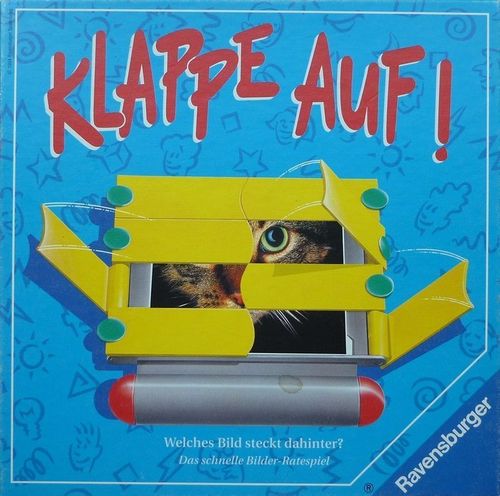
Klappe auf!
Klappe auf! Rulebook
Table of Contents
Table of Contents
Components
- 1 picture box with 8 flaps and 2 compartments on the back, labelled "Correct" (Richtig) and "Wrong" (Falsch)
- 108 picture cards, printed on both sides (216 pictures)
- 3 picture templates (Bildschablonen)
- 1 game board
- 6 playing pieces in 6 colours
- 18 tip cards in 6 colours, 3 tip cards per colour
Object of the Game
The player who first reaches the goal with their playing piece wins the game.
Setup
- Place the game board in the middle of the table.
- Set up the picture box, shuffle all picture cards, and put them back into the box. It does not matter how or which picture is on top: a picture may be upside down or sideways.
- Each player receives a playing piece, which they place on the start space, and the 3 tip cards in their colour, which they keep in front of them.
The Game Leader
The oldest player is the first Game Leader (Spielleiter). They take the picture box and turn it so that the flaps face them.
They open all the flaps and place the front picture, which everyone saw while the box was being filled, at the very back of the stack. The picture now at the front must be guessed by the other players.
The Game Leader looks at the picture carefully, keeping it secret. If the Game Leader is not sure what the sought term is exactly, they secretly read the term under the corresponding picture number at the end of this rulebook (see the Picture List). The picture number is printed on the edge of the picture card. In the example in the original rules, the term to be guessed is "Clown".
The Game Leader then closes all the flaps and turns the picture box so that all players can see the flaps well. The game can begin: "Open the first flap!"
Guessing
The Game Leader opens any flap (with a finger at the edge). A small part of the picture becomes visible. What could it be? Quite clearly it is... or perhaps not? All the other players puzzle out loud.
Whoever has an idea what it might be gives one of their 3 tip cards to the Game Leader and names the term out loud.
In the example, Hugo (red) gives one of his tip cards and says "Bonbon" out loud.
The Game Leader secretly places the tip card in the "Correct" compartment or the "Wrong" compartment on the back of the picture box, depending on whether the term is right or wrong.
In the example, "Bonbon" is wrong, so the card goes into the "Wrong" compartment. The Game Leader says nothing at all; everything is strictly secret. The other players do not know whether "Bonbon" is right or wrong, and they keep guessing.
If no other player wants to make a guess, the Game Leader opens the next flap.
After 3 flaps have been opened, Eva (green) is quite sure it is a "Clown". She gives her tip card and names the term out loud. Tom (yellow) says that Eva is right, that it is a "Clown", and gives one of his tip cards.
Any player may at any time join an already named guess of another player. To do so, they name the term again out loud and give one of their tip cards.
Tip Cards
Each player may (but does not have to) make up to 3 guesses per picture. It does not matter whether another player has already made the same guess before.
The 3 guesses (terms) that one player may make must be different from each other.
If a player is completely sure they know the correct term, they may still give only 1 tip card for it.
Speed matters when giving a tip card: whoever gives their tip card first may name the term first.
The Game Leader stacks the tip cards in the two compartments "Correct" and "Wrong". The card given first is at the very bottom, and the card given last is at the very top.
Revealing the Secret
The Game Leader keeps opening more flaps, and the players keep naming terms and giving their tip cards.
This continues until:
- all players have guessed the picture (every player has a tip card in the "Correct" compartment), or
- all players have given their 3 tip cards, or
- all flaps are open and no player has guessed the picture.
Now the guessing is over!
The Game Leader opens all the flaps, so everyone can see the picture. Quite clearly, it is...
...a "Clown"!
Scoring and Moving the Playing Pieces
For each tip card in the "Correct" compartment there are points. The Game Leader takes all the tip cards out of this compartment as one stack. The player who gave their tip card first, which is at the very bottom of the stack, receives 5 points
(in this example, Eva (green) receives 5 points)
and moves their playing piece 5 spaces forward. The player whose card lies on top of theirs moves their playing piece 4 spaces forward (in this example, Tom (yellow)). The next players may move 3, 2 and 1 spaces forward. The 6th player who guessed correctly receives nothing and their playing piece stays where it is.
The Game Leader always moves their own playing piece 3 spaces forward.
Note on the source: the main rules above say the Game Leader moves their playing piece 3 spaces. The Quick Rules at the end of the rulebook say the Game Leader "always receives 3 points". Both statements are printed as such in the source and are reproduced as printed.
Starting a New Round
When all playing pieces have moved forward and all tip cards have been returned to the players, a new round of guessing begins.
The player to the right of the current Game Leader, going clockwise, is the new Game Leader. They receive the picture box and turn it so that the flaps face them. They take out the picture card that was guessed in the previous round and place it at the back of the picture box. They look at the new picture secretly (or read the term in this rulebook), close all the flaps, turn the picture box around, open the first flap, and the game starts again.
End of the Game
The game ends as soon as the first playing piece reaches the goal.
But now it is "Klappe auf!" ... the game begins. (Printed as a closing line in the original rulebook.)
Picture Templates
For a harder game, simply slide a picture template in front of the top picture. The more the template covers the picture, the harder the guessing becomes. The other rules remain the same.
The simplest template is the one with circles. The most difficult is the one with rectangular cut-outs. It shows less than a quarter of the picture and has one special feature: it can be turned four times and shows a different section each time. With this template, every picture can be played through four times without the same picture section appearing twice.
Variant 1: Special Spaces
For more tension at the end of the game, play with the special spaces, with or without a template.
- A player whose playing piece stands on such a space may only keep 2 tip cards, and can therefore give only 2 tips per picture. A player who moves onto such a space for the first time must give up one of their tip cards.
- A player whose playing piece stands on such a space may only keep 1 tip card, and can give only 1 tip per picture.
All other rules remain the same.
Variant 2: Memo
This variant is also harder than the basic version and may be played with or without a template. The Game Leader opens the first flap, but before opening the second flap, closes the first one again. Before opening the third flap, the second one is closed again, and so on.
The players therefore only ever see a part of the picture and must remember what they saw before.
All other rules remain the same.
Picture List
The picture number is printed on the edge of each picture card. The Game Leader looks up the term under the number to check the answer. The English column is a translation; the German column is the term as printed in the original rulebook (spelling as printed).
| No. | English | German (as printed) |
|---|---|---|
| 1 | hair dryer | Fön |
| 2 | clothes peg | Wäscheklammer |
| 3 | trekking bicycle | Fahrrad (Trekking) |
| 4 | binoculars | Fernglas |
| 5 | pansy | Stiefmütterchen |
| 6 | hot dog | Hotdog |
| 7 | violin | Geige |
| 8 | sea turtle | (See)-Schildkröte |
| 9 |
Quick Rules
(Kurzspielregel, as printed at the end of the original rulebook.)
Game Leader:
- knows the picture alone
- opens the flaps one by one
- sorts the tip cards handed in into "Correct" and "Wrong"
- awards the points 5, 4, 3, 2, 1
- always receives 3 points
- changes clockwise
Other players:
- try to guess the picture as quickly as possible
- each player gives only one tip card per term named
- each player may name up to 3 different guesses per picture, and it does not matter whether someone else has already named the same guess
Points: Whoever first guessed the term correctly, which is the bottom tip card in the "Correct" compartment, receives 5 points and moves their playing piece 5 spaces forward. The next player, whose card lies above it, receives 4 spaces, the next 3, 2 and 1 spaces forward.
Note: the Quick Rules say "always receives 3 points" for the Game Leader; the main rules say the Game Leader always moves 3 spaces. See the note under "The Game Leader" above.