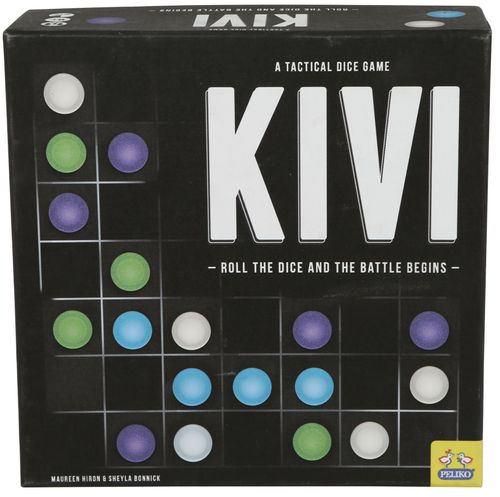
Kivi
Kivi Rulebook
Table of Contents
Table of Contents
Components
- 1 game board
- 6 dice
- 40 stones (10 per colour)
Aim of the Game
To score the most points by building lines of consecutive stones, either horizontally or vertically. The player with the most points after 10 rounds wins the game.
Preparations
Place the game board in the middle of the play area. Each player chooses the stones in one colour and piles all of the ten stones in front of himself. Decide the order of play by rolling one die.
Playing
In turn, players roll all 6 dice. The player may accept the roll or re-roll all or any of the dice. Up to two re-rolls are permitted in a turn.
If a player achieves any of the vacant targets on the game board, the player places one of his stones in the target square. There may be several options of where to place a stone. For example, when 6, 4, 4, 4, 2, 2 come up on the dice, the stone can be placed either in the "All even" square or in the "1 x 3 of a kind, 1 x Pair" square.
If five of a kind or a run of six (1, 2, 3, 4, 5, 6) is rolled, the player may place a stone on any vacant square.
If six of a kind is rolled, the player may take over any square, even if it is already occupied by another player's stone. The player places the displaced stone in any other vacant square.
If the player does not manage to roll any of the targets, he places a stone in the game box.
Once the player has placed a stone, on the board or into the box, the play continues clockwise.
Note 1. It is usually best to place stones on squares adjacent horizontally or vertically to those already occupied by oneself, if possible. (See Scoring)
Note 2. All of the dice are taken into account. If the player rolls 5, 5, 5, 3, 3, 2, he should place the stone in the "1 x 3 of a kind, 1 x Pair" square, not in the "3 of a kind" square.
Scoring
When each player has had 10 turns and all the stones have been placed, do the scoring.
Single stones count the value of the square in which they sit:
- Red squares are worth 3 points
- Black squares are worth 2 points
- White squares are worth 1 point
Lines of consecutive stones are worth the total of the single stones in the line, multiplied by the number of stones in the line. As the lines can be horizontal or vertical, some squares might score in two directions.
Targets on the Game Board with an Example Roll
| Target | Example roll |
|---|---|
| 2 Pairs | 1, 1, 2, 2, 5, 6 |
| 3 Pairs | 1, 1, 2, 2, 3, 3 |
| 3 of a kind | 1, 1, 1, 2, 3, 5 |
| 4 of a kind | 1, 1, 1, 1, 2, 3 |
| 1 x 3 of a kind, 1 x Pair | 1, 1, 1, 2, 2, 5 |
| 1 x 4 of a kind, 1 x Pair | 1, 1, 1, 1, 2, 2 |
| 2 Triples | 1, 1, 1, 2, 2, 2 |
| Run of 4 | 1, 2, 3, 4, 6, 6 |
| Run of 5 | 1, 2, 3, 4, 5, 5 |
| All odd | 1, 3, 5, 1, 3, 5 |
| All even | 2, 4, 6, 2, 4, 6 |
| 12 or less on 6 dice |
Illustration of Points Scored
The printed example shows the green player's stones on the board. Points for the green player:
- Across: stones 1 + 2 + 3 = 6, line in total 6 x 3 = 18
- Across: stones 3 + 2 = 5, line in total 5 x 2 = 10
- Down: stones 2 + 1 + 2 = 5, line in total 5 x 3 = 15
- Down: stones 2 + 3 = 5, line in total 5 x 2 = 10
- Singles: 1 + 2 = 3
Total = 56