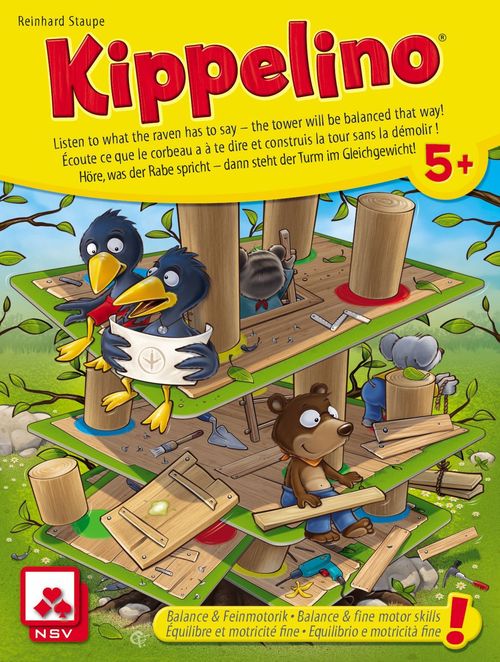
Kippelino
Kippelino Rulebook
Table of Contents
Table of Contents
Game concept
The tree house grows level by level. You place two wooden discs on the top board – and then place the next building board on top of them. Then another two discs and another building board, etc. – you must always place the wooden discs in the place indicated. The higher the tree house is built, the greater the danger it will collapse.
All the players form a team and try to use all the building boards and all the wooden discs (the "playing against each other" variant comes after the rules).
Materials
- 1 bottom plate
- 12 building boards (each with a front and a back)
- 24 wooden discs
Setting up the game
Place the bottom plate in the middle of the table. Place two wooden discs on the two places marked with an X. Mix up or shuffle the 12 building boards and put them down in a draw pile (with the architect raven facing up) next to the bottom plate. Keep the pile of 22 remaining wooden discs to hand.
- Bottom plate
- Concealed draw pile
Playing the game
You need to decide who begins and is the builder first. The builder takes the top building board from the draw pile and carefully lays it – board side up – on top of the two wooden discs. The builder can rotate and place the building board however they want. The builder takes two wooden discs from the pile and carefully places them on the new top building board (see "Building advice"). Both wooden discs must be placed on the colours which can now be seen on the top of the draw pile (architect raven).
Note: The two wooden discs don't have to be placed exactly in the middle of the colours. The main thing is that they both somehow touch the colour indicated by the raven, even just a little bit.
Example: Tim places the building board on top of the two wooden discs on the bottom plate. He then places the two wooden discs on red and green (as indicated by the raven) on the top building board.
The game continues in a clockwise direction with the next player becoming the builder and continuing to play as just described: take the top building board from the drawing pile, lay it on the tower with the board side up, and then place two wooden discs on top (noting the architect raven's colours!).
Example: Sarah first lays down the building board, and then places the two wooden discs (as indicated by the raven) on red and blue.
The game continues this way in a clockwise direction.
Building advice: When placing a building board on top, you should always consider where the next wooden discs need to go as the weight of the wooden discs could cause the whole construction to collapse.
Very important: You're absolutely allowed to put the next two wooden discs on the building board before placing it on top, and then putting both down at once: building board + 2 wooden discs at the same time. This can sometimes be very helpful in finding the right position for the building board. You're also allowed to carefully adjust the tower if it becomes wonky. However, you are not allowed to remove any building boards or wooden discs from the tower after they've been placed. It can also be helpful to carefully run your fingertips along the top of the tower every now and then to determine whether it has started leaning to one side.
The tower is considered to have collapsed if a building board touches the table top (or bottom plate). It doesn't matter what the upper levels look like – the main thing is that the table top and the bottom plate are not touched.
Should the team succeed in using all 12 building boards, a celebration and a topping out ceremony are in order!
Note: No wooden pieces need to be placed on the final building board.
All 12 building boards have been successfully used. Congratulations because that's really difficult!
Don't forget: You're a team! You should give younger players in particular a bit of help. You could say, for example, in which direction the building board should be turned to help with the balance of the tower. It's also allowed to hold the tower a bit while a building board is being placed, or even while it's being adjusted. Help each other!
Playing against each other
You can, of course, play against each other. Figure out who starts and then play as described. Whoever causes the tower to collapse on their turn scores one minus point. You keep playing until one player has three minus points (you can also do or more or fewer points, it's up to you). The player with the fewest minus points is the winner.
Note on the source text: the printed sentence "you can also do or more or fewer points" is transcribed as printed; the intended meaning is that the players may agree to play to more or fewer minus points.