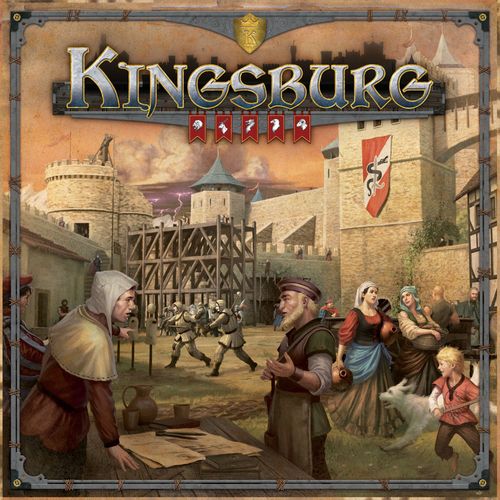
Kingsburg (Second Edition)
Kingsburg (Second Edition) Rulebook
Table of Contents
Table of Contents
- Object of the Game
- Your First Game
- Components
- Setup
- Playing the Game
- Winning the Game
- 2-Player Rule Changes
- Expansion Modules
- Clarifications
- Game Phase Summary
Object of the Game
Over the course of the game, players gain victory points (VP) by influencing the king's advisors, constructing buildings, and repelling the invading enemies. The game ends at the end of the fifth year, and the player with the most VP wins.
Your First Game
If this is your first time playing Kingsburg, we recommend playing the basic game, which does not use any of the expansion modules, and is explained below.
If you are already familiar with Kingsburg, feel free to use any of the expansion modules.
Components
- 1 Game Board
- 5 Province Sheets (double-sided)
- 20 "+2" Tokens
- 1 Season Marker
- 1 King's Envoy Marker
- 1 Year Marker
- 1 Rulebook
- 6 Bonus Dice
- 15 Player Dice (3 for each player)
- 15 Wooden Disks (3 for each player)
- 60 Goods: 25 Gold, 20 Wood, 15 Stone
- 120 Building Tokens (24 for each player)
- 25 Enemy Cards
- 5 Reference Cards
Expansion Module Components
- 14 Alternate Building Strips (2 copies of 7 different building strips)
- 30 Soldier Tokens (6 for each player)
- 24 Governor Cards
- 16 Advisor Tiles (for each advisor except the King and Queen)
- 29 Destiny Cards
- 4 Optional Scenarios
Setup
These are the setup steps for the basic game. If you are playing your first game, follow these steps. If you are using any expansion modules, also follow the setup steps listed under those modules.
-
Place the game board in the center of the table. On the game board, place the season marker on space "1" and the king's envoy marker on space "5" of the season track. Then place the year marker on space "I" of the year track.
-
To create the supply, place the goods and the "+2" tokens in their corresponding spaces on the board, and place the bonus dice near the board.
-
To create the enemy deck, sort the enemy cards into five piles according to the roman numeral shown on the card backs. Starting with year V and in descending order of year, randomly take one card from each pile without looking at it and place it in a facedown pile on space "8" of the season track. Return the remaining cards to the box without looking at them.
-
Each player chooses one color and takes the player dice, wooden disks, and building tokens of that color, a reference card, and a province sheet with its blue side faceup. Return any player pieces of unused colors to the box.
-
Each player places one of his wooden disks on space "0" of the soldier track and another disk on space "0" of the score track. Then collect each player's last wooden disk and place each of them on a different space of the turn order chart in a random order starting from the top.
Playing the Game
The rules below describe the basic game for 3 to 5 players. For additional rules for a 2-player game, refer to "2-Player Rule Changes" below.
The game is played over a series of five rounds called years. Each year is divided into eight phases: four seasons and four special events that occur before each season. The phases appear in the following order:
- The King's Favor
- Spring (First Productive Season)
- The King's Reward
- Summer (Second Productive Season)
- The King's Envoy
- Fall (Third Productive Season)
- Recruit Soldiers
- Winter (The Battle)
At the end of each phase, advance the season marker to the next space and proceed with the next phase.
Phases 1, 3, 5, and 7 are special events, such as the king helping certain players, or calling the soldiers to arms before battle.
Phases 2, 4, and 6 are productive seasons, during which players take turns influencing the king's advisors to gain different rewards and construct buildings. Productive seasons follow these steps:
a) Roll Dice and Set Turn Order b) Influence the King's Advisors c) Receive Advisor Rewards d) Construct Buildings
Unlike the other seasons, phase 8 is not a productive season. Each winter, players face the invading army, which is the top card of the enemy deck. Depending on the battle's outcome, players can gain or lose goods, VP, or even buildings.
At the end of each year, move the season marker back to space "1" of the season track and start a new year. The game ends at the end of the fifth year.
Open Information
Each player's goods, tokens, and province sheet are open information and must be visible to the other players at all times. All rolled die results must remain visible after rolling.
Phase 1: The King's Favor
The king needs all his governors to improve their provinces, so he helps the governor with the least-developed province. The player with the fewest constructed buildings on his province sheet gains one bonus die, which he rolls during this spring, and then returns to the supply when this spring ends.
If there is a tie for fewest buildings, the king helps the tied player with the fewest goods. If there is still a tie, the king helps all tied players. Each tied player gains 1 good of his choice instead of gaining a bonus die.
During the first year, because all players are tied, each player gains one good of his choice, and no one gains the bonus die.
Phase 2: Spring
Spring, the first productive season, is resolved as follows:
a) Roll Dice and Set Turn Order
Players roll all their dice simultaneously, including any bonus dice. Then, if players have effects that change die results or reroll dice, they may use those effects, following the current turn order.
After modifying dice, set the new turn order based on the total value of the dice rolled by each player. The player with the lowest dice total goes first, the player with the second-lowest dice total goes second, and so on. Rearrange the players' disks on the turn order chart accordingly.
If there is a tie, keep the disks of the tied players in the same order in relation to each other on the turn order chart.
Setting the Turn Order example: Players roll their dice at the start of Spring. Ann's dice total is 12, Brian's is 6, and Cindy and David each rolled a total of 9. The players now set the turn order.
Brian goes first because he has the lowest dice total. Cindy and David have the same dice total but Cindy's disk was previously in a higher position than David's, so she goes next, followed by David. Ann, who has the highest dice total, goes last this season.
b) Influence the King's Advisors
In turn order, players either influence one advisor or pass. A player who passes cannot influence advisors for the rest of this season.
To influence an advisor, a player assigns one or more of his dice to the advisor's space on the board. The total value of the assigned dice must be exactly equal to the advisor's rank (indicated on the shield by his or her portrait).
Each advisor can be influenced by only one player, so a player cannot assign dice to an advisor who already has dice assigned to it.
If a player has no dice left or cannot legally assign any dice he has left to influence the advisors (see "Bonus Dice and '+2' Tokens"), that player must pass.
When all players have passed, this step ends.
Bonus Dice and "+2" Tokens
During the game, players gain bonus dice and "+2" tokens that they can add to their player dice to influence the advisors.
A player may assign bonus dice exactly like player dice, but he cannot assign only bonus dice to influence an advisor; he must assign at least one player die.
When assigning dice to influence an advisor, a player can use a single "+2" token to increase the dice total by exactly two.
Each player can use only one "+2" token per productive season.
A player can use a "+2" token on a group of dice that includes a bonus die.
Influencing the King's Advisors example
Ann goes first and assigns her 3 and 5 to the Treasurer (#8). David notices that no one else rolled a 3, so he decides to assign his 2 and 5 to the Astronomer (#7), and saves his 3 for later. Brian could influence the Champion (#13), but instead he decides to go all in and assigns his 4, 4, 5, and his "+2" token to the Inventor (#15). Cindy can no longer assign her 2 and 6 to the Treasurer (#8) because of Ann, so instead she assigns her 2 and 2 to the Merchant (#4).
Now it is Ann's turn again. Since her only die left is a 1, she assigns it to the Jester (#1). David is next, and he assigns his 3 to the Architect (#3) as planned. Brian has no dice left, so he passes. Cindy assigns her remaining 6 (yellow die) and 6 (bonus die) to the Duchess (#12).
No player has any dice left, so this step ends.
c) Receive Advisor Rewards
In ascending order of rank, each advisor helps the player who influenced him or her. If there are no dice assigned to an advisor, skip that advisor. Each advisor's rewards are:
- Jester — Gain 1 VP.
- Squire — Gain 1 gold.
- Architect — Gain 1 wood.
- Merchant — Gain 1 gold or 1 wood.
- Sergeant — Recruit 1 soldier (advance your disk one space on the soldier track).
- Alchemist — Spend 1 good of your choice to gain the other 2 goods (e.g., spend 1 stone to gain 1 gold and 1 wood).
- Astronomer — Gain 1 good of your choice and 1 "+2" token.
- Treasurer — Gain 2 gold.
- Master Hunter — Gain 1 gold and 1 wood or 1 stone and 1 wood.
- General — Recruit 2 soldiers and secretly look at the top card of the enemy deck. Then return it facedown on top of the deck.
- Swordsmith — Gain 1 gold and 1 stone or 1 stone and 1 wood.
- Duchess — Gain 2 goods of your choice and 1 "+2" token.
- Champion — Gain 3 stone.
- Smuggler — Spend 1 VP to gain 3 goods of your choice. You can spend 1 VP even if you have zero or negative VP by moving your token back on the score track (e.g., from space "0" to space "59").
- Inventor — Gain 1 stone, 1 gold, and 1 wood.
- Wizard — Gain 4 gold.
- Queen — Gain 2 goods of your choice and 3 VP and secretly look at the top card of the enemy deck. Then return it facedown on top of the deck.
- King — Gain 1 gold, 1 stone, and 1 wood and recruit 1 soldier.
When all players have gained rewards from their advisors, each player takes back his player dice. If any "+2" tokens were used this season, return them to the supply. Also, return all bonus dice to the supply.
d) Construct Buildings
In turn order, each player may construct one building.
To construct a building, a player spends goods equal to its cost shown on his province sheet. Then he places one of his building tokens on its building space of his province sheet to show that he owns it, and immediately gains the number of VP shown on that building's red banner.
In each row there is only one building that can be constructed, which is the leftmost building not already constructed. A player can construct a building only if he already owns all the buildings located to its left in the same row.
If a player currently owns a building, he cannot construct a second copy of that building.
The player who has the king's envoy can use it to construct one additional building this turn (see "Phase 5: The King's Envoy").
Constructing a Building example
Ann has 2 gold and 1 wood. She spends 2 gold to build the Statue. To show that she now owns the Statue, she places a building token on the Statue's space of her province sheet. The Statue is worth 3 VP, which she gains by advancing her disk on the score track three spaces. Now that she owns the Statue, she will be able to build the Chapel during a later productive season.
As long as a player owns a building, he benefits from its effect described on his province sheet. For more details on building effects, see "Building Clarifications" below.
Building Restrictions example
Ann can build any of the highlighted buildings because they are either located in the leftmost column or she already owns the buildings located to their left.
Phase 3: The King's Reward
The king is pleased with his most prosperous governor. The player who owns the most buildings immediately gains 1 VP. If there is a tie, all tied players immediately gain 1 VP.
Phase 4: Summer
Summer, the second productive season, is resolved just like spring.
Phase 5: The King's Envoy
The king sends his most trusted envoy to help the governor with the least developed province. The player who owns the fewest buildings takes the king's envoy marker.
If there is a tie for fewest buildings, the tied player with the fewest goods takes the king's envoy marker. If there is still a tie, no one takes the marker.
The king's envoy can be used during any productive season to use one of the following effects:
- Influence an advisor who has already been assigned dice (by yourself or another player). Assign your dice to influence the advisor following the normal rules. For this season, the advisor will give his or her reward twice.
- Construct one additional building during the last step of a productive season. Spend goods equal to each building's costs and follow all the normal building rules.
After using the king's envoy marker for either effect, return the marker to its space on the season track. If a player does not use the king's envoy before the start of phase 5 the following year, he simply returns the marker to its space on the season track.
Phase 6: Fall
Fall, the third productive season, is resolved just like spring.
Phase 7: Recruit Soldiers
In turn order, each player may recruit soldiers to prepare for the impending invasion. A player can recruit any number of soldiers by spending two goods of his choice per soldier. For each soldier he recruits, he advances his disk one space on the soldier track.
Phase 8: Winter
Winter is not a productive season. Instead, the players must face an invading enemy army.
First the king sends reinforcements to help each governor defend his province; the first player rolls a single die, which applies to all players. Each player advances his disk a number of spaces on the soldier track equal to the die result.
Next, reveal the top card of the enemy deck, which is the threat facing the players this winter.
Enemy Card Anatomy
Each enemy card shows: the enemy's strength, the penalty if the players are defeated, and the reward if the players are victorious. The back of each enemy card shows the enemy's range of possible strengths, giving the players a sense of what to expect.
Then determine each player's battle strength: add any modifiers (positive or negative) from buildings he owns to his position on the soldier track.
Finally, determine the outcome of each player's battle by comparing his battle strength to the enemy's strength.
- If a player's battle strength is higher than the enemy's strength, the player is victorious and gains the rewards shown on the enemy card. If the player also has the highest battle strength, or is tied for the highest, he immediately gains 1 VP.
- If a player's battle strength is equal to the enemy's strength, the player barely manages to repel the attack and does not gain any rewards or suffer any penalties.
- If a player's battle strength is lower than the enemy's strength, the player is defeated and suffers the penalties shown on the enemy card.
Types of Battle Penalties
- Lose Goods: The player returns any goods lost to the supply. If he does not have enough goods of the corresponding type, he simply loses all the goods of that type.
- Destroy Building: Destroy the rightmost building on the player's province sheet. If multiple buildings are eligible, destroy the building that is also the closest to the top. When a building is destroyed, the player removes his building token from its space and immediately loses the number VP shown on that building's red banner. That player can construct that building again during a future productive season.
- Lose Victory Points: The player moves his disk back the number of spaces on the score track indicated by the penalty.
Resolving a Battle example
The players reveal the top card of the enemy deck: an army of Goblins with a strength of 4.
Ann's battle strength is 4 (2 soldiers + 1 from the Palisade, + 1 from the Barricade), so the battle ends in a tie; no rewards and no penalties for Ann.
Brian's battle strength is also 4 (3 soldiers + 1 from the Guard Tower); no rewards and no penalties for Brian.
Cindy's battle strength is 5 (2 soldiers + 1 from the Guard Tower + 1 from the Blacksmith + 1 from the Barricade). She is victorious and gains 1 stone as a reward. Since she also has the highest battle strength, Cindy gains 1 VP immediately.
David's battle strength is only 3 (1 soldier + 1 from the Barricade + 1 from the Guard Tower). He is defeated and must lose 2 gold, but he has no gold and 1 wood, so he does not lose any goods. The Goblins also destroy one of his buildings. David owns five buildings: the Inn, Guard Tower, and Barricade in the first column, and the Market and Crane in the second column. Of these five buildings, the Market is in the rightmost column and topmost row, so it is destroyed. David removes his building token from the Market space on his province sheet.
After resolving all battles, return the enemy card to the box and reset each player's disk to space "0" on the soldier track.
End of the Year
After winter (phase 8) is finished, the current year ends. If it is the end of year V, the game ends.
Otherwise, advance the year marker one space and place the season marker on space "1" of the season track to begin a new year.
Winning the Game
At the end of the fifth year, the player with the most VP wins. In case of a tie, the tied player with the most goods wins. If there is still a tie, the tied player who owns the most buildings wins. If there is still a tie, all tied players share the victory.
2-Player Rule Changes
With two players, the game is played normally, except for one additional step during each productive season:
At the start of each productive season, before doing anything else, roll three player dice of an unused color. Assign these three dice to influence the advisor whose rank matches the dice total. Then roll two player dice of a different unused color and assign them to influence another advisor in the same way.
If the dice total of the second roll is the same as the first, instead assign each die of the second roll to influence the advisor whose rank matches the die result. If both dice show the same result, assign one die and set aside the other for this season.
Because these advisors have been influenced, players cannot influence them during this season unless someone uses the king's envoy to do so.
At the end of the productive season, remove these dice so they can be used again during the next productive season.
Component Limitations
When you gain or spend goods or tokens, take them from or return them to the supply. The supply is considered unlimited. If at any time the supply runs out of any goods or tokens, use a substitute. There is no limit to how many goods or tokens a player can possess.
Beyond the Basic Game
Now that you have read these rules, you are ready to play your first game. If any questions come up, see "Clarifications" below.
The basic game already has a lot to offer, but you might want to add some expansion modules for variety. You can find detailed instructions on how to use the different expansion modules below.
Expansion Modules
This section of the rulebook explains how to use the six expansion modules included with the game. You can add any number of these modules in any combination to the basic game.
If you decide to use multiple modules, set them up one at a time in ascending numerical order.
Module 1: More Buildings
This module offers new building options.
Setup
Instead of using the blue side of the province sheet as recommended in the basic game rules, all players use the red side of the province sheet.
During the Game
Players have seven rows of buildings instead of five. All rules for constructing and destroying buildings stay the same.
Scenario Sheets
These four scenarios were originally written by the designers for fun to be published online for free. Each scenario offers a set of additional rules that affect the game differently to renew the game experience.
Before setting up the game, players decide if they want to play using a scenario. They can either choose a specific scenario or choose one randomly.
All rules specific to a scenario are included on its sheet. Unless specified otherwise, each scenario can be played using any of the expansion modules.
Module 2: Alternate Buildings
This module offers alternate building strips, each of which covers an entire row of a province sheet, replacing the original buildings.
Setup
At the end of setup, before starting the game, shuffle all 14 alternate building strips facedown. If the players are using module 2 but not module 1, remove the A and G strips.
Deal two strips to each player. Then each player chooses whether to use both, one, or none of those strips. If a player is dealt two identical strips, he may return one of them in exchange for another random strip.
Place each chosen alternate building strip on the province sheet to cover the row with the matching letter, replacing it. Return all unused strips to the box.
During the Game
All rules for constructing and destroying buildings stay the same. For questions about a specific building, see "Building Clarifications" below.
Drafting Variant
Instead of randomly dealing strips at the end of setup, if all players agree, they can draft them as follows:
Place all of the strips faceup. The first player, who was randomly determined during setup, selects one building strip, followed by the next player in clockwise order, and so on until each player has chosen one strip.
Then, starting with the player who chose last and proceeding counterclockwise, each player chooses one strip until all players have chosen a second strip.
Each player simultaneously chooses which strips, if any, he will use this game. Return all unused strips to the box.
Module 3: Governor Cards
This module offers governor cards, which represent you, the player. Each governor has a unique effect that can be used during the game.
Setup
At the end of setup, before starting the game, shuffle the governor cards and deal three cards facedown to each player. Return the remaining cards to the box. Each player chooses one of his three governor cards to keep, places it facedown in front of him, and returns the other two cards to the box.
After all players have chosen a governor, they simultaneously reveal their cards. Each governor card has an effect that benefits the player who chose it.
During the Game
By default, governor effects are optional unless they constitute a restriction ("you do not gain…").
Most governor effects can be used only once per season, while some effects can be used once per year, or only once at the start or at the end of the game.
The only governor effects that can be used multiple times start with the phrase "Whenever…". They are the Tax Collector, the Carpenter and the Sculptor's second effect.
Some governor effects can be used only when certain conditions are met. If these conditions are not met, the effects cannot be used.
Some governors, like the Damsel or the Carpenter, have more than one effect. These effects are independent of each other and may be used at different times during the game.
For questions about a specific governor, see "Governor Card Clarifications" below.
Module 4: Destiny Cards
This module offers destiny cards, each of which has an effect that lasts for an entire year.
Setup
At the end of setup, before starting the game, shuffle the destiny cards and place them facedown near the game board to create the destiny deck.
During the Game
Each year, at the start of phase 1, draw the top card of the destiny deck and read it aloud.
This card's effect applies during the whole year. At the end of the year, discard the card.
Destiny card effects are mandatory unless specified otherwise ("each player may spend…").
For questions about a specific destiny card, see "Destiny Card Clarifications" below.
Module 5: Soldier Tokens
This module offers soldier tokens, which replace the die roll during phase 8 to determine the king's reinforcements.
Setup
Each player takes the six soldier tokens of his color.
During the Game
During each phase 8, do not roll a die for the king's reinforcements. Instead, before the enemy card is revealed, each player simultaneously and secretly chooses one of his soldier tokens.
When all players have chosen a token, simultaneously reveal the tokens. Each player gains soldiers equal to the number shown on his revealed token as reinforcements. Return all of the revealed soldier tokens to the box.
Game End
Each player gains VP equal to the number shown on his remaining soldier token.
Module 6: Alternate Advisor Rewards
This module offers advisor tiles, which add a new twist to the game by changing advisor's rewards for advisors #1–16.
Setup
At the end of setup, before starting the game, shuffle the advisor tiles and place them facedown near the board.
During the Game
At the start of each productive season, the first player in turn order draws one tile, reveals it, and places it on the matching advisor. For the rest of the game, this advisor provides the effect shown on the tile instead.
The rewards of each alternate advisor are explained here:
-
Jester — Gain the rewards from the advisor with the next lowest rank who has not been influenced this season.
-
Squire — Gain 2 "+2" tokens or spend 1 "+2" token to gain 1 gold and recruit 1 soldier.
-
Architect — Gain 1 good, chosen by the player on your left.
-
Merchant — Gain 1 good of your choice from this tile. When this tile is first placed on the board and whenever there are no goods on it, place 1 gold, 1 wood, and 1 stone from the supply onto this tile. If multiple players influence this advisor during the same season (for example, by using the king's envoy), they gain this advisor's reward in turn order.
-
Sergeant — Gain the good on this tile. When this tile is first placed on the board and whenever there are no goods on it, roll a die. On a 1–2, place 1 gold; on a 3–4, place 1 wood; and on a 5–6, place 1 stone on this tile. If multiple players influence this advisor during the same season (for example, by using the king's envoy), they each gain 1 good of the same type as the good on this tile, taken from the supply. Then return the good on this tile to the supply, and replace it by rolling a die.
-
Alchemist — Spend 1 good of your choice to recruit 1 soldier and gain 1 VP or spend 1 VP to gain 1 good of your choice and recruit 1 soldier or spend 1 soldier to gain 1 good of your choice and gain 1 VP. You can spend 1 VP even if you have zero or negative VP by moving your token back on the score track (e.g., from space "0" to space "59").
-
Astronomer — Choose an opponent; he gains 1 good of his choice, then you gain 2 goods of the same type.
-
Treasurer — Gain 1 good, chosen by the player on your left. Then gain 1 good, chosen by the player on your right. In a 2-player game, your opponent chooses both goods.
-
Master Hunter — Choose two different rewards from among these:
- Gain 1 gold
- Gain 1 wood
- Gain 1 VP
- Recruit 1 soldier and gain 1 "+2" token
-
General — Gain 2 gold or 2 wood or 2 stone.
-
Swordsmith — Gain 1 stone and recruit 1 soldier and gain 1 VP.
If you are the player with the fewest goods (or tied for fewest), you may choose not to recruit the soldier or gain the VP (but not both) to gain a second stone.
Inverted Order Variant
After you have used the standard rules for this module, you can try this variant:
At the end of setup, place all of the advisor tiles on the matching advisors. At the end of each productive season, remove the advisor tile from the advisor of highest rank who was influenced this season. If no advisor with an advisor tile was influenced this season, instead return the advisor tile of lowest rank still in play to the box.
Clarifications
- Players can have negative VP. Track this by moving the player's disk back past space "0" of the score track. So space "59" acts as space "–1," space "58" as space "–2," and so on.
- There is no limit to the number of bonus dice you may roll during a single productive season.
- If you have multiple bonus dice, you may add them to a group of dice to influence the same advisor, but only if that group includes at least one player die.
- Battle modifiers (shown as "+1", "+2", "+3", or "–1") are added to the soldier track only after determining the players' battle strength during phase 8, not beforehand.
- In case of a timing conflict between different players' effects, the turn order determines who goes first.
- If your governor and/or your building effects occur at the same time, you choose the order in which to resolve them. After resolving an effect, check if the remaining effects still apply and if conditions have been met for new effects to occur. You can use effects that depend on dice total (such as the Heiress's, the Priest's, and the Prince's effects) only after all reroll effects have been resolved.
Building Clarifications
General Clarifications
- Building effects are optional unless they constitute a penalty ("–1 battle strength") or a restriction ("you must…," "you do not…," "this building cannot…").
- Most building effects can be used only once per season or phase. This includes effects that occur "at the start of…" or "at the end of…" a season, and battle modifiers (such as "+1 battle strength"). If you use one of those effects, flip that building's token to show that the effect has been used during the current season.
- A few building effects can be used only once per game ("At the end of the game…") or have an ongoing effect, such as the Mint and the Basilica.
- Other building effects can be used multiple times per season or phase and start with the phrase "Whenever you…". They are the Barracks, Stables, Crane, Recruiting Office, Woodshop, and Architects' Guild.
- Some buildings, like the Farm or the Fortress, have more than one effect. These effects are independent of each other and may be used at different times during the game.
- Some buildings' effects can be used only when certain conditions are met. If these conditions are not met, the effects cannot be used.
- Buildings whose effects occur "at the end of" a season can be used during the same season in which they were constructed. (For example, if you build an Inn during summer, you would gain the "+2" token provided by the Inn at the end of that summer.)
Specific Building Clarifications
Altar: Bonus dice are included in your dice total.
Architects' Guild: You do not gain an extra VP for constructing the Architects' Guild. Extra VP are not lost if a building is destroyed, even the Architects' Guild itself. You must still own the Architects' Guild at the end of the game to gain its bonus of 3 VP.
Barracks: You may use this effect multiple times when recruiting soldiers.
Bazaar: You can use this building to influence the Politician governor card, but only for its rank #5 reward.
Brewery: The Brewery's effect is not optional; you cannot choose to keep your soldier.
Chapel: You can use both the Statue and the Chapel during the same season, but each effect can be used only once. For example, if you roll your player dice and one bonus die and roll 2, 2, 2, 2, you can use the Statue's effect to reroll one die. If the rerolled die shows a 1, your total is now 7, so you can still use the Chapel to reroll all your dice. However, if the new total happened to be higher than 7, or if you had rolled four identical numbers again, you could not reroll any more dice this season.
Crane: The Crane gives you a discount of 1 gold when constructing buildings in columns III and IV. For example, constructing the Farms will cost you only 1 gold (instead of 2 gold), 3 wood, and 1 stone.
Griffin Ranch: Bonus dice are included in your dice total.
Hidden Refuge: When a building is destroyed, this building does not prevent you from losing the number of VP shown on the destroyed building's red banner.
Inn: If you have built the Inn and the Town Hall, you may spend the Inn's "+2" token immediately to use the Town Hall.
Makeshift Defenses: This building's effect works against any enemy whose strength is 5 or less. When checking to see if this effect applies, ignore effects that modify the enemy's strength (such as the "Fierce Enemies" or "Green Power" destiny cards).
Market: The Market allows you to influence an advisor whose rank is one point higher or lower than the sum of your assigned dice. For example, you can use a group of dice whose total is 9 to influence the Treasurer (#8) or the General (#10). When using this effect, it is recommended that you assign your dice without changing their value, to remind yourself that you have used the Market's effect this season.
Military Academy: When playing with modules 1 and 5, roll one die for the Military Academy and divide the result by two (rounded up). Roll the die after choosing a soldier token.
Monastery: "+2" tokens are not goods, so they do not prevent you from gaining VP from the Monastery.
Ramparts: You do not need to spend 1 stone to be victorious in case of a tie.
School: This building is used at the end of phase 7, so soldiers recruited during that phase count toward activating the School's effect.
Stables: When you influence the General (#10), recruit 3 soldiers instead of 2. When you influence the Sergeant (#5) or the King (#18), recruit 2 soldiers instead of 1.
Statue: You can use both the Statue and the Chapel during the same season, but each effect can be used only once. For more information, see "Chapel" above.
Town Hall: You can use the Town Hall only once per season. As a result, you cannot spend 1 "+2" token and 1 good to get 2 VP, nor can you spend 2 tokens or 2 goods. If you have built the Inn and the Town Hall, you may spend the Inn's "+2" token immediately to use the Town Hall.
University: Bonus dice are included in your dice total.
Governor Card Clarifications
Architect: While determining whether any opponents own more buildings than you, the Architect counts any buildings constructed by players before you in the turn order.
Carpenter, Miner, Sculptor: These governors do provide the free good at the end of year V. This good counts toward the extra VP awarded by the Cathedral.
Minstrel: The Minstrel's effect is the last one to be resolved at the end of each year, after players have gained rewards from battle, governor cards, and buildings (and, when using Module 5, after soldier tokens at the end of the game).
Philosopher: You may use this effect before or after the effect of the Statue, Chapel, or Altar. You gain 1 VP if your dice total is less than 10 after using the Philosopher's reroll effect and only if you use no other effect to reroll your dice again.
Politician: Other players cannot influence the Politician. You can assign your own dice to one or both of the advisors on this card. The rewards from these extra advisors on the card are awarded at the same time as the advisors on the game board with the same ranks. Assigning dice to this card does not prevent you from assigning other dice to the game board and vice versa.
Preacher: You gain 1 VP thanks to the Preacher even if you are the player who did not construct any buildings this season.
Priest: Any effects used to gain bonus dice that occur "at the start of" the productive season (such as the Farms, Vineyard, or Fairy) are resolved before the effect of the Priest's divine blessing.
Prince: Bonus dice are included in your dice total. However, the Prince's effect changes only your player dice (changing their values into 3, 4, and 6).
Sorcerer: If there are fewer than 3 buildings available to construct in column I, simply construct the remaining buildings in that column. If any of those buildings are destroyed, you still lose the number of VP shown on the destroyed buildings' red banners.
Tax Collector: You gain the good immediately after an opponent constructs a building, so you can spend the good during the same season.
Destiny Card Clarifications
Famine: If you have the Prince governor card, you can change your two dice into a 6 and a 3, a 6 and a 4, or a 4 and a 3.
Good Year: If the Priest invokes a divine blessing, in turn order, each player gains 1 bonus die and chooses if he gains 1 good from Good Year or 1 VP from the Priest. Players who already have any bonus dice from other effects (such as the Farms, Vineyard, Fairy, or phase 1) gain 1 VP and 1 good.
The King Is Sick: If the king dies, endgame effects are still resolved. Any endgame bonuses are also scored including the Paladin (from module 3), and all unused soldier tokens (from module 5).
Rising Stars: You gain the good (or token) immediately after assigning dice to the advisor. If you have the Duke governor card, you can assign dice to an advisor to gain the good (or token) placed on the advisor and later move those dice to the Duchess (#12). Do not place goods on the Politician governor card.
Secret Deals: You may place your token on another player's Politician governor card, but you cannot influence him. If you placed your token on the Politician, the player who owns the Politician can influence him only if he places his token on it.
Urban Expansion: If you can build an extra building (for example, by using the king's envoy), it is possible for either effect on this card to occur more than once.
Game Phase Summary
- The King's Favor — The player who owns the fewest buildings gains a bonus die to roll during this spring. In case of a tie: The tied player with the fewest goods gains the bonus die. If there is still a tie, each tied player gains 1 good of his choice, but no one gains the bonus die.
- Spring (First Productive Season)
- Roll dice and set turn order
- Influence the king's advisors
- Receive advisor rewards
- Construct buildings
- The King's Reward — The player who owns the most buildings gains 1 VP. In case of a tie: All tied players gain 1 VP.
- Summer (Second Productive Season)
- Roll dice and set turn order
- Influence the king's advisors
- Receive advisor rewards
- Construct buildings
- The King's Envoy — The player who owns the fewest buildings takes the king's envoy marker. In case of a tie: The player with the fewest goods takes the marker. If there is still a tie, no one takes the marker.
- Fall (Third Productive Season)
- Roll dice and set turn order
- Influence the King's advisors
- Receive advisor rewards
- Construct buildings
- Recruit Soldiers — In turn order, each player may recruit soldiers. A player can recruit any number of soldiers by spending 2 goods of his choice per soldier.
- Winter
- Roll for king's reinforcements
- Reveal the enemy card
- Resolve the battle for each player
- Reset the soldier track
Kingsburg™ Second Edition is a game owned and developed by Giochi Uniti srl, published in Italy by Giochi Uniti srl - Via S. Anna dei Lombardi, 36 - 80134 - Napoli - Italy - Tel +39 081 193 23393. For any information about this product please write to: [email protected]. Stratelibri is a trademark of Giochi Uniti. Kingsburg is TM & © 2017 Giochi Uniti srl. Z-Man Games is a TM of Z-Man Games, a division of Asmodee North America, Inc. This project uses images created by David Gurrea and published at http://www.davegh.com. Made in China. All the characters in this game are fictional.
Warning! Not suitable for children under 3 years of age: it contains small parts that can cause choking if swallowed.