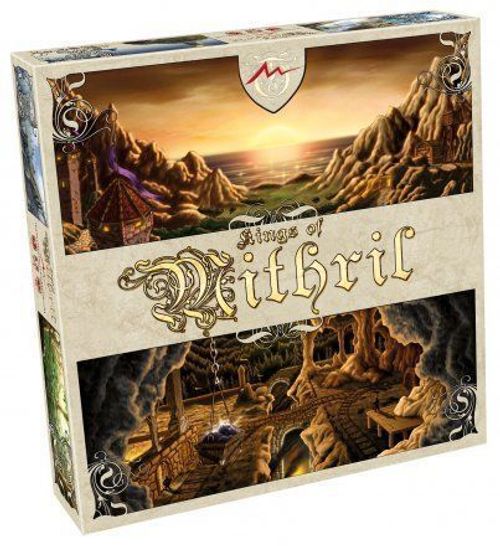
Kings of Mithril
Kings of Mithril Rulebook
Table of Contents
Table of Contents
Preparations
Preparations Before Playing the Game for the First Time
- Remove the tiles from the cardboard frames and divide them into piles as follows:
- Octagonal resource tiles (Barley, Metal and Gold)
- Octagonal hourglass tiles
- Bailiff figurine with matching stand
- Octagonal Production Shields (in four colours)
- Triangular game tiles
- Remove the wrappers from the decks of cards and divide the cards into seven piles according to their colour.
Preparations Before Each Game
- Shuffle each of the seven decks of cards and place them next to the board.
- Place the hourglass tiles in a pile in the space provided on the game board:
- If there are two players, use 7 hourglass tiles
- If there are three players, use 8 hourglass tiles
- If there are four players, use 9 hourglass tiles
- Place the Bailiff figurine on top of the hourglass tiles.
- Give each player a mining camp tile.
- Distribute Production Shields to the players according to colour.
- Each player gets one of each resource tile (barley, metal and gold).
- Roll the dice to see which player gets to go first.
Taking a Turn
- Buying more tiles (voluntary)
- Placing tiles on the board (adding Production Shields and drawing cards)
- Rolling the dice and moving the Bailiff (collecting resources if applicable)
- Drawing a new tile according to the previous roll of the dice
- The turn ends and the player hands the dice to the next player, moving in a clockwise direction.
Each Player's First Turn Takes an Abbreviated Form
Players may not buy tiles on their first turn. Players must place their mining camp tile in a forest space of their choosing. The chosen forest space must be adjacent to the mountain. Players may not place mining camp tiles in spaces adjacent to sectors of the mountain that already have another player's mining camp adjacent to them. The player does not receive a Points Card for this first tile placed on the board. (Later in the game, players receive a Points Card for each tile placed in a forest space.) Next, the player will roll the dice, draw a new tile and then the first turn is over. From the second round onwards, the game follows the normal steps for each turn.
Buying More Tiles
Players may spend their resources to buy additional tiles at the beginning of their turn. There are three types of resources in the game: Barley, Metal and Gold.
The prices of additional tiles are as follows:
- The price of a mining tile (2-4) is one Barley tile.
- The price of an exterior tile (5-8) is one Metal tile.
- A player may exchange a Gold tile for any tile (2-8).
The player takes the purchased tile and pays the Banker by handing over a corresponding resource tile.
A player who has sufficient resources may buy several tiles in the beginning of a turn.
Note! The newly purchased tile(s) are placed on the board in the tile placement step of the turn they are bought in. A newly purchased tile may not be saved for use in subsequent turns.
Basic Rules for Tile Placement
In the tile placement step of each turn, the player places tiles (drawn in the previous turn and/or purchased in the beginning of the same turn) in the triangular spaces on the board. Tiles must be placed according to the following rules:
- An exterior tile (5-8) must always be placed outside the mountain, while an interior tile (2-4) must always be placed inside the mountain.
- Tiles must be placed adjacent to the player's existing mining tunnel or road. (At least one edge of the newly placed tile that connects to a road or tunnel must be adjacent to an open road or tunnel on the board.)
- Players may not place tiles in such a way as to connect the road or tunnel networks of two different players.
Additional Rules for Tile Placement
- Placing a Workshop (2), Village (7) or Tower (8) creates a dead end that no further road or tunnel tiles may connect to.
- A tile may be placed in such a way as to have the end of a route remain open until the end of the game. (This happens if a route leads to another tile on the board that does not have an open route to the tile being placed, or if the route on a tile being placed leads to the edge of the board.)
- Players may make their rivals' expansion more difficult by placing tiles in such a way as to block off routes on adjacent tiles placed by other players. (Tiles may not, however, be placed on the board in such a way as to connect two separate kingdoms with each other.)
- A tile may also be placed adjacent to the edge of the mountain to have a road continue as a tunnel or vice versa.
A player does not have to place all the tiles in his/her possession on the board. In some situations it may be sensible to decide not to place a particular tile on the board. After the tile placement step, the player must return any remaining tiles to the Bank.
After Placing the Tiles
The placement of certain tiles is followed directly by the placement of Production Shields and/or drawing Points Cards.
Production Shields are placed in the following cases:
- When a player places a Village tile in a field triangle (not in a river or forest), place the player's Production Shields in the two buildings outside the playing surface at the edge of the field in question: one Production Shield in each building. (There are Barley tiles on the outer edge of the island corresponding to these buildings, and the buildings will produce Barley for the player as the game progresses.)
- When a player places a Workshop tile inside the mountain, place the player's Production Shield in the building on the outer edge of the island corresponding to the Metal tile on the same side of the mountain as where the Workshop was built. (Workshops produce Metal for the player as the game progresses.)
- When a player places a Village tile in a triangular river space, place the player's Production Shield in the building downriver outside the playing surface. (These buildings on the outer edge of the island have the Gold symbol and produce Gold tiles for the player as the game progresses.)
If a player has no further unplayed Production Shields, this step is skipped.
The Player Will Draw a Points Card in the Following Cases
- Villages: A player who places a Village in any triangular space on the board draws one card from the Agriculture pile. (Orange pile)
- Towers: A player who builds a Tower in any triangular space on the board draws one card from the Military pile. (Blue pile)
- Workshops: A player who builds a Workshop in any triangular space on the board draws one card from the Metalwork pile. (Red pile)
- Expanding mining operations: A player who places any tile in a mountain sector where he/she has no previous tiles draws one card from the Mining Operations pile. (Grey pile)
- Expanding logging operations: A player who places any tile in a forest space draws one card from the Logging Operations pile. (Green pile)
- Expanding Border Patrol: A player who places any tile in a border space draws one card from the Border Patrol pile. (Border spaces are spaces adjacent to the edges of the playing surface.) (Purple pile)
- Animal husbandry: A player who forms a closed loop of road tiles (not mining tiles), i.e. a loop enclosed by a road, draws cards from the Animal Husbandry pile. (Brown pile) The player receives one card for each six intersections of map triangles enclosed by the loop.
Closing the Kingdom: A player who places a tile in such a way as to terminate the final route from his/her Kingdom, i.e. when tile placement results in all roads and tunnels being closed off by a Village, Tower or Workshop, draws two cards from the Military pile. After this, the player in question will play no further part in the game until the Final Election. The player's turn ends and the next player continues.
A player may also receive several Points Cards and/or Production Shields as a result of placing only one tile on the board (e.g. by building a Village in the forest). The player may have a look at the Points Cards drawn from the piles, but they may not be revealed to other players. The value of each card is indicated as a number of shields near the bottom edge of the card. As the values of cards received for different activities vary, the players cannot be certain of each other's total scores. The total points on the cards are added up in the Final Election phase of the game.
Rolling the Dice and Moving the Bailiff
The player will roll two four-sided dice. The sum will be between 2 and 8. The player will then move the Bailiff figurine clockwise along the spaces on the edge of the playing surface, with the number of steps corresponding to the roll of the dice. (When the Bailiff passes the hourglass arrow, i.e. the Bailiff's starting point, remove one hourglass tile from the board.) Players will receive resource tiles if they have Production Shields in the building corresponding to the space in which the Bailiff stops. (One building may house several Production Shields, including those of several players.)
Collecting Resources
When the Bailiff stops in a Barley space, the Bank will distribute Barley tiles to the player corresponding to the number of Production Shields the player has in the building corresponding to the space. The same applies when the Bailiff stops in a Metal or Gold space (i.e. players who have Production Shields in the corresponding building receive one Metal or Gold tile for each Production Shield they have in the building). This distribution of resource tiles also applies to players other than the one whose turn it is. Production Shields are placed in the buildings when certain conditions are met in tile placement.
If the Bank does not have a sufficient amount of the resources to be distributed based on the Bailiff's movement, no player receives resources on the turn in question.
Drawing a New Tile
In this step, the player draws a tile from the Bank corresponding to the previous roll of the dice (tiles are numbered 2-8 to correspond with the possible outcomes of the roll of two four-sided dice). The tile is placed in front of the player to be played in the tile placement phase of that player's next turn. While the other players take their turns, the player may plan his next move based on the tile he/she has drawn. If the Bank no longer has any tiles of the type corresponding to the roll of dice, the player can choose any tile from the Bank instead.
Final Election
When the Bailiff passes the hourglass arrow and there are no more hourglass tiles in the pile, the world building ends and players proceed directly to the Final Election, which determines the winner of the game. To begin the Final Election, the players reveal their Points Cards. First, players collect Crowns based on the number of Military cards they have. One Tower Card is worth two Crowns while a Castle Card is worth three. The Crowns are indicated on the bottom edge of the front of each card. The Garrison Card does not yield any Crowns directly, but the player holding the Garrison Card gets to flip over all Tower Cards in his/her possession, which makes them worth three Crowns instead of two.
Next, the players will collect Crowns based on the other six construction activities. For these activities, only the player who has the highest number of shields will score Crowns. The six activities, Agriculture, Logging Operations, Mining Operations, Metalwork, Border Patrol and Animal Husbandry, are scored in this order. For each activity, the players count the total number of shields indicated in the Points Cards for the activity in question. The player who scores the highest number of shields will flip over one of the cards for the activity in question, displaying the five Crowns on the back side of the card.
If two or more players have an equal amount of shields for a given activity, the player with the highest-numbered card wins the five Crowns. No Crowns are allocated for activities for which no players have any cards. When all the activities have been scored, the players will count the total number of shields displayed on their cards. In the event of a tie, the holder of the highest-numbered card (of all cards, regardless of activity) wins.
In a two-player game, the player with the greater number of Crowns wins the game. With more than two players, the title of King is determined over several rounds of elections: If there are three players, two rounds of elections take place. In a four-player game, three rounds of elections take place. Each round is resolved as described above, with the player who scores the lowest number of Crowns eliminated. The eliminated player is out of the running to win the game. Before each new round of elections, the players turn their cards face-up. The winners of activities may change in subsequent rounds of elections as eliminated players are no longer in the running in any of the six activities. The Crowns from Military cards are calculated in the same manner as in the first round of elections.
The winner of the final round of elections (the player with the most Crowns displayed, or in the event of a tie, the player with the highest-numbered card) is declared King of the island and winner of the game.