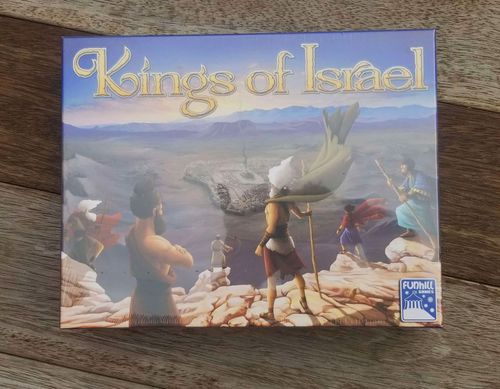
Kings of Israel
Kings of Israel Rulebook
Table of Contents
Table of Contents
Game Components and Sample Setup
- 4 Prophet Tokens
- 1 Black False Prophet Token
- 1 Purple King Timeline Token
- 6 Yellow Idol Tokens
- 9 White Altar Tokens
- 27 Black Sin Cubes
- 3 Destruction Cubes
- 4 Player Guides
- 1 Starting Player Card
- Map of Israel Gameboard
- 8 Ability Cards
- 30 Blessing Cards
- 40 Location Cards
- 34 Resource Cards
- 30 Sin & Punishment Cards
Setting Up the Game
- Place the King Timeline token on the Saul space.
- Seperately Shuffle the Ability, Blessing, Resource, and Sin & Punishment decks and place each deck face-down by the game board.
- Each player takes a Prophet Token, a Player Guide, and a random Ability Card. Keep the drawn Ability Cards face-up, as they are a permanent special ability unique to each prophet.
- Players should each place their Prophet Token in the Starting Location listed on their Ability card.
- Place a single Altar (white token) in Samaria.
- Each player draws two Resource Cards from the Resource deck and places them in their hand.
- Shuffle the Location deck and place it face-up. Draw a number of Location Cards equal to the number of players plus two, while discarding any Nation or "Shall Be Again" Cards and replacing them with new cards. Place a single Sin Cube (black cube) in each of the locations drawn.
- Once completed, draw a number of Location Cards equal to the number of players plus one, while discarding any Nation or "Shall Be Again" Cards and replacing them with new cards. Place two Sin Cubes in each of the locations drawn.
- Finally, draw a number of Location Cards equal to the number of players, while discarding any Nation or "Shall Be Again" Cards and replacing them with new cards. Place an Idol (golden calf) in each of the locations drawn.
- Shuffle the discarded and drawn Location Cards back into the Location deck and place the deck face-down.
- Give the Starting Player card to the oldest player and then begin the game, making sure to skip the first Sin Increases Phase (See Game Round Summary section).
An example of a normal 3-player setup is shown on the previous page.
How to Win and Lose
The prophets win as a team by building a certain number of Altars in Israel. These Altars will act as beacons for the Israelites in the upcoming difficult years, reminding them of their God. The number of Altars needed to win varies by the number of players, as seen here:
- 2 Player Game - 7 Altars
- 3 Player Game - 8 Altars
- 4 Player Game - 9 Altars
Alternatively, if ever a Sin Cube or an Idol ever needs to be placed on the board, and none are available in the supply, then evil overruns Israel and the prophets lose!
Game Round Summary
-
King's Godliness Phase - The Starting Player draws a Sin & Punishment Card during the reign of a bad king or a Blessing Card during the reign of a good king.
-
Sin Increases Phase - Draw an amount of Location Cards equal to the number of players plus one, adding Sin Cubes to those locations. Sin might spread and Idols might appear.
-
Prophets Work Phase - Beginning with the Starting Player and going clockwise, each player takes their turn using their four actions.
-
End of Round Phase - The Timeline Marker moves down to the next king on the timeline and the Starting Player Card passes to the next person clockwise. If the Timeline Marker hits "Israel Destroyed" the players lose!
King's Godliness Phase
Look at the timeline on the left side of the game board and see where the Timeline Marker is resting. If it is in a white space, then the prophets are living during the reign of a good king and the Starting Player draws a Blessing card. If the space on the timeline is red, the prophets are living during the reign of an evil king and the Starting Player must draw a Sin & Punishment card and resolve it immediately.
Special Rule for 3-4 Players - Some spaces on the timeline are marked as being for 3-4 or 4 Players. Those spaces are during the reign of short-lived kings and only occur for 3-4 Players or 4 Players, respectively. Instead of a full turn, only the King's Godliness Phase occurs with any Sin & Punishment cards drawn occuring at the start of the next full turn. Then move the Timeline Marker down to the next applicable king.
Blessing Cards
Blessing Cards can be played anytime during the Prophets Work Phase and do not take an action to play, nor do they count against a player's hand size. Most Blessings are one-time events, but if the card states, "Place this card out face up...", the card is instead a permanent effect for the rest of the game.
Sin & Punishment Cards
Sin & Punishment Cards are events either caused by the Israelites or the surrounding nations committing an evil act, or are due to the Israelites being punished for their sin. The cards are normally one-time events unless the card states "Place this card out face up...", in which case it is a permanent effect for the rest of the game. There are also special events called "Foretold Events" that do not happen immediately.
Foretold Events
Foretold Events are evils and punishments that the prophets have been warned about and have been given time for which to prepare. If you draw a Foretold Event from the Sin & Punishment deck, and it is not face-up, first do anything stated prior to the Foretold Event portion of the card. Then place the card face-up underneath a number of cards in the Sin & Punishment deck equal to the number of players.
After doing all this, draw another Sin & Punishment card to replace that newly drawn Foretold Event.
In a 3-player game, a Foretold Event is drawn. After doing anything stated before, "Foretold Event", the Starting Player then places the card face-up underneath three cards in the deck, making sure the title is still visible.
Sin Increases Phase
IMPORTANT - FOR THE FIRST TURN OF THE GAME, SKIP THE SIN INCREASES PHASE!
During this phase, one at a time the Starting Player draws a number of Location Cards equal to the number of players plus one, and adds a Sin Cube to each of the locations. If a Sin Cube would ever be placed in an outside nation, that Sin Cube is not placed but instead sin spreads and a Sin Cube is placed at EVERY location connected to that nation by road.
Increasing sin at Judah would cause Sin Cubes to appear in Bethel and Jericho.
Sin increases at Samaria and spreads. Mount Ebal subsequently causes another spread of sin but not back to Samaria since that location already received a Sin Cube from the card drawn.
IMPORTANT - A LOCATION CAN NEVER HAVE AN INCREASE OF SIN OCCUR MORE THAN ONCE PER CARD!
If adding a Sin Cube to a location gives it three or more Sin Cubes, then additionally place an Idol at that spot, if it does not contain an Idol already. Only one Idol may be at a location at a time.
A Sin Cube added to Shiloh would also add an Idol to that location.
If a Sin Cube is placed in a location with an Idol, then additionally place a Sin Cube in each neighboring location (not nations) connected to it by road. If this causes a sin cube to be placed in a location that already has an Idol, then sin also spreads from that location and so on.
A Sin Cube added to Mount Nebo causes sin to spread to all roads connected to it, but not to adjacent nations.
Prophets Work Phase
Beginning with the Starting Player and going around clockwise, each player takes four actions of their choice. An action may be performed more than once, but each time it is performed one or two, if a player removes an Idol, actions are spent. During the Prophets Work Phase anyone may play Blessing Cards (for free) at any time, even during another player's turn.
Possible Actions:
- Move Prophet
- Preach to Israelites
- Destroy an Idol
- Acquire Resources
- Build an Altar
- Make a Sacrifice
- Give Resources
Action Explanations
Move Prophet: Move your prophet from one location to another if the locations are connected by a road (solid black line) or by sea (dotted black line). If traveling by road, you may discard a Cattle or Grain Resource Card from your hand to move up to three times, instead of one, for just one action.
Preach to Israelites: Remove one Sin Cube from your current location.
Destroy an Idol: Using two actions, you may remove one Idol from your location. The two actions must be used on the same turn and cannot be split up between rounds.
Acquire Resources: Draw one Resource Card from the Resource deck. You may never have more than six Resource Cards in your hand. If at any time your hand is greater than six you must discard down to six cards. If the Resource deck is ever empty, then shuffle the Resouce discard pile to form a new Resource deck.
Build an Altar: Discard a Gold, a Stone, and a Wood Resource card from your hand to build an Altar at your location. Only one Altar may be built at each location. If enough Altars are built your team wins the game (see How to Win and Lose section).
Make a Sacrifice: If at a location containing an Altar, you may discard a Cattle and a Grain Resource Card to make a sacrifice to God. If you do so, remove all Sin Cubes from the Altar's location and a Sin Cube from each neighboring location that is connected to you by road.
A sacrifice at Hazor removes all sin from its location and a single cube from each neighboring locations. The Idol is not affected by the sacrifice.
Give Resources: If at the same location as another player, you may give that player up to two Resource Cards from your hand for one action. You may discuss what Resource Cards you have, or what the other player needs, before giving them the cards.
End of Round Phase
End of Round Maintenance: Pass the Starting Player card to the next person clockwise. Then move the Timeline Marker down one king on the timeline, while skipping any kings that are for more players than are currently playing. If the Timeline Marker hits the "Israel Destroyed" space, your team loses!
Easy Version
If things are just not going well when playing Kings of Israel, and they shouldn't, you can play the Easy Version instead! There are just two rule changes needed to play the Easy Version:
- Each player leaves their hand out face-up when playing.
- During the End of Round Phase, each player that had made a sacrifice that turn may draw a Blessing Card.
With these changes players can help each other out more easily by seeing each others hand, and also get a little more help from the additional Blessing Cards.
Expert Version
This version is for experts only and not suggested for the faint of heart! In the Expert Version of Kings of Israel, the False Prophet token is also used. At the start of a certain round, the black token is placed in Samaria. For the rest of the game, the False Prophet tries to destroy Altars and corrupt Israel while the prophets do their work.
The round the False Prophet first appears in Samaria:
- 2 Player Game - Baasha
- 3 Player Game - Solomon
- 4 Player Game - Saul
Every round at the end of the Prophets Work Phase, the False Prophet takes his turn in two steps. First, unless at an Altar without a prophet, the False Prophet moves one space.
How the False Prophet decides where to move
- The False Prophet will first try to move to an Altar to eventually destroy it. If he is adjacent to an Altar by road or sea, he moves there.
- If no Altar is adjacent to the False Prophet, he instead tries to move to an adjacent Idol.
- Finally, if no Altar or Idol is next to the False Prophet, he moves into an adjacent space containing the least amount of Sin Cubes.
- The False Prophet will NEVER move into a location with a prophet. If there is no place for him to safely move, the False Prophet will stay in his current location.
- If there are multiple locations that the False Prophet wants to move into the most, the Starting Player chooses which of the locations he visits.
In this example, the False Prophet's first choice is to move into Cabul with its Altar, but the Blue Prophet prevents him from moving there. For his second choice, the False Prophet looks to move into Mount Carmel with its Idol, but the Orange Prophet prevents him from moving there. Finally, the False Prophet looks for the adjacent location with the least amount of Sin Cubes, which is Dor. The False Prophet proceeds to sail to that location.
After the False Prophet moves, or possibly does not move, he will then add a Sin Cube to his current location. If this causes the False Prophet to create an Idol at a location with an Altar, the Altar is destroyed!
In addition to this, Sin Cubes and Idols cannot be removed from a False Prophet's location by any means.
How to defeat a False Prophet
A False Prophet can be destroyed if he is at the same location as an Altar. If a player makes a sacrifice at a location containing a False Prophet, remove a single Sin Cube from each adjacent location and then remove the False Prophet from the board. At the start of the next Sin & Punishment phase, the Starting Player must put the False Prophet back on the board at a location of their choice, as long as the chosen location does not contain a prophet. This represents a new False Prophet appearing.
Campaign Mode
The Campaign Mode is designed to slowly introduce players to the game and allow the teams to gradually increase the game difficulty. Each level is represented by a king, with the kings becoming more prominent as the difficulty level increases. Start with Jehoash at the top and follow the rules changes shown to the right. Once you defeat a king, try moving down to the next level. Only the greatest teams will be able to defeat all of the levels!
Jehoash Player Hands: Face Up and start with 3 Resources Each Location Deck: Remove one copy of every Nation and Shall Be Again card Sacrificial Blessings are in effect
And Jehoash the son of Jehoahaz took again out of the hand of Benhadad the son of Hazael the cities, which he had taken out of the hand of Jehoahaz his father by war. Three times did Joash beat him, and recovered the cities of Israel. - 2 Kings 13:25
Joram Player Hands: Face Up and start with 2 Resources Each Location Deck: Remove an Ammon, Aram, Assyria, Judah, and Phoenicia card Sacrificial Blessings are in effect
Now Jehoram the son of Ahab began to reign over Israel in Samaria the eighteenth year of Jehoshaphat king of Judah, and reigned twelve years. And he wrought evil in the sight of the Lord; but not like his father, and like his mother: for he put away the image of Baal that his father had made. - 2 Kings 3:1-2
Ish-Bosheth Player Hands: Start with 2 Resources Each Location Deck: Remove an Ammon, Aram, Judah, and Phoenicia card. Sacrificial Blessings are in effect
How much more, when wicked men have slain a righteous person in his own house upon his bed? shall I not therefore now require his blood of your hand, and take you away from the earth? - 2 Samuel 4:11
Saul Player Hands: Start with 2 Resources Each Location Deck: Remove a Judah and Phoenicia card.
And all the people went to Gilgal; and there they made Saul king before the Lord in Gilgal; and there they sacrificed sacrifices of peace offerings before the Lord; and there Saul and all the men of Israel rejoiced greatly. - 1 Samuel 11:15
Jehu Player Hands: Start with 2 Resources Each Location Deck: No changes
And the Lord said unto Jehu, Because thou hast done well in executing that which is right in mine eyes, and hast done unto the house of Ahab according to all that was in mine heart, thy children of the fourth generation shall sit on the throne of Israel. - 2 Kings 10:30-31
Solomon Player Hands: Start with 3 Resources Each Location Deck: Remove a Shall Be Again card False Prophet is in effect
Behold, I have done according to thy words: lo, I have given thee a wise and an understanding heart; so that there was none like thee before thee, neither after thee shall any arise like unto thee. - 1 Kings 3:12
David Player Hands: Start with 2 Resources Each Location Deck: No changes False Prophet is in effect
Yea, though I walk through the valley of the shadow of death, I will fear no evil: for thou art with me; thy rod and thy staff they comfort me. - Psalm 23:4
Important Notes
-If a played card has multiple options, and the card does not state which option to select, the Starting Player gets to choose. For example, the Sin and Punishment card, "Brimstone and Fire" could potentially have multiple locations that have the same amount of Sin Cubes. In this case, the Starting Player decides which one of those locations is destroyed.
-If two cards conflict, Sin & Punishment cards have priority. For example, if a Sin & Punishment card is out that prevent players from entering Mount locations, and a player proceeds to play a Blessing card that allows anyone to move into any location containing Sin Cubes, the players are still prevented from entering a Mount location even if that location contains Sin Cubes.
Tips
- Remove Idols as soon as possible! Idols can cause a lot of damage and should not be left alone. Also address locations with multiple Sin Cubes very quickly since those locations are one step away from building an Idol.
- Worry the most about the locations connected to outside nations, since those locations are the most likely to be given Sin Cubes.
- Do not forget that you may play Blessing Cards on other prophets' turns! Sometimes a properly timed playing of a Blessing Card will save a lot of valuable actions.
- In a 3-4 player game, make sure your team removes extra amounts of Sin Cubes and Idols prior to a short-lived king. The extra Sin & Punishment Cards drawn can cause chaos if your team is not ready for surprises.