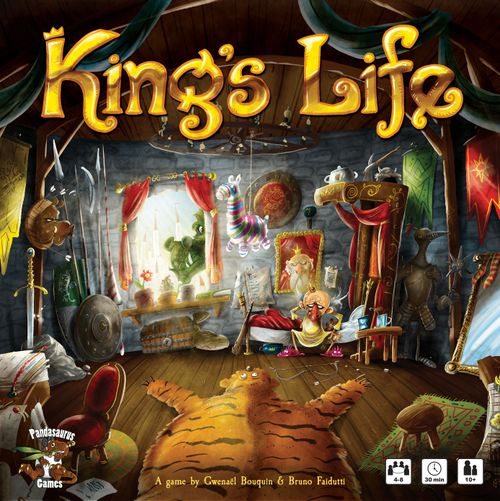
King's Life
King's Life Rulebook
Table of Contents
Table of Contents
Components
- 4 activity preference cards: Tourney, Feast, Hunt, Dance
- 71 suggestion cards (48 activity cards and 23 character cards). Simply referred to as "cards" in these rules.
- 5 day cards: Tuesday, Wednesday, Thursday, Friday, Saturday
- 5 support bonus tokens (values 0, 1, 1, 2 and 2)
- 1 first player marker
- 8 player standees
- 8 player support tokens
- 1 board
Setting Up
- Place the board in the center of the playing area.
- Shuffle the support tokens and place them randomly, face down, on the five spaces of the board.
- The game is played in five consecutive days, from Tuesday to Saturday. Order the cards with Tuesday at the top, then Wednesday, and so on. Place the day cards in a face up pile next to the board.
- Shuffle then place the activity preference cards facedown next the board.
- Each player takes the standee and support token of the color of his choice, and places them both in front of him. The standee is to denote your player color.
- Determine a random first player for the first day. Later in the game, the first player is always the one who won the last day (or the previous one if the day was cancelled).
A Game's Day
King's Life is played over five rounds, each round being a day in the life of the king. Each day plays as follows:
- The King's Will – Determine the king's preferences that day.
- Deal suggestion cards – Shuffle the deck and fill players' hands.
- Suggestions to the King – Create a program, by playing cards, to influence the king.
- Determine Winner of the Day – Player with best program wins the day.
The King's Will
Tuesday (The First Day)
- Shuffle the four activity preference cards.
- Draw the top three cards and place them, starting on the top space (+1), on the board. The drawn cards should be placed face up.
- The fourth, and final activity preference card, will not be used. Place it face down at the bottom of the board.
Each following day
- Remove the three faceup activity preference cards from the board.
- Place the previous round's facedown activity preference card on the top space (+1) of the board.
- Shuffle the three remaining cards. Draw and place two cards on the remaining spaces.
- The fourth, and final activity preference card, will not be used. Place it face down at the bottom of the board.
Deal Suggestion Cards
Tuesday
- Deal six (6) suggestion cards to each player.
- Starting from the start player each player can discard up to three cards from his hand as he wishes and draw the same number of replacement cards.
Wednesday and Thursday
- Shuffle the discard in the draw pile.
- Draw up to complete a hand of six (6) cards.
Friday and Saturday
- Shuffle the discard in the draw pile.
- Draw up to complete a hand of seven (7) cards.
Mulligan
If a player, after changing cards on Tuesday or completing his hand any other day, has only character cards, and not a single activity card, he can choose to mulligan.
- Show the hand to other players then discard it.
- Draw up to complete a new hand.
Number of Players Affects Hand Size
When playing with seven players the number of cards per player is reduced by one.
- Five (5) cards on Tuesday, Wednesday and Thursday
- Six (6) cards on Friday and Saturday
When playing with eight players, it is reduced by two.
- Four (4) cards on Tuesday, Wednesday and Thursday
- Five (5) cards on Friday and Saturday
Suggestions to the King
Initial Suggestion Round
- Each player selects a card in his hand and plays it face down.
- Only cards with a sun icon at the bottom can be played in this first round.
- All played cards are revealed simultaneously and take effect or become the first cards in the players' displays.
Subsequent Suggestion Rounds
Starting with the first player, and continuing clockwise, each player in turn can either: play a card (suggestion or character card) or pass.
A player who passes is out of the game for the rest of the day, and cannot play any more cards, though he can still win the day as a main courtier or as a support (see below).
This goes on until all players have passed. This means that if only one player has not passed, he can keep on playing cards as long as he wants and has cards.
Playing a Suggestion Card
- The player plays a suggestion card from their hand and adds it to their display to create a program for the King.
Note that one card of value 1 in each activity has an additional effect: the player draws a card from the drawing deck.
Playing a Character Card
Character cards are played in the same way as activity cards but they have a special effect. The effect of each character is detailed on the card and includes when the card may be played. These are also detailed on last page of this rulebook.
Most character cards are played and immediately discarded after the effect is performed. Some cards stay in a player's display (see detailed descriptions on last page).
A Guard and a Fool: A player playing a Guard or Fool card is considered passing, and can support another player normally.
A Peon: A player playing a Peon is not passing, and will continue playing but won't be able to support any other player when passing if he has no more support token.
A Game's Day Continued
Passing
A player who passes cannot play any more cards until the end of the day. Though he can still win the day if his display happens to be the strongest program in the end – it's unlikely, but it can happen.
- A player who has no more cards in hand must pass.
- To make clear that a player has passed, they should lay their standee down.
Support
A player who passes can decide, at that moment, to support another player, even another player who has already passed.
- The passing player announces which other player he supports and places his support token in front of him.
- The passing player can also choose a face up card in his display and add it to the display of the player he is supporting.
- Each player can be supported by only one other player.
This means that players who pass late in the day usually cannot support any more, all the players who can win the day being already supported.
Winning the Day
When all players have passed, the value of the program they suggest to the king is reckoned, and the king opts for the best one.
Reckoning display values
- A program is made of one or more cards of the same activity (hunt, tourney…) in a player's display.
- The value of the program is the sum of the cards' value, plus one if the proposal's activity is at the top of the board.
- Cards of the face down activity have NO value.
- There can be cards of many activities in a display, but the program is made with cards of only the activity with the highest total value. Cards in other activities are ignored.
- In case of two programs with the same value in different activities, the king opts for the one in the activity that is higher among his preferences, as shown on the board.
- In case of two programs with the same value and same activity, the king cannot make his decision and spends the whole day thinking about it. The day is cancelled with no winner, both the day card and the day support bonus token are discarded, without revealing the token.
Scoring Example
The King is interested in: Hunting (+1), Dancing, and Tourney. He is not interested in Feasting.
The players' displays are:
- Player A – 8 total. Hunting: 3, 3, 1. Dancing: 2 (not counted). Feasting: 1 (not counted).
- Player B – 8 total. Hunting: 2 (not counted). Dancing: 4, 2, 2.
- Player C – 7 total. Hunting: 3 (not counted). Tourney: 4, 2, 1. Feasting: 1 (not counted).
- Player D – 0 total. Feasting: 5, 4, 2 (not counted).
Player A and B both have a display value of 8 (Player A with Hunting: 3, 3, 1 and 1 point bonus for the hunting activity, Player B with Dancing 4, 2, 2). Player A wins the day because Hunting is above Dancing in the King's preference. Player C has a display value of 7 (Tourney cards 4, 2, 1). Player D is out because the King is not interested in Feasting.
Game End & Victory
Victory Points
- The player who displayed the best program takes the day card, earning the amount of victory points shown on the card.
- His supporter, if any takes a support token from the board. They can look at it but must keep it secret from other players. If the winner had no support, a support token is discarded without looking at its value.
- All cards in all players' displays are then discarded and shuffled together with the draw deck.
The rulebook illustrates the victory point icons 0, 1, 2 and 3 beside this section.
The Winner
After Saturday, players add the victory point values of the day cards and support tokens they have won. The player with highest total wins.
Ties
In case of a tie, the tied player with the most support points wins. In case of further tie, it's a shared victory.
Character Card Effects
All cards, except the Duke and Queen, are played during the 'Suggestions to the King' phase on the player's turn.
Played in the Player's Display
- Duchess (x2): The Duchess is a "wild" suggestion card, which adds to the program's value in any activity.
- Little Prince (x1): The player, if any, who supported the winner of the day will take this card and keep it with his day cards and scoring tokens. It is worth 1 victory point at the end of the game.
- Merchant (x1): This card must be placed next to an activity card in the player's display. The value of this activity card is doubled. If, due to any card effect, the doubled activity card is discarded, swapped or stolen by another player, the Merchant is discarded, swapped or stolen with it.
- Priest (x1): All cards with a face value of 5 have no value this day.
- Princess (x1): The winner of the day, if any, will take this card and keep it with their day cards. It is worth 1 victory point at the end of the game.
- Sorcerer (x1): This card must be placed next to an activity card in the player's display. The activity of this card is changed to any other activity of your choice. If, due to any card effect, the changed activity card is discarded, swapped or stolen by another player, the Sorcerer is discarded, swapped or stolen with it and its effect continues.
Played at the End of the Day
- Duke (x1): This card is played at the end of the day, and can be played by the supporter of the winning player. The rewards for the day's winner and his support are swapped. The card is then removed from the game and is NOT shuffled back with the other cards at the beginning of the next day.
Played at Any Time
- Queen (x1): This card can be played at any moment to cancel a card just played by another player. The cancelled card is discarded without effect and the affected player cannot play a replacement.
Played and Discarded After Effect
- Astrologer (x2): Look at a face down support token on the board. It can be today's or a later one, or a token already won by a player.
- Chamberlain (x2): Swap two activity preference cards (even the face down card if you want). If you swap the face down card with another one, the card placed at the bottom is turned face down, and the face down card is turned face up.
- Dog (x1): Discard all your other cards in hand, and draw the same number of cards from the drawing deck.
- Fool (x1): Take back in hand any or all of the cards in your display and pass. If you take back character cards (Courtesan, Little Prince, Princess, Monk, Merchant, Sorcerer), their effect is cancelled.
- Guard (x2): Play this card when passing. It allows you to support a player who already has a support. The former support is cancelled and the token given back to its owner, and only yours is valid.
- Jester (x1): Swap two cards (activity cards only, no character cards) in two other players' displays.
- Peon (x1): When playing this card, you can normally support an unsupported player, but you have not passed. This means you can still play more cards when your turn will come, though you won't be able to support another player when passing (unless your token is given back to you by a guard).
- Rainy day (x1): With such bad weather, there's no sense in doing anything. The day immediately ends with no winner. The day card and support token are discarded. The rainy day card is removed from the game and is NOT shuffled back with the other cards at the beginning of the next day.
- Thief (x2): Take a card of the stated value (3 or 4) from another player's display and add it to your display.