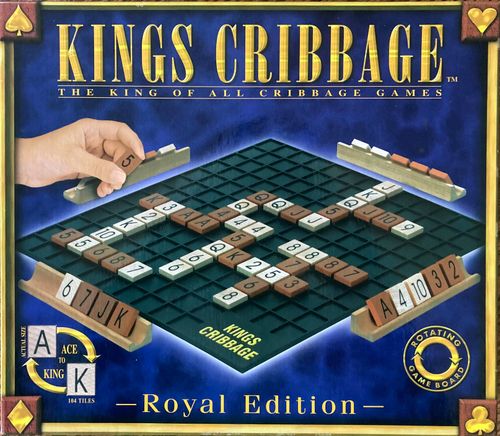
Kings Cribbage
Kings Cribbage Rulebook
Table of Contents
Table of Contents
Object
- Outscore your opponent by making or extending Crib Hands with the tiles. (The concept of the game is similar to using tiles to create words in a word game.)
- A Crib Hand is a row of 2 to 5 tiles that combine to form cribbage points (runs, pairs and/or fifteens).
Start
- Low draw plays first. (Keep score with a pen and paper.)
- Without peeking, all players draw 5 tiles from the bag and place them on their tile holder.
- The first person to play forms a Crib Hand using 2, 3, 4 or 5 of their tiles, then positions them in a straight line, next to each other, anywhere on the board.
- Each turn is complete once a player records their score and replenishes their tile stock to 5.
- All plays after the first must merge with the tiles already on the board to create or extend Crib Hands. (See box cover photo and examples for details.)
Rules
- No play (Crib Hand) may exceed 5 tiles. (See example 6.)
- Played tiles must be in a straight line.
- Diagonal playing or scoring is never allowed.
- Every tile played must contribute points toward a Crib Hand.
- Runs do not need to be in sequence. (see examples)
- All plays, after the first, must consist of 1 to 5 tiles.
- Face tiles are valued at 10 when making "fifteens".
- Aces are valued at 1 when making "fifteens" or "runs".
- 6's can be turned around and played as 9's or vice versa, but once they are on the board their value is set.
- If no play is possible, player misses a turn and can exchange from 1 to 5 of their tiles with those in the bag.
How to Score
(Same as cribbage)
Fifteens — Tiles which total 15 (ex. 6 + 9 = 15) . . 2 points
Runs
- Run of 3 (ex. 4 3 5) . . . . . . . . . . . 3
- Run of 4 (ex. 4 3 5 6) . . . . . . . . . 4
- Run of 5 (ex. 4 3 5 6 7) . . . . . . . . 5
Pairs — 2 points per pair
- 3 of a kind (ex. 8 8 8) . . . . . . . . . 6
- 4 of a kind (ex. 8 8 8 8) . . . . . . . . 12
- 5 of a kind (ex. 8 8 8 8 8) . . . . . . . 20
10 Point Bonus
- First player to start.
- Play all 5 of your tiles in one turn.
- Create or extend a Crib Hand so that all 5 tiles are the same color (ex. 2 3 J J 5, or 7 8 7 6 8). Note: Same rules apply vertically.
End Game
When no tiles are left in the bag, the game ends immediately if one player runs out of tiles or no play is possible by any player. Leftover tiles are deducted from each player's score at face value. (Face tiles = 10, Aces = 1)
Optional Rules
Servant — The player with the lowest score after each round is called the "Servant" and he or she must keep score for the other players. This rule creates additional amusement as it becomes a status symbol not to become the Servant.
Joker — The first player to shout "Joker" if they spot points unclaimed by their opponent (after their score is recorded), may claim those points. Should the shouter yell out before the points are recorded or if there are no missed points, the shouter becomes the Joker and 5 points are deducted from his or her score.
Solitaire — Separate the dark and light tiles then play them against each other using the standard rules.
Examples of Play
Yellow tiles represent the current play. Red lines connect the scoring tiles. Brown tiles represent all previous plays. In the diagrams below, tiles marked with an asterisk (*) are the new tiles placed on this turn; plain tiles were already on the board from an earlier turn.
Example 1 — "The Queen and I will play an example game for you. My first play can be anywhere on the board that I choose."
*10* *Q* *3* *2*
Fifteens: 2 (4 pts) · Pairs: 0 (0 pts) · Runs: 0 (0 pts) · Total: 4
Example 2 — "My play makes two runs, one pair, and four fifteens. Can you see them?"
A vertical Crib Hand is formed through the board's existing Q, reading top to bottom: J, Q, Q, 10, 5 (the new Q pairs with the Q already on the board; the row of 10-Q-3-2 from Example 1 is now a previous play).
              *J*
              *Q*
10   Q   3   2
              *10*
              *5*
Fifteens: 4 (8 pts) · Pairs: 1 (2 pts) · Runs: 2 (6 pts) · Total: 16
Example 3 — "I have made 3 new Crib Hands with my play and get points for all of them."
A new horizontal row is formed below the vertical 10, extending from it: 3, 2, 3, each of the first two connecting vertically to the 3 and 2 already above them.
              J
              Q
10   Q   3   2
     10  *3* *2* *3*
              5
Fifteens: 2 (4 pts) · Pairs: 3 (6 pts) · Runs: 0 (0 pts) · Total: 10
Example 4 — "My top King is the same as placing an 'S' tile at the end of a word in a word game."
A King is added to extend the lower row, and a second King is placed beneath it, pairing vertically: K, K.
              J
              Q
10   Q   3   2
     10  3   2   3   *K*
              5           *K*
Fifteens: 4 (8 pts) · Pairs: 2 (4 pts) · Runs: 0 (0 pts) · Total: 12
Example 5 — "See how I get more points by extending the existing Crib Hand with the 4, 5 & 6 tiles vertically?"
A new vertical Crib Hand of 4, 5, 6 is added one column to the left, with the middle tile (5) also joining the horizontal row through the 10.
              J
*4*           Q
*5*  10  Q   3   2
*6*      10  3   2   3   K
              5              K
Fifteens: 5 (10 pts) · Pairs: 0 (0 pts) · Runs: 1 (3 pts) · Total: 13
Example 6 — Illegal play. "The '3' makes a pair vertically, but... also extends the horizontal Crib Hand to six tiles. (Five is the maximum.) This play must be removed."
              J
4             Q
5    10  Q   3   2   *3*
6         10  3   2   3   K
              5              K
The top horizontal row (5-10-Q-3-2) already has five tiles; adding the new 3 makes six, which is illegal, even though that same 3 also forms a legal vertical pair with the 3 below it.
Example 7 — Illegal play. "The play makes a run of three horizontally, but... the '4' does not relate to the pair of '2's in the vertical direction. This play must be removed."
              J
4             Q        *4* *5* *6*
5    10  Q   3   2
6         10  3   2   3   K
              5              K
The new 4, 5, 6 form a valid run of three by themselves, and the new 4 sits directly above the existing pair of 2's — but a 4 does not combine with those 2's to score anything, so it fails to "contribute points toward a Crib Hand" as required by Rule 4. The play must be removed.
Questions & Answers
Q: Must all of the tiles in a Crib Hand relate to each other? A: No, but all tiles played must contribute points to the Crib Hand. (ex. 6 6 7 7 is legal but 6 7 7 is illegal, the 6 does not relate to any tiles in the row)
Q: When I make a play, do I need to form a new Crib Hand with the tiles that are already on the board? A: Yes, the tiles must interlock like letters in a word game.
Q: Can I play or score tiles diagonally? A: No.