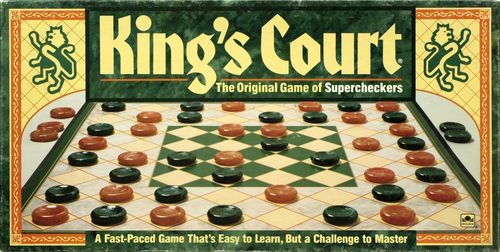
King's Court
King's Court Rulebook
Table of Contents
Table of Contents
The Rules
Play is much like Checkers, but in this royal version of play, all playing pieces are treated like Kings and the battles continues untill all of the player's pieces are removed from the beige squares in the Center Court.
Who Plays First
The first move is always made by the player having the red pieces. (There is a coin in the table if you feel like flipping it to decide). Play then alternates between green and red.
How to Play
- Each player may move only one piece at a time.
- The player who has the red pieces begins play by moving one of the closest red pieces to the Court, onto and adjacent beige square (FIRST ROW ONLY, YOU CANNOT CAPTURE WITHIN THE FIRST MOVE).
- The player who has the green pieces the moves one green piece from the OPPOSITE side of the board onto an adjacent beige square. (SAME AS BEFORE, FIRST ROW ONLY, YOU CANNOT CAPTURE WITHIN THE FIRST MOVE)
- From this time on, each player must have AT LEAST ONE piece on a beige square within the Center Court at ALL TIMES. If the player fails to have at least one piece on these squares, even if he/she has pieces in the outer area, that player immediately loses the game.
- On subsequent turns, a player may move one piece horizontally or vertically, always landing on a beige square. Player do not have to move from opposite sides of the board after their initial moves.
- Players may move from the Center Court back to the outer area if the choose, but they must keep at least one of their pieces within the Center Court at all times.
Jumping
- A player may jump ANY piece in an adjacent square if the space beyond is empty. Jumping is not permitted on the first two moves of the game.
- Jumping is done just as in Checkers. A player may jump playing pieces of either color (red or green), but only the opponent's pieces are removed from the game board when jumped. If a player jump his/her own piece, it remains on the board.
- Unlike Checkers, it is not mandatory to jump over the opponent's pieces
- A player may jump as many pieces as possible in one turn, provided there is a landing space behind each of the pieces jumped. A player may jump both green and red pieces in multiple jumps, traveling several directions in one turn.
End of the Game
- The game ends when one player has eliminated all of the opponent's pieces from the Center Court. This occurs even if the opponent still has pieces in the outer area of the board.