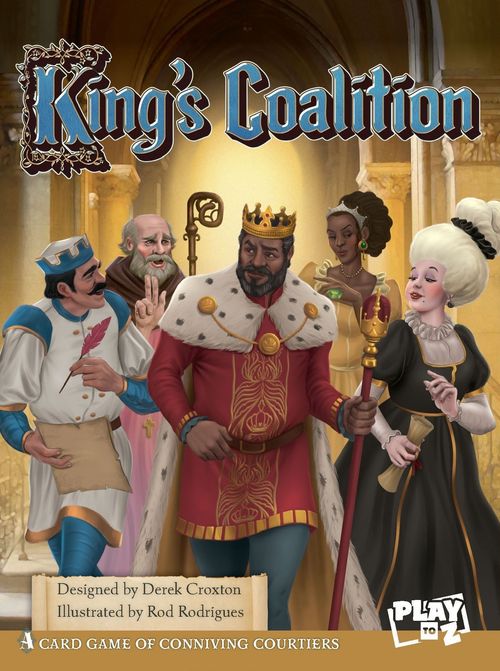
King's Coalition
King's Coalition Rulebook
Table of Contents
Table of Contents
Components
A. 4 Bonus Tokens (+30, +20, +15, +10) B. 64 Subjects cards C. 21 Large Bonus cards D. 5 Reference cards E. 1 First Player token F. 1 Scorepad
Setup
- Deal every player 7 Subjects cards.
- Place 6 Subjects cards facedown in a row in the middle of the table. These 6 cards are referred to as "hidden" cards and will be revealed one per turn. Place the Subjects deck to the left of the first card.
- Place the Set and Sequence Bonus cards faceup underneath the row of Subjects cards. Then place 4 Bonus cards facedown underneath the remaining Subjects cards. Place the remaining Bonus cards back in the box.
- Place the Bonus tokens in descending order starting with the leftmost bonus card.
- Deal each player a Reference card (making sure one of them has a "crown" on it). The player who receives the Reference card marked with a "crown" gets the First Player token.
Gameplay
Before a new round starts, the player with the First Player token will prepare the round as follows:
- Reveal the leftmost hidden Subjects card and add it to the middle of the table - the Recruitment Area.
- If there are Bonus cards still facedown, reveal the leftmost one.
Then, beginning with the First Player, each player will take their turn in clockwise order. A player's turn consists of two actions, Recruit and Dismiss.
Recruit
You must add a card to your hand. You may choose any faceup Subjects card from the Recruitment Area or draw a card from the top of the Subjects deck.
OR
Enlistment
If you choose a faceup Peasant card from the Recruitment area, you may keep it in your hand as a normal Recruit action OR you may may "Enlist" it. Enlisting is a special form of Recruiting in which you move the Peasant faceup to your Coalition Area (in front of you). It counts as part of your hand, but you do not Dismiss on a turn that you Enlist a Peasant.
- Enlisted Peasants (those in your Coalition Area) may not be Dismissed on future turns in lieu of other cards in your hand. Once Enlisted, they are yours until the end of the game.
- Peasants that begin the game in your hand, or that you Recruit from the deck, remain in your hand. They could conceivably be Enlisted on a future turn if you Dismiss them to the Recruitment Area and then on a future turn Recruit them, triggering their Enlistment power. Of course, other players may Enlist that Peasant before you decide to do this.
Dismiss
Unless you Enlisted a Peasant this turn, you must Dismiss one card from your hand into the Recruitment Area. If you Recruited from the top of the deck you may Dismiss the card you drew. However, if you Recruit you cannot Dismiss the same card you Recruit.
End of a Round and End of the Game
When each player has taken a turn, the round ends.
- If it is the end of the 6th round (no more hidden Subjects cards are available), the game is over, immediately go to scoring.
- If it is not the end of the 6th round, pass the First Player token to the left and begin the next round as stated above.
At the end of the 6th round, each player reveals their hand and adds up their score.
Scoring
A player's score consists of the sum of the face value of all the cards in their hand and Coalition Area, plus any bonuses that they qualify for.
The player with the highest score wins. In case of a tie, the player with the lower total face value of cards wins (this includes cards in the Coalition Area).
Two bonuses are always available: sets of the same class and sequences of numbers. In addition, four Bonus cards will have been revealed during the game which you may also qualify for. Note: A single card can count for multiple bonuses. Below is some detail on the two bonuses that are present in every game:
Set: If you have a set of at least 3 cards of the same class, you qualify for this bonus. However, the score will max out at 75 points even if you have more than 7 cards of the same class (using Enlisted Peasants for example).
You may qualify for multiple set bonuses, e.g. if you have 4 Artisans and 3 Merchants, you get a +15 bonus for the Artisans and a +5 bonus for the Merchants.
This is the only bonus that you can receive more than once.
Sequence: If you have a sequence of at least six consecutive numbers, you qualify for a sequence bonus. The classes of these cards are not relevant, only the numbers on them. Example: If you have a sequence from 4-10, you will score 30 points.
Class Abilities
Four of the five Ministers have special abilities that are explained here in more depth:
Ministers
Counts as various classes: These Ministers have a value of zero and may count as a different class when you score your hand. One Minister can count as an Artisan, Gentry, or Merchant, and the other can count as a Knight, Clergy, or Noble, as indicated on the card. Once you have decided, however, the Minister counts as that class for all purposes. Either may, instead, remain as a Minister.
Counts as any (even/odd) card for a sequence: These Ministers have a value of one, but you may change the value to any even or odd value, as indicated on the card, to get a bonus for a sequence of six or more cards. If used in this way, the Minister still scores only one point for its printed face value.
Advanced Abilities
Once you become familiar with the game, you may wish to add in these additional powers for the other classes (besides Peasants and Ministers, which already have special powers).
Only one ability that replaces your "normal turn" can be used during your turn. So if you have a Gentry and Noble in your hand, you can only activate one of them during your turn to replace your normal turn.
Artisans: If you have an Artisan in your hand, you may show it and Enlist an "apprentice" Artisan instead of your normal turn. The Enlisted Artisan works the same as an Enlisted Peasant in all respects (it goes into your Coalition Area, may not be Dismissed, etc.), except that you may only ever have one Enlisted Artisan during a game.
Gentry: Instead of your normal turn, you may Dismiss two Gentry to take any two cards in any combination from the top of the Subjects deck or the Recruitment Area.
Knights: If you have a Knight at the end of the game, you may "appoint" a Peasant, Artisan, Gentry, or Merchant as a Knight. This card becomes a Knight for all purposes.
Nobles: Instead of your normal turn, you may Dismiss 1 Noble and any other card to pick up two cards from the Recruitment Area and add them to your hand.
Merchants: Each Merchant in a sequence makes the sequence worth +5 points.
Example: You have a sequence of cards from 1-6. In your hand are three Merchants, valued at 1, 4, and 8. Your six card sequence is worth 30, instead of 20, because of the two Merchants in it. The 8 point Merchant is not part of the sequence, so it does not add to the score of the sequence.
Clergy: When scoring a set of Clergy, score it as though you had one more Clergy than you actually have.
Example: You have 2 Clergy at the end of the game. You score 5 points as though you had a set of 3 Clergy. Note that this does not give you an additional Clergy for any other bonus.
Tournament Style
For a slightly longer and more strategic experience, we recommend you play 4 games and declare a victor based on the total overall score. You can decide to not reuse any bonuses so that you will see 16 unique bonuses, but that is a matter of preference.
Scoring Example
Matilda first scores the face value of the cards in her hand (which include those in the Coalition Area): Her total is 24. Next come the bonuses. She has a 7-card sequence from 0-6, scoring 30 points. She has 4 Peasants, so she also scores +15 points for the set bonus.
Looking at the other bonuses, Matilda qualifies for the 20 point Commoner bonus since she has no Nobles and at least 3 Peasants. In addition, she can qualify for the Aristocratic bonus if she changes the Minister to a Clergy: she'll now have cards in the Knight class and the Clergy class, meeting the requirement for the Aristocratic bonus. These two bonuses give her another 30 points. Her total score is 99 points!
Transcription note: the Reference card values (the 0-12 score-reference grid on card D) and the 21 Large Bonus card conditions (for example "Egalitarian" and "Rentier") appear only as card artwork in the printed rulebook and are not spelled out in its text; they are printed on the cards themselves and are not transcribed here.