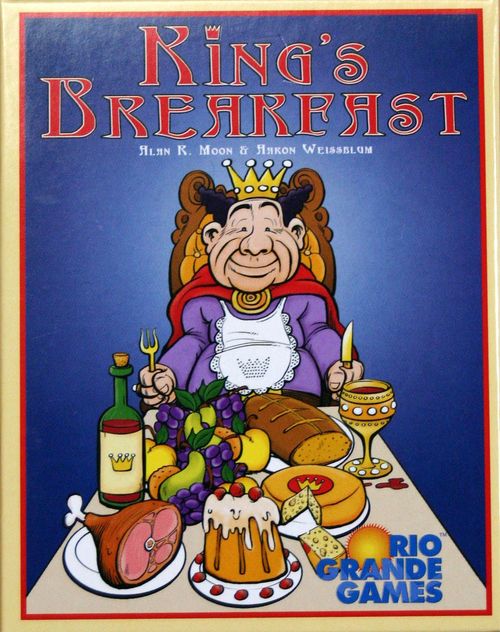
King's Breakfast
King's Breakfast Rulebook
Table of Contents
Table of Contents
Contents
- 110 cards: 105 portions of food (15 each of 7 dishes)
- 5 Emerald cards
Preparation
- Place the box at one side of the table. This is the place where the king puts his portions.
- The players choose among themselves, using any method they desire, who shall be the chef for the first course.
- The chef shuffles the cards and places them face down on the table as a supply.
Playing the Game
The game is played over several courses. Each course has the following steps:
- Prepare the table for the course
- Take portions
- Serve the king
Then the chef gives the card supply to his left neighbor, who is now the chef for the next course.
1. Prepare the Table for the Course
The chef deals twice as many cards as players in the game. He deals from the top of the card supply and places them face up in the middle of the table as the table for the course.
Portion cards. There are seven different dishes, that are distinguished by different colors. Each card represents one portion of the dish shown on the card. As the chef deals the cards, he sorts them by dish, overlapping the portions of the same dish, so that all players can see immediately how many portions of each dish are on the table.
Emerald cards. There are five Emerald cards in the deck, representing the king's pet dragon. When the chef deals an Emerald card, he places it face up as a single card next to the dishes.
2. Take Portions
The chef begins and takes an action. The other players follow in clockwise order each taking an action until each player has taken one action. On a player's turn he must take one of the following actions:
a. Take a dish from the table. The player takes all portion cards of one dish from the table, putting them in his hand. The player may not choose to take just some of the portion cards of a dish...
or
b. Take a portion from the supply. The player draws 1 portion card from the supply and puts it in his hand, without showing it to the other players.
On a player's turn, if there are no dishes left on the table, he must take a portion from the supply.
If he draws an Emerald card, he must use it immediately or place it face up as a single card next to the dishes on the table. He receives no replacement for this card...
or
c. Use Emerald to take 2 portions from the king. This action is only possible when one or more Emerald cards are on the table and there are at least 2 portion cards in the king's place. The player takes 1 Emerald card from the table and any two portion cards from the king's place. He removes all three of these cards from the game.
He must remove 2 portion cards. He may remove 2 of the same dish or 1 each of 2 different dishes.
3. Serve the King
When each player has taken one action and there are still dishes on the table, the king is served.
All dishes on the table are served to the king by placing them next to the box, sorted by dish with the portions overlapping, so all players can see how many portions of each dish the king has.
When there are only a few dishes on the table for a course and the players take all the dishes for themselves, there is nothing left for the king and he gets nothing in this course.
Portion cards served to the king cannot be taken by a player into his hand. Emerald, however, in the service of a player can remove them from the game.
If there are still Emerald cards on the table at the end of a course, they remain for the next course. The dragon remains until he gets something from the king to eat.
The chef of the next course will deal two new cards for each player regardless of any Emerald cards left from previous courses.
Game End
The game ends immediately, when there are not enough cards in the supply to fill the table for the course. These cards are removed from the game.
Scoring
Now the game is scored.
The players lay their hands face up on the table, sorted by dish. Each dish the king has is also important for scoring.
Took too many portions? Each player compares the number of portion cards he has of each dish with those of the king for that dish.
If a player has more portion cards of a dish than the king, he discards all these cards from his hand. These cards are removed from the game. The player scores no points for this dish.
Tallying. Now each player tallies his points. Here again, the number of portion cards the king has of each dish is important to the tallying: for each portion of a dish that a player has he scores the number of portions the king has of that dish.
Example: The king has 4 portions of cheese. If a player has 4 or fewer portions of cheese, he scores 4 points for each portion. Thus, a player with 3 portions of cheese scores 4 x 3 = 12 points for his cheese.
Each player tallies the points for all his portion cards.
The player with the most points is the winner.
If two or more players tie for the most points, the player among them who discarded the least cards in total (cards discarded for having more of a dish than the King) is the winner.