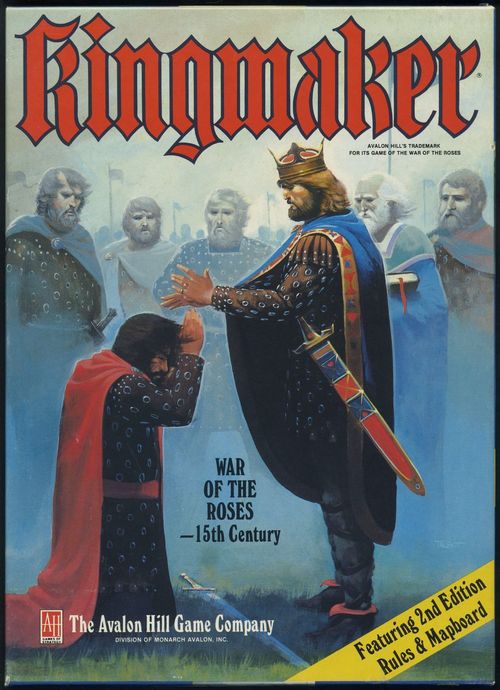
Kingmaker
Kingmaker Rulebook
Table of Contents
Table of Contents
Brief Description of Play
KINGMAKER is played by from 2 to a recommended maximum of 7 players. The object of the game is to control the last of the eight rivals of the royal houses of Lancaster and York for the throne of England. To accomplish this, players maneuver Noble counters representing the 23 major families in England in order to capture and support their royal heir while simultaneously eliminating all other rivals through combat. Each Noble counter has a corresponding Noble card which the controlling player displays and which he may strengthen with title, office and other awards. At the beginning of each player's turn, a card from the Event deck is drawn and any instructions thereon are followed by all players. At the end of each player's turn, a card from the Crown deck is drawn which may add a new Noble to his faction or may augment the strength and power of one already in play.
Components
-
Mapboard representing England in the late 15th Century (see Terrain Key P. 5 for identification of the various features on the board).
-
Deck of 80 large cards hereafter referred to as the Crown deck (see Crown Deck Key P.5 for identification of the different types of Crown cards).
-
Deck of 90 small cards hereafter referred to as the Event deck (see Event Deck Key P.7 for identification of the different types of Event cards).
-
126 cardboard counters (see Counter Key P.6 for identification of the different types of counters).
-
Rules booklet.
-
Game box and lid.
NOTE: Dice are not required for play in the Basic Game.
It is important to become familiarized with the various types of cards and the features on the board before starting play.
Basic Game
Prepare for Play
- All Crown and Event cards and all counters marked with an asterisk in the upper right corner are removed from play for the Basic Game.
NOTE: An asterisk indicates equipment relevant to optional or advanced game rules only.
-
Both the Crown and Event decks are shuffled thoroughly. The Event deck is placed face down in its designated location on the gameboard. A discard pile will be maintained adjacent to the deck. As soon as an Event card has been played, it is placed here face up. During the game, if the Event deck becomes depleted, the discard pile is shuffled and reused as the Event deck. Cards in the discard pile can never be reviewed.
-
36 cards are removed from the Crown deck and are distributed evenly to all players. Any remaining cards are returned to the deck which is then placed on the board.
-
Each player must separate the Crown cards dealt to him according to type and arrange them in front of him in the manner described below:
a. All Noble cards are placed face up.
b. All title cards must be allocated (given), one apiece, to each untitled Noble. Title cards which cannot be allocated are placed in Chancery.
c. All office cards must be allocated, one apiece, to each titled Noble. Office cards which cannot be allocated are placed in Chancery.
NOTE: A Noble can never have more than one title and office.
d. All town, bishop, mercenary and ship cards remaining are allocated without restriction to any Noble(s).
All cards dealt must either be allocated to a Noble or placed in Chancery and cannot be retained to be played later.
Any player(s) not receiving a Noble card in the deal draws cards from the Crown deck until one appears which he plays. The inverted cards are reshuffled into the deck. Every player must start the game with at least one Noble card.
Once a Crown card has been allocated to a Noble card, it may never be returned to any player's hand or transferred to another noble except as outlined in Transfer (P.4).
Chancery
A separate pile for office and title cards which cannot be allocated at the start of play or which belonged to Nobles killed or executed during play is maintained face down. They may be reapportioned during Parliament (P.4). Cards in the Chancery can never be reviewed.
Faction
The arrangement of Crown cards in front of each player represents his faction. The basic unit of the faction is the Noble. He will be represented on the game board by a corresponding counter. The other Crown cards placed under him are his awards. These cards increase his strength in troops, give him control of certain cities, towns and castles, allow him to travel by ship, and award him several other privileges to be outlined in the rules. Each player controls and maneuvers the Nobles and their awards in his faction.
Any town, city or castle awarded to a Noble is considered friendly to all Nobles of his faction. They may enter these places freely. A neutral town, city or castle (not under any faction's control) may not be entered by any Nobles of a faction. An unfriendly town, city or castle (controlled by another faction) may be entered only by permission of the player controlling the faction. Any ship awarded to a Noble may be used by all Nobles in the faction.
The number of Nobles in a faction will fluctuate as some are killed or executed and others added through the draw of the Crown deck. A player will be able to add new Crown cards to his faction. He may not add a Crown card to a Noble "under siege" or at sea that would increase his troop strength. A player who loses all of his Nobles is not eliminated from play. He continues as a new faction.
Setting Out Counters
- The seven royal heir counters are placed in the following locations on the gameboard:
House of Lancaster
Henry VI—in London
Margaret of Anjou—in Fotheringhay
Edward, Prince of Wales—in Coventry
House of York
Richard, Duke of York—in York
Edward, Earl of March—in Harlech
George, Duke of Clarence—in Cardigan
Richard, Duke of Gloucester—in Calais
They are placed on the symbol of the town, city or castle that they occupy. Royal heirs do not have Crown cards to represent them.
-
For each Noble card allotted in the deal, the corresponding Noble counter is placed by the controlling player in any one of the castle(s) on the board that is listed on his card. Place the counter on the symbol of the castle that he occupies. These castle(s) are identified by the coat-of-arms of the owning Noble.
-
Each ship counter awarded to a Noble by either a ship or office card is placed on the port listed on her card.
Sequence of Play
KINGMAKER is played in turns. Each player takes his turn in clockwise order around the table. When all players have taken their turn a round of play is completed. The game continues for an unlimited number of rounds until the requirements for victory have been fulfilled. Play starts with the player who controls the Noble allocated the office of Chancellor of England. If no Noble holds this office then play starts with the player who controls the Noble who has been allocated the senior Bishop in this order: Canterbury, York, Durham, Carlisle, Lincoln, Norwich; otherwise play starts with the player with the most troops. Each player's turn is composed of 6 phases which must be completed in the exact sequence presented below:
-
Chance Phase—The top card of the Event deck is drawn and any instructions printed thereon are acted upon by all players.
-
Movement Phase—All, some or none of the player's counters are moved.
-
Combat Phase—Any battles or sieges are resolved.
-
Parliament Phase—Parliament may be summoned by the sole king or the Noble awarded Chancellor of England office (if there is no sole king).
-
Coronation Phase—A royal heir first in the line of succession in his or her royal house may be crowned king.
-
Crown Deck Phase—A card is drawn from the top of the Crown deck. It may be played immediately or kept hidden and played at any time. When a Noble card is played, the corresponding Noble counter is placed in one of the castle(s) listed on his card. It may happen that the castle(s) held by a Noble to be played becomes unfriendly. In this case, he may be placed on board at the nearest friendly town, city or castle. Any other type of Crown card must be allocated to a noble in order to be played.
Movement
1. Noble Counters
A Noble may move up to 5 squares in any direction (including diagonally) subject to certain terrain restrictions (see Terrain Key P.5). A Noble may move any part of his allowed 5 squares or he need not move at all. This constitutes his move for the turn. The path of movement over land is never blocked.
2. Royal Heir Counters
A royal heir may not move unless captured or instructed to do so by an Event card. Once captured a royal heir must have at least one Noble with him (her) at all times and may never be voluntarily left alone. A royal heir is always allowed to move with the accompanying noble(s).
3. Ship Counters
A ship may move up to 5 squares at sea in any direction (including diagonally). A ship may move any part of her allowed 5 squares or not at all. This constitutes her move for the turn. A ship may stay at sea indefinitely unless forced to port by an Event card. A ship's movement may never be blocked while at sea.
A ship may move unloaded or with passengers. A ship may never move on land but may enter a friendly or unfortified port. A port is counted as a separate square in movement. A ship may move along an estuary to reach a port. A ship may never enter an unfriendly or neutral port unless ordered there by an Event card or attempting to besiege it with her passengers. A ship which occupies or involuntarily enters a neutral port is free to leave in her turn. A ship which occupies or involuntarily enters an unfriendly port may leave only by permission of the player controlling the port.
Sea Transportation
A Noble may combine land and sea movement but never in the same move.
To embark (pick up) a Noble counter, a ship must occupy a friendly or unfortified port. A ship may embark any Noble counter(s) which occupy the square in which the port is located at the start of her move. The ship then immediately moves out to sea carrying the passengers on board. The troop strength of the Noble(s) travelling on a ship at sea can never exceed the capacity printed on the ship's counter. The troop strength of Noble(s) can be split between 2 or more ships as long as they travel together.
To disembark (drop off) Noble counter(s), a ship must occupy a port. If a ship enters a friendly or unfortified port, the passengers may be placed anywhere in the square in which the port is located. Disembarked noble(s) may combat any force in the square.
For a ship to voluntarily enter and disembark Noble counter(s) in a neutral or unfriendly port, her passengers must participate in a siege of the port.
Passengers of a ship which involuntarily enters a neutral or unfriendly port must attempt to besiege it if able. If unable to besiege or if unsuccessful in the siege they end their move in the port square in the open.
Noble counter(s) cannot stay aboard a ship in port. They must be disembarked.
A ship may embark Noble counter(s) only at the start of her move. Disembarkation of passengers ends her move.
Royal heirs may accompany nobles to sea.
A ship whose Crown card is returned to the Crown deck or which changes ownership while carrying passengers remains under the control of the previous owner until the ship next touches port.
Road Movement
A Noble beginning his move in a square containing any part of a road may travel an unlimited distance along it as long as he doesn't pass through a town, city or castle on the road (symbol printed over the road) which he or his faction does not control. In this case the Noble must stop in the square. If the town, city or castle is not controlled by anyone he must end his move at that point. If the town, city or castle is controlled by another player he may request permission to pass through which, if granted, allows him to continue road movement, but if denied causes him to end his move there.
Movement on and off a road cannot be combined in the same move.
Any number of Noble and royal heir counters may use road movement.
Stacking
There is no limit to the number of counters which may occupy a square. Nobles of the same faction in the same square need not be together. Those Noble(s) which are to be together are stacked in a single pile and are termed a force.
Towns, Cities and Castles
A Noble(s) may end his turn inside a friendly town, city or castle in the square that he occupies. It costs nothing to enter. The counter(s) is placed over the symbol. A player may allow the Nobles of another faction to enter a town, city or castle he controls. If a noble occupies a square containing one or more friendly towns etc., the controlling player must indicate his exact location upon entrance into the square. There are limitations as to the number of troops each town, city or castle may hold (see Terrain Key P.5).
Combat
At the end of his movement phase, a Noble may combat any unfriendly Noble or force of Nobles occupying the same square. He is termed the attacker and the Noble(s) that he is attacking are termed the defender. A Noble may make only one attack per round and only in his turn. A defending Noble may never be attacked more than once in a turn.
Any number of Nobles in the same force may combine their strength for an attack. All Nobles defending in a force must be attacked together. Nobles in the same force cannot attack or be attacked separately. Combat is never required and is always voluntary. Ships are never involved in combat.
There are two types of combat: battle and siege.
Battle:
A battle may be fought only between Nobles in the open (not in a town, city or castle). Six steps must be followed to resolve battle.
-
The attacking player designates which Noble(s) he is attacking and which Noble(s) he is using in the attack.
-
Both players add the total strength in troops of their Noble(s) involved. These strengths are compared as a ratio (see Table of Odds P.23).
-
The attacking player draws the top card from the Event deck and refers to the lower pink half of the card.
4a. If the ratio between the two forces is equal to or greater than that printed on the card, then the larger force is victorious and captures all defeated Noble and royal heir counters with them.
b. If the ratio between the two forces is less than that printed on the card then the battle is considered indecisive and there is no victor.
c. If the result on the card reads "Bad Weather Delays Attack," then no attack occurs and the Nobles remain where they are.
- Also printed on the card is a list of Nobles killed. All Nobles participating in the battle even if indecisive and named on the list are killed. Loss of Nobles incurred in this manner does not alter the battle or the results. The Event card is placed on the discard pile.
Siege:
Each town, city and castle on the gameboard has its own permanent garrison (see Terrain Key P.5). For a player to enter a town, a city or a castle not under his control, he must capture it by siege (exception: Open Towns P.5).
Three steps must be followed to procure and resolve a siege:
-
The attacking player must allocate as many Nobles in a stack to the siege as needed to maintain at least an equivalent (equal) strength to the garrison of the defending town, city or castle. Any Noble(s) inside may add their strength to the garrison. If more than one player's noble(s) are inside, only one faction (defenders' choice) may add to the defense. If an attacking player cannot collect enough Nobles to match at least the defending strength of the town, city or castle, he may not besiege it.
-
The attacking player draws the top card from the Event deck to determine if any of the participating Nobles are killed. The odds ratio is ignored. The Event card is placed on the discard pile.
-
A siege is always successful and the town, city or castle plus all Nobles and royal heirs inside are captured unless delayed by "Bad Weather." In this case, the town, city or castle is termed "under siege."
Noble and royal counters inside a town, city or castle "under siege" may leave only if able to reduce the besieging force's strength to less than equivalency. Noble(s) inside may sally forth and initiate or join a battle against the besieging Nobles. The garrison is used in defense only.
A faction which desires to besiege, relieve or enter any town, city or castle already "under siege" must first battle the original besieger. If successful they may either assume the place of the original besieger or enter the town, city or castle if friendly.
Any victorious Noble may end his turn inside the captured town, city or castle.
A captured town, city or castle immediately becomes controlled by and friendly to the faction of the capturing Noble(s) (see Transfer P.4).
The attacking player may call off combat anytime prior to drawing for a result. Once initiated all combat must be resolved. If the attacking player draws a free move or writ card, he keeps the card and must draw again.
Nobles Killed
When a Noble has been killed either by combat or by plague, his counter is removed from the board and his card plus all awards are returned to the appropriate receptacle (either the Crown deck or Chancery). All towns, cities or castles formerly under his control become neutral and any occupants are immediately expelled.
Capture of Royal Counters
A royal heir is captured by a faction when one or more noble counters of that faction occupies the same open area of a square, town, city or castle as the royal counter at the end of their move. If the royal counter is accompanied by another player's Noble(s) they must all be defeated by combat in order to make the capture. A captured royal heir may be executed and removed from play at any time by the controlling player.
A player may not control royal heirs of both royal houses for more than two consecutive rounds from point of capture. He must either execute or transfer to another faction all controlled royal heirs of one royal house.
Capture of Noble Counters
Any Noble(s) captured in successful combat may be ransomed back to the losing player for some consideration (see Transfer and Trade and Gifts P.4). A ransomed Noble must be returned with any title and office cards possessed prior to combat.
Any Noble not ransomed in the turn of capture must be executed and removed from play (see Transfer P.4).
Parliament
A player controlling the sole King, or Chancellor of England if there are two or no Kings, has the privilege of summoning Parliament. Six steps must be followed to summon Parliament.
- The King or Chancellor must occupy an unfortified town, town or city (not castle) excluding Calais or one under siege, which is to be the location of the Parliament.
2a. A "writ" card must be presented to another player's Noble summoning him to Parliament. More Nobles may be summoned using other "writ" cards (one "writ" for each Noble to be summoned).
b. In order for the Chancellor to summon Parliament he must also play a "Parliament" Card.
-
Each Noble summoned by a "writ" card must immediately move to the Parliament location ignoring movement limitations.
-
Any Noble not summoned may voluntarily move to Parliament ignoring movement limitations.
A Noble may not be summoned nor moved to Parliament if on an island or Calais unless an empty (friendly or loaned) ship(s) is available to transport him to the mainland. The ship(s) must be large enough to support the Noble's troop strength. A ship transporting Nobles to Parliament must end its movement at any friendly or unfortified port on the mainland.
-
The player summoning Parliament draws from the Chancery a number of cards equivalent to the number of Nobles attending Parliament.
-
He must distribute these cards to any Nobles (not necessarily at Parliament) which have not yet received a title and/or office card. Any cards which cannot be distributed are returned to the Crown deck.
The King's Peace forbids any combat in the square in which Parliament is held until the next turn of the player who summoned the Parliament.
Coronation
-
Only the senior surviving member of a royal house can be proclaimed and crowned King. (see Victory Conditions for the order of succession P.4).
-
The senior royal heir to be crowned King must occupy a cathedral with one or more Nobles possessing either an archbishop or two bishops cards.
When the above two conditions have been fulfilled the controlling player announces that the royal heir has been crowned King.
Victory Conditions
To win, a player must control the last royal heir in the game and he (she) must be crowned King.
There may be two Kings simultaneously in play, one from each royal house. At the start of play Henry VI is already King. Richard of York as soon as he has been crowned may also be crowned King. If either or both should be killed, the next in line of succession of either or both houses may be crowned King. Below is the table indicating the order of succession for both houses.
House of Lancaster — Line of Succession
- King Henry VI
- Margaret of Anjou (Henry's wife)
- Edward, Prince of Wales (their son)
House of York — Line of Succession
- Richard, Duke of York
- Edward, Earl of March (Richard's eldest son)
- George, Duke of Clarence (Richard's third son)
- Richard, Duke of Gloucester (Richard's youngest son)
A royal heir may not be crowned King until all above him in the line of succession have been killed. There can never be more than two Kings (one from each royal house) in play at the same time.
NOTE: Margaret may be crowned Queen Regent after the death of Henry. As Queen Regent she assumes all the privileges of King.
Beaufort:
If all Lancastrian royal heirs have been killed, the Noble, Beaufort, may be crowned King. In effect he is fourth in line of succession in the house of Lancaster. He still performs like a Noble in all respects.
If crowned his faction may not control a royal heir of the other house.
If the last crowned royal heir on the board is a Lancastrian, the player controlling him is declared the winner whether Beaufort is in play or not.
If the last crowned royal heir on the board is a Yorkist, the player controlling him is declared the winner if Beaufort is not in play.
Transfer
-
Town, ship, bishop and mercenary cards (hereafter referred to as transferables) allocated to a Noble or royal heir counter(s) accompanying a force may be transferred voluntarily to any other Noble(s) occupying the same square at any time provided that the transferred card(s) is not utilized in the turn of transfer. The Nobles need not belong to the same faction.
-
Transferables and royal heir counters are involuntarily transferred to an unfriendly faction if they were awarded to or accompanied a Noble captured or executed by that faction as a result of combat. The transferables must be distributed among the victorious Noble(s) immediately upon transfer.
-
A town card is involuntarily transferred to an unfriendly faction if the town named on the card was captured by that faction. The transferred card must not be allocated to a victorious Noble in this case but placed by itself. This indicates that the town is controlled by the faction rather than a particular Noble.
-
Noble and title cards (hereafter referred to as non-transferables) can never be transferred either voluntarily or involuntarily. If a Noble is executed, his card returns to the Crown deck and any awarded title card is placed in Chancery.
-
Office cards are semi-transferable. They can never be involuntarily transferred but may be voluntarily transferred between any Nobles attending Parliament with the permission of the player summoning Parliament.
Any captured town, city or castle may be transferred voluntarily by the controlling player to another faction as long as at least one representative Noble of each faction occupies the same square. Ships, towns, cities or castles named on a semi- or non-transferable may also be voluntarily transferred (never involuntarily transferred) to another Noble in the same square. The parent card cannot accompany the transfer. It is noted to which Noble the transfer is made. If he should be killed or executed the control of the transferred town, city, castle or ship reverts to the Noble allocated the parent card.
Trade and Gifts
A player may give or trade any ship, bishop, town, city, mercenary or writ cards not played (i.e., in his hand). The recipient may not allocate a traded card to a Noble who is involved in combat in the turn of the trade. Cards given or traded need not be played immediately.
A ship may be loaned to another faction as long as it is moved in only one turn per round.
STOP! Do not proceed any further. You have finished the Basic Game Rules.
Terrain Key
| Feature | Function | Effect on Combat | Effect on Movement |
|---|---|---|---|
| Boundary of Square | Delineates various size and shaped figures hereafter referred to as squares. | No effect | No effect |
| Clear Square | — | No effect | No effect |
| Forest Square | — | No effect | Movement ends upon entering. Movement into the open is made normally. |
| Road Square | — | No effect | see Road Movement P.3 |
| River | — | No effect | No effect. If not stippled it is not a boundary. |
| Estuary | — | No effect |
Crown Card Key
| Card | No. in Deck | Allotment | Notes |
|---|---|---|---|
| Untitled Noble | 14 | Basic unit of game. | Does not have title (May be given title card). Non-tradeable. Non-transferable. |
| Titled Noble | 9 | Basic unit of game. | Has title. (May not be given title card. May be given office card). Non-tradeable. Non-transferable. |
| Title | 8 | Maximum of one may be given to Noble without title. | Has troops. May have fortified town. Non-tradeable. Non-transferable. |
| Office | 12 | Maximum of one may be given to Noble with title. | Has troops, towns, city or royal castle. May have bonus of extra troops in some areas, may have bonus of ships. Non-tradeable. May be voluntarily transferred in Parliament only. |
| Bishop or Archbishop | 6 | Any number may be held by any Noble. | Has cathedral town or city. Used for coronations. Tradeable. Transferable. |
Counter Key
| Type | Number | Symbol | Notes |
|---|---|---|---|
| Noble Counter | 23 | Heraldic Shield | Each counter corresponds to one Noble card. Counter represents strength of Noble plus any troops awarded him. |
| Royal Heir Counter | 7 | Red or White Rose and name. | There is no card for royal counter. They cannot move or fight alone. Once captured they may never be left alone. |
| Ship Counter | 8 | Ship's name, port of origin and capacity. | Awarded to a player through certain office and ship cards in Crown deck. May carry Noble and Royal counters at sea. Ships are never involved in combat. |
| Faction Counter | 84 | Various symbols | Seven different sets of 12 available. Each player uses one set. Counters are placed on towns, cities or castles to identify the controlling faction. |
Event Card Key
| Card | No. in Deck | Key Color | Effect | Notes |
|---|---|---|---|---|
| Plague | 17 | Red/Pink | All Noble and Royal heir counters in the town(s) or city named are killed immediately. Ships in port are not affected. | Plague never strikes Calais or castles. |
| Storms at Sea | 10 | Light Blue/Pink | Every ship at sea must immediately be moved to the closest port. A ship and any passengers may be moved normally in their turn. | If more than one port is equidistant in squares to the ship, controlling player has choice of which port to enter. |
| Raid and Revolt | 23 | Green/Pink | All Noble counters named for themselves or in respect of titles, offices, or Bishop cards awarded to them must move immediately to the location named. If unfriendly, place in the open. | Any Royal heir counter(s) with the summoned noble may accompany him. A Noble at sea, on an island, under siege, or at Calais cannot respond. A Noble called to two or more places as a result of the Crown card(s) he holds may choose where to go. A Noble is sent into the town, city, or castle named. A ship must always respond. Those summoned may move normally in their turn. |
| Embassy |
Short Game
The following three rules may be used separately or together to provide a shorter game.
-
Distribution of Crown Cards—During the initial deal, distribute all the cards in the Crown deck rather than just 36 cards. Each player need not play all the cards dealt to him, though he must display at least one Noble card. If, in a rare case, a player does not receive a Noble, all the cards are reshuffled and redealt.
-
Setting Out Royal Counters—Place Edward, Prince of Wales with Margaret in Fotheringhay. Place Richard, Duke of Gloucester in Plymouth.
-
Time Limit—Play may be terminated at any time before the condition of Victory has been met either by mutual agreement or at a pre-designated time. At the point of termination each player determines his worth based upon his total number of votes in both Houses of Parliament (see Optional Rule: Parliament P.8). The player with the greatest worth is declared the winner.
Optional Rules
Any or all of these rules may be added at the players' discretion. These rules supersede any conflicting rules in the Basic game.
Initial Placement
To insure that no player can be influenced by another's set-up during the initial placement of nobles, each player writes down the castles in which his nobles will start before setting out the counters.
Commission
A writ card now assumes an additional function besides its use in Parliament. As a commission, a writ card may be utilized by a player to substitute a Noble or Nobles in his faction for any Noble (not necessarily in the same faction) responding to a raid or revolt. The commissioned Noble(s) must be equal to or greater in strength than the specific Noble, title, bishop or office card being summoned. If a bishop or archbishop card without a troop strength has been summoned by a raid or revolt, the commissioned Nobles must be equal to or greater in strength than the total strength of the Noble possessing the bishop card.
One writ card is used for each Noble named on the Event card.
Ambush
A battle in which the attacking force cannot hope to gain at least an indecisive result (i.e., the defending force has a ratio of 4 to 1 or better in troop strength) is no longer allowed. An attacking force which is too weak to do battle may ambush instead. An ambush is conducted in the same manner as a normal battle except that only the lowermost printed Noble in the "Nobles killed" section of the Event card is killed. The other noble(s) above him in the "nobles killed" section are ignored. As it is required for the defender to be at least 4 times stronger than the attacker, any surviving ambusher(s) are automatically captured by the defender. "Bad Weather" postpones an ambush.
Noble(s) in a town, city or castle cannot be ambushed.
Town Fighting
This is a fourth type of combat and occurs only in the following three situations:
-
A Noble or Nobles inside a town, city or castle which has become neutral.
-
A Noble or Nobles forced into an unfriendly or neutral port which they are unable to besiege.
-
Two forces in combat and both occupying the same town, city or castle.
Town fighting is always resolved as a battle. In situations 1 and 2, the affected Nobles must attack the garrison plus any unfriendly Noble(s) inside in their turn. If successful they capture the town, city or castle. If unsuccessful they are captured (and executed if in a neutral town, etc.). If the result is indecisive they are immediately expelled into the open.
In situations 2 and 3 player controlling the town, city or castle may choose to attack the unfriendly noble(s) inside. This may be done with the garrison and any of his forces inside and/or moved into the town, city or castle. This attack frees the affected noble(s) from his obligation to attack in his turn.
Bishop Cards
Bishop card(s) allocated to a killed or executed Noble are no longer returned to the Crown deck or transferred but are placed in Chancery. They become non-transferable.
Optional Parliament
Optional Parliament is procedurally identical to that in the Basic game but with the following additions.
- Players must determine the number of votes their faction controls in both the House of Commons and the House of Lords using the following table. All votes in Commons are counted as long as the possessing Noble or controlled royal heir is on the board whether in attendance or not. Noble or royal heir counters voting in Lords must be in attendance.
Parliamentary votes are printed on the appropriate Crown cards under the heading Commons for House of Commons and Lords for House of Lords. Town and City votes are not placed on the title, office and bishop cards but must be counted on the board. Use of faction counters to identify controlled or captured towns and cities will facilitate this process.
- The proposed recipient of a title or office card must be approved by both the House of Commons and the House of Lords for him to receive the card. Approval or disapproval in either House is decided by the most votes (a tie results in disapproval).
House of Commons
| Royal Heirs | Votes |
|---|---|
| King (Chancellor if no sole King) | 20 |
| Senior Lancastrian | 10 |
| Senior Yorkist | 10 |
| Offices | Votes |
|---|---|
| Warden of the Northern Marches | 2 |
| Chancellor of the Duchy of Cornwall | 2 |
| Chancellor of the Duchy of Lancaster | 3 |
| Constable of the Tower of London | 3 |
| Warden of the Cinque Ports | 5 |
| Towns and Cities | Votes |
|---|---|
| Each controlled or captured city | 4 |
| Each controlled or captured town (except Calais, Swansea, open town) | 3 |
| Nobles | Votes |
|---|---|
| Neville | 3 |
| Percy | 2 |
| Beaufort | 2 |
| Mowbray | 2 |
| All other titled Nobles | 1 |
Total 156
House of Lords
| Royal Heirs | Votes |
|---|---|
| Senior Lancastrian | 10 |
| Senior Yorkist | 10 |
| Nobles | Votes |
|---|---|
| Neville | 4 |
| Mowbray | 4 |
| Percy | 3 |
| Beaufort | 3 |
| Courtenay | 2 |
| Stanley | 2 |
| Talbot | 2 |
| Stafford | 2 |
| Pole | 2 |
| Fitzalan | 2 |
| All other Nobles | 1 |
| Bishops | Votes |
|---|---|
| Archbishop of Canterbury | 7 |
| Archbishop of York | 5 |
| Bishop of Durham | 4 |
| Bishop of Carlisle | 3 |
| Bishop of Lincoln | 2 |
| Bishop of Norwich | 2 |
Total 82
-
The proposed recipient of a bishop card (see Optional Rule "Bishop Cards") needs the approval of the House of Lords only.
-
The player summoning Parliament may propose one recipient for each card drawn from the Chancery. Any cards which cannot be allocated as a result of a disapproval in either the Commons or the Lords are given for distribution to the next player in the following order:
a. Player whose faction controls the largest total vote in both Houses;
b. Player whose faction controls the second largest total vote in both Houses;
c. Player whose faction controls the most town votes. (This includes the Warden of the Cinque Ports who has 5 town votes).
A player may be able to propose recipients more than once if he meets more than one of the requirements.
-
Bishop cards may be allocated only by the player summoning Parliament. He may propose recipients for these bishoprics as often as he wishes.
-
A player receiving an office or bishopric in his faction may not utilize its vote (if any) in the Parliament in progress.
-
If Parliament is summoned during the two round period of grace in which a player may control senior royal heir counters of both royal Houses, he must count votes for the counter of one House only. He need not execute any royal counters during Parliament though for the purposes of determining votes those of the unfavored House are considered executed (i.e., cannot be counted at all).
-
Offices and titles which cannot be allocated are placed in the Crown deck. Bishoprics which cannot be allocated are returned to Chancery.
-
Proposed recipients need not accept the title, office or bishopric being offered to him. If refused, the awarding player may choose another recipient.
-
If during a Parliament there are two crowned Kings in play (not necessarily attending Parliament), a vote is taken for Parliamentary support for one before any other business is begun. Support is determined by the most votes in both Houses. This supported Crowned royal heir must act as sole King in all respects upon conclusion of Parliament until his voted support is lost in a subsequent Parliament. If support is not given to either Crowned royal heir, neither can act as the sole King.
Return from Parliament
All nobles in play may return to their home castles (printed on Noble card), ignoring movement restrictions, immediately upon conclusion of Parliament. A player may demand that all players secretly record which of their Nobles if any are returning and to which home castle before any actual movement takes place.
Alliance
Different factions may ally without restriction for purposes of both offense and defense. The following rules must be enforced to form and continue an alliance.
- An alliance may be formed by two or more factions at any time. The allying factions must announce the alliance.
All Nobles of the allying factions are considered allied. Allies can never attack one another.
-
Allied Nobles in the same square may combine their forces for combat and/or for movement.
-
Allied Nobles together for combative and/or movement purposes must choose a commanding Noble in the faction of the player who will control them (place all allied Noble cards and awards together under the commander). The player controlling the commander may move and/or fight these Nobles in his turn. Nobles under a commander need not stay together though they still remain under his control. A new commander may be chosen at any time the involved Nobles are in the same square. If a commander is killed or executed, movement and combat of the Nobles under his command reverts back to the controlling players until a new commander is chosen.
-
An alliance may be terminated at any time by any one of the allying players. One round of peace between the former allies must be enforced from the point of termination. They may not attack one another during this round.
-
Division of spoils is decided by the player controlling the commander. A Noble or royal heir under a commander may use a free move card as long as the player controlling his faction provides the card.
IMPORTANT: No counter (Noble, royal heir or ship) can ever move or attack in more than one turn in a round.
Optional Trade
For those players who desire unlimited wheeling and dealing allow all cards held in the hand to be tradeable.
Optional Victory Conditions
The player who can obtain a majority vote (half the total vote plus one) in the House of Commons and the most votes in the House of Lords to support a Crowned royal heir under his control as the one and only King of England is declared the winner.
Advanced Game
Introduction
The Advanced game introduces new concepts which increase both the complexity of the Basic/Optional game and the number of play options available to each player.
All Basic game and Optional rules apply except where noted otherwise. In cases where there is a conflict in the rules, the Advanced game rule always takes precedence.
Components
All Event cards, Crown cards, counters and board sections marked with an asterisk in the upper right corner are now usable. Their functions are detailed in the Advanced Game Components Key (P.12).
A pair of dice will need to be supplied.
Prepare for Play
-
All Advanced Event cards are shuffled into the Event deck. All Advanced Crown cards but the two Plantagenet Noble cards, the French Aid Mercenary card and the two King's Pardon cards are shuffled into the Crown deck.
-
Distribute the Crown cards as described in the Basic game. After the deal, the French Aid card and the King's Pardon cards are shuffled into the Crown deck available for draw in the Crown Deck Phase.
Setting Out Royal Counters
The starting locations for the royal heirs have been rearranged somewhat and 2 locations have been added.
House of Lancaster
Henry VI—in London
Margaret of Anjou—in Coventry
Edward, Prince of Wales—in Kenilworth
House of York
Richard, Duke of York—in York
Edward, Earl of March—in Harlech
Edmund, Earl of Rutland—in Ireland
George, Duke of Clarence—in Cardigan
Richard, Duke of Gloucester—in Calais
Edmund, Earl of Rutland is the third in the line of succession in the House of York after Edward, Earl of March.
Advanced Battle
This system of battle differs from that of the Basic game in order to provide a greater variety in the outcomes of battle and to present a greater emphasis toward the individual conduct of the battle.
The procedure for each battle must be followed in the sequence presented below.
-
The attacking player draws the top card from the Event deck to determine whether "Bad Weather" has postponed the attack. All other information on the card is ignored. If the attack is not postponed continue to step 2.
-
All Noble and royal heir counters involved in the battle are removed by their respective owners to a convenient open area off the mapboard. A note is made of the square which they occupied to prevent misplacement of the counters upon their return.
3a. The defending player deploys his Nobles into battle formation.
b. The attacking player deploys his Nobles into battle formation opposite the defending battle formation.
-
Odds are determined for each individual encounter that the attacker wishes to initiate.
-
The attacking player draws an Event card for each individual encounter that he initiates. Results are determined as described in the Basic game. The victory ratio may be modified by defensive position or by leadership. The "Nobles Killed" section is ignored—rather the "Nobles Killed" Table (P.11) is utilized.
6a. The attacking player may move any or all of his Nobles or royal heirs in battle formation to an adjacent position.
b. The defending player may move any or all of his Nobles or royal heirs in the battle formation to an adjacent position.
-
The defending player may counter-attack following steps 4 and 5. He now becomes the attacker. A round of battle has been completed.
-
Steps 6 and 7 may be repeated by each player in turn for as many rounds as needed to accomplish either of these two conditions:
a. All Nobles of one side have been either captured or killed.
b. A round of battle has been completed in which no attack is made.
Battle Formation
Nobles must deploy into specific locations in battle formation. Each formation is divided into two rows of three columns plus a reserve stack.
-
Battle line—The first row of Nobles who are to receive the brunt of the fighting.
-
Secondary line—The second row of Nobles immediately behind the battle line.
-
Reserve—A stack of Nobles who cannot, or who the owning player desires not to, occupy a position in either the battle or secondary line.
Nobles may be stacked in reserve. They may not be stacked in the battle or in the secondary line.
Deployment
- The defending player must deploy his Noble counters into battle formation in the manner described below.
a. A minimum of one Noble to a maximum of three Nobles are placed in the battle line. At least one Noble must be in the battle at all times. All Nobles in the battle line are face-up.
b. A Noble may be placed in the secondary line, face-down, in each column occupied by a Noble in the battle line. He must always be placed behind a Noble in the battle line.
c. Noble(s) not placed in either the battle or the secondary line are placed in the reserve face-down.
d. Each royal heir accompanying the Noble(s) must be attached to one particular Noble of choice. He is stacked with this Noble in the same facing.
- The attacking player deploys his Nobles into formation in the same manner as the defending player. His formation is placed across from the defender's formation and facing it.
Each battle formation consists of a battle line of up to three columns, a secondary line behind it, and a reserve stack behind that, for both the attacker and the defender facing one another.
Individual Encounter
An attacking player may attack any noble in the battle line opposite a noble in his battle line. He is under no obligation to attack and can choose which noble(s) he does wish to battle.
Each defending Noble in the battle line facing an attacking Noble must be attacked separately. Each attack is termed an encounter and is resolved individually using the battle procedure outlined in the Basic game with one exception. A "Nobles Killed" Table is substituted for the "Nobles Killed" section of the Event card (see P.11).
The procedure for determining the participants for each individual encounter is performed as follows:
-
Those opposing Nobles in the same column and in the battle line may only battle one another.
-
A Noble in the secondary line and in the same column may join into the encounter.
-
An unopposed Noble or one not attacked in a different column may join into the encounter if it is the closest or one of the closest to him.
-
A Noble or Nobles battling in a different column may strip off troops from their strength to join into the encounter if he qualifies under the following 2 conditions:
a. It is the closest or one of the closest encounters to him.
b. He maintains at least a 2 to 1 superiority in strength ratio in his own encounter. All Nobles involved in combat must be shown face-up.
- Each individual encounter is resolved separately. A "Bad Weather" result is considered an indecisive encounter. Those Noble counters killed or captured are removed immediately from the battle formation. A Royal heir accompanying a killed or captured Noble counter is himself captured. A Noble cannot be recaptured until all Nobles of the capturing force have been themselves killed or captured. Captured Nobles may be executed at any time by a Noble of the capturing force before this occurs. Exchange of captured Noble(s) and/or royal heir(s) may also occur at any time.
Battle Movement
-
A Noble in a battle or secondary line may be moved to any adjacent position (including diagonal movement).
-
A Noble in the battle line cannot be moved to the reserve. A Noble in the secondary line may be moved to the reserve.
-
A Noble in the reserve may be moved to any position in his battle formation.
-
Nobles may transfer positions among themselves if adjacent.
-
A royal heir may reattach himself to any other Noble in the battle formation.
Remember: A Noble may not be placed or remain in the secondary line if there is no Noble in the same column in the battle line.
Encounter Modifications
-
The original defender always adjusts the encounter ratio one step in his favor (i.e., 3 to 1 becomes either 4 to 1 or 2 to 1), in every encounter in which his Nobles are defending.
-
A royal heir or heirs accompanying a Noble or Nobles in the battle line may adjust the encounter ratio one step upwards or downwards in the controlling player's favor for all encounters along the battle line.
-
Opposing modifications will cancel out one another on a one for one basis.
-
Modification can never be greater than one step. Even if a player is able to qualify for a two step modification, he gains just one step.
Disposition of Nobles After Battle
Upon conclusion of the battle, all surviving Noble and royal heir counters are returned to the square that they occupy.
Ransom and Execution
A Noble to be executed cannot transfer his transferable Crown cards involuntarily to the capturing faction. If executed, all awards are returned to the Crown deck or Chancery. He may voluntarily transfer all transferables for ransom.
Revised Alliance
The one round period of peace is deleted. Instead allies may terminate the alliance and attack each other or anyone else in the same round. Former allies may also move in one turn and attack in another in the round of alliance termination though they still may not move or attack in two turns of the same round.
Nobles Killed Table
This table supersedes and amplifies the "Nobles Killed" section on the Event card. A pair of dice is needed to utilize the table.
| Reason | Who Affected | Dice Results | Disposition |
|---|---|---|---|
| Each encounter or Siege | Each Noble of larger force | 2 | Noble killed |
| Each encounter or Siege | Each Noble of smaller force | 2, 3 or 12 | Noble killed |
| Ambush | One selected Noble or royal heir (chosen by ambusher) in the target force | 2, 3 or 4 | Noble or royal heir killed |
| Ambush | Each Noble and royal heir in the target force | 2 or 12 | Noble or royal heir killed |
| Raid and Revolt | Each Noble responding | 2 | Noble killed |
| Plague | Each Noble and/or royal heir in the afflicted town(s) and/or city |
For every titled Noble or Crowned royal heir killed or executed, the former controlling player may roll a pair of dice to determine whether the succeeding heir is loyal to the same faction.
Loyalty Table
| Who Affected | Dice Results | Disposition |
|---|---|---|
| 1. Titled Nobles and crowned royal heirs killed or executed by battle, siege, town fighting or ambush | 2 through 7 | Noble returns to former faction (may be replayed at any time). Crowned royal heir remains in the same square. All awards are lost. |
| 2. Nobles or royal heirs killed by plague or Raid and Revolt | 2 through 5 | — |
Advanced Game Components Key
| Terrain Feature | Function | Effect on Combat | Effect on Movement |
|---|---|---|---|
| Ireland | Place of refuge | No effect | Unlimited port facilities along coast. |
| Continent | Place of refuge | No Combat Allowed | Unlimited port facilities along coast. Land movement allowed between Continent and Calais. |
| Scotland | Decorative function only. | No Combat Allowed. | Entry not allowed. |
Advanced Game Event Card Key
| Card | No. in Deck | Color Key | Effect | Notes |
|---|---|---|---|---|
| Mercenaries go home | 3 | Black/Pink | Causes named mercenaries in play to be immediately returned to the bottom of the Crown deck. | — |
| French Siege | 1 | Green/Pink | If Captain of Calais or a commissioned substitute(s) of 50 troops minimum are not available, Calais becomes a permanent part of the Continent. | If Calais is lost to the Continent, the Captain of Calais office card is immediately removed from play. |
| Revolt in Wales | 2 | Green/Pink | (Duke of York to Stokestay) is added to the instructions. | Part of the basic game deck |
| Parliament must be summoned. | 2 | Yellow/Pink | Parliament is summoned immediately to a location which the player who drew the card chooses. Ignore if there is just one King in play unless it is Henry. Parliament still must be summoned if Henry is sole King. |
Advanced Game Crown Card Key
| Card | No. in Deck | Allotment | Notes |
|---|---|---|---|
| Duke of Lancaster and Duke of York (titled Noble) | 2 | Immediately given to the faction which captures the first in succession of the appropriate royal house. May be allocated offices, etc. It need not be played immediately. When played, the appropriate noble counter is placed in one of the castle(s) named on the card. | If the royal heir first in succession is killed the card plus all awards is given to player who controls next in line or next successor when captured. The counter remains in position. If noble himself is killed he is immediately returned to the faction controlling the proper royal heir, but all awards are lost. Neither noble has any vote in either house of Parliament. |
| French Aid Mercenary | — | May be allocated to a Noble in Calais or the Continent only. It allows unlimited naval transport to controlling faction one way from Calais or Continent to England. Ships are not provided. | Can never be transferred but may be traded. It can only be used once in an attack or siege. Afterwards it is immediately returned to the bottom of the Crown deck. |
| King's Pardon | 2 | Used to prevent a captured noble from being executed. The pardoned noble is released from capture and returns to his faction with all of his awards. (May be used at any time regardless of number of Kings in play). Counter remains in position. | Held in hand until used. Once used it is placed in Chancery. During Parliament most votes in both Houses determines whether it returns to Chancery or the Crown deck. Tradeable. |
Examples of Play
The original rulebook illustrates each of the following examples with board and card diagrams; the diagrams themselves are not reproduced here, but the accompanying explanatory text is transcribed in full below.
Crown Card Distribution
In a four player game, each player was dealt nine cards.
Player A: Player A separates and places in front of him his two Nobles, Neville and Greystoke. He has two titles but can only allocate one as Neville is already titled. He chooses to give the earl of Richmond, the more powerful office, to his untitled noble, Greystoke. The title, earl of Salisbury, must be placed, face down, in Chancery. Both of his Nobles are now titled and each can receive one office. With three offices available, Player A must lose one to Chancery. He chooses to give to Neville, his more powerful Noble, the Chancellor of England and to Greystoke, the Marshal of England. The Chancellor of the Duchy of Cornwall follows the earl of Salisbury to Chancery. Although Player A may seem to be better served by giving the Marshal to Neville, this office's strength is deceptive for the Noble awarded it is frequently removed from the scene of action to quell raids or revolts in the kingdom. The remaining mercenary and town cards may be allocated, in any combination, to either or both Nobles. Player A decides to allocate the town to Neville and the mercenary to Greystoke.
Player B: Receiving just one Noble, Roos, Player B must allocate to him as many of his cards as he can. Of the two titles available, he gives him the earl of Westmorland, the more powerful title, and he loses the duke of Exeter to Chancery. The one office, Warden of the Cinque Ports, can be given to Roos now that he had been titled. The remaining cards, having no allocation restrictions set upon them, can all be given to Roos.
Player C: Player C has been dealt three untitled Nobles and just one title. Only the Noble allocated a title can be allocated an office. Player C must think ahead. He has a very powerful office, the Chamberlain of the County Palatine of Chester, and he would like to allocate it to a Noble who can gain the greatest advantage from it. Herbert, who has a castle in Wales, seems to be the most promising candidate. He is allocated the title and the office. The remaining office, Treasurer of England, is sent to Chancery. The two mercenaries and one town card are allocated to Hastings and Herbert. Player C, desiring not to dissipate his strength, has left Scrope without any awards.
Player D: Player D has received two titled Nobles, one untitled Noble and, fortunately, one title. He cannot allocate the title to Beaufort or Fitzalan for they are already titled. But by allocating the earl of Worcester to Bourchier, Player D has available three titled Nobles, all of whom are eligible to receive an office. With but one office and a mixed blessing at that (the Warden is the second most summoned office in the Event deck), Player D chooses to allocate it to Fitzalan, the least powerful of the three. The remaining Crown cards can be distributed in any manner. Player D allocates his two bishop cards to Beaufort, available for coronation, in case Beaufort should become first in line of succession.
NOTE: All cards in the deal were either allocated to a Noble or placed in Chancery. No player can hold a card of the initial deal.
Movement
Player A wishes to move one of his Nobles, Neville, situated in Bristol to the friendly port of Dover where the ship, le Michael, is stationed to transport him to Calais and, thence, to another friendly port, Berwick.
Immediately, Player A must make a decision, whether to move Neville overland or by road. Certainly the most advantageous route would be by road which allows Neville to arrive at Dover in one move but there is one qualification. Oxford, Wallingford and London each block the road and must either be friendly to Neville's faction or under the control of another player willing to allow Neville passage through. Unfortunately, Wallingford is neutral and so it is impossible to proceed further than that square in his move. Berkeley and Canterbury also block the road but, being in the entry and exit square, respectively, cannot prevent Neville from entering or leaving the road in those squares. Remember, a Noble may enter a road at any point in the entry square and exit the road at any point in the exit square.
Player A decides to move Neville overland through the Oxford and St. Albans squares into the London square. This is his five square move for this turn. Although Player A has a "Free Move" card, he refrains from playing at this time.
Fortunately, in the ensuing round Neville has been unmolested and is ready to continue in Player A's next turn. Neville reaches Dover with 2 squares remaining in his move. He is not allowed to continue out to sea but must wait at the port until the start of his next move. Player A decides that this is an opportune time to utilize the "Free Move." Both Neville and le Michael start the move in port and so fulfill the requirements to embark and move out to sea. At a troop strength capacity of 100, le Michael is just large enough to transport Neville's strength of 100 troops. Although two counters are being moved, only one "Free Move" need be played since Neville is moving as a passenger.
Calais is easily reached being just two squares from Dover. Normally, if Calais were unfriendly or neutral, Neville could not land there, being too weak to besiege the port; but in a previous turn, Player A had sent Percy, another of his Nobles, who with his awards had a total troop strength of 200 to besiege Calais. The siege was successful though, unfortunately, he had been killed in the process. Even so, Calais is considered captured and friendly to the faction. Neville is free to land and capture Richard, duke of Gloucester, who is still inside. At this point, Neville ends his move.
In his next turn, Player A is ready to embark Neville, joined by Richard who must now accompany at least one Noble of the faction at all times. He moves le Michael with the passengers the full movement allowance to the square that is two squares east of Berwick. From here, le Michael can move to Berwick if forced to port by storm.
During the ensuing round, Player A hopes for just that but is disappointed until, on the last chance, he, himself, draws a "Storms at Sea" Event card in his turn. He immediately moves le Michael to Berwick, the closest port of his choice. Neither Neville nor le Michael are prevented from moving in the movement phase because movement as a result of directions of an Event card does not affect regular movement. Neville has reached his destination and decides to end his move here. Player A moves le Michael five squares back toward Dover.
Combat
A force composed of several Nobles of Player B's faction enters the Coventry square. In his hand, Player B holds several Crown cards drawn during previous Crown Deck Phases but not yet played.
In the Coventry square are situated three separate forces controlled by two other players. Player C controls two forces: one in the open, accompanied by Henry VI, and another in Coventry, comprised of Scrope, accompanied by Edward, Prince of Wales. Player C could have concentrated the whole force in Coventry but he preferred keeping the bulk of his force in the open away from the danger of plague. Player D, also, has a force occupying the Coventry square in the open.
Player B has three separate targets which his force may attack. To capture Scrope and Edward, Prince of Wales, he must besiege Coventry. The garrison strength is 200 which with the troop strength of Scrope combines for a total defense of 300. Player B has more than enough troops to match this strength and conduct the siege but he must always keep in mind that Player C can add cards from his hand to Scrope. The probability that the siege might fail is but 1 in 6, which is the probability that a "Bad Weather Delays Attack" result would be drawn.
An attack on Player C's force in the open has less chance of success. It would have to be waged as a battle. The ratio of troop strength of the two forces is 310 to 270, which reduces to less than 5 to 4, the minimum odds for a successful attack. Player B knows that he can readjust these odds by allocating cards from his hand to Nobles of his force; but, even if he added both the office and the mercenary, he could only readjust the ratio to 5 to 4 in his favor. This has just a 1 in 6 chance for success. If Player C is able to allocate, by awards, 40 troops from his hand to his force, he can readjust the odds back below 5 to 4. This attack appears to be very unfavorable.
The remaining attack open to Player B would be a battle against Player D's force also in the open. The ratio of troop strength between these two forces would be 310 to 250, again below 5 to 4. With the additions from his hand, Player B can raise the ratio to 380 to 250 or 3 to 2 in his favor. This is still highly risky with but a 1 in 3 chance for success, but it is a 200% improvement over the other battle. Player B, again, must keep in mind that Player D may be able to add cards from his hand to his force readjusting the odds in an unfavorable direction.
Of Player B's three choices of attack, the siege is most likely to succeed; but, for purposes of illustration, a recreation of all three attacks will be described.
Player B decides to besiege Coventry. Counting the troop strength for both the attacker and defender, he has 10 troops more than is necessary to match the 300 troops defending the town. He can leave Howard, with a troop strength of 10, out of the siege protecting him from death if his name should appear in the "Nobles Killed" section of the Event card. He decides not to, though, in case Player C should increase Scrope's troop strength with a Crown card from his hand. Of course, Player C cannot add the duke of Exeter, the only card in his hand, to Scrope as he is already titled but Player B does not realize this.
Player B draws an Event card and checks the combat results section, ignoring the instructions and the ratio of victory. As fate would have it, the two Nobles killed are Audley and Howard. Audley is not involved in the conflict and, therefore, is not affected; but Howard is. His counter is removed from play and his Noble card is placed at the bottom of the Crown deck. If he had any awards, these too, would be returned to the Crown deck or Chancery.
Before the Event card was drawn, Player C had the opportunity to execute Edward, preventing his capture, but cannot do so subsequently. The moment that the result of combat is determined, the losing side no longer has control of any captured royal heirs.
As a result of the successful siege, both Edward and Scrope are captured. Player B decides to keep and support Edward for the throne. Scrope, he offers back to Player C for ransom. Player C cannot trade the title in his hand but offers to transfer the control of London, awarded to Mowbray who is in the same square, to Player B. This is accepted and Scrope with his title and office remains in Player C's faction. His counter stays in the Coventry square in the open, apart from Player C's other force. Coventry is now under the control of Player B's faction. If the identifying Town card is in play, it should be given immediately to Player B. In any case, a faction counter can be used to identify the town as being under his control. When the Town card is drawn, it should be given immediately to Player B. Town cards of captured towns are always placed by themselves indicating that they are under the control of the faction and not a specific Noble.
In the battle against Player C's force in the open, Player B decides to add the Chancellor of the Duchy of Cornwall office to the titled Noble, Grey, changing the original battle ratio of 310:270 to 360:270 (reduced to 5 to 4 rounded down). Player C adds the duke of Exeter to Herbert readjusting the ratio a second time to 360 to 290 or less than 5 to 4. Player B has no choice but to allocate the Scots Archers Mercenary card to one of his four nobles. In this case, he gives the card to Howard. This readjusts the ratio a third time up to 380:290 which is 10 more than is needed to gain a 5 to 4. Player C is unable to readjust the ratio as he holds no other Crown cards in his hand and the 5 to 4 ratio stands. For Player B to win the battle, he must draw a 5 to 4 victory ratio on the Event card. Player C, recognizing the slim chance of success, chooses not to execute Henry.
Player B draws an Event card which lists 4-1 as the ratio for victory and Clifford and Courtenay as the Nobles killed. The battle is indecisive since the victory odds, 4 to 1, is greater than the troop strength ratio, 5 to 4, of the battle. One of the two Nobles named in the "Nobles Killed" section, Courtenay, is participating in the battle and is killed. His counter is removed from the board, his Noble card is placed under the Crown deck and his office is placed on the Chancery pile. Although the result of this battle was indecisive, Player B was fortunate to weaken the strength of Player C's faction through the death of Courtenay.
In the third attack, Player B battles the force controlled by Player D. By allocating the Chancellor of the Duchy of Cornwall to Grey and the Scots Archers to any one of the Nobles, he will be able to increase his troop strength to 380 giving him a 380 to 250 advantage in troop strength ratio. This is enough to guarantee a 3-2 odds in his favor. Player D decides to lower this ratio by allocating the earl of Worcester to Stanley and the Chancellor of England to Beaufort. This increases the troop strength of his force to 330, more than enough to reduce the strength ratio to below 5 to 4. Player B, seeing that he hasn't enough strength to acquire the minimum ratio for victory, calls off his attack instead. He cannot transfer his attack to one of the other two forces and must be content with no combat.
Parliament
Player D has moved a noble of his faction to Hereford (unoccupied) with the intention of summoning Parliament. At this point of the game there are two Kings in play, Richard of York and Margaret of Anjou. Player C was able to crown Richard, the 1st in line of succession in the house of York, King in the city of York where he was located, by allocating the archbishop of York to Mowbray, one of his Nobles. Mowbray, as the archbishop, was awarded the control of the city of York into which he immediately proceeded. As York is a cathedral city and Mowbray had the archbishop of York, with Player C's announcement that Richard was crowned King of England, all conditions for a coronation were fulfilled.
Player B, whose faction had captured Margaret, had a more difficult time crowning her Queen Regent. As second in line of succession in the house of Lancaster, Margaret is eligible for coronation only upon the death of Henry VI, the present King. By chance, plague struck London killing Henry, before he could be captured or summoned away by an Embassy. With the eligibility of Margaret assured, Player B confronted another obstacle. He had no bishops or archbishops in his faction available to perform the ceremony. He was able to strike a bargain, though, with Player D who had two bishops allocated to Percy, a noble in his faction. By mutual agreement, Percy moved to Salisbury, a cathedral and unfortified town, in anticipation of Margaret's arrival in Player B's next turn. With all requirements for coronation being fulfilled, Player B announced that Margaret had been crowned Queen Regent of England.
This move certainly worked into Player D's plans. Not only had he allocated two bishops to Percy but he had also allocated the office of the Chancellor of England to him. With two Kings in play, only he can now summon Parliament. He must, though, fulfill two requirements to summon Parliament:
-
The Chancellor (Percy) must occupy a town, unfortified town or city (not a castle or Calais). By moving Percy from the coronation site, Salisbury, to the open town of Hereford, Player D has fulfilled this first requirement (although he could have remained in Salisbury, it being a legal Parliamentary site). Although neither Percy nor any other Noble of his faction controls or can control Hereford, he may enter this open town freely if it is unoccupied; otherwise, Player D must either get permission from the player whose Nobles occupy the town or he must successfully besiege it to enter.
-
If the Chancellor summons Parliament, he must be able to play one "Parliament" card. He must, also, have at least one "writ" card to utilize in summoning a Noble of another player's faction. Player D has been able to draw one "Parliament" and several "writ" cards in the previous rounds.
With both of the requirements fulfilled, Player D announces upon the conclusion of the Combat Phase of his turn that he is summoning Parliament in Hereford. He plays the "Parliament" card which gives the Chancellor the right to do so and he plays a "writ" card on Hastings, a Noble in Player A's faction. Although Hastings is in Bamburgh, because of the suspension of movement limitations when moving to Parliament, he must proceed directly to Hereford. Player D may use other "writ" cards to summon other Nobles but is not required to do so. He decides to retain them to utilize in a subsequent Parliament. Both of the expended cards are placed on the discard pile.
All players must now make a decision whether they wish to voluntarily send their Nobles to Parliament. They should keep in mind that for each Noble in attendance, Player D may draw one card from Chancery and that their Nobles need not be at Parliament to be eligible for an award. Player B and C decide not to attend. Player A, fearing for the safety of Hastings, does decide to send his Nobles, consolidating his faction in the process. He plays a Noble, Beaufort, that he has been holding in his hand and moves him along with Courtenay and Stanley, Nobles of his faction already in play, to Hereford. Stanley, though in Douglas, can move to Parliament since Player A has a ship available and large enough to transport him. Player A just moves the ship to Douglas, embarks Stanley, moves to any friendly port, unfortified port or open town, if unoccupied by unfriendly Nobles, and disembarks him. Stanley then proceeds to Parliament. Player D sends his other two nobles, Berkeley and Audley.
There are seven Nobles in attendance allowing Player D to draw 7 cards from Chancery. He can draw only 5 as that is the number of cards residing there at this time.
He must now distribute these cards to those Nobles which can be allocated offices and/or titles. Of course, he looks to his own Nobles first. Percy is permanently titled and has the office of Chancellor of England so cannot be awarded a title or office; but, of his other two, only Berkeley has been awarded a title. He gives, to Berkeley, the Chamberlain of the County Palatine of Chester and, to Audley, the earl of Worcester and the Admiral of England. To Hastings, he allocates the duke of Exeter and, to Talbot, a Noble in Player B's faction, he allocates the Constable of Dover Castle. After distributing all of the cards, Parliament is ended. No combat may take place in the Hereford square until Player D's next turn.
There is one point to remember. Although the player summoning Parliament may choose to which Nobles he may allocate the offices and titles that he draws from Chancery, he must distribute as many as possible even if it means to eligible Nobles who are a part of unfriendly factions.
Optional Parliament
Without going into detail, here are a few points to remember concerning Optional Parliament.
-
Optional Parliament differs from the Basic Parliament only in the procedure of distributing Crown cards from Chancery. Both Parliaments are summoned in the same way.
-
When determining votes, the senior Yorkist and the senior Lancastrian is defined as the 1st in succession of that house, in play, and not the 1st in succession of those royal heirs attending Parliament. If the senior royal heir has not been captured, his votes are considered abstentions and cannot be claimed by any player.
-
A Noble or captured senior royal heir does not have to be at Parliament in order to vote in the House of Commons. He must be at Parliament in order to vote in the House of Lords.
-
The number of votes needed to approve an award depends upon the number of votes cast and not the total number of votes or the number of votes available at that point of the game. So, if there are only 10 votes cast in the House of Lords and 20 cast in the House of Commons, a Noble who can get 6 votes in Lords and 11 votes in Commons supporting him receives the title or office being offered him. This also applies to bishoprics.
-
When counting the town and city votes for the House of Commons, you count every town and city captured by or awarded to your faction excluding those in Wales, Calais or open. Town votes are printed on the town cards. They are not included on office, title and bishop cards. The player who has the Constable of the Tower of London has a total of 7 votes—3 for the office and 4 for the city of London. If London is captured by another faction, London's votes go to the capturing faction. Placing faction counters on towns and cities captured or awarded by bishop, office and title cards facilitates the vote counting.
-
A noble being proposed for a bishopric need only the approval of the House of Lords. Only the player summoning Parliament is allowed to propose a recipient for a bishopric.
-
A player receiving an office, title or bishopric during Parliament cannot add its votes, if any, to his faction during that Parliament.
Advanced Combat
An attack has been announced by Player E against a force of Nobles in the open and under the control of Player F. Player E draws an Event card to determine whether "Bad Weather" has delayed the attack. The result is negative and the battle can proceed. Both players remove the involved Noble and royal heir counters from the board to an open area.
Player F sets up his battle formation. He designates that Neville is on the left flank and that Mowbray is at the center. Behind Neville he had placed Stafford and behind Mowbray he has placed Grey. With Neville, he has also placed Henry VI. He has not put any Nobles in reserve.
Player E sets up his attack formation opposite the defender's. Player E has placed Scrope behind Talbot and Roos behind Percy. He, too, has not placed anyone in reserve. Margaret accompanies Talbot and Edward accompanies Percy.
There are, in the first half of the round of battle, two potential encounters: between Talbot and Neville, and Mowbray and Percy. Player E decides to attack in both. Player F has the option to add his Nobles in the secondary line to the encounter in the same column that each occupy. Player F can and does add Stafford to Neville and Grey to Mowbray. He cannot have Stafford support Mowbray or Grey support Neville as neither occupy the same column as the encounter that they wish to join. Player E adds the two Nobles in his secondary line to their respective encounters.
The first encounter pits Stafford and Neville against Talbot and Scrope. The troop strength of each is 220 which forms a ratio of 220 to 220 or 1-1. This by itself would automatically result in an indecisive encounter but, because Neville is the original defender and a royal heir is on the defending battle line, this ratio can be modified. The attacking player can cancel one of the two modifications as he, also, has royal heirs on his battle line but it still gives the defender a difference of one modification in his favor. Player F has a trick which he plays now. He adds a Saxon mercenary which he has been holding in his hand to Neville which alters the ratio to 230 to 220 in his favor. This reduces to a majority victory ratio which, with the one step modification, increases the odds to 5-4 in his favor. Player E does not hold a card in his hand which he can add; so, the ratio stands.
In the second encounter, both players add their Nobles of the secondary line into the encounter (i.e., Mowbray and Grey versus Percy and Roos). The troop strength ratio is 270 to 170, or 3-2 in Player E's favor. This is modified by Player F to 5-4 in the same manner as in the first encounter. Bourchier, who is alone in the battle line, may join the encounter that is closest to him (i.e., Percy versus Mowbray). He cannot join the encounter between Neville and Talbot as it is farther away. Player E decides not to include him into the second encounter as his troop strength would have no effect. All involved Nobles should now be face up.
Player E draws an Event card for each encounter. The first card states a 3-1 Victory which results in an indecisive attack for the first encounter. The second card states "Bad Weather" which, also, results in an indecisive attack for the second encounter. Both players must now roll for casualties utilizing the "Nobles Killed" Table. Each player, in turn, rolls two dice once for each Noble and any royal heir(s) accompanying, involved in an encounter. Since Neville and Stafford and Percy and Roos are the stronger force in their respective encounters, only a "2" will result in their death. The other Nobles will be killed if a "2," "3" or "12" is rolled. The results of these rolls are that no one was killed.
Player F, now, may counterattack. Player F has the option of moving Nobles to an adjacent position which he declines to do. Player E does decide to switch Talbot with Roos, hoping to get better odds against Mowbray. Bourchier is unable to move because his only open position, in the secondary line immediately behind himself, cannot be occupied unless Player E has a Noble available to fill in his position which he does not have. Player E does place Edward with Bourchier. Here, Edward will not have to roll for battle death as Bourchier is not involved in an encounter.
Player F attacks Roos with Neville and Stafford. Player E adds Scrope into the encounter making the troop strength ratio 230 to 180 or 5-4 in Player F's favor. As Player F is not defending, he loses one of his modifications. The other two cancel one another leaving the odds ratio just as it is.
Player F would rather not attack Percy but realizes that, if Percy can get a 2-1 or better odds against a single attack by Mowbray, Player E can strip off excess troops above this ratio and add them to Scrope and Roos. Or, if Player F does not attack at all, Player E can add Percy's and Talbot's total strength against Neville. Player F decides to attack hoping for an indecisive result. Including the Nobles of the secondary line who join in, the troop strength ratio for this second encounter is 310 to 170 or 3-2 in Player E's favor. Again, Bourchier's strength can have no effect on the odds, so Player E declines to use him in this encounter.
Player F draws a 5-4 result for the first encounter which results in a victory for Neville and Stafford. He draws a 4-1 for the second encounter which results in an indecisive attack. Both players roll for casualties for each Noble and royal heir involved in battle and all survive but Mowbray, for whom Player F rolls a "12," and Margaret, for whom Player E rolls a "2." Roos and Scrope are now captured.
At the start of the second round, Player E may arrange his Nobles in preparation for another attack. Before he starts, though, Player F, realizing the weakness of his position with the loss of Mowbray, decides to offer a deal. He will return the two captured Nobles if Player E calls off his attack. Player E agrees to these terms and, after Player F's second half of the round in which he declines to make any attacks, the battle is over. Both players return their surviving Nobles to their proper location on the game board.
Historical Notes
IN 1399, KING RICHARD II was deposed from the English throne by his cousin Henry, the son of the powerful John of Gaunt, duke of Lancaster. The childless Richard's legitimate heir, the 6 year-old Earl of March, was passed over. Although Henry IV's coup d'etat was generally welcomed after the despotic government of Richard, it was to prove the key event in the century of uncertainty which followed Henry's death in 1413.
Henry's son, Henry V, died only nine years later after a brief but brilliant military career in which he conquered most of a weakened France. He left as heir to the two kingdoms a child of only nine months, Henry VI. During Henry's childhood the government was shared by the late King's brothers and the powerful noble families of the realm including the Beauforts, cousins to the King, the Percys, the Mowbrays, and the Nevilles. For two centuries the nobility had expected to share in the government; and, but with a few disagreements over policy, this is what did occur until Henry VI came of age and the true nature of the Lancastrian revolution became apparent.
The government was financially weak, comparing unfavourably with the wealthier nobles. The revival of French military strength caused a further drain on resources, until it could not prevent the loss of all the French possessions except Calais. By 1450 demoralization among the nobility was complete.
There now appeared on the stage two protagonists who were destined to influence events for the next ten years: Margaret of Anjou and Richard, duke of York. Margaret, a beautiful and arrogant French princess, had been married to Henry VI in 1445. She rapidly fell under the influence of William de la Pole, earl of Suffolk, and in concert began to dominate Henry, who was quite incapable of governing alone. The "all-party" government of the King's minority was quickly replaced by a government of a favored few. Chief of those excluded was Richard, duke of York.
Richard of York was the heir of John of Gaunt's younger brother, Edmund; but he was also the heir, on his mother's side, of the Earl of March who had been passed over when Henry IV had siezed the throne in 1399. His father had been executed for plotting to place the Earl of March (his brother-in-law) on the throne, and from this Richard of York had learned to proceed with caution. For years he served the Lancastrian interest well, notably in France. Later when sent to Ireland, as an unofficial exile, he performed his duties with efficiency. He took no overt part in the impeachment and subsequent murder of Suffolk. But when it became clear, in 1450, that the court faction was determined to exclude him despite the example of Suffolk; and that the Queen and the Beauforts would continue to dominate affairs, Richard acted. He landed with an army in Wales, gathered his supporters, and marched to London to demand a place in government. On this occasion open fighting was avoided, but York's action was a warning of future events if the Lancastrian government continued to exclude him, Henry's only legitimate heir. The following year, 1453, was another year of crisis.
The English forces in France were finally defeated in the battle of Castillon; and Henry had the first of a number of bouts of madness. Margaret and Beaufort tried to keep the illness secret, but when a son was born to Margaret later that year a meeting of the council had to be called. York could no longer be excluded, and in 1454 he was made Protector of the Realm.
Both sides were now preparing for war, aware that the quarrel between York and the Beauforts had reached a climax. The chief protagonists already moved about with large bodies of armed retainers, and local rivalries between nobles were causing outbreaks of violence. When Henry unexpectedly recovered from his madness in 1455, York found himself faced with no alternative but violence in his attempt to gain both his rightful place in government and settlement of his grievances. He succeeded by defeating the Lancastrian forces in the first battle at St. Albans and killing Beaufort. York was helped in his enterprise by his relatives, the Nevilles, whose own personal rival, Percy, earl of Northumberland, also died in the battle.
York governed the country for three and one half years before Margaret's scheming brought renewed warfare between the factions. The Lancastrians succeeded in driving both York and Neville out of the country to their respective bases in Ireland and Calais and in dispersing Yorkist sympathizers but to no avail. Richard invaded in 1460 and easily defeated the Lancastrians at Northampton in July of that year. Richard of York now openly claimed the throne, only to discover that the nobles in his faction were not whole-heartedly behind this move. He had to be content with a compromise, whereby Henry VI remained King for life, and Richard would then succeed him. Richard enjoyed the government for only two more months. At the year's end he was cornered near Wakefield by a superior Lancastrian force and killed.
Disastrous though Richard's death was to the Yorkists, they still controlled Henry VI. Edward, earl of March, Richard's eldest son, an able military commander at 18, was proclaimed King as Edward IV. Edward defeated the Lancastrian forces in Wales at Mortimer's Cross on February 2nd 1461, and then marched rapidly to join forces with his cousin Richard Neville, earl of Warwick, who was entrenched at St. Albans awaiting Queen Margaret and the remaining Lancastrian army. But Margaret too, like Edward, was an able commander, and on February 17th outflanked and defeated Warwick before Edward could arrive, recapturing her husband Henry VI. Returning to London, she was refused entry by the city populace—a fateful decision—and she was forced to retreat northwards, pursued by the now united and rejuvenated Yorkist forces. On March 28th the two armies, among the largest ever gathered in England, fought a bloody battle at Towton. The Lancastrians were utterly defeated, and Margaret with Henry fled into Scotland.
England had a few years of stable Yorkist government under Edward before the architect of their victory, Warwick the 'Kingmaker,' quarrelled with his protege. Together with the impressionable George, duke of Clarence, Edward's brother, Warwick staged a coup d'etat in 1469. It was relatively bloodless, with the chief victims being Edward's wife's relations who had been forming a formidable court faction which had threatened to exclude Warwick. But the coup had little support. Edward endured a few weeks "house arrest" before staging a successful counter-coup. Warwick fled abroad to gather strength for a military expedition. In France, and under the auspices of the French king, the arch-rivals Warwick and Queen Margaret formed an alliance against Edward. Their forces landed in England in September 1470, and Edward was forced to flee in turn to Burgundy. Henry VI, now completely imbecile, was taken from the Tower and 'Readapted' as King. Warwick, of course, was the real ruler.
Warwick was remarkably lenient with the Yorkists known to be loyal to Edward, and there were few executions. But the struggle in England had become part of a larger diplomatic battle between the European rivals, France and Burgundy; and Warwick was no match for the skills of their rulers, Louis XI and Charles the Bold. Edward with the aid of Charles returned to England, landing at Ravenspur (Ravenser) on March 14th 1471. Evading the stronger enemy forces, and joined by his treacherous brother, Clarence, he reached London on April 11th. From there he marched out to meet Warwick at Barnet. Edward's victory was decisive, and Warwick was killed. Without delay Edward marched west to meet the Lancastrian forces under Margaret which had landed from France on the day of Warwick's defeat. He caught them at Tewkesbury. The chief Lancastrian nobles, together with Edward, Prince of Wales, were killed and Margaret was taken prisoner. Henry VI was murdered in the Tower on Edward's return to London.
England now had twelve years of peace under the stable government of Edward IV. The direct descendents of the usurper Henry IV were by now all dead, and the Yorkist King had two sons to establish his dynasty. Clarence, still untrustworthy, was arrested and murdered. There was a hope and expectation that the political and military struggle was finally over. But there was to be a further period of war upon Edward's death.
The King died at a young age in April 1483, leaving as heir his son Edward, who was only 12 years-old. In the ensuing struggle for power during the minority, Richard, duke of Gloucester, Edward IV's trusted younger brother, finally emerged victorious over the faction of the Queen Mother. Richard had been effective ruler of much of the country during his brother's reign, but he now alienated by his tactics all but a few of his supporters. He successfully defeated a revolt by Stafford, duke of Buckingham, but was himself defeated and killed at the battle of Bosworth Field in August 1485 by Henry Tudor, earl of Richmond. Henry VII, whose claim to be the heir to the House of Lancaster derived from the Beauforts who had been excluded from the succession in 1397, succeeded in uniting the country. He married Elizabeth of York, Edward IV's daughter, the sister of Edward's murdered sons. Discontented Yorkists tried to raise revolts in the name of the murdered princes and Clarence's son, who was actually a prisoner in the Tower, but by 1497 Henry was secure. The Wars of the Roses were at an end.
Biographies
AUDLEY—John, father and son. Father died in 1459 leading Lancastrian forces at Blore Heath. The same year his son was captured while attempting to win over the Calais garrison from Warwick. He then joined the Yorkists, and was later a member of Richard III's council.
BEAUFORT—Dukes of Somerset. Descendents of John of Gaunt in illegitimate line and expressly excluded from the succession when legitimised in 1397. Fanatical Lancastrians and enemies of York. Edmund's control of the government was the chief cause of Richard of York's disaffection which culminated in the battle of St. Albans I and Edmund's death (1455). Henry, Edmund's son, was victorious at Wakefield and St. Albans II. Pardoned by Edward IV in 1463, but once again took up arms with Margaret and was killed at Hexham in 1464. Edmund, Henry's brother, was killed in the Lancastrian defeat at Tewkesbury. Lady Margaret, sister of the first Edmund, was married first to Edmund Tudor, and had son, Henry, who defeated Richard III at Bosworth to become Henry VII. Married Henry Stafford, who raised unsuccessful revolt against Richard. Later married Lord Stanley.
BERKELEY—Family generally supported Lancastrians, but received favours from Edward IV and Henry Tudor.
BOURCHIER—Henry and Thomas, brothers. Henry had family connections with York and Lancaster, but was a loyal Yorkist, fighting with Warwick at Northampton and St. Albans II. Made Earl of Essex in 1461. Thomas became Archbishop of Canterbury in 1454. Tried to reconcile Margaret and Richard in 1458. Loyal to Edward IV and raised troops for him in 1471. Crowned both Edward and Richard III.
CLIFFORD—Thomas and John, father and son. Thomas was killed at St. Albans I. His son, John, demanded compensation for this death in 1458. In 1459 he supported the Yorkists, but fought against them at Wakefield the following year. He was killed at Towton.
COURTENAY—Earls of Devonshire. Early supporters of York. Thomas joined the Lancastrains and was executed by the Yorkists after Towton. His brother Henry was executed in 1466. Their brother John was killed at Tewkesbury. Their cousins succeeded to the title. One was killed at Tewkesbury, two others fought with Stafford against Richard III but escaped with Henry Tudor to fight with him at Bosworth.
CROMWELL—One of the leaders of the attack on Suffolk in 1449. Treasurer of England. Fell out with Warwick before his death in 1456.
FITZALAN—Earls of Arundel. William fought at St. Albans II with Warwick, who was his brother-in-law. His son married a sister of Elizabeth Woodville, Edward IV's queen. Both survived the wars.
GREY—Edmund fought for Henry VI until the battle of Northampton when his desertion to the Yorkists helped decide the battle (1460). Earl of Kent in 1465. Married a sister of Elizabeth Woodville. His son remained loyal to the Yorkists until the accession of Henry VII. Their cousins were the Greys of Groby; John was a Lancastrian who died at St. Albans II, and was the first husband of Elizabeth Woodville. His son, Thomas, fought for his step-father Edward IV at Tewkesbury, and was made Marquis of Dorset. Fled from Richard III after his brother Richard was executed, but was not trusted by Henry Tudor.
GREYSTOKE—Family supported the Lancastrians at the instigation of their powerful neighbours, the Percies, but the younger Lord G. went with Richard III to Bosworth Field. Like Percy, he survived the battle.
HASTINGS—William was a devoted Yorkist and acted for Edward IV when he fled from Warwick. Helped win Clarence back to his brother. Fought at Barnet and Tewkesbury. Judicially murdered by Richard III in 1483.
HERBERT—William, father and son. Father fought for Yorkists in Wales, but he and his brother were captured and killed by the Lancastrians in 1469. Son married another Woodville sister.
HOLLAND—Henry, duke of Exeter, was a descendent of Edward I and married Richard of York's daughter, but was a fanatical Lancastrian. After Towton he went with Margaret to Flanders. Reluctantly returned with Warwick and fought at Barnet, where he was wounded. He died two years later.
HOWARD—Related to the Mowbrays. John was a loyal Yorkist and was rewarded with the Norfolk dukedom in 1483. Killed at Bosworth.
MOWBRAY—John, duke of Norfolk. Early member of York's faction and married to Richard of York's neice. Swore allegiance to Lancaster in 1459, but again fought with the Yorkists in 1460 and 1461.
NEVILLE—Richard, earl of Salisbury, leader of Yorkist faction in early years, and was brother-in-law to Richard of York, the Duke of Norfolk, and Duke of Buckingham (Stafford). Captured and killed after Wakefield. His son Richard, earl of Warwick, the 'Kingmaker,' was York's closest collaborator and the architect of Edward IV's victory. Married his daughter to Clarence. Killed at Barnet in 1471. His brother, John, Lord Montagu, was a loyal Yorkist until 1469, when he quarrelled with Edward. He joined his brother and was killed at Barnet. His brother, George, was Archbishop of York in 1465. His brother William, Lord Fauconberg, was made Earl of Kent in 1460. He played a prominent part at Towton. Died in 1463. His bastard son, Thomas, took part in his uncle's activities in 1471, unsuccessfully attacked London and was executed by Edward IV.
PERCY—Earls of Northumberland. Enemies of the Nevilles, their rivals as the premier family in England. Henry, second Earl, died at St. Albans I. His son, Henry, third Earl, also died fighting for the Lancastrians at Towton. Henry, fourth Earl, his son, was imprisoned by Edward, but eventually pardoned. Befriended by Richard III but betrayed him at Bosworth, an action which resulted in his being killed by the Yorkshire peasantry in 1489. Ralph, another son of the second Earl, died fighting for the Lancastrians at Hedgely Moor in 1464.
POLE—Dukes of Suffolk. William was the dominant implacable enemy of Richard of York, and figure in the Council until his arrest in 1450. On intimate terms with Margaret of Anjou, whose marriage to Henry VI he had arranged. Murdered on the way to exile in 1450. His son John, supported the Yorkists and fought at St. Albans II. He married Edward IV's sister. Supported Richard III but accepted Henry VII after Bosworth. His son, John, earl of Lincoln, remained loyal to Richard III, who had declared him his heir (he was R's nephew). Defeated and killed at Stoke in 1487 fighting against Henry VII.
ROOS—Loyal to the Lancastrians. Thomas was executed after the defeat at Hexham.
SCROPE—Fought for the Yorkists.
STAFFORD—Dukes of Buckingham. Humphrey tried to reconcile Margaret and Richard, but was killed at Northampton on the Lancastrian side. His cousin, also Humphrey, was made Earl of Devon. He fought for the Yorkists at Towton, but failed Edward in 1469 and was executed. Henry, grandson of the first Humphrey, was a supporter of Richard III, but rebelled against him in 1483 in favour of Henry Tudor, whose mother he had married. He was captured and executed.
STANLEY—Thomas fought for the Lancastrians at Northampton, but survived to serve Edward IV loyally until 1470, when he supported Warwick. Again became loyal Yorkist after Barnet and rewarded by Edward. Imprisoned by Richard III, but released. Married Henry Tudor's mother as his second wife (his first had been Warwick's sister) and betrayed Richard at Bosworth. His brother William supported York, but betrayed Richard at Bosworth.
TALBOT—Earls of Shrewsbury. John, 1st Earl, was a famous general during the Hundred Years War who died in 1453 in the battle of Castillon. His son, John, was a staunch Lancastrian. Treasurer of England from 1456 to 1458. Killed with his brother at Northampton. His son, John, the 3rd Earl, died in service of Edward IV. George, the 4th Earl, sided with Henry VII. Fought in the battle of Stoke (1487).
Designer's Notes
IN THE HISTORICAL NOTES, certain modern but inappropriate expressions have been deliberately included in the text. Terms such as "revolution" and "coup d'etat" do not reflect accurately the political mentality of the 15th century. Because of this we can easily overrate the importance of the dynastic element in the politics of this period. The struggles of the years between 1450 and 1490 were struggles for power between groups of self-interested nobles. Many had family ties with one or both of the two rival dynasties of Lancaster and York; but family ties were never allowed to obscure their chief concern—power and dominance within their personal sphere of influence. KINGMAKER is, therefore, a game concerned with power—not the sterile evocation of the quaint passions for the Red Rose and the White.
The "scientific model" of the period, upon which the game is based, rests on this interpretation of events, logically extended. The basic units of the game are, therefore, the Nobles and not the rival claimants for the throne. By extension the Royal Pieces become mere pawns, with no movement of their own. In terms of history, of course, we know this to be wrong. However much Henry VI, Clarence, and Edward, Prince of Wales, were manipulated by those around them, we know that Richard of York, Margaret of Anjou, Edward IV and Richard III were decision-makers in their own right. But the model had been constructed to make a political/military game possible, and the interpretation has therefore to be accepted. For another game—perhaps a purely military one—a very different model would have to be constructed.
The next problem involves determining the number and strength of the Nobles, the basic units. The action of the game—which has no fixed time periods—takes place over thirty years of English history, and the units therefore represent noble familes, not individuals. In the course of these years many families lost several successive heads—the Beauforts: father, son, and uncle; the Percies: father, son, and grandson; and the Nevilles: father and three sons. This is reflected in the game when families reappear after death—sons, brothers, or cousins succeed to the family estates. It explains, too, how Archbishops can be "held" by Nobles, so representing relatives in the Church.
The start of the game has been fixed at about 1453—the year of crisis in which France was finally lost, Henry VI went mad, and the birth of a son to Margaret shattered Richard's hopes of succeeding to the throne peacefully. Those families which were active in this period with the titles they possessed form the basis of the game's framework of Nobles. There was no room for 'arrivist' families like the Woodvilles; unconnected branches of the Grey family had to be merged; cadet branches of the Nevilles were merged into the main family; the families of Tudor, Beaumont, Blount, Tiptoft, West and Dacre, among others, were sacrificed. To enable new creations of titles some Nobles were split from titles they actually possessed in 1453. Holland lost the Dukedom of Exeter, and the Neville family gave up the Earldoms of Westmoreland and Salisbury.
Drastic pruning affected the castles and their significance. The number was reduced to 36, and their geographical position matched with families who possessed strength in that area. No attempt was made to recreate the exact holdings, since the chief role of the castles is as foci of power in the absence of true territories. The households of the various Nobles were built up as a more accurate reflection of their relative strength, with the model's analysis of the connection between military and political power firmly in mind. The households fell into four groups. The major titled Nobles, like Neville and Mowbray, had 50, the minor Nobles only 10. In between there were the other titled Nobles (30) and the more powerful minor nobles (20). Stanley, although untitled, was given 50 to compensate for his isolation on the Isle of Man, while Percy was given 100 to reflect his great strength in the North.
Towns, Bishops, Ships, and Titles presented few problems, although their number was reduced, like the number of families, as a result of play-testing. Some towns lost their fortifications; the Archbishop of York lost a castle; and the Open Towns evolved as a means of giving powerless Nobles protected staging-posts. The Mercenaries arrived last of all, replacing Abbeys (with a rather elaborate 'sanctuary' rule) as a means of providing extra troops.
The Offices gave the greatest opportunity for affecting the dynamics of the game after the holdings of the Nobles themselves. They started out as a simple reflection of the King's powers of patronage, and offices like that of the Steward and the Treasurer still have little dynamic effect. But it was early appreciated that many of the offices could be used to test and temper the more powerful power blocks. So the Marshal pays for his 100 troops with the many calls to deal with Peasant Revolts, and the Chamberlain of the County Palatine of Chester can make Wales play an important part in many games.
The cards in the Event Pack supply more of the game's dynamics. Taken too literally, the seven categories of cards may appear to caricature the Middle Ages and the concerns of the nobles who lived at that time. Plague was by no means as prevalent as the 17 cards suggest. Once they survived childhood, the men and women of the time were remarkably little prone to accident and illness. Plague cards have to be analyzed primarily in game terms. Primarily they ensure that players do not keep their nobles in Towns indefinitely. Secondly they allow for the plausible death and removal from the politics of the time the heads of the Houses of Lancaster and York, and so ensure further variant scenarios.
The peasantry of the late 15th century was little affected by the Wars of the Roses. So is it really necessary to have so many Peasant Revolts? This is where the player has to abandon his simulation game training in favour of his imagination. In KINGMAKER it will depend entirely on the particular game what a Peasant Revolt centred on Bodmin really means. In historical terms it could be a false alarm or the beginning of a Lancastrian invasion, or even the revolt of the Cornish peasantry that the card suggests. In the practical terms of game dynamics it will divorce up to five nobles from their factions, testing their power and providing opportunities for attack or escape for others. So it is with the Raids and other Revolts which occupy so much of the time of the Marshal and the Warden of the Northern Marches. Power in the state—the nobles' ultimate objective—brings with it the responsibility of dealing with threats to the state. In game terms this was a perfect way of testing the strength of the players as they rose to political dominance. Embassies test in even more direct manner the strength of the court faction, and dissipate the dominance of London in the early stages of the game.
KINGMAKER was evolved over a period of many years. Its mechanics owe very little to other games, and a great deal to the prejudices of its sole designer. In consequence the mechanics may seem peculiar to members of the Avalon Hill school. By the early '60s, when Avalon Hill games started to infiltrate the U.K. in small numbers, the prototype was already in existence; play-testing was under way, with extant movement and combat systems. There was no desire to go back and re-learn in the light of 'AFRIKA KORPS' or 'BULGE.' If anything seeing and playing these fine games accelerated the desire to perfect the multi-player game in which complex movement and combat would not distract players from their political objectives. Hence a unique movement system where the mapboard does the work (smaller, more numerous squares where the ground is difficult; larger ones where easier) and the player only has to remember that pieces move up to 5 squares—no MFs. Hence also a combat system which hardly permits of military skill, outside of the large scale manoeuvre which won Edward IV his battles, and Margaret some of hers. No dice, no CRT, no retreat after combat, just a simple odds computation.
The Wars of the Roses, in common with many other periods of history, show men seeking power, fighting battles, and experiencing good and bad fortune. But the Wars of the Roses also have several unique characteristics which have a direct bearing on the manner and spirit in which the game was created by the designer. The whole series of events was dramatised by William Shakespeare in his plays, Henry VI Pts I, II and III and Richard III. Within are the great dramatic scenes of the age, and quite a few invented ones, too. But each stage in the thirty year struggle is painted in the bright colours of the master dramatist's genius. The game tries to recapture some of the excitement of the drama, and to encourage the players to identify with the passion Shakespeare puts into the mouths of his characters. Scenes like the quarrel between Richard Plantagenet and Suffolk and Somerset in the Temple Rose Garden, like the murder of Richard by Margaret and Clifford after Wakefield, and the final scenes at the battle of Bosworth should be compulsory reading for the KINGMAKER player. They will arouse his spirit for victory far sooner than any history of the age.
The other characteristic of the age which has been foremost in the designer's mind is its 'colour'—by which is meant the whole panoply of heraldry, castles, murder, exile, and triumphant coronations that we associate with the Wars of the Roses. Win or lose, the game should be enjoyed for its evocation of the end of the Middle Ages and the beginning of the Modern.
Table of Odds
| Weaker Force | Majority* | 5-4 (1¼-1) | 3-2 (1½-1) | 2-1 | 3-1 | 4-1 |
|---|---|---|---|---|---|---|
| 10 | — | — | — | 20 | 30 | 40 |
| 20 | — | — | 30 | 40 | 60 | 80 |
| 30 | — | 40 | 50 | 60 | 90 | 120 |
| 40 | — | 50 | 60 |
*Advanced Game only
How to Use the Table
-
The weaker force locates his troop strength along the left-hand column.
-
The stronger force reads across the row containing the weaker force's strength to locate his troop strength.
-
If his strength is not listed he must choose the closest smaller strength.
-
The head of the column containing the larger force's troop strength lists the ratio for the battle.
Example:
A force with a troop strength of 410 attacks a smaller force with a troop strength of 280.
-
Defender locates his strength on the SMALLER FORCE COLUMN.
-
Attacker reads along the row headed by 280. The values are 290, 350, 420, 560, 840, 1120. None of these values corresponds to his strength of 410.
-
He locates the closest smaller value to 410 which is 350.
-
Reading up the column he discovers that the 350 is in the 5-4 column. The ratio for the battle is 5-4.
To win, the attacker must pick a card containing a ratio of 5-4 or less. All other ratios are greater, a selection of which would result in an indecisive battle.
The Principal Descendants of Edward III
The rulebook includes a full-page genealogical chart, "The Principal Descendants of Edward III," tracing the royal houses of Lancaster and York down through seven generations from Edward III to the Tudor era, with birth/death dates and marriages for each descendant. The chart is printed as a dense diagram rather than running text and is not reproduced here; the family relationships it documents are summarized in the Biographies under Historical Notes above.
Grid Location Table
| Name | Code | Description |
|---|---|---|
| Abingdon | F-4 | Unfortified town |
| Alnwick | A-4 | Castle |
| Appleby | B-3 | Castle |
| Arundel | G-4 | Castle |
| Ashby | D-4 | Unfortified town |
| Bamburgh | A-4 | Royal Castle, Port |
| Barnet | F-5 | Unfortified town |
| Bath | F-3 | Unfortified town |
| Beaumaris |