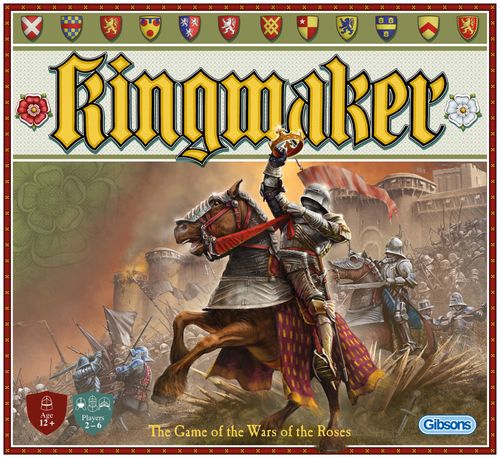
Kingmaker (2023 Edition)
Kingmaker (2023 Edition) Rulebook
Table of Contents
Table of Contents
- Game Overview
- Kingmaker II Rules
- Objective
- Components
- Royalty and the Succession
- Your Faction
- Set-Up
- Sequence of Play
- Event Phase
- Movement Phase
- Combat Phase
- Parliament Phase
- Coronation Phase
- End of Turn Phase
- Winning
- Prestige Points
- Control of Royal Pieces
- Chancery
- Crown Cards
- Alliances
- Historical Background
Game Overview
Kingmaker depicts the period of English history in the 15th century that became known as the Wars of the Roses. Players manoeuvre Noble pieces representing the leaders of 24 major families in England and Wales in order to gain control over a Royal piece of their own, while also eliminating rival Royal pieces and weakening their opponents through political and military actions. Each player controls a Faction consisting of one or more Nobles. Each Noble piece on the board has a corresponding Noble card displayed by the controlling player in their Faction space. Players can strengthen their Nobles with a Title, an Office, and other cards, such as Bishops, Mercenaries, and Ships.
At the beginning of your turn, you draw a card from the Event deck, and all players follow its instructions. During your turn, you may move your Noble pieces, fight battles, and conduct sieges. You may also have the opportunity to call Parliament to gain the benefit of additional Titles and Offices, and perhaps the chance to crown a new King. At the end of your turn, you draw from the Crown deck, which may enable you to add a new Noble to your Faction or increase the power of a Noble already in play.
You win Classic Kingmaker only by eliminating all rival Royal claimants to the throne. You can win Kingmaker II not just by eliminating all Royal pieces other than your own, but also by amassing political prestige through the acquisition of cities and positions in the government and the church.
Kingmaker II Rules
For 2 to 5 players. Duration: about 45 minutes plus 30 minutes per player.
Objective
A single Faction or Alliance of more than one Faction can win Kingmaker II in one of two ways:
- By controlling the last surviving Royal piece, crowned,
or
- By gaining overwhelming prestige through domination of the government, cities, and the church, while also controlling a King.
Components
This edition of Kingmaker has the following components:
- 1 Guide to Kingmaking
- 3 Rulebooks (Kingmaker II, Classic Kingmaker (includes Extended Classic, Options & Variants), The Solo Challenge)
- 4 Player aids
- 2 Solo Challenge player aids
- 1 double-sided game board (Kingmaker II/Classic Kingmaker)
- 1 small battle board (for use with optional battle rules in Extended Classic version)
- 329 die-cut counters for Royal (8), Noble (168), and Ship pieces (11), plus Faction (120), Alliance (9), Stack (6), Battle (1), Besieged (3), King's Peace (1), and Start Player (1) markers, and 1 Prestige Victory tile
- 90 Crown cards
- 140 Event cards
- 40 other cards (3 Victory Condition cards, 14 Faction cards, 8 Royal cards, 5 City cards, 8 Major Battle/Major Siege cards, 2 Plantagenet cards)
- 2 six-sided dice
Kingmaker II Game Board
The Kingmaker II game board depicts England, Wales, and part of France, as well as areas for storing cards, noting each Faction's Prestige points, any Alliances, and a track for recording each Faction's largest army. The map is divided into Regions by thick purple lines and the sea. Each Region is further sub-divided into Areas by white lines.
Key to the numbered items on the board:
- Event deck and Crown deck — Space for storing these decks and discard piles.
- Prestige points track — Records the number of Prestige points held by each Faction and Alliance.
- Chancery — Used to hold unawarded Offices and Titles or those relinquished by killed Nobles.
- Clamour for Parliament — Holds the Clamour for Parliament Event cards when drawn.
- Other cards — Space for storing Victory Condition cards, Royal cards, Major Battle/Major Siege and City cards.
- Army Troop Strengths track — Enables players to track the number of troops in each main army.
- Key to the map
- Stacking zones — In conjunction with Stack markers, may be used to hold the game pieces of large stacks on the board.
- Alliances track — Holds a marker for each Faction. Put markers of allied Factions in the same row.
The Map
Most of the map consists of the mainland of England and Wales. The map also depicts parts of Ireland and Scotland, but these are not used in this version. There are 3 islands (also not part of the mainland): the Isle of Man, the Isle of Wight, and Anglesey. The Calais Area is also depicted, and forms a separate Region of its own. A number and letter grid reference is printed on the edges of the map, so that players can readily look up the position of locations mentioned on the cards. Please note that the blue lines in the sea on the map are Sea Borders and NOT part of the grid.
See the Terrain Chart on the Player Aid for details of terrain types and their effect on movement and combat.
Game Pieces and Cards
- 7 double-sided Royal pieces. The reverse shows the Royal piece crowned, except for Henry VI who is always crowned if alive. Front: Henry VI, Margaret of Anjou, Edward of Westminster, Richard, Duke of York, Edward, Earl of March, George, Duke of Clarence, Richard, Duke of Gloucester. Reverse: Henry VI, Margaret the Queen, King Edward, King Richard, King Edward, King George, King Richard.
- 6 sets of 24 double-sided Noble pieces, each set with a background in a player colour. On the reverse is the same shield with a fortified-location icon to show they are inside a fortified location. Use any 5 sets of player pieces for Kingmaker II.
- 6 sets of 20 Faction markers with Faction badges, each set with a background in a player colour.
- 6 Stack markers with Faction badges, each set with a background in a player colour.
- 9 Ship pieces. On the reverse is the same ship with an anchor to show the ship is in port. Front/Reverse pairs: Le Christopher (200, Southampton), Le George (150, Rye), Le Margaret (200, Lynn), Le Michael (100, Bristol), Le Nicholas (100, London), Le Patrick (150, Douglas), Le Rose (100, Plymouth), Le Swan (100, Berwick), Le Trinity (150, Rye).
- 9 Alliance markers (3 of each), numbered 1, 2, and 3 on front and reverse.
- 1 Start Player marker.
- 3 Besieged markers.
- 1 King's Peace marker.
- 14 Faction cards (F01-F14). On the reverse is the Sequence of Play for easy reference.
Crown card types shown in the manual include Titled Noble, Untitled Noble, Title, Office, Archbishop or Bishop, Ship, Town, and Mercenary. Royal, Major Battle/Major Siege, and City cards are shown separately. Event card types illustrated include Raids and Revolts, Mercenaries Go Home, Storms at Sea, Plague, Clamour for Parliament, Chancellor, Free Move, and Embassy.
Royalty and the Succession
Members of the Houses of Lancaster and York are each represented by a Royal piece and a Royal card. The Royal piece shows where that Royal person is on the board. The corresponding Royal card is placed with ("attached to") a Noble card in a player's Faction space, to show the Noble and player that controls them. One side of the Royal piece and Royal card show a crown (except for Henry VI, who is crowned on both sides); use this side only after that Royal person has been crowned.
Only the senior surviving Lancastrian and Yorkist can be crowned King. There can be 0, 1, or 2 Kings in play at any time in the game.
At the start of the game, the Lancastrian Henry VI is the sole King. Other Lancastrian Royal pieces cannot be crowned until Henry is dead. Richard, Duke of York, is the senior member of the House of York, so he is eligible to be crowned King, regardless of whether or not there is a Lancastrian King.
The line of succession for each house is:
- House of Lancaster: Henry VI, then Margaret of Anjou*, then Edward of Westminster.
- House of York: Richard, Duke of York, then Edward, Earl of March, then George, Duke of Clarence, then Richard, Duke of Gloucester.
A Royal piece cannot be crowned King, or Queen Regent, until the Royal pieces above them in their house have died. For example, George, Duke of Clarence, cannot become King until Richard, Duke of York, and Edward, Earl of March, have died.
* Margaret may be crowned as Queen Regent after Henry's death. As Queen Regent she assumes all the privileges of King. All references to a King include Margaret of Anjou as Queen Regent following her coronation.
A Noble and all his awarded Crown cards act together as a unit. There are limited ways in which awarded cards can be voluntarily removed from a Noble or transferred from one Noble to another (see Card Transfers, below). A Noble unit's troop strength is the sum of its Noble card and all its awarded cards, plus any regional bonus that applies where the Noble currently is (for example, a base troop strength of 100, becoming 130 north of the Trent because of the regional bonus of the Bishop of Durham).
A typical Noble card shows: the card identifier; the number of times the Noble is called by Events; a Title, if the Noble has one already printed on their card (some Nobles have a Title already printed on their Noble card; you can award 1 Title to a Noble that does not already have one); the Noble's family shield; the family name; the Noble's home castles; the Noble's troop strength; and votes in Parliament (variant rules only). A Title typically adds extra troops to your Noble's troop strength. Only Nobles with Titles can have an Office. Any Noble with a Title can have a maximum of 1 Office. An Office typically gives control of fortified locations, extra troops and sometimes even more troops, when the Noble is in a specific Region, called a "regional bonus". Regional bonuses only apply when the office-holder is on land in the specific region shown on the Office card. Any Noble can have a maximum of 1 Archbishop or 1 Bishop card. Some have a regional bonus pictured on the card. Apart from the limits of 1 Title, 1 Office, and 1 Archbishop or Bishop, a Noble can be awarded any number of other Crown cards, such as the Town, Mercenary, and Ship cards. However, carefully consider how you allocate Crown cards for, if one of your Nobles is killed, your Faction will lose this Noble card and all their awarded cards.
At the end of each of your turns you will draw Crown cards into your hand. There is no hand limit. You can play cards from your hand into your Faction during the game. See Crown Cards, below.
Prestige Points (Introduction)
Some cards provide Prestige points that contribute towards the achievement of Prestige Victory. These cards have a Prestige icon on them. For example, each Office, each Archbishop, and each City (Bristol, London, Norwich, and York) carries 1 Prestige point. See Prestige Points, below, for full details.
Your Faction
Your Faction consists of the cards that you place faceup in front of you (in your "Faction space") plus the corresponding Noble and Ship pieces on the board. These cards are "in play", whereas cards in your hand, in the decks, or in the discard piles are not "in play". See the Guide to Kingmaking for an example of a Faction set-up.
Your Nobles are the foundation of your Faction. Each Noble is represented on the board by a Noble piece with a shield depicted on it and in your Faction space by a Noble card showing the same shield. To add a Noble to your Faction, place the relevant Noble card faceup in front of you, then find its Noble piece in your player colour and place it on one of the home castles listed on the Noble card. At the start of the game you control all the home castles listed on your Noble cards. If you want to add a Noble to your Faction during the game, and your Faction or Alliance does not control the home castle on the card, place the Noble piece in the nearest friendly Town, City, or Castle.
All non-Noble Crown cards that you start with, and any other non-Noble Crown cards that you want to include in your Faction during the game, must be awarded to one of your Nobles before they can be used. Crown cards that you pick up during the game do not have to be awarded to one of your Nobles immediately. They can be held "in hand" until you are ready to reveal them. When you award a card, tuck it faceup under the Noble card, so that all players can see at least the additional troop strength at the bottom of each card. The faceup cards in your Faction are public information.
Note: ignore references on the cards to "Lords" or "Commons". These are only used in variants.
You can group together (stack) or split up your Nobles in the same open field or fortified location at any time. If another Faction attacks your Nobles, all your Nobles in the same open field, or the same fortified location, automatically fight together as a single defensive stack.
A friendly Noble is one from your Faction or a Faction allied to your own. Other Nobles are enemies.
A friendly fortified location (a City, fortified Town, castle, or Royal castle) is one that is controlled by your Faction or a Faction allied to your own. A neutral fortified location is not controlled by any Faction. An enemy fortified location is controlled by a Faction other than your own or a Faction allied to your own. An unfriendly fortified location is neutral or enemy controlled.
Note: an unfortified town cannot be controlled by any Faction and is automatically considered to be in the open field of its Area.
Set-Up
This section explains how to set up Kingmaker II for 2-5 players using the pre-set Faction cards. We recommend that new players play at least their first game by using the pre-set Factions.
If you are not using the pre-set Faction cards, replace steps 4 to 6 as described in Alternative Set-up without Pre-set Factions, below.
-
Board: use the Kingmaker II board. Place the board in the middle of the playing area with the Kingmaker II side faceup. Each player will need space around it for their Faction cards and other playing pieces.
-
Royal pieces: put these on the board as follows:
- Henry VI in London (5B)
- Margaret of Anjou in Kenilworth (3C)
- Edward of Westminster in Coventry (4C)
- Richard, Duke of York in York (4E)
- Edward, Earl of March in Harlech (2D)
- George, Duke of Clarence in Cardigan (1C)
- Richard, Duke of Gloucester in Calais (6A)
-
Crown cards: Kingmaker II uses the 74 Crown cards with identifiers from C01 to C74. Do not use any cards marked CK or EXT at the top right of the card.
-
Pre-set Faction cards: when using the pre-set Factions, find the Faction cards for the number of players in the game, as identified at the tops of the cards, shuffle them, and deal 1 to each player. Take the Crown cards listed on your Faction card. If you are not using the pre-set Factions, distribute the Crown cards as described in Alternative Set-up without Pre-set Factions, below.
-
Crown deck: shuffle the remaining Crown cards and place them facedown as the Crown deck on the indicated space on the board.
-
turn over cards from the top of the Crown deck until you find a total of 2 Titles and/or Offices. Place these 2 cards faceup in Chancery in any order. Then reshuffle any other turned-over cards back into the Crown deck.
Note: In the first round of the game, your Nobles are not allowed to attack another Faction's Nobles.
2-player Kingmaker II
You can play 2-player Kingmaker II using the same method as for 3-5 players. However, for a more balanced game, we recommend that you add ownership markers from a 3rd non-player Faction to the following 4 Towns and Cities: London, Northampton, Shrewsbury, and York. Put the Crown cards for Shrewsbury (C60) and Northampton (C66) onto the City cards pile. Treat these 4 Towns and Cities as if they were owned by another player Faction; you cannot pass through them by Road movement until you have conquered them. If you conquer any of them, take its card and award it to one of your Nobles in the Area. Control of London and York does not go to the holders of the Office of the Constable of the Tower of London or to the Archbishop of York, respectively, but instead remains under the control of the non-player Faction until conquered by one of the players.
Alternative Set-up without Pre-set Factions
If you are not using the pre-set Factions, replace steps 4 to 6 with those described below, in order to distribute the Crown cards. This "controlled random" method is designed to provide significant variation, while preventing a player from having a devastatingly strong or catastrophically weak hand.
A. Remove 5 cards: put the following 5 Crown cards into the Crown deck discard pile: the Archbishop of York (C02), the titled Noble Percy, Earl of Northumberland (C13), and the three Offices, the Constable of the Tower of London (C35), the Marshal of England (C36), the Lord of the Isle of Wight (C43). These 5 cards will not be given to any player and will stay in the discard pile until you create the new Crown deck in step G below.
B. Deal specific card types: find the remaining Crown cards of each of the following types and sort them by type: titled Nobles (9 cards), untitled Nobles (14 cards), Titles (9 cards), Offices (11 cards). Shuffle each type separately, deal a number of each type facedown to each player as follows, then put the remaining cards of each of these types in a single facedown set-aside pile. Each player will now have 6 cards.
C. Deal random cards: gather up the rest of the Crown cards (Bishops, Towns, Ships and Mercenaries) and the pile of set-aside Nobles, Titles and Offices (but don't include the 5 cards in the discard pile). Shuffle these cards together, and deal a number of cards facedown at random to each player.
D. Put the undealt cards facedown onto the Crown deck space.
E. Create Factions: all players now create their factions as in pre-set Factions step 11, above, except that whenever they are unable to award a Title or Office, they place that card faceup in Chancery, take a replacement card from the Crown deck, and award it in accordance with the Faction restrictions. Whenever any Archbishops or Bishops cannot be awarded, put the card into the Crown deck discard pile and take a replacement card for each from the Crown deck, and award it in accordance with the Faction restrictions. Do not put any random cards in Chancery as you would have done in the pre-set Factions set-up step 6.
F. Faction troop strengths: add up the total troop strength of your Faction, ignoring regional bonuses (regional bonuses are in brackets at the bottom of the card). If you have between 200 and 290 troop strength (between 300 and 390 for a 2-player game), ignore the rest of this step.
- If your Faction has fewer than 200 troop strength (fewer than 300 in a 2-player game), take a card from the Crown deck. If that card has no troop strength or only a regional bonus troop strength, discard it. If it has any unbracketed troop strength, award it to one of your Nobles. Repeat this until your Faction has at least 200 troop strength (at least 300 in 2-player).
- If your Faction has 300 or more troop strength (400 or more in 2-player), choose and discard cards from your Faction space until it has fewer than 300 troop strength (fewer than 400 in 2-player).
G. New Crown deck: finally, gather up the discard pile (including the 5 cards originally placed there) and the Crown deck, shuffle these cards together and place them facedown as the new Crown deck on the indicated space on the board.
H. Start player: play starts with the player who controls the most senior Archbishop or Bishop in this order: Canterbury, York, Durham, Carlisle, Lincoln, Norwich. In the unlikely event that no Archbishop or Bishop is in play, randomly select a start player. Give the start player the Start Player marker.
Time limit (optional)
Before starting the game, players may, optionally, agree on a rough time limit for play. We recommend a minimum of 45 minutes plus a further 30 minutes per player. For example, this would mean a duration of about 2 hours 45 minutes for a 4-player game. Play until the end of the round that is underway at the expiry of the time limit, so that all players have the same number of turns. Or, if the time limit is approaching at the end of a round, and the players agree, end the game then.
Sequence of Play
Summary
Beginning with the player with the Start Player marker, each player takes a turn in clockwise order around the table. When all players have taken their turn, a round of play has been completed. The game continues for an unlimited number of turns until the requirements for victory have been fulfilled or in accordance with the time limit option (see above).
Each player's turn is composed of 6 phases that must be completed in the sequence below.
- Event Phase: draw the top card of the Event deck and follow the instructions in the details of the Event Phase, below. In a 2-player game, each player takes 2 Event cards in the Event Phase instead of 1.
- Movement Phase: move any or all of your pieces.
- Combat Phase: resolve any of your attacks (battles and sieges).
- Parliament Phase: under certain conditions you may be able to summon Parliament.
- Coronation Phase: under certain conditions you may be able to crown a Royal piece.
- End of Turn Phase: draw Crown cards (usually 2) into your hand, and end your turn by discarding 1 Crown card.
Event Phase
If playing with 3-5 players, draw the top card of the Event deck. Reveal it to all players. Before implementing the drawn Event card, any player or players may play Crown cards from hand following the normal rules; see Playing Cards from Your Hand, below. Then, follow the relevant instructions below. Some of these instructions may affect any or all players, not just the player taking their turn. Ignore the black half of the card if there is one; the black half applies only in the Combat Phase.
In a 2-player game, draw 2 Event cards instead of 1.
Note: unless playing the 2-player game, only draw 1 Event card in the Event Phase, regardless of the type of Event card drawn.
Looking through the Event deck or its discard pile is not allowed. If the Event deck runs out, immediately reshuffle the Event deck discard pile together with the cards removed during the set-up (see Set-up step 18d) to form a new Event deck.
After responding to a Raid or Revolt, an Embassy, or a Storms at Sea Event, any piece may subsequently move normally in their Faction's turn.
After resolving a Raid or Revolt, an Embassy, a Storms at Sea, a Mercenaries Go Home, or a Plague card, place it faceup in the Event deck discard pile.
Raid or Revolt (37 cards): Looking at the orange part of the Event card, find all the Nobles in play either named themselves or named in respect of Titles, Offices, Archbishop or Bishop cards awarded to them. Place these specified Nobles onto the named locations immediately; other Nobles cannot accompany them. For fortified locations, the Nobles must be placed in the named fortified location, if possible; you cannot choose to place them in the open field. If the fortified location is not controlled by your Faction or an ally, or if it is under siege, or if the Noble has more troops than the fortified location can hold, place the Noble in the open field in the location's Area. In cases where Nobles from more than 1 Faction are to be placed, follow the order printed on the card starting at the top.
The owner of a Noble called to 2 or more locations may choose which one to go to.
Any Royal piece attached to a specified Noble must accompany him, but, before the Event is resolved, the owner of the Noble can reallocate the Royal piece to another Noble within the same open field or fortified location; see Reallocation to another Noble under Control of Royal Pieces, below.
A Noble besieged, at sea, on an island (Anglesey, Isle of Man, Isle of Wight), or in Calais cannot respond to an Event card.
A ship at sea, on an island (Anglesey, Isle of Man, Isle of Wight), or in Calais cannot respond. If a specified ship is in a port but not on an island or in Calais, it must always respond if required by the card. Only ships associated with the relevant Office respond.
For example, "Admiral to PLYMOUTH with 2 ships": If in play, place the Admiral in Plymouth, unless he is currently besieged, at sea, on an island, or in Calais. If either or both of the Admiral's ships are in port on the mainland of England and Wales, place them immediately in the port at Plymouth. If the Noble who is Admiral also has another ship, that ship does not respond, even if one or more of the Admiral's ships cannot respond.
Mercenaries Go Home (3 cards): Discard all the specified Mercenary cards from all Faction spaces faceup to the Crown deck discard pile, including those at sea or on islands. Cards in players' hands are not affected.
Plague (17 cards): All Royal pieces in the Towns or City named are killed. All Nobles in the Towns or City named are also killed, except that, if a Faction would lose more than 1 Noble, only the Noble of that Faction with the highest troop strength, excluding regional bonuses, is killed (if equal, the player owning the Nobles chooses). See Capture and Death of Nobles, below, and Control of Royal Pieces, below, and follow their instructions. The player losing the Noble may be entitled to draw replacement Crown cards; see Rally to the Cause, below.
Plague never strikes castles. Ships in port are not affected.
Note: in Kingmaker II, plague can strike Calais.
Embassy (6 cards): If there is a sole King in play, place that Royal piece and the Noble it is attached to onto the location named on the card. Any other friendly or allied Nobles in the same open field Area or fortified location with the King may accompany him. If the King is besieged, at sea, on an island (Anglesey, Isle of Man, Isle of Wight), or in Calais, he cannot respond to the Embassy.
Note: Royal pieces and Royal cards may be reallocated at any time, including during Event resolution, so the controlling player can reallocate the King before the Embassy takes effect.
Ignore and discard this Event if there is no King or there are 2 Kings in play.
Note: do not take another Event card!
Storms at Sea (9 cards): Place each ship at sea into its closest port, counting movement points. If there are 2 or more ports the same number of movement points away, the owner of the ship chooses the destination port.
Ships with passengers must choose a friendly or unfortified port if possible. If the only closest port is unfriendly, place any passengers in the open field in the port's Area and the empty ship in the port. Otherwise, passengers may be placed in the open field or any friendly fortified location in the Area in which the port is located. After responding to Storms at Sea, any piece may subsequently move normally.
Chancellor (5 cards): Give this card to the player whose Faction has the Chancellor of England in play. That player places it faceup in their Faction space until used; see Parliament Phase, below. If the Chancellor of England is not in play, discard it.
Note: do not take another Event card!
Prestige Victory Tile: When there are no Event cards in the deck on top of the Prestige Victory tile, put the tile by the Prestige Victory card. After the Prestige Victory tile has been revealed in this way, players may claim a Prestige Victory if they satisfy the requirements for it. See Winning, below.
Free Move (11 cards): If you draw a Free Move card, place it faceup in your Faction space until you are ready to use it. There is no limit to the number of these cards you can have.
Clamour for Parliament (4 cards): Put this card faceup on its space on the board. If there is already a Clamour for Parliament in play, put this card underneath it. See Parliament Phase, below.
Movement Phase
During your Movement Phase you may move none, any, or all of your Noble and Ship pieces, except for any Nobles that are besieged. Each Noble piece can use 1 type of movement: Regional, Road, or Sea. A Noble piece cannot combine any of these 3 types of movement in the same Movement Phase, except when using a Free Move (see Free Moves, below).
Place your Noble pieces and any accompanying Royal pieces in the open field or in a friendly fortified location of the Area in which they finish their movement. If any Nobles are in a fortified location, turn their pieces to the fortified side. See also Repositioning of Nobles under End of Turn Phase, below.
Note: If the player has not made the location clear, open field is presumed.
Stacking: Using Regional or Road movement, you may move a Noble piece individually or stacked together with other Noble and/or Royal pieces of your Faction. You may move a stack of Nobles together, or split them up and move them individually to the same or different Regions and Areas. For movement purposes, a stack is simply a convenient way to move a group; each Noble piece must keep to these movement rules individually.
There is no limit to the number of pieces that may occupy an Area. In complex situations, move a Faction's stack of pieces to one of the stacking zones at the foot of the game board and indicate the stack's position on the map by placing the corresponding Faction's Stack marker in the stack's location.
Nobles cannot occupy fortified locations controlled by another Faction unless they are allied. However, they can pass through such fortified locations with the owner's permission.
See Alliances, below, for the movement of allied pieces.
Terrain
See the Terrain Chart on the Player Aid for details of how different locations and terrain types affect movement.
Regional movement
You may move a Noble piece to anywhere within its current Area, to any other Area in the Region it currently occupies, or to any Area in an adjacent Region across one purple regional boundary.
Nobles can only cross estuaries or move onto islands using Sea movement.
Regional movement cannot be blocked by enemy Nobles.
Road movement
Using Road movement, a Noble piece can move along directly connected roads from one Area containing a road to any other Area containing a road. A piece can start or end its Road move in the open field or in any friendly fortified location in the Area containing part of the road.
Notes: As the River Trent passes through Newark, there is no section of road south of Newark before the border, so, if Newark is controlled by an enemy player, your Nobles cannot use Road movement to enter the Area from the south without that player's permission. The road south-west of Norwich passes through all 4 of the Areas containing Bury, Framlingham, Thetford, and Wingfield.
An enemy fortified location across the road blocks it, and a moving Noble or stack of Nobles attempting to use the road to pass it must stop in that Area, unless the location's owner permits passage through it, in which case the moving Noble or stack can continue its Road movement. A fortified location across the road with a Besieged marker is blocked and cannot be passed by road at all.
Notes: enemy Nobles in the open field do not block roads, even if placed on a road! Place names don't block roads! Players may try to negotiate passage through fortified locations prior to moving, but this is not mandatory for either the moving player or the blocking player. For example, Oscar wants to move his army towards York via Shrewsbury, which is owned by Beth. He asks Beth for free passage through Shrewsbury should he decide to use Road movement in that direction. Beth asks that, in return, she should have free passage for a future move down a road that Oscar might control. Oscar agrees and carries out the move along the road to York. Of course, this agreement is not enforceable! Beth could decide to block Oscar's army at Shrewsbury when he arrives outside the gates, just as Oscar could decide not to honour his agreement to a future free passage along a road he controls.
Place a blocked Noble in the open field or in a friendly fortified location in the Area of the blocking location.
Nobles may use Road movement through neutral and friendly fortified locations; only enemy fortified locations block road movement. However, Nobles cannot stop inside neutral fortified locations on the road, or inside enemy locations where free passage has been permitted.
See Guide to Kingmaking for further examples.
Sea movement
In your Movement Phase, you may move each of your Ship pieces up to 5 movement points in any direction, including diagonally. Each port or sea Area costs 1 movement point to enter and a ship can only enter ports and sea Areas.
A ship can only move into or move out of a port via the closest sea Area to the port's anchor icon. A port is counted as a separate Area for Sea movement, but it is situated inside the fortified location or unfortified town closest to the anchor symbol in the land Area. A ship may move along an estuary to reach a port; the estuary does not count as a separate sea Area.
If you move a Noble piece by sea, that Noble piece cannot use Regional or Road movement in the same Movement Phase, except by using a Free Move.
A ship may stay at sea indefinitely unless forced to port by a Storms at Sea Event card; see Event Phase, above. A ship's movement can never be blocked while at sea. When a Ship piece is in a port, flip it so that the side with the anchor icon is showing; when at sea, flip it so that the other side is showing.
A ship may move empty or with passengers (one or more Noble pieces and any attached Royal pieces). An empty ship may enter or leave any port, regardless of ownership.
Examples: a ship in port at Pevensey can expend 4 movement points to reach the port at London, counting 1 point to leave the port, 2 points to cross the other 2 sea Areas along the coast of France, and a 4th point to enter the port at London. There is no extra cost in Kingmaker II to move up the Thames estuary. A ship from Chichester could also reach London in a single move, expending an extra movement point, but from Corfe it would cost a 6th point for the journey, so would take an extra move. See also the Guide to Kingmaking.
Ports and transporting pieces by sea
Passengers can only board a ship when using Sea movement and only in an Area with a friendly or unfortified port. Ports at fortified locations are controlled by the owner of that location. Unfortified ports can never be controlled by any Faction. Any ships may use unfortified ports with no hindrance.
Boarding ships: at the start of the ships' move, any passengers in the Area of a friendly or unfortified port containing one or more friendly ships can board them, if the combined troop strength of the Nobles being transported does not exceed the total capacity printed on the Ship pieces. Multiple ships in a single Area provide up to their total capacity for an entire stack. If the capacity would be exceeded, any additional Noble cannot embark.
Regional bonuses of troop strengths from Crown cards are not transported by sea, so do not count against the ships' capacity. Regional bonuses only apply when the holder is on land in the specific Region shown on the card.
Once the passengers have embarked, the ship immediately moves out to sea carrying the passengers on board (this move counts as the first of the 5 Areas allowed in Sea movement).
Examples: Beth owns Tattershall castle (5D), currently occupied by her Noble Cromwell. She has a ship at the port of Boston in the same Area as Tattershall. In her Movement Phase, she chooses to use Sea movement and puts Cromwell on board the ship directly from Tattershall. This does not count as extra land movement for Cromwell, because he is in the same Area as the port of embarkation. In contrast, the Noble Pole in Wingfield (6C) would not be able to embark directly on a ship at the nearby port of Caister, because Caister is in an adjacent Area, not the same Area as the port; to get there, Pole would have to use Regional or Road movement, which cannot be combined with Sea movement, except through use of a Free Move card.
Disembarking from ships: to disembark passengers, a ship must occupy a port at the end of its move. Passengers on a ship in port must disembark. If a ship enters a friendly or unfortified port, each Noble on the ship must be placed in the open field or in any friendly fortified location in the Area in which the port is located.
Ships with passengers may only choose to disembark in the Area of a neutral or enemy port at a fortified location if they have sufficient troop strength, excluding any regional bonuses, to attempt to besiege the location. All the Nobles transported by ship must attempt to besiege the location containing the port in the Combat Phase following their move, or, if they call off the attack, they must remain on board in the sea space next to the port. At the start of the Siege Resolution step of the siege attack, place the passengers in the open field of the Area and the ships in the port. Exception: a ship with passengers may enter the Open Town of Kingston if it is unoccupied, or occupied by friendly Nobles.
Note: you cannot add cards from hand to, or transfer cards to or from, ships' passengers attempting to besiege a port.
An attack from ships cannot be combined with an attack from land.
For the effect of the Storms at Sea Event on ships with passengers, see Event Phase, above.
Ship cards changing ownership or discarded: a ship whose Crown card is discarded, or which changes ownership while carrying passengers, remains under the control of its passengers until the ship next touches port. The Ship piece is then removed from the board if the Crown card was discarded. If it had changed ownership while at sea, the Ship piece remains in the port it landed at and can be moved normally in the new owner's turn next round.
Loaning ships
A Ship piece may be loaned to another Faction as long as it is moved in only 1 turn per round. A loaned ship is moved by the player owning its passengers until it reaches port, at which time authority to move it automatically returns to the player who owns the card. The ship card does not have to be traded or transferred for this loan to happen.
Movement and Royal pieces
Royal pieces have no movement ability of their own. You can only move a Royal piece when it is attached to one of your Nobles, or when it is instructed to do so by an Event card. Once you have gained control of a Royal piece, you must have at least 1 Noble with them at all times, and they may never be voluntarily left alone. Each Royal piece has a Royal card that you must allocate to a Noble to show the attachment.
Royal pieces may accompany Nobles to sea.
Free Moves
During your Faction's Movement Phase you may use a Free Move card to make an additional move for a single ship, Noble, or Royal piece in your Faction, either before or after moving it normally, but note that a Royal piece must be attached to a Noble at all times. If you wish to move a Noble with an attached Royal piece, both of which have moved once already, you would have to use 2 Free Move cards, 1 for the Noble and 1 for the Royal piece. If you wish to move a Noble that hasn't yet moved with an attached Royal piece that has moved once already, you would have to use a Free Move card for the Royal piece.
A ship with any passengers (Noble and Royal) counts as a single piece.
Notes: You cannot use Free Moves to move a newly acquired Royal piece in the turn that you gained control of it, because you cannot gain control of a Royal piece before the end of your Movement Phase. You can use a Free Move for Sea movement to transport Nobles (with or without Royal pieces) that have used or are subsequently going to use normal Regional, Road, or Sea movement this turn.
You cannot use 2 Free Move cards to affect the same piece in the same Movement Phase. You can use more than 1 Free Move card in the same Movement Phase, but they must be used on different pieces.
Example: you cannot use a Free Move on a Noble, then use a Free Move for a Ship piece to move that Noble again by Sea movement.
When used, put the card faceup in the Event deck discard pile.
A Free Move card cannot be given away or traded.
Combat Phase
In your Combat Phase, you may use 1 or more of your Nobles to attack any enemies occupying the same land Area. Attacking is never required and is always voluntary. Ships are never involved in combat.
There are two types of attack: battles and sieges.
You may carry out as many separate attacks as you wish, and you decide the order of these attacks, within the following restrictions:
- An attacking Noble can be included in only 1 battle or siege in a single Combat Phase. A defending Noble or fortified location can never be attacked more than once in a single Combat Phase.
- A Noble can only attack in his Faction's Combat Phase (exception: see Alliances, below).
If there are Nobles from multiple enemy Factions or Alliances in an Area (typically Nobles from more than one enemy Faction, or an enemy in the open field and another in a fortified location), you can split your attacking Nobles into separate stacks and attack these multiple targets.
Your attacking Nobles are termed the attackers, and the Nobles or fortified location that you are attacking are termed the defenders.
Note: In the first round of the game, your Nobles are not allowed to attack another Faction's Nobles.
Battles
A battle is a combat fought between Nobles in the open field (including at an unfortified Town), and not in a fortified location.
Carry out the following steps in sequence.
-
Attackers: the attacking player chooses the Nobles they wish to use as the attackers. Only friendly Nobles in the open field in the Area may attack. A Noble included in this step cannot be included in another battle or siege in this Combat Phase.
-
Defenders: the attacking player designates the defending Nobles that will be the target of the attack. The defenders must be all the Nobles from a single enemy Faction or Alliance in the open field in the Area. These Nobles are automatically considered to be a single defending stack. If there are Nobles from multiple different enemy Factions or Alliances in the open field, the attacking player chooses 1 enemy stack to attack.
-
Comparing strengths: the attacking and defending players each add together the total troop strengths of their Nobles involved. These strengths are compared as a ratio, larger troop strength versus smaller troop strength (see Table of Odds on the Player Aid). Alternatively, to work out odds with a calculator, divide the larger strength by the smaller strength. The odds are mapped to the result from the calculator, as shown on the Player Aid.
Note: a stack with equal or smaller strength than that of an enemy stack may still attack in a battle. It will never win the battle, but it can hope to inflict lucky casualties by a fortuitous Nobles Killed result when the Event card for resolution is revealed.
-
Adding cards: starting with the defending player and going clockwise around the table until everyone has passed, each player with Nobles involved in the battle may award Crown cards from their hand to their Nobles in the battle, and/or kill Royal pieces attached to their Nobles, or pass. If all players have not yet passed, you can continue to add cards on your go, even if you have previously passed.
Then recalculate the odds. The attacking player may call off a battle at any time prior to drawing an Event card for the battle's result. Once the attacking player has drawn an Event card for resolution, the battle must be resolved (as per step 5, Battle Resolution), and further Crown cards cannot be added nor can Royal pieces be killed.
Notes: Troops on cards traded between players' hands cannot be used in the Combat Phase of the turn of the trade. Unlike in a siege the attacking player in a battle cannot add more Nobles from the Area to their attacking Nobles at this stage.
See Guide to Kingmaking for examples.
Very weak odds battles
If the attacker is the weaker side with less than 1-4 odds in Battle Resolution (step 5, above) - attacker has less than a quarter of the defender's strength - and a Bad Weather Delays Attack is not drawn, then all the attackers are captured by the defenders automatically – ignore the KILLED section of the card.
Sieges
Each fortified Town, City, and castle has its own permanent garrison. If you want to take control of a fortified location that you do not own (except for an unoccupied Open Town), you must capture it by siege.
Carry out the following steps in sequence.
-
Attackers and Defenders: all Nobles from a single Faction or Alliance in a fortified location, together with the permanent garrison (see Key on board), are considered a single defending stack (the defenders). The attacking player allocates one or more of their Nobles, including allies, in the Area to the siege (the attackers). A Noble included in this step cannot be included in another battle or siege in this Combat Phase. The final combined troop strength of the attackers must be at least equal to the strength of the defenders. If the attackers' strength is less than the defenders' strength, the attackers cannot carry out a siege attack.
-
Adding cards: starting with the defending player and going clockwise around the table until everyone has passed, each player with Nobles involved in the siege may award Crown cards from their hand to their Nobles in the siege, and/or kill Royal pieces attached to their Nobles, or pass. The attacking player may also add one or more uncommitted friendly Nobles from the Area to the attackers if desired. If all players have not yet passed, you can continue to add cards (or attacking Nobles from the Area, or kill Royal pieces) on your go, even if you have previously passed.
Then recalculate whether the attackers have sufficient strength to conclude the siege. If not, the siege cannot continue. The attacking player may call off a siege at any time prior to drawing an Event card for the siege's result. Once the attacking player has drawn an Event card for resolution, the siege must be resolved (as per step 3, Siege Resolution), and further Crown cards cannot be added nor can Royal pieces be killed.
Note: Troops on cards traded between players' hands cannot be used in the Combat Phase of the turn of the trade.
-
Siege resolution: the attacking player draws the top card of the Event deck. If it is a Free Move card, the attacking player keeps it and draws another. If it is a Clamour for Parliament card, put it faceup on its space on the board and draw another. Keep drawing until a card with a black lower half is drawn. The attacking player refers to the black section only, ignoring the top half.
Note: During Siege Resolution, Royal pieces can be reallocated, but not executed; Crown cards cannot be transferred.
a. Bad Weather: If the result on the card reads Bad Weather Delays Attack, the siege is not concluded, and all the Nobles remain where they are for the rest of the Combat Phase. The fortified location is now "besieged"; mark it with a Besieged marker.
Besieged locations
Restrictions when location has a Besieged marker:
- Noble and Royal pieces that are besieged cannot move.
- You cannot add any cards to besieged Nobles, neither can you place a new Noble from your hand into a besieged location.
- Noble and Royal pieces that are besieged cannot respond to Events and cannot attend Parliament.
Nobles inside a besieged location may sally forth in their Combat Phase and initiate battle against the besieging Nobles or join a battle started by a relieving army that is attacking the besiegers. The permanent garrison is used in defence against a siege only and does not take part in battles. Cards and additional Nobles cannot be added to sallying Nobles until after the battle. If the sallying Nobles do not win the battle, they return to the fortified location and remain besieged if the besiegers still have sufficient strength.
A Faction that wants to besiege, relieve, or enter any fortified location that is already besieged, must first fight a battle against the original besieger. If the attackers win the battle, the location is no longer besieged; remove the Besieged marker, and all besieged restrictions are lifted. The victorious Nobles may enter the location if friendly. If the attackers do not win the battle, the besieged location remains besieged and any pieces inside it stay there, even if they sallied forth.
Lifting a siege: remove the Besieged marker, and lift all besieged restrictions, in the following cases:
- If, at any time, the besiegers' troop strength is not at least equal to the strength of the permanent garrison plus any defending Nobles inside.
- If, at any time, the besieging player chooses to abandon the siege (for example, after negotiation, to attend Parliament, or to move elsewhere).
Capture and death of Nobles
See also Control of Royal pieces, below.
Nobles killed by Plague or combat resolution Event cards: When a Noble has been killed either through a Plague Event or by being named on a combat resolution Event card, the Noble piece is removed from the board. Put any Title or Office cards faceup into Chancery and discard the Noble card together with any other awarded Crown cards faceup to the Crown card discard pile. Put any awarded Major Battle/Siege and City cards back onto their spaces on the board. Adjust Prestige points. All locations under his control become neutral, except that locations mentioned on Crown cards revert to the owner of that card if in play; change Faction markers for these locations as appropriate. Any occupants now in a neutral or enemy location are immediately expelled into the open field in the Area.
Example: the Noble previously awarded the City of Norwich card is killed by Plague. Ownership of Norwich reverts to the Bishop of Norwich if that card is in play, and he takes the City of Norwich card.
The player losing the Noble(s) may be entitled to draw replacement Crown cards; see Rally to the Cause, below.
Captured and executed Nobles: Any Noble captured in a successful combat may be ransomed back to the losing player for some consideration; see Card Transfers, below, and Trading, below. A ransomed Noble must be returned to his Faction with any Title, Office, and Major Battle/Major Siege cards possessed prior to combat, and the ransomed Noble's owner places the Noble piece onto one of the home castles printed on his Noble card. The ransomed Noble may, with the agreement of his captor, retain or gain other Crown and City cards as part of the ransom negotiations.
Any Noble not ransomed in the turn of capture must be executed and removed from play. Discard the Noble card and put that Noble's Title and Office cards, if any, faceup into Chancery. Return that Noble's Major Battle/Major Siege cards, if any, back onto their space on the board. The player losing the Noble(s) may be entitled to draw replacement Crown cards; see Rally to the Cause, below.
Subject to any ransom negotiations, the other Crown cards and City cards of ransomed or executed Nobles are involuntarily transferred to the victor's Faction and awarded to any of that Faction's Nobles in the Area of the combat, within the restrictions described in Your Faction, above. Any Bishops that cannot be awarded (noting that Archbishop or Bishop cards can be replaced if desired) must be put in the Crown deck discard pile.
Note: adjust Prestige points for affected Factions.
Chancellor of England: If the Noble awarded the Chancellor of England is killed, discard all Chancellor Event cards that are currently held.
Parliament Phase
If a Clamour for Parliament card is in play, a player controlling the sole King, or the Chancellor of England if there is no King or 2 Kings, may summon Parliament.
To summon Parliament, follow these steps:
-
The King (or the Chancellor of England if he is calling Parliament) must occupy an Area containing an unfortified Town, friendly fortified Town or City (not a castle), excluding Calais or one that is besieged. The Area containing this Town or City will be the location of the Parliament. A Clamour for Parliament card must be in play. In order for the Chancellor of England to summon Parliament, the controlling player must also play a Chancellor Event card; place the card in the Event deck discard pile.
-
The player summoning Parliament must name a Noble from another Faction, not an allied Faction, that must attend Parliament. A summoned Noble on the mainland of England and Wales must attend Parliament. A Noble besieged, at sea, on an island (Anglesey, Isle of Man, Isle of Wight), or in Calais cannot be summoned or voluntarily attend Parliament.
-
The summoned Noble must be placed immediately into the Area of the Parliament's location ignoring movement limitations.
-
Starting with the player who summoned Parliament and going clockwise round the table, players may have any other Nobles voluntarily attend Parliament ignoring movement limitations in the same way and with the same exceptions listed in step 2, above. Nobles attending Parliament at a fortified Town or City may enter it if they are part of, or allied to, the Faction controlling it; other Nobles in the Area cannot enter it, but still count as attending Parliament.
-
The player summoning Parliament shuffles the Chancery cards and draws a number of them equal to the number of Nobles attending Parliament. If there are more Nobles than cards, draw all of them.
-
The player then reveals all the drawn cards and must award them to any Nobles (not necessarily those attending, and not necessarily in their own or allied Factions) that do not have a Title and/or Office, within the restrictions set out in Your Faction, above. Exceptions: you cannot award cards to Nobles under siege or at sea. All the cards must be awarded, if possible. Any cards that cannot be awarded are discarded to the Crown deck discard pile. At any point during this step, Offices (not Titles) may be transferred between Nobles attending Parliament with the permission of the player who called Parliament and the agreement of the players controlling the Nobles affected.
Note: adjust Prestige points for affected Factions.
Coronation Phase
Only the senior surviving member of each of the House of Lancaster and the House of York can be crowned King. There can be 0, 1, or 2 Kings in play at any time in the game.
The senior Royal piece to be crowned King must:
- Be with 1 or more friendly Nobles collectively possessing either an Archbishop or 2 Bishop cards.
- Occupy an Area with a cathedral; if the cathedral is in a fortified Town or City, it must be a friendly one.
If the cathedral is in a friendly fortified Town or City, friendly Nobles and Royal pieces may optionally enter the location.
Note: These pieces can be repositioned into the Open Field in the End of Turn Phase.
When the above 2 conditions have been fulfilled, the controlling player announces that the Royal piece has been crowned King, or Queen Regent if Margaret of Anjou; turn over the Royal piece and the Royal card to the crowned side.
Note: adjust Prestige points for affected Factions.
End of Turn Phase
Carry out the following steps in order.
Note: in most turns you will simply draw 2 Crown cards into your hand and discard 1 card from hand.
-
Prestige Victory: after the Prestige Victory tile has been revealed from the Event deck, if you or your Alliance control a King or the Queen Regent and have achieved the required number of Prestige points for a Prestige Victory (see Winning, below), you may claim the Prestige Victory card. You do this before you draw your End of Turn Crown cards, so you cannot use these cards to reach the Prestige points' requirement.
-
Draw Crown cards: draw the top 2 cards from the Crown deck. Put these cards in your hand. a. If the Crown deck has run out when you need to draw a card, shuffle the discard pile to form a new deck and continue to draw as described above. b. If you are unable to draw more than 1 card, put that card in your hand. c. If you are unable to draw any cards at all, do nothing. d. If you drew 2 cards, at the end of your turn you must choose 1 of your Crown cards in hand to discard faceup to the Crown deck discard pile.
-
Repositioning of Nobles: you may reposition any of your Nobles (together with attached Royal pieces) in fortified locations into the open field of the Area they occupy.
-
Politicking: after you have drawn cards and before you discard, you may discuss matters with other players, trade cards in hand, play Crown cards from hand, declare or end Alliances, transfer eligible cards between Nobles, and execute Royal pieces (this last is mandatory if you have held Royal pieces from 2 houses since your previous turn). If you drew 2 Crown cards at the start of the phase, you must keep at least 1 Crown card in your hand to discard.
-
Discard a Crown card and end your turn: as the final action of your turn, you must discard 1 Crown card from your hand faceup to the Crown deck discard pile. Exception: if you drew 0 or only 1 card at the start of the phase, do not discard a card, but tell the other players that you have finished your turn.
The Crown cards are described in Crown Cards, below.
Winning
There are 2 ways to win: Royalty Victory and Prestige Victory. There is a Victory Condition card for each of these, which summarises the conditions.
Royalty Victory: at any time that your Faction or Alliance has the last surviving Royal piece, crowned, your Faction or Alliance wins a Royalty Victory immediately.
Prestige Victory: your Faction or Alliance wins if you claim the Prestige Victory card and continue to hold it until the end of your next turn.
Claiming the Prestige Victory card: after the Prestige Victory tile has been revealed from the Event deck, you may claim the Prestige Victory card if your Faction or Alliance controls a King and has the required number of Prestige points or more (dependent on the number of players, see the Prestige Points needed to win table under Prestige Points, below). You claim the Prestige Victory card at the start of your End of Turn Phase before you draw Crown cards. Exception: you cannot claim a Prestige Victory card while the King's Peace is in effect, and you cannot call Parliament while you hold a Prestige Victory card.
Prestige Victory: your Faction or Alliance wins if they continue to hold at least the required number of Prestige points until the end of the next turn of the player who claimed the Prestige Victory card. Ignore any rival claims to Prestige or Shared Prestige Victory while a player holds the Prestige Victory card.
If you win on your own, you gain a Prestige Victory.
If you win as part of an Alliance, you gain a Shared Prestige Victory. If you are currently a member of an Alliance, you can only claim a victory for your Alliance and not for your individual Faction.
Continuing the game: return the Prestige Victory card to the display and continue the game if:
- The Prestige point total is reduced to less than the required number at any time before the end of the next turn of the player who claimed the Prestige Victory card.
- Any Faction leaves or joins the Alliance while a member of the Alliance holds the Prestige Victory card.
- A Faction holding the Prestige Victory card joins an Alliance.
Minor Victory in a time limited game: where no Faction or Alliance has achieved a Royalty, Prestige, or Shared Prestige Victory by the end of the time limit round, ignore Alliances. The player whose Faction has the most Prestige points wins a Minor Prestige Victory. When 2 or more Factions are tied for the most Prestige, any player who controls the Chancellor of England wins a Minor Prestige Victory, regardless of Prestige points; if there is no Chancellor of England, the players who tied for the most Prestige have a joint Minor Prestige Victory.
No Royal pieces left on the board: if, at any time, all Royal pieces are dead, the kingdom devolves to a province of France and all players lose.
Prestige Points
You will gain, and may lose, Prestige points for your Faction during the game. You gain Prestige points for your Faction's or your Alliance's single highest scoring Royal piece on the mainland of England and Wales, for having specific Crown cards in your Faction space, for winning major battles and sieges, and also bonuses for dominion over Religion, Cities and Government, as specified in the following table.
Prestige Points Table
| Prestige Points | Reason |
|---|---|
| 4 | Control of sole crowned King. Only the single highest scoring Royal piece controlled by your Faction or Alliance on the mainland of England and Wales counts. |
| 3 | Control of 1 of 2 crowned Kings. Only the single highest scoring Royal piece controlled by your Faction or Alliance on the mainland of England and Wales counts. |
| 2 | Control of any single other Royal piece. Only the single highest scoring Royal piece controlled by your Faction or Alliance on the mainland of England and Wales counts. |
| 1 | Each Office in your Faction space. |
| 1 | Each of the Archbishop of Canterbury or Archbishop of York in your Faction space. |
| 1 | Each of Bristol, London, Norwich or York in your Faction space. |
| 2 | Each Major Battle card in your Faction space. |
| 1 | Each Major Siege card in your Faction space. |
| 2 | Dominion over Religion bonus: at least 1 Archbishop and 3 other Archbishop/Bishops in your Faction space. |
Count the Prestige points for each Faction. Mark these on the Prestige Points Track on the board and adjust as points are gained and lost during the game. Cards in your hand gain no Prestige points.
When an Alliance is formed, track the total Alliance Prestige points using an Alliance marker. Only the Alliance's single highest scoring Royal piece on the mainland of England and Wales gains Prestige points for the Alliance. All the other Prestige points of the allied Factions are then counted towards the Alliance's total points, and all the Alliance's relevant cards including controlled Cities, count towards bonus points.
Example: in an Alliance of 2 Factions with each Faction holding 2 Cities, the Alliance scores 1 Prestige point for each of the 4 Cities, and the Alliance also qualifies for the bonus 4 Prestige points awarded for controlling all 4 Cities (Dominion over Cities). Thus the Alliance will score 8 Prestige points for their Cities, even though the individual Factions only score 2 points each for them.
Prestige Points needed to win
| Number of Players | Individual Faction | 2 Allied Factions | 3 Allied Factions |
|---|---|---|---|
| 2 Players | 15 | - | - |
| 3 Players | 13 | 18 | - |
| 4 Players | 11 | 15 (max 2 allied Factions) | - |
| 5 Players | 10 | 14 | 16 (max 3 allied Factions) |
* 1. Not during King's Peace. 2. Prestige Victory tile in the Event deck must have been revealed.
Control of Royal Pieces
You can only gain control of Royal pieces at the end of your Movement Phase or at the end of your Combat Phase.
You automatically gain control of a Royal piece at the end of your Movement Phase if the Royal piece is not attached to another Faction's Noble, and at least 1 of your Noble pieces is in the same open field, fortified Town, City, or castle that the Royal piece occupies.
Note: typically, you will gain control of a Royal piece at the end of your Movement Phase by having previously played a Crown card that gives you control of the fortified location containing the Royal piece and then moving there, or, following an Embassy Event, by moving to the open field Area with the unfortified town containing the King (an unfortified town counts as part of the open field of its Area).
You automatically gain control of a Royal piece at the end of your Combat Phase if you defeat any enemy Nobles accompanying the Royal piece or permanent garrison protecting it. After a battle, put the Royal piece with your victorious Nobles in the open field. After a successful siege where there is a Royal piece in the captured location, you must place at least one of your victorious Nobles into the same fortified Town, City, or castle occupied by that Royal piece.
Note: the capturing Noble(s) must be in the same location as the Royal piece, not just the same Area. This means that after a siege these pieces will be in the fortified location at the end of your Combat Phase.
Take the Royal card of the controlled Royal piece and attach it to one of your Nobles in the location occupied by the Royal piece. The Royal card and Royal piece must be attached to one of your Nobles at all times – you must ensure that this is unambiguous. In cases of doubt, the attachment of the Royal card to a specific Noble determines its position. Some Royal cards provide control of castles; place one of your Faction markers on the castles named on the card. You lose control of these castles if you lose control of the Royal piece and card.
Note: during your End of Turn Phase, you may reposition any of your Nobles (together with attached Royal pieces) in fortified locations into the open field of the Area they occupy; see Repositioning of Nobles under End of Turn Phase, above.
Single Noble with a Royal piece: if a single Noble with a Royal piece is killed by the KILLED section of a combat resolution Event card, but the Noble did not lose the combat, the now solitary Royal piece stays where it is. Later in the game any other Noble can gain control of it. Return the Royal card to its place on the board.
Reallocation to another Noble: you can reallocate a Royal piece and its associated Royal card at any time to another Noble, not necessarily in your Faction, within the same open field or fortified location in the Area that the Royal piece currently occupies. This includes during the resolution of an Event or combat.
Example: Neville, the Marshal of England, is being called away to deal with a Peasant Revolt. King Henry is currently with Herbert in the same open field Area as Neville, and there are only these 2 Nobles there. Furthermore, Herbert has far fewer troops than Neville. Beth, the owning player, decides that the King is safer with Neville than with Herbert, so reallocates him to Neville prior to leaving to suppress the revolt. She could not transfer mercenaries or other troops at this time, because those cards are not transferable during the resolution of an Event. If the 2 Nobles were in the same Area, but Neville was in the open field and Herbert in a fortified location, then Beth could not reallocate the King to Neville, because the 2 Nobles were not in the same specific location.
You can execute (remove from play) a Royal piece attached to one of your Nobles at any time, except during battle resolution or siege resolution, or while any Event is being drawn and resolved. If you do, put the Royal piece and its associated Royal card back in the box; they are no longer needed.
Note: adjust Prestige points for affected Factions.
A Faction or Alliance cannot control Royal pieces of both Royal houses for more than 1 round. By the end of your next turn after you gained control of the Royal piece from the second house, you must either execute one of the Royal pieces or allocate it to a Noble of a non-allied Faction in the same Area. When you gain the Royal pieces from the second house, turn your Royal cards by ninety degrees to remind yourself.
Chancery
Chancery is a separate space for Title and Office Crown cards that cannot be awarded during set-up or that belonged to Nobles killed or executed during play. Place cards faceup in Chancery; players can look at them at any time. Cards in Chancery may be awarded during Parliament.
Crown Cards
See Your Faction, above, for details of how to allocate Crown cards to your Faction.
Looking through the Crown deck is not allowed, but you can look through the Crown deck discard pile. There is no hand limit. The number of Crown cards you have is public information, but you may keep hidden what they are. You may reveal them to any player or players whenever you desire.
Crown Cards Table
| Type of card | Number in pack | Award | Notes |
|---|---|---|---|
| Untitled Noble | 14 | Basic unit of the game. | Provides troops and has 1 or more home castles. Does not have a Title. May be awarded 1 Title card and subsequently 1 Office card. May be awarded 1 Archbishop or 1 Bishop card. Not transferable. |
| Titled Noble | 10 | Basic unit of the game. | Provides troops and has 1 or more home castles. Has an intrinsic Title. May not be awarded a Title card. May be awarded 1 Office card. May be awarded 1 Archbishop or 1 Bishop card. Not transferable. |
| Title | 9 | Maximum of 1 may be given to a Noble without a Title. | Provides troops and may include a fortified Town. Not transferable. |
| Office | 14 | Maximum of 1 may be given to a Noble with a Title. | Provides troops and possibly Towns, a City, or Royal castles. May provide a regional bonus of troops pictured on the card. May provide bonus ships. May be voluntarily transferred at Parliament only. |
| Bishop or Archbishop | 6 |
Mini-maps and Troop Strengths on Crown Cards
Many Crown cards have printed on them a mini-map with a drop pin icon, indicating the location of each fortified place that the card gives control of, or the starting point of a ship. Each mini-map is also colour-coded to show where the troop strength on the card, if any, can be used on the board.
A green mini-map means that any unbracketed troop strength can be used anywhere on the board; for example, any Noble can use the troop strength on its card throughout the board.
A grey mini-map shows that the card gives no troop strength or bonus, unless that mini-map also has a purple section; for example, the Bishop of Durham has no troops on most of the board, but the purple section of the mini-map shows that this card provides its bracketed troop strength of 30 north of the River Trent.
A purple section on a mini-map denotes the Region where a regional bonus, indicated by a bracketed troop strength, can be deployed; for example, the Chancellor of the Duchy of Cornwall can use its regional bonus of 100 in the Devon and Cornwall Region, in addition to its unbracketed 50 troop strength anywhere on the board.
Bishops and Archbishops
Each Noble can be awarded a maximum of 1 Archbishop or 1 Bishop card. If a Noble is either executed or captured (and ransomed) and loses an Archbishop or Bishop card, the player who gained that card may award it to any friendly Noble in the Area, as long as no Noble ends up with more than 1 Archbishop or 1 Bishop.
As Archbishop and Bishop cards are transferable (see Card Transfers, below), the owning player may use voluntary transfer to replace an Archbishop or Bishop card with another Archbishop or Bishop card awarded to a different Noble. In addition, an awarded Archbishop or Bishop card can be replaced with a different one from your hand. Place any unawarded Archbishop or Bishop card into the Crown deck discard pile.
Towns, Cities, and Castles
Fortified Towns, Cities, and castles can be controlled by a Noble through the award of a Crown card that gives ownership or as the result of conquest. An uncontrolled fortified location is "neutral". An unoccupied Open Town (Cardigan, Hereford, or Kingston) cannot be controlled by any Noble. An unfortified Town cannot be controlled by any Noble.
Each fortified Town, City, and castle has a permanent garrison controlled by the owning player, and it can also protect a number of additional troops up to its capacity (see Terrain Chart on the Player Aid). Nobles occupying a fortified location cannot exceed this number of additional troops. Nobles with troop strengths that cannot be accommodated must be placed in the open field of the Area.
Use your Faction markers to indicate fortified locations that you control at the start of the game and that you acquire during the game. Players may optionally agree to mark only controlled locations on roads or that have a port.
Note: the Open Towns of Cardigan, Hereford, and Kingston are not controlled in this way, but only by occupying them; they have no Crown cards.
The Cities - Bristol, London, Norwich, and York - have their own City cards. When Le Michael, Ship of Bristol, the Office of the Constable of the Tower of London, the Bishop of Norwich, and the Archbishop of York Crown cards are awarded, they give ownership of the Cities of Bristol, London, Norwich, and York respectively, if the City is neutral or subsequently becomes neutral. Take the City card from its space on the board and award it to the Noble with that Archbishop, Bishop, Office, or Ship card.
If you take a Town or City with its own specific Town or City card by siege, refer to Control under Combat Phase, above.
Extended example: Beth awards the Constable of the Tower of London to Neville. London was neutral, but now Beth's Faction controls it via this Office card, so she takes the London City card from its space on the board and awards it to Neville. She places her Faction marker on London. She adds 2 Prestige points to her total, 1 for the Office and 1 for London. Later in the game, Oscar's army (which includes Stanley) takes London by siege. He replaces Beth's marker on London with his own marker, takes the London card from Neville, and awards it to Stanley. He adds 1 Prestige point to his tally and reduces Beth's by 1. Some time later, Stanley succumbs to plague, so Oscar's Faction loses control of London. He removes his Faction marker from the City. As Neville still has the Constable of the Tower of London, Beth regains control of London, puts her marker back on it, and takes back the London card, awarding it to Neville again. Oscar loses a Prestige and Beth gains one.
Playing Cards from Your Hand
You can add a Noble from your hand to your Faction or award non-Noble Crown cards from your hand to Nobles in your Faction at any time in your turn or any other player's turn, except when drawing and resolving an Event card in combat. If adding a Noble, follow the steps described in Your Faction, above. You cannot add Crown cards to Nobles in besieged locations or to Nobles at sea.
Card Transfers
A transfer is the movement of an awarded card from one Noble to another Noble. For reallocation of Royal pieces and Royal cards, see Control of Royal Pieces, above.
Some types of card are transferable with or without restrictions. A transfer is voluntary if the owning player chooses to carry out the transfer and the receiving player agrees to it. A transfer is involuntary if the player owning the card has no say.
Not transferable: players cannot transfer Nobles in play from one Faction to another. Major Battle/Siege and Title cards are not transferable at all.
Transferable in Parliament: players may transfer Offices between Nobles attending Parliament with the permission of the player who called Parliament and the agreement of the players controlling the Nobles affected. See Parliament Phase, above.
Transferables: Archbishop, Bishop, City, Mercenary, Town, and Ship cards.
- Voluntary transfer: players may voluntarily transfer these cards between Nobles in the same open field or fortified location within an Area at any time, including during the owner's turn or another player's turn, EXCEPT when any Event card is drawn and resolved (typically, for combat resolution or in the Event Phase). If 2 Factions are involved, both Factions must agree to the transfer. You may use transferred cards as normal immediately after the transfer has been completed, but no card is permitted to move during Movement Phases in more than one turn per round, nor to participate in more than one attack per round.
- Involuntary transfer: these cards may be involuntarily transferred as a result of combat. See Captured and Executed Nobles under Combat Phase, above.
Players may voluntarily transfer Towns, Cities, Castles, and Ships without cards that are listed on Noble, Title, Office, Archbishop and Bishop cards to another Faction. Mark the transferred ownership by replacing its Faction marker with one from the new owner. If a Ship without a specific card changes ownership, put one of the new owner's Faction markers on the Ship piece. If the card listing the location or ship is discarded or lost to Chancery, the transferred ownership is immediately lost; the location becomes neutral, and the ship is removed from play next time it enters a port.
Trading
Trading is the movement of cards from your hand to the hand of another player and vice versa, including giving them away with nothing in return. Trading is not dependent on Nobles of the trading Factions occupying the same Area. Trading is always voluntary. Trading partners do not have to be allies.
You may trade any Crown cards that are in your hand at any time. However, players cannot use troops from traded cards in the Combat Phase of the turn of the trade.
You cannot trade Free Move cards. You can only use them with your own pieces or with pieces in an allied Force (see Alliances, below).
Rally to the Cause!
Immediately after a Noble or Nobles are killed, the owning player puts to one side any Crown cards that are to be placed in Chancery, discarded, or involuntarily transferred to the victor of a battle or siege, then draws 1 Crown card from the Crown deck into their hand for every 2 Crown cards that were set aside. Finally, place any set-aside Titles and Offices in Chancery and put the other set-aside Crown cards in the Crown deck discard pile or transfer them to the victor, as appropriate. This sequence ensures that the player losing the cards will not immediately redraw the lost cards if the Crown deck has to be reshuffled. If the Crown deck and discard pile are both empty, the player receives no Rally to the Cause cards.
Example: Oscar's Noble Berkeley is killed in a successful battle by being listed in the KILLED section on the combat resolution Event card. Berkeley was the Earl of Kent, Chancellor of the Duchy of Cornwall, and owned Lancaster and a Ship, as well as the York City card. There are 5 Crown cards in Berkeley's unit (the Noble, Title, Office, Town, and Ship cards; note that York is a City card, and not a Crown card), so Oscar draws 2 Crown cards from the Crown deck into his hand. The Noble, Town, and Ship cards are discarded, the Title and Office go faceup into Chancery. The City card is returned to its space on the board, but Oscar gets no compensation for losing it.
Alliances
Players may form Alliances. The following rules apply to forming, continuing, and ending an Alliance.
-
Alliances can be formed from the moment that the head of either house has been claimed by a player. At the start of the game, the heads of house are Henry VI and Richard, Duke of York. However, early plagues could devolve the succession down to more junior members; for example, a plague in London would remove Henry VI from the succession, and would immediately enable Alliances to be entered into should a Faction have claimed Margaret of Anjou in Kenilworth.
-
Two or more Factions may form an Alliance by announcing their Alliance at any time to all the other players. All these Alliance rules apply from the moment the allies announce their Alliance. One of the allied players puts their Faction marker on the Alliance track in the same row as their ally's Faction marker. Where 3 Factions are allied, make sure that all 3 of the relevant markers are in the same row.
-
In an Alliance with 3 Factions, all members are automatically allied to each other, and these rules apply to all the allied Factions. A Faction cannot be a member of more than one Alliance.
-
If the players allying have Royal pieces from both houses, then immediately after they form their Alliance by announcing it, all their controlled Royal pieces from one of the houses must be executed, so that the members of the Alliance only control either Lancastrian or Yorkist Royal pieces and not both.
-
If an allied Faction gains control of a Royal piece from one house while the Alliance also controls a Royal piece from the other house, the Faction must, by the end of their next turn after gaining control, either execute the Royal pieces from one house or end the Alliance (see Leaving an Alliance, below).
-
Use an appropriate Alliance marker to track the Alliance's Prestige points total. An Alliance's Prestige points total is the sum of each allied Faction's Prestige points, adjusted so that only the Alliance's single Royal piece on the mainland of England and Wales with the most Prestige points is included in the count, and any bonus points are included in relation to all of the Alliance's cards in play.
-
All pieces of the allied Factions can freely enter, remain in, or pass through all fortified locations controlled by their allies.
Leaving an Alliance
An allied player may announce that they are leaving the Alliance only during their End of Turn Phase. All Alliance rules and conditions (including victory conditions) end immediately, except for an Alliance with 3 Factions, in which case the 2 other allies may agree to stay in the Alliance. Adjust the board as follows:
- Remove the leaving player's marker from the allies row on the Alliance board.
- Any Noble pieces from the rival Factions who are in fortified locations that are no longer friendly are automatically expelled into the open field of the Area.
- Any ships at sea containing Nobles from 2 or more rival Factions are treated as if a Storms At Sea Event has occurred.
- If any Faction leaves the Alliance while the Alliance holds the Prestige Victory card, return the card to the display and continue the game.
Historical Background
A Short History of The Wars of the Roses
The Wars of the Roses is a term popularised in the 19th century. It covers the period of internecine warfare in England that lasted intermittently for most of the second half of the 15th century. As a term, it implies a level of continuity both of cause and conflict that is far from the truth.
The Wars of the Roses had long roots, back to Edward III. But its main cause was that after the death of Henry V, England ended up with a King in Henry VI who was more suited to the cloister than the battlefield. He was also subject to bouts of severe mental illness that incapacitated him for long periods of time. Henry also came to power after a long minority, when various nobles had become used to exercising power on the King's behalf. England divided into rival camps, jostling for influence.
The Wars of the Roses can be broken down into four periods. The first period from about 1450 to 1459 was a period that might be called The Struggle for Influence. Starting with Cade's rebellion this encompassed the vying for power between Richard, Duke of York, the senior Prince of the Blood and heir to the throne, and Edmund Beaufort, Duke of Somerset, cousin to the King and favourite of both Henry and his wife, Margaret of Anjou. York's exclusion from power led to an attempt at "armed negotiations" in 1452 at Dartford where he was convinced to disband his army and to swear an oath of loyalty to the King.
In 1453 the Queen gave birth to Edward of Westminster, which displaced York as heir. At about the same time Henry suffered a full mental collapse, and Parliament appointed York as Protector, who promptly imprisoned Beaufort. The King's recovery in 1455 led to York's dismissal and the reinstatement of Beaufort. York therefore revisited his 1452 strategy, supported by the Neville family. This resulted in the first Battle of St Albans, the capture of the King, and the death of Beaufort and other prominent nobles, such as Clifford and Percy.
The victory at St Albans saw York and his supporters take control of the government, but not for long. Henry returned to health and reasserted his authority. By 1459, York and his supporters were once more threatened. Again, he raised an army, this time at Ludlow, and called his supporters to meet him. The Royal faction reacted quickly and intercepted the Earl of Salisbury. The resulting Battle of Blore Heath saw the Royal forces defeated. York's combined army, which included Richard Neville, Earl of Warwick (Salisbury's son), and men from the Calais garrison, were confronted by the rest of the Royal Army at Ludford Bridge. Here the Calais troops switched sides, and the Yorkist leaders fled, York to Ireland, Warwick and Salisbury to Calais. This victory was followed by the "Parliament of Devils" in November 1459, which saw York and his followers stripped of their lands and titles.
The second period from 1460 to 1464 became The War for the Throne. Although the Nevilles did not know it yet, York had concluded that the only way he could hold on to both his lands and his life was to claim the throne in his own right. 1460 saw the return of the "Calais Lords" and the defeat of King Henry's army at Northampton. Soon afterwards York claimed the throne publicly and through Parliament was acknowledged as Henry VI's heir. York, however, was ambushed at Wakefield, captured, and killed, making his 18-year-old son, Edward, Earl of March, the Yorkist claimant to the throne.
Early in 1461 Edward fought and won his first battle as commander at Mortimer's Cross. Two weeks later Warwick was defeated at 2nd St Albans by Margaret's army, and her husband was freed. Moving swiftly from the Welsh borders, Edward united with Warwick and entered London. He then headed north with incredible speed, and destroyed the Lancastrian Army at Towton, the most important battle of the Wars. The following years saw mopping up operations, including the Battles of Hedgeley Moor and Hexham, as the Yorkists captured Henry VI and broke up pockets of Lancastrian resistance. Edward IV was secure upon his throne, and the Lancastrians were in disarray.
Warwick then became unhappy at Edward's growing independence, as he regarded him as his protégé. This led to the third period: Warwick's Rebellion. In 1469 he provoked a rising in the North and suborned Edward's brother George, Duke of Clarence. At the Battle of Edgcote forces loyal to Edward were defeated, and Warwick captured Edward near Coventry. Warwick found he was unable to control Edward, and an uneasy peace lasted until another rising the following year. Although Edward triumphed at the Battle of Losecote, Warwick and Clarence escaped and made common cause with the exiled Lancastrians. When they returned with an army, Edward's support collapsed and he was forced to flee abroad. Henry VI was freed from captivity and restored to the throne in the "Readeption".
The restoration didn't last long. In 1471 Edward returned, landing at Ravenspurn. He marched south gathering support and defeated Warwick at Barnet. He then defeated forces under Margaret of Anjou and Edward of Westminster at Tewkesbury. Westminster was killed and Margaret fled. The Lancastrian line was effectively extinct. Edward was secure upon his throne and, twelve years of peace ensued.
The final period of the wars followed Gloucester's coup d'état. Edward IV died unexpectedly in 1483, his heir a minor. Richard of Gloucester initially swore loyalty to him, but then claimed the throne, and had himself declared King by Parliament as Richard III. He faced a series of poorly co-ordinated risings in late 1483 known as Buckingham's Rebellion, but was deposed by Henry Tudor at Bosworth. Henry's was a weak claim to the throne, and he faced several revolts, notably those by Lambert Simnel and Perkin Warbeck, but held on to pass the throne peacefully to his son, Henry VIII.
— Graham Evans, Chair, Northamptonshire Battlefields Society