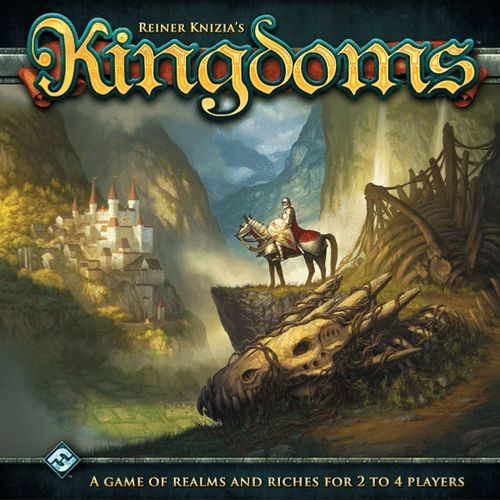
Kingdoms
Kingdoms Rulebook
Table of Contents
Table of Contents
Object of the Game
The object of Kingdoms is to collect the most gold over three rounds by placing castles on the board in the same rows or columns as valuable resource tiles.
After three rounds, the player with the most gold wins!
Components
Each copy of Kingdoms contains the following:
- 40 Plastic Castles, including:
- 16 Rank 1 Castles (4 per color)
- 12 Rank 2 Castles (3 per color)
- 8 Rank 3 Castles (2 per color)
- 4 Rank 4 Castles (1 per color)
- 1 Game Board
- 64 Cardboard Tokens, including:
- 19 Copper Coins with a value of 1
- 12 Copper Coins with a value of 5
- 20 Silver Coins with a value of 10
- 8 Gold Coins with a value of 50
- 4 Gold Coins with a value of 100
- 1 Epoch Counter
- 23 Cardboard Tiles, including:
- 12 Resource Tiles
- 6 Hazard Tiles
- 2 Mountain Tiles
- 1 Dragon Tile
- 1 Gold Mine Tile
- 1 Wizard Tile
- This Rulebook
Component Overview
This section describes the components of Kingdoms.
Plastic Castles
Each castle has a rank of 1 to 4, indicated by the number of towers on the castle. The higher a castle's rank, the more influential it is in a kingdom.
Game Board
The central portion of the game board is divided into five rows and six columns. When playing castles and tiles, they are placed into a space that is part of a row and a column. The board also displays the epoch track and has areas for a tile supply and a gold bank.
Resource Tiles
These 12 tiles represent farms, villages, cities, and other resources of a player's kingdom. Each resource tile shows a value between "+1" and "+6" which indicates the amount of gold that tile is worth.
Hazard Tiles
These six tiles represent dangerous monsters and locations that rob a kingdom of its wealth. Each hazard tile shows a value between "-1" and "-6" which indicates the amount of gold that tile is worth.
Mountain Tiles
These two tiles represent impassable obstacles.
Dragon Tile
This tile represents a fierce dragon that disrupts all commerce in the kingdom, leaving the worst elements in the land free to wreak havoc.
Gold Mine Tile
The gold mine tile represents a valuable resource that is desired by every kingdom.
Wizard Tile
This tile represents a powerful wizard. Castles are greatly enhanced when in his presence.
Epoch Counter
The game is divided into three rounds known as epochs. Players use the epoch counter to keep track of the current epoch.
Gold Coins
These coins are used to track how much gold each player has.
Setup
- Each player chooses a color and takes all the rank 2, 3, and 4 castles of his color and a number of rank 1 castles determined by the number of players (see below).
Number of Castles per Player
| Number of Players | Rank 1 Castles | Rank 2, 3, & 4 Castles |
|---|---|---|
| 2 | 4 | all |
| 3 | 3 | all |
| 4 | 2 | all |
- Sort the gold coins by denominations and place them in the gold bank area of the game board.
- Give 50 gold to each player.
- Shuffle all the tiles facedown and place them in the tile supply area of the game board.
- Each player draws one tile and secretly looks at it, then places it facedown in front of him. This tile is known as that player's starting tile.
- Place the epoch counter on space "1" of the epoch track.
Play
Randomly choose one player to take the first turn.
When that player's turn is over, the player to his left takes his turn. Play proceeds clockwise in this manner.
On a player's turn, he must take one of three actions:
- Place One Castle: Place one friendly castle onto an empty space on the board; or
- Draw and Place One Tile: Randomly draw one of the facedown tiles from the tile supply area, look at it, then place it faceup onto any empty space on the board; or
- Place Starting Tile: Take the starting tile drawn at the beginning of the epoch and place it faceup onto any empty space on the board.
Players may only pass if they are unable to take any of these three actions.
Note: Once a castle or tile has been placed onto the board, it cannot be moved or replaced for the rest of the epoch.
Scoring
The epoch ends when there are no more empty spaces on the board. Each player then scores each row of the board, starting with the top row. Then he scores each column of the board, starting with the column on the left.
To score a row, add the values of all resource tiles, then subtract the values of all hazard tiles. Then multiply this total value by the total ranks of the player's castles in that row. Special tiles may affect scoring (see below). The final score for the row determines the amount of gold the player collects from (or pays to) the bank.
Follow the same procedure for the columns. Note that each tile and castle will score twice at the end of every epoch: once for its row, and once for its column.
Some tiles have special functions during scoring:
- Mountain Tile: The mountain tile divides its row and column into two parts, each of which is scored separately.
- Gold Mine Tile: The gold mine tile doubles the value of all other tiles in its row and column, regardless of whether those tiles have a positive value (resource tiles) or a negative value (hazard tiles).
- Wizard Tile: The wizard tile increases the rank of each castle that is orthogonally adjacent to the wizard tile by one.
- Dragon Tile: The dragon tile cancels all resource tiles in its row and column when that row and column are scored. Only the hazard tiles in that row or column (if any) have any value.
The Second & Third Epochs
After scoring an epoch, follow these steps to prepare for the next epoch:
- Remove all castles from the board. Return all rank 1 castles to their respective players for use in the next epoch. Return all other castles to the game box.
- Remove all the tiles from the board, shuffle them, and place them in the tile supply area of the game board.
- Each player draws one tile and secretly looks at it, then places it facedown in front of him.
- Place the epoch counter on the next space of the epoch track.
The player with the most gold after the first epoch takes the first turn during the second epoch. The player with the most gold after the second epoch takes the first turn during the third epoch.
Game End
The game ends after the third epoch. The player with the most gold wins!
Game Variants
Use these variants to change the game experience.
Down to the Last Castle
This variant is played using the standard rules, but with the following changes:
Do not use the epoch counter. The number of epochs is unknown at the start of the game.
All players begin the game with all of the castles of their color, regardless of the number of players.
At the end of each epoch, remove all castles from the board (including rank 1 castles) and place them in the game box.
The game ends at the end of the epoch in which at least one player has placed his last castle. The epoch continues until every space on the board is full or no player can perform actions. The board is then scored as normal, and the player with the most gold wins.
When using this variant, it is possible that every space on the board may not be filled during the last epoch. If this happens, the empty spaces have a value of "0" when scoring. If players are unable to play during this epoch, they must pass until either no other players can play or the board is full.
No Luck
To eliminate the element of luck from the game, place all of the tiles faceup at the beginning of the epoch and do not draw a starting tile. Play continues as normal, but players may choose which tile to draw and place.
Score as You Go
Instead of scoring the entire board at the end of the epoch, score each row (and column) immediately as it becomes filled.
Example of Scoring
On the following page is a sample game board at the end of an epoch. The base value for the columns and rows of the sample game are listed, along with explanations of how the more complicated rows and columns are calculated.
Row 1
The Town has a value of "+3," while the Troll has a value of "-6." Therefore, the base value of this row is "-3."
This base value is multiplied by the total ranks of the castles that the players have placed in the row. The red and blue players have each placed a single rank 1 castle in the row, so each must pay three gold to the bank.
The yellow player has placed a rank 4 castle and a rank 1 castle in this row. The rank 1 castle is adjacent to the Wizard, so that castle increases to rank 2. The yellow player now has a total of 6 ranks in the row, so he must pay 18 gold to the bank.
Row 4
A mountain splits this row into two parts.
On the left side, the Dragon cancels the Village, so the yellow player's rank 2 castle does not score anything.
On the right side, the Knight has a value of "+5," which is multiplied by the blue player's rank 1 castle for a total of 5. The blue player collects five gold from the bank.
Column 2
The Windmill has a value of "+4," but it is canceled by the Dragon; only the Dire Wolves have any effect, so the base value of this column is "-3." This value is doubled by the Gold Mine, so the red player has to pay six gold to the bank for his rank 1 castle.
Column 4
The Mountain divides the yellow player's castle from the rest of the column. The yellow player scores no gold.
On the other side of the Mountain, the Village has a value of "+1," while the Raider's value is "-5." Therefore, the base value of the column is "-4," and the blue player has to pay four gold to the bank for his rank 1 castle.
Column 6
The values of the Knight and the Farm are "+5" and "+2" respectively, so the base value of this column is "7." The Wizard increases the rank of the two adjacent rank 1 castles in this row by one. The yellow and blue players now each effectively have a rank 2 castle and they each collect 14 gold from the bank.
The rest of the rows and columns are scored in the same manner. The following table shows the results after the first epoch.
Scores After the First Epoch
| Player | Rows | Columns | Total |
|---|---|---|---|
| Yellow | -6 | 50 | 44 |
| Red | -5 | 8 | 3 |
| Blue | 25 | 29 | 54 |