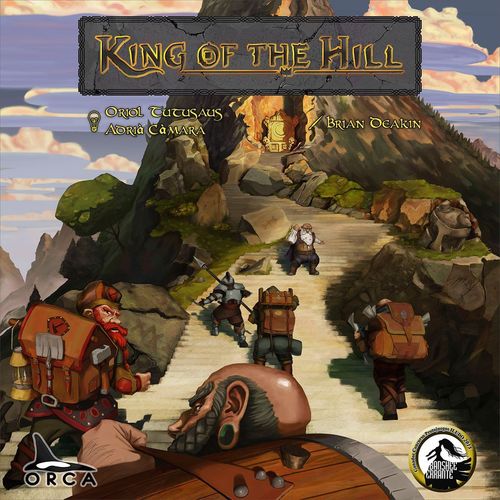
King Of The Hill: The Dwarf Throne
King Of The Hill: The Dwarf Throne Rulebook
Table of Contents
Table of Contents
Introduction
The dwarf king of "Dwarfen" has died without leaving an heir to the throne. The Council of Elders needs to elect a new king. The most influential dwarf clans of the kingdom heed the call and arrive at the high court to conquer the crown and control the Hill. They do what they do best: to brag about their great successes and deeds to win over the Council of Elders.
The players represent the dwarf clans fighting for power and glory. Each player needs to impress the members of the Council of Elders with their great deeds in order to gain their vote.
Objective of the game
The player with the highest number of victory points is the winner.
Components
- 1 Game Board
- 30 Clan Members Meeples (6 for each player)
- 30 Clan cards (6 for each player)
- 5 Clan boards (1 for each player)
- 25 Clan tokens (5 for each player)
- 40 Dwarf Counselor cards
- 12 Rune cards
- 10 Resource cards
- 1 Veto card
- 1 Last Player token
- 5 Clan markers
Set-up
Unfold the game board in the center of the table to make it accessible to all players.
Thoroughly shuffle the Resource cards and put them next to the game board, facedown. This is the Resource deck. Do the same with the Rune cards and the Dwarf Counselor cards, creating the Rune deck and the Dwarf Counselor deck, respectively.
Each player chooses a color and then takes the Clan cards, the Clan board, and the Clan Member meeples of the chosen color. The number of meeples will depend on the number of players (see table 1).
Each player takes the number of Dwarf Counselor cards indicated for the number of players (see table 1).
| Players | Clan Members | Clan Cards | Counselor Cards |
|---|---|---|---|
| 2 | 3 | 1-6 | 7 |
| 3-5 | 6 | 1-6 | 6 |
Table 1
The Clan board of each player allows him or her to control the five resource kinds, which will be realized during the course of the game.
The Clan tokens are used to mark the kind of resource that is accessible for each player, as they are won and lost throughout the course of the game.
Each player begins by putting his or her Clan token on the 0 of each resource, with the following exceptions:
- Each clan starts with two resource units, as indicated in the upper right corner of the Clan board. In this case, move the Clan token of this resource from 0 to 2.
- Each player can then look at his or her Dwarf Counselor cards and add two resources of his or her choosing, although they can not add to their starting resources. This means that he or she can choose two resources of the same type or one resource of two types.
Set-up key (as printed): Emblem and Clan name; Starting Resources; Victory points; Resources marker; Clan Marker; Last Player Token.
You are now ready to play!
Playing rounds
There are as many rounds as there are players, with exception of a 2-player game, which will have four rounds.
| Players | Rounds |
|---|---|
| 2 | 4 |
| 3 | 3 |
| 4 | 4 |
| 5 | 5 |
The player with the longest beard (or, in the absence of beards, the smallest player) starts the first round. In each new round, the first player will be the player sitting to the left of the previous first player. The player on the right of the first player will be the last player and takes the Last Player token.
During the round, each player places his or her Clan Members on the places of influence in which to fight for: Resources, the power of the Runes, the votes of the Dwarf Counselors or the influence of the Bard, who can sing their praise.
Places of influence on the board (as printed): Council of Elders; The Bard; Runes; Main Resource; Secondary Resource; Resources.
Each round has four phases:
- Placing the Clan Members
- Fighting for power
- The Bard is playing
- Influencing the Dwarf Counselors
1. Placing the Clan Members
Beginning with the first player and continuing clockwise around the table, players take turns placing each of their Clan Member meeples (3 meeples in the case of 2-player games) one by one in the places of influence until all players have placed all 6 of their meeples on the board.
There are several places of influence:
- Resources: There are five places, one for each resource: Warfare, Metal, Wisdom, Gold, and Diplomacy. In these places there are two icons drawn. The largest icon indicates the main resource, which can be won by the clan members, while the smaller icon indicates the secondary resource.
- Runes: The location is marked by a engraved rune. Rune cards, which benefit the player who owns them, can be won here.
- Council of Elders: Players can attain the favor of the Dwarf Counselors, which may then be substituted for Resources.
- The Bard: Here you can buy the services of the Bard. He allows you to change Resources, choose new Dwarf Counselor or discard them in exchange for another Resource.
Those places marked with a "5" will only be played when there are 5 or more players.
Rune locations are marked with a "4+", meaning that they will not be played in games with 2 and 3 players. Please refer to the rules for 2 and 3 players, later.
Important: When you place the Clan Members in the places of influence must occupy the empty space with the lower number.
Once all players have placed their Clan Member meeples on the board, cards from the Resource deck are placed face up in the indicated spaces of each Resources place of influence. The number of cards taken from the Dwarf Council deck is equal to the number of positions in the Council of Elders (4 in 3- to 4-player games and 5 in 5-player games). These are placed face up in the indicated spaces of the Council of Elders place of influence. For 2-player games, see at the end of the rules.
Finally, two cards from the Rune deck are placed face down in the spaces indicated for the Rune place of influence.
2. Fight for the power
The last player of the round decides in which order the places of influence will be resolved. He or she will choose a place of influence, indicated by the placement of the Last Player token, and the players with at least one Clan Member in this place of influence will fight for the power. Once the fight is resolved, he or she will successively choose another, until all fights are resolved in each place of influence.
Resolution of the fight
Each player with at least one Clan Member in the chosen place of influence will play a Clan card from their hand, by placing it face down on the table. The Clan cards may only be used once per round and are discarded after each use. These cards will be recuperated at the end of the round, so that each player must bear in mind which places of influence interest him or her most. Only one Clan card will be played, regardless of how many Clan Members there are in the place of influence chosen.
After all players have chosen their Clan cards, they are revealed.
The player with the higher Clan card value is the winner. In the event of a tie, the player whose Clan Member is in the position with the lowest number is the winner.
If a player has more than one Clan Member in a fight, he or she must add a value of +1 for each additional Clan Member to the Clan card that has been played. To compensate, for each additional Clan Member with an immediately inferior value to the card that has been played, one Clan card must be discarded from the remaining cards in hand during that round.
For example: Adrià has two Clan Members in the resource of Metal. He plays a 4. Because he has one additional member, he would also need to discard the 3 card. If he does not have a 3 in hand, he should discard the 2, and so on. The final value to resolve the fight is a 5 (4 for the card played +1 for the additional member).
The cards played are discarded and placed next to the player, face up and in view of all other players, so that any player may consult them to see which cards are left to play in the round.
Spoils of the fight
In the 5 Resources: The player with the highest value is the winner and takes the main prize. The player with the second highest value takes the second prize.
The prizes awarded are described in the Resource cards, which have been placed in each Resources place of influence. All of the Resource cards have a line separating the two prizes awarded: that of the winner (in the upper half) and that of the second place winner (in the lower half). No prizes are awarded to the third or fourth place player.
For example: Brian is the last player and chooses the resource of Metal place of influence to resolve the fight. Adrià has a Clan Member there, just as do Marta and Anna. The three players choose a Clan card from their respective hands, they are played face down and then revealed at the same time. Adrià has played a 5 and both Marta and Anna have played a 4. Adrià is the first place winner and takes the main prize. Because Marta and Anna have tied, they must now check to see who had placed their Clan Member earliest, and thus has their Clan Member in a position of lower value. Anna placed her Clan Member in position 1 and Marta had hers in position 3, so Anna beats Marta and takes second place in the fight, thus taking second prize. Marta is left in third place and thus receives no prize.
In each prize, the higher number defines the amount of main Resources which are won in that place of influence and the lower number defines the amount of secondary Resources.
For example: The card on the right is in the fourth place of influence (main Diplomacy and secondary Wisdom), so the winner takes 4 points for Diplomacy and 1 point for Wisdom, whereas the second place winner takes 2 points for Diplomacy and 1 point for Wisdom.
Key to the prize card (as printed): Winner in the fight; Main Resource; Secondary Resource; Second place in the fight.
The Resources won are added to the player's Clan board using the Clan token.
Important: If a player is alone in a place of influence, he or she still plays his or her cards. He or she is considered the winner of the fight and takes both the first and second prizes!
In the Runes: Just as in the previous case, there are also two winners. The first place winner takes the two Rune cards, which was placed face down beside the game board. Without sharing them to the other players, he or she keeps one and the other goes to the second place winner. The Rune cards can be played throughout the game or reserved until the final point tally. One victory point is awarded for each unused Rune card at the end of the game.
Important: If a player is alone in the Rune place of influence, he or she still plays his or her cards. He or she is considered the winner of the fight and keeps both Rune cards!
In the Council of Elders: Each Clan Member acts independently, which is why there is no +1 for additional members. Instead, each player should play one Clan card for each Clan Member that he or she has in the Council of Elders in order to obtain a prize for each Clan Member placed. Once the fight is resolved, the Clan Members are placed in descending order by values played (the one with the highest value in position 1, the second highest value in position 2, etc.), taking into account that in the event of a tie, the player with the Clan Member previously in the lower value position is the winner. Each player, in order of values played, takes one of the Dwarf Counselor cards. If he or she chooses not to keep the card, they may add any single Resource to the Resource marker on their Clan board and discard the chosen Counselor card.
For example: Adrià, Brian and Marta place their cards in the Council of Elders. Marta uses her Clan card with a value of 5 and Adrià and Brian use their card with a value of 4. Marta wins and is placed in position 1. Adrià and Brian are tied, but Adrià was in a position of lower value, such that he now goes after Marta, in position 2, followed by Brian.
In the Bard: Just as in the Council of Elders, each Clan Member acts independently and therefore, there is no +1 for additional members. Each player should play one Clan card for each Clan Member he or she has in the Bard. Once the fight is resolved, the Clan Members are placed in order by the values played (the highest value in position 1, the second highest in position 2, etc.), taking into account that in the event of a tie, the player with the Clan Member previously in the lower value position is the winner. Beginning with the player whose member is in the lowest position, one Action of the Bard is chosen and placed on the Arrow of the action chosen by the executing Clan Member. There may be only one Clan Member in each action of Exchange of Resource, which means that this may only occur once per turn. The actions of winning or discarding a Dwarf Counselor card can be done multiple times during the turn, so that there may be multiple members on there. These actions will be resolved during the following phase: The Bard is playing.
3. The Bard is playing
Once all of the fights in all places of influence have been resolved, the actions of the Bard are then decided. These actions may be resolved simultaneously. The Bard allows different actions. The majority of the actions may happen only once, even though various clan members allow multiple actions:
- Exchange of Resources: There are 3 actions which allow the exchange of different types of Resources:
- Exchange 1 Resource for a different Resource, in the Clan board. The player may make up to 3 exchanges when he or she chooses this action of the Bard.
- Exchange 1 Resource for 3 different Resources, all being different to the prior Resource exchanged, as well as different from each other.
- Exchange 1 Resource for 2 Resources of another type.
- Obtain a Dwarf Counselor: A player may spend any Resource from his or her Clan Board in order to acquire a card from the Dwarf Counselor deck. This is allowed more than once per round (once for each Clan Member who chooses this action).
- Discard a Dwarf Counselor: A player may discard a Dwarf Counselor from his or her hand in order to add any Resource to their Clan board. This is allowed more than once per round (once for each Clan Member who chooses this action).
4. Influence of the Dwarf Counselors
In this step, each player may pay for the influence demanded by the Dwarf Counselors in his or her hand by placing them on the table and thus, winning their favor.
Each player may pay the necessary price of influence in order to win the favor of one Dwarf Counselor card in hand. In order to do this, the player must pay the necessary Resources indicated on the card by reducing these quantities in his or her Clan Board.
One player may influence more than one Dwarf Counselor during this Phase of Influence. This phase may be resolved simultaneously. Once the Dwarf Counselors have been influenced, a player shows the card to the other players and then places it face down in a pile in front of him or her and puts the Clan marker on top of it.
After paying for the influence, for each Dwarf Counselor a player wishes to keep in hand until the following round, the player must pay one Resource of any kind. In contrast, the player must discard those Counselors which are unwanted or unable to pay for.
The discarded Counselors are placed face up next to the Dwarf Counselor deck. When all the cards in the deck have been used, the deck is reshuffled to form a new one.
For example: Adrià has 4 Resources of Wisdom, 2 of Diplomacy, 2 of Metal and 1 of Gold in his clan board. In his hand he has the Dwarf Counselor Beatrice Beis. To influence him costs 2 of Wisdom and 1 of Gold, which gives him 2 victory points at the end of the game. Now he has only 2 Wisdom Resources, 2 of Diplomacy and 2 of Metal left in his Clan board. He still has 2 Dwarf Counselor cards, which he cannot influence. Because he would receive 4 victory points for each, he decides to withhold them. He decides to pay one Resource for each, and because neither need Metal in order to be influenced, he decides to spend 2 Resources of Metal. Adrià now has 2 Wisdom and 2 Diplomacy Resources in his Clan board.
Once the Influence of the Dwarf Counselors Phase is over, if the just played round was not the final round, the first player takes the Last Player token and starts a new round, where the player seated to his or her left will become the first player.
End of the game
The game is over after the Influence Phase of the last round of play, which depends on the number of players. If at the end of Phase One, the Placing of the Clan Members, there are not enough Dwarf Counselor cards to refill the Council of Elders, the game ends at the end of that round. Once the game is over, the victory points are counted.
Victory Points (VP)
- The VP granted for each influenced Dwarf Counselor is depicted in the shield of the card (1, 2, 4 or 6).
- 1 VP is granted per unused Rune, although some Runes grant other quantities of VP.
- 1/3/6 VP are granted for every 3 alike Resources in the Clan board.
The player with the most victory points (VP) is declared the winner and pronounced the new King of Dwarfen.
In the event of a tie, the player with the most influenced Dwarf Counselor cards wins the game. If the tie is still unbroken, the player with the most Resources wins the game.
For example: Adrià finishes with 3 Counselors of 2 VP, 1 Counselor of 4 VP and another of 6 VP. He has 6 Resources of Metal (3 VP) and 3 of Gold (1 VP) plus one unused Rune (1 VP). Adrià's final victory points add up to 21 (16 for Dwarf Counselors, 4 for Resources, and 1 for the unused Rune).
Rules for 3-player games
The Runes place of influence is not utilized in 3-player games. The Rune cards are still used in the game, but they are fought for in the Council of Elders place of influence. When the Council of Elders cards are drawn, 4 Dwarf Counselor cards are placed face down in the Council of Elders place of influence, and 2 Rune cards are placed face down in the Rune place of influence. When a player is awarded the prize from the Council of Elders, he or she may choose between taking a Dwarf Counselor or keeping a Rune card (the first player choosing a Rune card may still look at the two cards and keep only the one desired, leaving the other face down in the Rune place of influence).
Another important difference in the 3-player game is the right to veto. At the start of each round, before placing the Clan Members, the starting player chooses a place of influence exempt from the placement of Clan Members, by placing the Veto card on that place. This place will thus be treated as nonexistent during the round.
Rules for 2-player games
The rules for 2-player games are the same for 3-player games, with slight differences.
Each player only has 3 Clan Members, because with two players all Clan Members will be placed in all places of influence, except in the Runes and the vetoed place. Only one Clan Member may be placed in each place of influence, such that if one player has already placed a member in one place of influence, no other player may place a Clan Member in that same place and must therefore, choose another place from the remaining available places.
Three Dwarf Council cards and 2 Rune cards will be placed in the Council of Elders. Once the Resource cards are revealed, the players place one of their Clan cards face down in each one of the places of influence to fight for. The last player chooses the order in which the cards will be revealed, due to the possibility of one player choosing to use a Rune card to affect the resolution of the fight. (In 2-player games use only Rune cards with a "2" drawn on them)
There will be only one winner in each Resources place of influence who will receive the winner's prize of the Resources cards. The second place prize is thus ignored.
In the Council of Elders place of influence, if the first player chooses to take a Rune card, he or she will still look at both and keep only one, discarding the other and leaving the second player without the option to choose a Rune card. If the first player chooses a Dwarf Counselor card, the second player may still choose between Runes and Dwarf Counselor. The unchosen cards are discarded without effect.
Optional Rules
Advanced game
The advanced game mode is for those players who enjoy a more strategic game. The rules change in this mode:
- Before placing the Clan Members, all of the Resources, Rune and Dwarf Counselor cards are placed in their respective positions. The Rune cards are placed face down and the other cards placed face up, such that the players will know which Resources and Dwarf Counselor cards are available in the round and will have more control regarding where they elect to place their Clan Members.
- Once the Clan cards have been used, they are placed face down next to the player. Therefore, the players must pay close attention during all fights if they want to know which of the other player's cards are left to play.
Sharing the glory
With this rule, a player may opt out of participating in the fight in a place of influence where he or she has placed Clan Members and may instead choose to support another player who is also in this place of influence by donating a +1 for each of his or her Clan Members in that place.
This should be announced prior to choose the Clan cards which will be played.
The two players should agree on the price of support, which will be in the form of Resources. For each Clan Member, they may agree upon the amount and kind of Resources that one player will pay the other in exchange for their support. These resources are paid before playing the Clan cards. The supporting player will discard any one Clan card from his or her hand for each Clan Member who has given their support.
The player who receives the support may decide whether or not to accept this support.
Important: A player may only support one single player per place of influence.
Rune cards
The Rune card reference on the last page of the rulebook (as printed) lists the following effects. The page shows 10 effect entries, while the components list 12 Rune cards.
- Transform the value of the played Clan card in six.
- Take two Resource cards that are in places of influence and exchange them.
- Swap the position of one of your Clan Members with one of another player's Clan Members, who are in any place of influence.
- Force an opponent to change his or her played Clan card, for another one in his or her hand. The played card returns to the player's hand.
- Once the Clan cards are shown, you can change your played card for another one in your hand.
- If you are the winner of the fight in a Resource place, as an additional reward you get +1 main Resource and +2 secondary Resource. If you are second, you get +2 main Resources and +1 secondary Resource.
- If there is a tie with the Clan cards shown, your card is the winner, regardless of where your Clan Member is placed.
- If you have more than one Clan Member in a fight, you can add a value of +1 for each additional Clan Member to the Clan card that has been played, without discarding a card.
- In this influence phase, you don't have to spend Resources to keep Dwarf Counselor cards in hand.
- At the end of the game win 2 or 3 victory points.