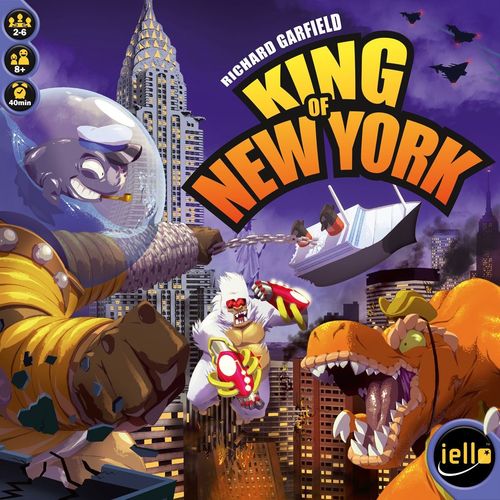
King of New York
King of New York Rulebook
Table of Contents
Table of Contents
Contents
- 1 rulebook
- 1 gameboard
- 64 cards + 2 special cards: Statue of Liberty and Superstar
- 46 tokens (13 Web, 13 Jinx, 5 Souvenir, 15 Carapace)
- 8 dice (6 black and 2 green)
- 6 Monster boards
- 6 cardboard figures + 6 plastic stands
- A bunch of Energy cubes
- 45 Building/Unit tiles
Goal of the Game
The goal of the game is to become King of New York. The game ends as soon as a Monster has earned 20 Victory Points or if it is the last Monster standing.
Setup
Place the gameboard in the middle of the table, accessible to all players. This represents the City of New York, comprising five distinct boroughs: Staten Island, The Bronx, Queens, Brooklyn and Manhattan (divided into three zones: Lower, Midtown, and Upper Manhattan).
Shuffle all the cards — except the 2 special cards — together in order to form a face-down deck. Put the top 3 cards of the deck face-up on the table near the deck and the tokens.
Place the 2 special cards, Statue of Liberty and Superstar, face-up beside the deck.
Place the tokens beside the board. They will be used for certain card effects.
Put the 6 black dice in the middle of the table, and keep the 2 green dice to the side (they're only used in certain circumstances).
Each player chooses a Monster, takes its figure, and its Monster board, and sets the dials to 10 Life Points and 0 Victory Points.
Form a pool of the Energy cubes.
Shuffle all the Building tiles together, and form stacks of 3 Building tiles, Building-side-up. Place 3 of these stacks in each borough of New York. Don't look at the buildings below the top one; they will be revealed as the destruction ensues.
Tile Description
Each tile depicts a Building on one side, and a Unit on the other. These are things that the Monsters can destroy.
- Durability: The number of Destruction results required to destroy it.
- Reward for destroying it.
Rules for destroyed tiles:
- If the tile you destroy is a building, flip it over to its Unit side, and place it in the borough.
- If the tile you destroy is a Unit, remove it from the board.
Building/Unit pairings:
- A Building with a durability of 1 always has an Infantry on its Unit side.
- A Building with a durability of 2 always has a Jet on its Unit side.
- A Building with a durability of 3 always has a Tank on its Unit side.
How to Play
Players take turns in clockwise order.
In order to see who goes first, each player rolls the 6 black dice and the 2 green dice, and whoever rolls the most Attacks starts the game.
Starting with the first player, and going clockwise: Place your Monster in the borough of your choice, except Manhattan. There can be no more than 2 Monsters in any borough.
Note: From here on out, the rules and cards will refer to the players as Monsters.
On Your Turn
- Roll the Dice (up to 3 times)
- Resolve the Dice (mandatory)
- Move (generally optional, but sometimes mandatory)
- Buy Cards (optional)
- End Your Turn
1. Roll the Dice
On your turn, you can roll the dice up to three times.
For your first roll, you will roll the 6 black dice (the green dice are only used with particular cards).
For your second and third rolls (both optional), you can reroll any or all of the dice (even ones that you chose to keep on a previous roll).
2. Resolve the Dice
The symbols on the dice after your final roll indicate your actions for this turn.
You can resolve the dice in whatever order you like, however all the dice of the same type must be resolved before resolving another type.
3. Move
- If there is no one in Manhattan you must move there. When you arrive in Manhattan, you must place your Monster on Lower Manhattan on the 2–4 space.
- If there is already 1 Monster in any zone of Manhattan, you have two options: You can move to any borough that doesn't already have 2 Monsters in it (except Manhattan), or you can just stay in your borough.
- If you were already in Manhattan, advance to the 2–4 space in the next zone up in Manhattan.
Note: Once you are in Upper Manhattan, you no longer move during this phase.
Note: If you were already in Manhattan, you may not move to another borough (unless you have been damaged by another Monster's attack).
4. Buy Cards
After resolving the dice and making a move, you can buy one or more cards from those available.
You are also welcome to spend 2 Energy cubes in order to discard the three available cards and reveal three new ones.
You can buy and/or discard cards in any order you like, and as many times as you want, as long as you have the Energy cubes to do so.
Each time you buy a card, immediately reveal a replacement for it from the deck.
• Example: Kong has 10 Energy and doesn't like the cards currently available. He spends 2 Energy to discard the three cards and reveal the next three. He still has 8 Energy and sees an interesting card that costs 3 Energy. He buys it and reveals a new card. He still has 5 Energy which he decides to keep for another turn.
5. End Your Turn
Certain card effects activate during this phase.
This is the end of your turn; pass the dice to the player on your left.
Dice Effects
Description of the dice: Each die has 6 symbols.
- Lightning bolt: Energy
- Heart: Heal
- Claw print: Attack
- Star: Celebrity
- Building: Destruction
- Skull: Ouch!
Energy
You earn 1 Energy cube for each Energy you roll.
You can hoard Energy cubes until you want to use them.
Attack
You inflict one damage for each Attack you roll.
- If you are in Manhattan each Attack you roll inflicts damage to all Monsters outside Manhattan.
- If you are not in Manhattan each Attack you roll inflicts damage to all Monsters in Manhattan.
Each Attack causes any Monster(s) damaged to lose 1 Life Point.
If a Monster loses its last Life Point, it is eliminated.
If there are no Monsters in Manhattan at the start of your turn, you don't inflict any damage, even if you roll Attack.
Heal
Each Heal you rolled allows you to heal 1 Life Point that you've lost, unless you are in Manhattan.
A Monster cannot have more than 10 Life Points.
Destruction
You can use Destruction to destroy Buildings or eliminate Units.
The Durability of a Building or Unit indicates the number of Destruction you have to roll in order to destroy it on your turn.
When you apply as many Destruction points as the Unit or Building's durability, it is destroyed, and you earn as many Victory Points (for High-Rises or Tanks), Energy (for Power Plants or Jets), or Life Points (for Hospitals or Infantries) as indicated on the tile.
When you destroy a Building, turn it over to its Unit side, and place it in the same borough. If there are still Buildings in the stack, this will reveal a new one, and you can even destroy it immediately if you have enough Destruction remaining.
When you destroy a Unit, take it and put it in front of you.
You cannot destroy a Unit on the same turn that it appears.
If you have enough Destruction to destroy a Building or a Unit, you must to do so; however you are not required to optimize your Destruction.
• Example: Captain Fish rolls four Destruction, he is in Queens, where there are 3 Buildings visible: a Hospital 2, a High-Rise 2, and a High-Rise 1. He decides to destroy the High-Rise 1 and High-Rise 2 to earn 3 Victory Points. He still has 1 Destruction, but the Buildings revealed are a Hospital 3 and a High-Rise 2. He can't destroy any more Buildings with the Destruction he has left.
Celebrity
If you roll fewer than 3 Celebrity nothing happens.
If you roll triple-Celebrity or more, you take the Superstar card, and place it in front of you. You immediately earn 1 Victory Point, +1 Victory Point per Celebrity beyond the first three Celebrity.
From now on, as long as you have the Superstar card in front of you, each Celebrity you roll earns you 1 Victory Point.
As soon as another Monster rolls a triple-Celebrity, he steals the Superstar card from you.
Ouch!
If you roll at least 1 Ouch!, the military opens fire:
- If you rolled one Ouch!, the Units in your borough attack you; you suffer 1 damage per Unit tile in your borough.
- If you rolled two Ouch!, the Units in your borough attack all the Monsters in your borough (including you, of course); each Monster in your borough suffers 1 damage per Unit tile in your borough.
- If you rolled three Ouch!, all Units in the entire city attack; each Monster suffers 1 damage per Unit tile in his borough.
Moreover, by rolling three Ouch!, you trigger a counterattack by the entire army, and you become the defender of the city: The Statue of Liberty comes to life and teams up with you. Take the Statue of Liberty card and place it in front of you. As long as you have the Statue of Liberty card in front of you, you have an extra 3 Victory Points. You lose the extra 3 Victory Points as soon as you lose the Statue of Liberty.
Card Description
- 1: The cost of a card is in the upper-left corner, and is paid in Energy cubes.
- 2: How to play the card is indicated above the text.
- 3: Effect of the card is indicated in the bubble.
KEEP: Keep these cards face-up for the remainder of the game unless indicated otherwise.
DISCARD: Resolve these cards' effects immediately, then discard the card.
Example cards: Chameleon — cost 4 Energy, KEEP: "You can discard as many Celebrity as you wish. For each Celebrity discarded, you can change the face of one of the dice you haven't resolved." Tesla Canon — cost 5 Energy, DISCARD: "+2 Victory Points. All Monsters (including you) must discard one KEEP card."
Dice Resolution Example
Kong is in Manhattan. It is Capt. Fish's turn. Capt. Fish rolls the 6 dice, and gets the following on his first roll: Ouch!, Celebrity, Celebrity, Destruction, Heal, Energy.
He keeps the Celebrity and rerolls the other four dice, trying to take the Superstar card; now he has: Celebrity, Celebrity, Destruction, Destruction, Destruction, Attack.
He has one roll left. This time, he decides to keep the Destruction and reroll the other three; now he has: Destruction, Destruction, Destruction, Celebrity, Ouch!, Attack.
• Dice resolution:
Resolution of the dice: Because he rolled three Destruction he destroys a High-Rise with 1 and an Infantry with 2, and earns 1 Victory Point (for the High-Rise) and 1 Life Point (for the Infantry). He eliminates the Infantry, and turns over the High-Rise to its Unit side, which is another Infantry; he puts it in his borough.
His Ouch! means the Infantry deals 1 damage to him.
His Attack inflicts 1 damage to Kong, who is currently in Manhattan. (If Capt. Fish had been the one in Manhattan, he would have inflicted 1 damage on all the other Monsters.) Kong remains in Manhattan.
Capt. Fish does not gain a Victory Point because he only got one Celebrity, and he doesn't have the Superstar card.
Capt. Fish got neither Heal nor Energy, so he doesn't heal any Life Points, and he doesn't gain any Energy cubes.
Capt. Fish does not move, and chooses not to buy any cards, so this is the end of his turn. He passes the dice to the player on his left.
Controlling Manhattan
At the start of the game, there are no Monsters in Manhattan.
If there are no Monsters in Manhattan at the end of your turn, you must move into Manhattan.
Note: The three zones of Manhattan — Lower, Midtown, and Upper — form a single borough. Therefore, there can only be one Monster in Manhattan, regardless of which zone it's in. Buildings and Units in Manhattan are accessible to the Monster in Manhattan, regardless of zone. Similarly, Ouch! allows Units in Manhattan to attack the monster in Manhattan, regardless of zone.
If you are attacked while you are in Manhattan, you may flee Manhattan, to leave your place to the Monster that attacked you (he will have to move into Manhattan during his movement). You still take any damage he inflicted on you. This is this only way you can leave Manhattan.
Note: A Discard card that directly damages you is not an attack.
If you are in Manhattan, and are eliminated during an attack, the Monster that attacks you will have to move into Manhattan during his movement.
Movement inside Manhattan:
- During his Move Phase, a Monster in Manhattan advances to the next zone's 2–4 space.
- When a monster enters Manhattan, place his figure in the 2–4 space in Lower Manhattan.
Effects of Manhattan
Being in Manhattan provides advantages and inconveniences:
- You earn 1 Victory Point when you seize control of Manhattan. Place your figure in Lower Manhattan.
- At the start of your turn, you earn a number of Victory Points and Energy, according to which zone of Manhattan you occupy:
- Lower = [+1 Victory Point / +1 Energy]
- Midtown = [+2 Victory Points / +1 Energy]
- Upper = [+2 Victory Points / +2 Energy]
- When you are in Manhattan, you cannot use Heal rolls to heal, but they can still serve to trigger other game effects; and you can always use cards to heal yourself.
In addition, the targets of your attacks are determined automatically by where you are:
- If you control Manhattan, your Attack inflicts damage to all Monsters outside Manhattan.
- If you are outside Manhattan, your Attack inflicts damage to all Monsters in Manhattan.
End of the Game
The game ends at the end of a turn if a Monster has reached 20 Victory Points and survived, or if there is only one Monster still in the game.
The Monster with 20 Victory Points, or who is the last survivor wins the game, and is crowned King of New York.
If all the Monsters have been eliminated in the same turn, nobody wins.
Advanced Rule
Rules for 5–6 experienced Monsters. In a 5- or 6-player game, there can be as many as two Monsters in Manhattan. The rules are the same for these two Monsters. Having one additional place for the Monsters is quite significant when you have so many Monsters stomping about.
- When a card or an effect targets the Monster in Manhattan, it affects all the Monsters in Manhattan.
- If you are not in Manhattan at step 3 of your turn, you must move into Manhattan if there are fewer than 2 Monsters there.
- Just as in the normal game, only the very first Monster on the very first turn is unable to inflict any damage. If Manhattan is only occupied by one Monster, the attacking Monster inflicts damage on the Monster in Manhattan, and then must move into Manhattan, too.
- When you progress in Manhattan, you move along the same type of space: If you are on 2–4, you will advance to the next 2–4; if you are on 5–6, you will advance to the next 5–6. Remember, there can only be 2 Monsters in Manhattan at once!
- If the monsters in Manhattan are attacked, the Monster on the 2–4 space says whether he will flee. If he flees Manhattan, he goes to the borough of his choice (provided it doesn't already have 2 Monsters in it), and the Monster on the 5–6 space moves to the 2–4 space in his current zone, unless he also decides to flee.
- At any time if the Monster in the 2–4 space is eliminated, the Monster on the 5–6 space automatically moves to the 2–4 space in his current zone.
- If the elimination of a Monster means that fewer than five Monsters remain in the game, from now on, there can only be one Monster in Manhattan. If there are still two Monsters in Manhattan, the one on the 5–6 space automatically moves out of Manhattan to the borough of his choice which doesn't have already 2 Monsters in it.
When you move into Manhattan, you normally move into the 2-4 space. If there is already a Monster in a 2-4 space regardless of the zone he is in, you must move into the 5-6 space.
There are effectively two tracks: 2–4 and 5–6. The Monster on 2–4 advances to the next 2–4 space; the Monster on 5–6 advances to the next 5–6 space.
When you are playing with 5–6 Monsters, if any 2–4 space is already occupied, the second Monster who enters Manhattan places his figure on the 5–6 space of Lower Manhattan.
Card Clarifications
- Whenever a card depicts a number followed by a Victory Point star, this indicates the number of Victory Points you earn by buying it.
- It's possible that you reach 20 Victory Points but die due to some cards. You must survive your entire turn in order to win. If all the Monsters are eliminated in the same turn… everybody loses!
- No cards permit you to have more than 10 Life Points unless they explicitly say that you can exceed 10 Life Points.
- Certain Discard cards are linked to a borough, and they cost 1 Energy less if you are in the right borough when you buy them.
- The Statue of Liberty and Superstar are Goal cards. You earn them exclusively by rolling a particular combination, and you lose them if someone else rolls that combination.
Statue of Liberty
You must roll three Ouch! in order to take the Statue of Liberty.
You immediately gain 3 Victory Points. You immediately lose 3 Victory Points if you lose the Statue of Liberty.
Superstar
You must roll three Celebrity in order to take Superstar.
You immediately gain 1 Victory Point, +1 Victory Point for each additional Celebrity that you just rolled.
While you have this card you gain 1 Victory Point for each Celebrity you roll.
Glossary
-
Reroll: Reroll as many of the dice as you wish, one time, unless the card specifies that you can only reroll one die.
-
Damage: Lose 1 Life Point.
-
Attack / Attacking / Attacker: A Monster is considered an attacker if it inflicts at least one damage with Attack from the dice; otherwise, the Monster is not attacking. If a card increases the damage from an attack, it only does so if the Monster is inflicting at least one damage already.
Cards that inflict damage as soon as they are purchased (such as General Ellis), are not considered to be attacks. Thus, this sort of damage does not enable Monsters in Manhattan to flee; similarly, cards that affect attacks cannot be played in response to such damage.
-
Flee / Drive Out: When you are in Manhattan, you may yield your place only if a Monster attacks you.
If a card forces or allows a Monster to leave Manhattan (such as Subway) the next monster who moves must enter Manhattan.
-
Eliminated: Having 0 Life Points (or fewer).
Summary of a Game Turn
On your turn, you must follow these phases in order:
0. Earnings (if you are in Manhattan or if you have Keep cards that give you earnings at the start of your turn)
- If you are in Manhattan, you earn the Victory Points and Energy indicated in the zone you occupy.
- Resolve the Keep cards that have effects at the start of the turn.
1. Roll the dice
Roll the dice up to 3 time.
2. Resolve the dice
You choose the order in which the dice are resolved, but you must resolve all the dice of one type before moving on to the next. If you get at least one Ouch!, you trigger an attack from the army.
3. Move
- You must enter Manhattan if there is no Monster there.
- If Manhattan was already occupied, you can either move in any borough that doesn't already have 2 Monsters, or stay where you are.
- If you were already in Manhattan, you must advance to the next zone.
4. Buy cards
You can buy cards by spending Energy.
5. End of your turn
If you are still alive and you have 20 Victory Points or you are the last Monster standing, you have won! Otherwise, end your turn by passing the dice to the player on your left.
Attack from the Army
- One Ouch!: Take 1 damage per Unit in your borough.
- Two Ouch!: You and the other Monster in your borough each take 1 damage per Unit in your borough.
- Three Ouch!: Each Monster everywhere takes 1 damage per Unit it its borough.