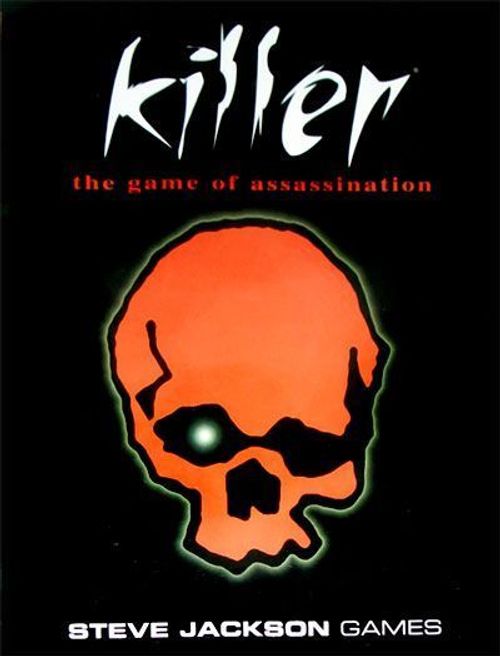
Killer
Killer Rulebook
Table of Contents
Table of Contents
- Disclaimer
- Basic Rules
- The GM
- Starting the Game
- Ending the Game
- The Contract
- The Bulletin Board
- Off-Limits Areas
- Time Limits
- Dropping Out of the Game
- Recruitment (Joining the Game)
- Secrecy
- Accomplices
- Legitimate Targets
- Bystanders
- Counter-Assassination
- Accidental Death
- Clean-Up
- Self-Destruction
- Witnesses
- Masks
- Wounding
- Duels
- Money
- Point Systems
- Role-Playing
- A Note on Idiots
- Scenarios
- Weapons
- Primitive Weapons
- Modern Weapons
- Bombs
- Poison
- Futuristic Weapons
- Weapon Table
- Group Attacks
- The Compleat Killer
- Other Real-Life Simulations
- Contract
- Death Certificate
- Afterword: A Scholar Looks at KILLER
Disclaimer
Players are encouraged to play this game in a reasonable and sensible fashion. Because the information and suggestions in this book may be used in circumstances outside his control, the author assumes no responsibility for any loss or injury occasioned by such use.
Basic Rules
The GM
The GM (Game Master) is the organizer and referee of a game of KILLER. A GM may wish to adopt some sobriquet, such as "Number One," "Central," "The Administrator," etc., to sign documents. If a game is run by a group of GMs, they could be referred to, collectively, as "The Committee."
The GM is responsible for organizing the game, filling out the Contract specifying the exact rules to be used, and assigning the original targets and victory conditions. During the game, the GM should be available to answer questions, make rule decisions, and solve any other problems that come up. If the game requires a central bulletin board, the GM should make sure it is kept up to date.
All players should have the GM's telephone number, and the GM should keep a list of the names, addresses, and phone numbers of everyone in the game. He will then be able to contact players quickly to inform them if (for instance) their "target" changes.
The GM may also wish to keep a "status chart" for the game, showing who is still alive, who has killed who and how, etc. This is by no means mandatory - if the GM keeps such a chart, it should be well hidden from prying eyes so that players don't learn who else is in the game. The GM is the only person who knows everything that is going on. It can be just as much fun to GM a game of KILLER as to play!
The GM may declare anyone dead (or alive) at any time, for any reason. He or she is the final authority in the game.
Needless to say, the GM may not be killed.
Starting the Game
A game begins when a GM organizes it - or when a group gets together and chooses a GM. It is possible to post an announcement of a meeting for potential players. This can give away the identities of the players, though; private talks with the GM may be better. Before starting play, you must decide:
(a) General nature of the game scenario. (b) Beginning time. (c) Ending time (or ending conditions). (d) Prizes, if any. (e) Name/address of the GM. (f) Location of the game bulletin board, if any.
The details of the Contract (see below) may be settled then, or left to the GM to finalize and post. The game must NOT begin until all players have had a chance to look at the Contract, since it contains all the rules, limits, weapons, etc., being used in that particular game. It is best if each player has a copy of the Contract and of this game book.
Ending the Game
A game may run until a pre-determined date, or it may go on until some specific condition is met (such as only one person being left alive!). If a game does not have a predetermined ending date, the GM should post the announcement that the game is over, and/or phone all players, as soon as possible. This will avoid unnecessary bloodshed.
The Contract
The Contract is the document which empowers the players to kill each other. It is drawn up before the game by the GM (or the Committee), and sets out exactly when, how, and why the players may engage in mutual slaughter. See p. 36 for a blank Contract form, which players are welcome to copy and use. The Contract should cover all the following:
- Scenario being used. Is this a role-playing game?
- GM's name, address, and phone number - plus times when he/she may be called.
- Location of game bulletin board.
- Allowable weapons. These may be specified by time period, by class, or just by a list of the legal weapons.
- Will the GM (possibly) OK other weapons during the game, or are the ones listed the only ones players must look out for?
- Boundaries of game area, and/or off-limits areas.
- Starting and ending dates of game.
- Hours during which assassination is legal.
- Witnesses required/permitted?
- Is wounding legal, or is this a "straight kill" game?
- Do players have more than one life each?
- Is money being used? If so, attach a price list for weapons, etc.
- OPTIONAL: A list of players in the game.
- Are accomplices legal?
- Is recruitment possible - that is, can new players enter after the game starts?
- If the point schedule differs from that in the book, specify.
- If any special rules are being used, specify.
The Bulletin Board
It is a very good idea for the GM to establish a bulletin board for game news. This should be in a public place and accessible 24 hours a day (or as close to that as possible). The GM may declare the area within fifty yards of the bulletin board to be "off limits," or he may speed up the game by allowing murders at the board! Either way, the availability of a bulletin board will reduce the number of phone calls the GM has to make. The bulletin board may be used for posting:
(a) names of people killed; (b) names (and photos?) of new entries in the game; (c) a complete copy of the Contract; (d) rule changes with their effective time; (e) announcements of cumulative scores; (f) "news reports," composed by the GM or an assistant, detailing particularly ingenious or messy killings, or any other news the GM thinks should be public property; (g) challenges for duels, and other messages between players;
and anything else the GM or players need to announce. Anyone may put up anything they like on the bulletin board, but ONLY THE GM may remove notices.
Off-Limits Areas
Certain areas should be off-limits in any game. No killing may take place in an off-limits area; if it occurs, the victim is alive, and the killer is out of the game. Off-limits areas should include:
(a) Public bathrooms for the opposite sex. (b) Classrooms while a class is in progress. (c) Churches, etc., while services are in progress. (d) Judicial or legislative chambers, or police stations. (e) Hospitals or infirmaries. (f) Moving automobiles or vehicles of any kind - or vehicles of any kind that are stopped in traffic.
GMs may declare any other areas off-limits for any reason. Such off-limits areas should be noted on the Contract at the beginning of the game. If necessary, additional off-limits areas can be posted on the bulletin board during the course of the game.
A common "off-limits" provision is a rule stating that no assassin may enter a victim's residence unless the victim (NOT another person) invites him in. An assassin assigned to kill his roommate, of course, may enter freely.
Players in an off-limits area may discuss the game and make plans, but NO action of ANY kind is permitted. Players may not attack in any way, including indirectly; that is, you may not plant a bomb, poison, or other death-trap on a player while he is in an off-limits area. It is also against the rules to attack from an off-limits area to a legal one, or vice versa.
Time Limits
The GM may set any time limits necessary for the game. These should be noted on the Contract at the beginning of the game. A game may be set to run for a specified number of days, or go on forever (or until one side wins). Likewise, in an "assassination" scenario, players may have only a set amount of time to complete each assassination once they know who their victim is.
The GM may also declare that the game will only be played for part of the day (say, between noon and 10 pm). This can be a good idea in an environment (i.e., school) where players require a little peace and quiet part of the time.
Dropping Out of the Game
A player may leave a game of KILLER at any time. One showy way to do it is to stage a public "suicide," either by acting it out or by posting a note on the bulletin board explaining that you have taken your own life (in remorse for your murderous deeds?). If you're not interested in drama, just phone the GM and say that you're dropping out. He can notify your assassin or enemies. This will keep them from wasting their time . . . and you no longer have to look into every room before you enter.
Recruitment (Joining the Game)
Some scenarios allow players to enter the game after it has already begun. This is called "recruitment." To be recruited, a player must find a team that will accept him (usually, they will be glad to!), and get the permission of the GM. The GM will see that the new player gets a copy of the Contract. If possible, the new player should have his own copy of this book. Depending on the scenario, the GM may then announce the new player's participation on the bulletin board, place a "news item" hinting at the recruitment without giving details, or keep it a total secret.
Secrecy
In general, it is in each player's interest to keep other players from finding out that he is in the game. Forewarned is forearmed; anyone known to be in the game will automatically be suspected of foul intentions by all the other players.
Specifically, though, it is illegal for a player to tell anyone (except the GM) about the circumstances under which he died. Wait until after the game is over! The reason is simple: dead men tell no tales. If someone assassinates you, and does it cleverly enough to leave no evidence, it would be unfair to him if you immediately broadcast the details. Not only would the other players then know he was in the game - they would have a good idea of his position and/or affiliation.
Witnesses to a killing are perfectly free to talk, though. This is another good reason to avoid witnesses, even if your Contract permits you to kill in public. One talkative witness can totally ruin your cover.
The GM may penalize an overtalkative player in any way he sees fit. Since he/she is already dead, sanctions may be limited - but it is easy (and aids play) to exclude a blabbermouth from later games.
Accomplices
An accomplice is someone who aids an assassin but does not actually carry or use weapons. The Contract for a particular game will specify whether accomplices are legal.
Your victim will not be able to attack your accomplices (legally), because they will never wear masks or hold weapons. Killing an accomplice carries the same penalties as killing a bystander (see below). Possible uses for accomplices include:
(a) spotting your victim to allow you to trigger a bomb or move in with a hand weapon. (b) distracting your victim's attention or luring him out of his place of safety. (c) carrying messages between members of a team of killers. (d) shouting "There he goes!" and pointing in the wrong direction to help you make an escape. (Legally speaking, this person is an accessory rather than an accomplice, because he helps you after the crime has been committed. Pish and tush on such technicalities.) (e) checking the game bulletin board for you if it is inconvenient or unsafe for you to approach.
If the game uses money, the GM may require that you pay him a fixed sum (say, $50) for every accomplice you "hire."
An accomplice may never actually kill a player by any means - including indirect ones such as poison or bombs. A kill made by an accomplice does not count; the victim is still alive, and the accomplice and/or the person he is aiding may be dead. Accomplices themselves may not be killed.
Legitimate Targets
Legitimate targets for assassination depend on the scenario, but will always include:
(a) your assigned victim (or victims), if any. In a team scenario, anyone identified as a member of another team is a fair target. (b) the assassin assigned to you, if you learn his/her identity. See Counter-Assassination. (c) anyone you see wearing a mask (see Masks). (d) anyone holding a gun or other weapon in sight. Even accidental exposure of a weapon can be construed as a "draw," leaving the weapon-holder open to attack. However, once the weapon is concealed again, its owner is no longer a target. Thus, if you see someone running down the street with a gun, he is fair game - but as soon as he puts the gun up, he becomes a bystander (see below) and may not be harmed. Of course, anyone who saw him with a gun will know that he's (probably) in the game, and that he must be treated with caution.
As a rule, it is never legal to kill another player unless you are after him. A player who blunders into a booby-trap that you have set becomes a legitimate target for that trap (see Accidental Death, below). As a rule, though, you will suffer a penalty if your booby-traps catch anyone but their intended target. Killing bystanders is very bad form . . . see below.
Bystanders
A "bystander" is anyone not playing the game OR anyone playing the game who is not a legitimate target.
Anyone killing a bystander may be subject to a penalty of many points - or, if no point system is being used, the GM may simply declare him dead. If you are sure that someone is your assassin, you may risk killing him. If you are wrong, of course, you will suffer the penalty. You are also advised to use a very harmless method of attack, since if he IS a bystander he may be displeased with you. Similarly, in a team game, the GM may rule that a bystander may be killed before he shows a weapon . . . but there will be a high penalty if the bystander is proved to be innocent, rather than an enemy. In general, it's safest to leave the bystanders alone. Politer, too.
Bombers must also be careful of bystanders. If non-players or players other than legitimate targets are within the radius of a bomb explosion, the victim may report this to the GM, who will penalize the bomber accordingly.
A victim fleeing from an assassin may certainly seek the company of bystanders, either as witnesses or as cover, to save his own life. However, any tactic that deliberately endangered a bystander (such as grabbing him and using him for a shield) would be illegal, and should be strongly penalized by the GM. In general, victims must avoid "harm" to bystanders just as much as assassins. A victim cannot use a bystander as a "stalking horse" or dummy. He also cannot get bystanders to open doors, check boxes, etc. for him. In the first place, this is not sporting. In the second place, if the bystander should set off a bomb, encounter poison, or otherwise meet a messy end under such circumstances, the victim is responsible for the death and will be penalized by the GM.
Counter-Assassination
If a victim realizes he is being attacked, he may use any legal weapon to defend himself. It is quite possible (especially if the assassin is slow, clumsy, or overly-dramatic) for the victim to turn the tables and kill his assassin. In a "combat" situation, the player that is hit first is dead - there are no "dying shots" or muscle-reflex trigger-pulls. In a case where both players actually fire at the same time and hit each other, both of them are dead, and should report this to the GM immediately.
It may also happen that a victim is attacked unsuccessfully and finds out who his assassin is. If this happens, the victim is free to hunt the assassin just as though their roles had been reversed. If the victim can assassinate his assassin, the next step depends on the scenario. In a regular "Circle of Death" game, the victim must simply go on trying to assassinate his own victim, while the person who had been trying to kill his assassin is now after him.
Unless you're very fast on your feet, it's a good idea to carry some sort of defensive weapon, against the moment when your assassin shows himself. Small pistols and blowguns are good for this. Remember: if you expose your weapon, it makes you fair game for anyone playing!
Players must be careful when defending themselves against assassination attempts. It is best to wait until there is actually a weapon in sight, just to make sure you aren't attacking someone who isn't even in the game.
Accidental Death
If Player A, assigned to kill Player B, sets a bomb or poison and gets Player C instead, then A does NOT get credit for a "kill," though he incurs no penalty unless the GM feels he really intended to get C after all. Nevertheless, C himself remains dead as a penalty for insufficient caution.
However, if Player A, assigned to kill B, pulls a gun or other weapon on C and does him in, the GM should treat the situation as though C had been a bystander. A is penalized, and C remains in the game. This discourages players from shooting each other merely on suspicion.
Clean-Up
The GM may require that each player give him a list of bombs, poisons, and other booby-traps planted during the game. After a game ends, all booby-traps must be cleaned up immediately, to avoid discombobulating non-players and to clear the area for the next game.
Self-Destruction
A player is safe from the evil effects of his own devices while he is designing and testing them. You may explode as many balloons as you like while developing the perfect trigger. When it comes down to an actual attempt, though, you can be blown up by your own bomb. A player who pops a balloon himself, while setting it as a bomb, should call and report to the GM that he has blown himself up. The same should hold true for an accidental self-poisoning. Reporting such an "involuntary suicide" is very much a question of honor; there is usually no way it can be enforced.
Witnesses
To add to the difficulty of the game, the Contract may specify that only a limited number of witnesses may see any assassination. A "witness" is anyone old enough to talk who is in a position to see the deed. In a case of any dispute, the GM's decision is final. The question to be asked is "If this had been a real murder, could that person testify in court?"
If the Contract specifies zero witnesses, killings will be very difficult. One or two is a more workable number.
If a killing is accomplished in absentia - by a bomb or poison - then witnesses do not matter. Note, though, that if a bomb is used, bystanders may be killed - so a "witness" situation is still to be avoided. If the killing is done with a camera, witnesses at the victim's location do not matter, but witnesses at the assassin's site are to be avoided.
If an assassin wears a mask, witnesses do not matter. However, masks have their own hazards - see below.
Alternatively, a scenario may require one or more witnesses to any killing - see the section on Death Certificates.
A victim who defends himself by killing his assassin does not have to worry about witnesses - he acted in self-defense. A victim who has learned his assassin's name and sets out to counter-assassinate him must follow the same witness guidelines as for an ordinary assassination.
Masks
Masks are only important in a game where assassinations must be performed "secretly" - that is, with few or no witnesses. If an assassin wears a mask, his identity remains a secret no matter how many people see the killing. However, the potential victim will probably be alarmed by the sight of a masked figure. Furthermore, a masked person is a fair target for anyone in the game . . . see Legitimate Targets, above.
Any kind of mask is legal - a domino face-mask, a Halloween mask, a bandanna tied over the face, or anything else you can come up with. The mask must be put on when no one can see you, and worn until you can take it off in similar privacy. Thus, to wear a mask is to court danger.
Sunglasses are not a legal mask. Too many non-combatants will be wearing sunglasses . . .
Wounding
The possibility that a player may only be wounded, rather than killed, adds complexity to the game. It also slows things down. The Contract for a game must specify whether wounding is allowed. If no wounding is allowed, any hit with a legal weapon is an automatic kill.
For each weapon, there is a "chance of wounding" shown on the Weapon Table. This is determined by rolling a six-sided die. K equals kill, W equals wound, M equals total miss. For instance, a grenade (if these rules are used) kills on a 1 through 4, wounds on a 5, and misses on a 6. Some weapons never miss.
Gun-type weapons that mark the victim (i.e., water guns) use a different system. Any hit to the body (or head, if using a harmless weapon) is automatically a kill. Any hit to the arm or leg is a wound. Multiple wounds have no cumulative effect. (Or, alternatively, the GM may rule that a second wounding is a kill.)
When an attack takes place that could result in a wounding, the victim must immediately phone the GM. The GM will roll a die and inform the victim whether he is dead, wounded, or hale and hearty. The killer must find out however he can. (If his victim is dead, and a bulletin board is being used, there will be an announcement.) But often a killer may not be sure whether he has gotten his victim, at least for a while, if he uses any but a "sure kill" method.
The effects of wounding last until midnight of the next day of the game. At the end of that time, the "wound" vanishes and the player may participate fully.
A wounded player may NOT attack another player in any way. He may defend himself against attacks by hiding, running, etc., normally, but may not counter-attack. He may communicate freely with all other players, and may act as an accomplice - but he IS a legal target while doing so.
Wounding is a good rule to add in a "team" game, especially one where not all the players know each other. It is not a good rule for a "circle of assassins" type game . . . it only slows things down.
Wounded players may be required to wear a button or name-tag saying "WOUNDED," to advertise their status to anyone who sees them.
Duels
Any player may challenge any other player to a duel at any time. The challenge does not have to be accepted (though in some games you lose points for declining a challenge). Either player may attempt a dirty trick before or during the duel; therefore it is customary to bring a "second" to watch your back and make sure the proprieties are followed.
A duel may be refereed by the GM, his chosen deputy, or any other person agreeable to both sides. The referee should probably not be a player, since he might then be tempted to kill all the participants. If one side can bribe the referee . . . that's the way the bomb bounces. The GM, of course, will not take bribes.
Any duelling weapons acceptable to both parties may be used. The commonest duelling weapon is the pistol. Dart guns, with three flour-tipped darts each, are excellent for settling affairs of honor. (Another traditional duelling weapon is the rapier. This should NOT be used unless both participants and the referee have genuine fencing experience and all necessary protective equipment!)
Duels are best in team-type games, and may even be used to settle a dispute between members of the same team. Duels are absolutely essential to the Renaissance version of KILLER (q.v.).
Money
Money may be added to almost any scenario. The GM should issue scrip representing money, giving each player (or team) a certain amount. He may even allow players to "earn" more money as the days go by. The money should be uncounterfeitable, as far as it is within the GM's ability to arrange this. If players can counterfeit money well enough to fool each other or the GM . . . they deserve to get away with it.
Money can be used in several ways:
(1) Buying weapons. The GM is the source of all weapons, and each weapon has a fixed cost. (Players taking weapons from downed foes may keep them in this instance, reporting the fact to the GM.) (2) Inter-player negotiations. Players may bribe each other for assistance (or to let each other alone). (3) As a victory condition. In addition to staying alive, players may have the objective of accumulating as much cash as possible.
The GM may rule that a player must carry all his money on him at all times, or that money may be hidden elsewhere. If killed, a player must give all money in his possession to his killer(s). Any money he has hidden is lost, unless its hiding place is already known to another player. A dead player may not reveal the location of his hoard to anyone but the GM.
Point Systems
In the simplest games of KILLER, there is no worrying about points. The winner is the last survivor, and that's that. As players become more skillful, a point system may be used to encourage cleverness, loyalty, and finesse. A point system is also needed if KILLER is played as a role-playing game - see the next section.
The GM may keep point totals secret till the game's end, or post them daily.
As always, the GM has the last word about points. In general, they should be awarded as follows:
- Each assassination performed - 20 points.
- Wounding a target but not killing him/her - 5 points.
- Great bravery in performing an assassination - 10 points extra.
- Use of an exceptionally ingenious device in a successful kill - 10 points extra.
- Exceptional treachery or duplicity in a kill - 5 points extra.
- Dying in a very realistic or artistic fashion - 5 points extra.
- Each $10 (game money) you end the game with - 1 point.
- Being the last survivor (or on the winning team) - 40 points.
Points may also be deducted by the GM, as follows:
- Poor sportsmanship - minus 10 points (or worse)
- Dangerous behavior as a victim OR assassin - minus 20 points (or worse)
- Attacking a non-combatant - minus 40 points and/or death
- Attacking outside time limits or in an off-limits area - minus 40 points and/or death.
Special point-values for other actions will be given in some scenarios. As will be seen, it is possible for one player to be the last survivor in a game, yet lose on points if another player had a better overall performance.
Role-Playing
In a role-playing game, each player adopts a name, background, and personality other than his own. Players may adopt aliases in any game, the better to terrify and confuse their foes. True roleplaying, in which players get extra points for acting "in character" and lose points for acting out of character, is best in a team game.
Each player should adopt a personality type, as described below. Each type has its advantages and disadvantages. The GM may invent other personality types, but no one type should be "better" than the others.
- Loyal - Gets points for bravery in an assassination attempt (GM's decision) even if kill is unsuccessful. Never gets points for killing anyone on his own team unless they were attempting a treacherous attack on other members of the team. 30-point bonus for dying "in the line of duty." 10-point penalty for taking a bribe (the enemy who bribes him should report this to the GM).
- Treacherous - 10 extra points for any sneaky method of killing (GM's decision). 5 extra points for killing a member of his own side. 10 extra points for getting an enemy to kill a member of his own side (unless that killer is also treacherous).
- Glory-hungry - Gets points for bravery in an assassination attempt (GM's decision) even if kill is unsuccessful. Gets 5 extra points for any kill of member of opposing side. 20-point bonus for dying in the line of duty (i.e., attacking a foe or defending a friend).
- Money-hungry - All money counts double for points. (This type may be combined with any other type. It isn't an unmixed advantage . . . if you are known to be money-hungry, people will offer you bribes, and you will be less likely to spend money when you need to!)
- Maniacal - 10 extra points for any unusually horrible method of killing (GM's decision). 10-point penalty for killing in any ordinary fashion (i.e., guns). (This type may be combined with any other type.)
- Brave and/or Stupid - Must inform ALL opponents of his name and address (photo optional) at beginning of game. 25% bonus on all points scored during game. (May be combined with any other type.)
- Cowardly - Loses points for any action the GM construes as "brave." May not challenge another player to a duel. Gains 10 extra points for shooting someone in the back. No extra points for killing with a bomb (bombs are dangerous) but 5 extra points for killing with poison. (May be combined with any of the above except "loyal" and "glory-hungry.")
In addition to the above point values, the GM may award additional points as he sees fit when players do a very good job of staying in character, and subtract points when they break character.
Players may also wish to take on aliases appropriate to the scenario being played, and to stay "in character" as much of the time as possible during game hours. In a Chicago-1920 game, one side might be composed of Godfather Don Vito Fettucini, his lieutenant Luigi Scallopini, and the button-men Guiseppi Verticelli and Tony (the Chicken) Cacciatori. In an espionage scenario, players would all be referred to by numbers, which might change at any time. When discussing the game, players should refer to each other by their game names; this adds greatly to atmosphere and confuses listeners no end.
A Note on Idiots
Veteran KILLER players have a term they use for a player who, emboldened by the possession of a brand-new watergun, goes around squirting everyone he meets. That term is "idiot."
This sort of behavior is irritating, immature, and tends to bring down public wrath on everyone who is playing the game. While there is no cure for idiocy, the GM will want to apply his strongest sanctions to anybody who is systematically molesting bystanders as "part of the game." Throw him out.
Scenarios
Each of the following scenarios gives a different background and set of special rules. KILLER is never the same game twice. You can make it as simple or as complex as you like . . . a team sport, or every man for himself . . . in the past, the present, or even the future.
The Circle of Death
This is the oldest form of the game, and the simplest. At the beginning of the game, the GM assigns each player a single victim. Each player is also the assigned victim of a single assassin. Thus, A is stalking B, B is after C, C is after D, and so on . . . down to Z, who is trying to kill A. Upon completing a successful kill, you must find out from your victim (or the GM) who your victim's target was. This person then becomes YOUR new target. If A kills B, he is then after C, and so on.
Nobody knows who his assassin is, unless the assassin reveals himself, either deliberately, or by making a clumsy attack. If you find out who your assassin is, he is fair game for you. As always, bystanders may not be endangered. If you kill your assassin (or if he is killed by his own assassin) then the person who was originally stalking your assassin will now be after you.
Since deaths may occur for a variety of reasons, your target may die through no action of your own. Therefore, it is a very good idea to have a bulletin board, on which deaths are posted as the GM finds out about them. If you see that your victim has been killed, you must immediately find out who your new target is.
Eventually, the circle will shrink to two people - each stalking the other. The survivor of the final encounter is the winner.
If a Polaroid camera is available, the GM may take a picture of each killer at the initial meeting. This can then be given to a killer, with (or without) other information, as part of his assignment. If everyone in the game knows everyone else, this will not be necessary.
"Circle of Death" is a good "warm-up" to use as a group's first scenario. It can be challenging, though . . . especially when the players have no idea how many others may be in the game or even who they are.
Five Targets
Each player is given the names of five other players. These five (and only these five) are his assigned victims. He must kill as many of them as he can during the course of the game. A time limit of about a week works best.
Each player is also a target of five other assassins. They are all trying to kill him. Should one of them succeed, the victim must acknowledge the death, but keep playing. During the course of the game, a player might die five times and kill five other players.
If a victim kills one of his assassins, that assassin may not try for him again. No two players should be assigned to kill each other. This means that a minimum of 11 players, plus a GM, are needed for this scenario. (If each player has 4 victims, 9 players will be needed. If each player has 3 victims, only 7 players will be needed.)
Score points as follows: For each victim killed, 2. For each time you die, -1. For each assassin killed while trying to kill you, 3.
Competition
From three to six assassins are competing to see which of them can kill a single target first. They may or may not know each other. Any assassin is fair game for any other. The assassin that kills the victim is the winner. Of course, the victim can shoot back!
If the victim can last a specified time (say, three or four days), all the assassins lose, and he wins.
Targets of Opportunity
This is a genuine free-for-all. Each player knows the names and addresses (possibly more) of ALL the other players. Each player is fair game for any other player. The last survivor is the winner. Alliances may be made, but they are not likely to last very long.
The GM may vary this game by letting new players into it after the beginning. If this is done, then (to be fair) deceased players should also be permitted to re-enter the game a set time after their death. The winner is the person who scores the most kills during the time the game runs, with each death of his own counting as a one-kill penalty. The full system of scoring may be added for more complexity.
This game is another good "warm-up" before a more complex scenario.
Single Contract
This game lasts for a specified time - say a week - and then ends. The GM writes the name of each player on a slip of paper, mixes them up, and then pairs them randomly. Each person has one victim, and each person is the assigned victim for one assassin - but there is no order to the pairings, except that your victim may not also be your assassin. This one works well if all the players know each other.
If you successfully kill your victim, you do not get another victim - you just try to stay alive for the rest of the week. If you are killed, you can STILL go after your own victim . . . unless he was the one who killed you. If you find out who is trying to assassinate you, you MAY try to get them first. Objective is to kill your own victim without being killed; therefore, there can be multiple winners. At the end of the week, start over. The GM may award prizes for especially creative slaughters - or it may be done by a vote. The one-week time span allows for some fairly elaborate plans.
Team Killer
The GM divides all the players into two (or more) teams. The objective of each team is to wipe out the other teams while keeping at least some of its own members alive. The basic game is as simple as that, but a number of variations are possible:
(1) If each team is drawn from a different group (school, dormitory, department, or whatever) then players may not know members of the other team by sight. Each team starts out knowing only the names of the members of the other team, and must do their own spotting.
(2) This may be carried even farther. Each team starts out knowing the names of only a few members of the other team - say, its leader and a couple of others. Each player may have up to ten yes-no questions a day to be asked of the GM in order to learn the identities of other enemies. Of course, anyone seen with a weapon may usually be assumed to be a foe.
(3) The role-playing rules work well when added to a multi-player multi-team game. Players then have an incentive to sell each other out, and paranoia is thereby increased. If players are earning points individually, being on the winning team should be worth a fifty-point bonus.
(4) One player on each team, chosen randomly by the GM before play begins, may be a traitor! Only the leader of the other team (and the GM) knows this at the beginning of the game. A leader may tell his other team members who their "spy" is - or keep his identity secret and let him fend for himself. The traitor must choose between blowing his cover in a single treacherous attack, or working from within to feed information to his teammates and "set up" killings to be performed by others. Anyone can kill a teammate at any time, in hopes they are eliminating the traitor. Of course, they may guess wrong . . .
The Bodyguards
This is a two-team game, although the teams can be very small. One player represents a single Godfather. The rest of his team represent his bodyguards. The members of the other team are assassins sent to eliminate the Godfather.
At the beginning of the game, the assassins all know who and where the Godfather is. They do not know who the bodyguards are. The bodyguards do not know who the assassins are or how many there may be.
The game runs for a fixed period of time (say, a week). The assassins win if they get the Godfather. The bodyguards win if the Godfather survives, and win decisively if they have killed most or all of the assassins. Once a bodyguard (or assassin) has been conclusively spotted by the other team, he/she may be killed at any time or place that is not off-limits . . . but the usual penalties for a mistaken killing are in force.
This game calls for strategy. The leader of the assassins may deliberately sacrifice a couple of his assassins in order to "spot" the bodyguards . . . or he may attempt a diversionary tactic. For this scenario, it may be assumed that both assassins and bodyguards are willing to die if it will help their side win.
If the Godfather's team is winning too easily, you may vary the game by assuming that the Godfather is a very old man . . . perhaps ill. He cannot carry weapons, but must depend on his bodyguards to protect him. A compromise would be to allow him a single-shot dart gun for emergency use.
The Agents from 2080
This is a science-fiction scenario - set in the present. A small team of time-travelling agents has come from the year 2080. Their mission . . . to alter world events in order that their future can come about. To do this, they must first defeat a crack team of present-day intelligence agents.
The future team may use weapons from any period. Naturally, they are likely to choose such effective nasties as the bacterial spray and the flashlight laser, since these are quicker and more accurate than dart guns or water guns. They also have the advantage that their future bombs are more effective than present-day ones. However, their team is very small - say, three people - and they cannot use accomplices. They also cannot use their futuristic defenses, like shields.
The "present" team should be two or three times as large. They cannot use the future weapons, even if they capture one (it will self-destruct). They may use any primitive or modern weapons the GM allows.
At the beginning of the game, the "future" players are all unknown to the present-day agents. From half to two-thirds of the present-day agents are known to the killers from the future. Every two days, the GM will give the future players one of the unknown names (of course, the future players may have found out about that person already). The game ends when one side or the other is wiped out.
This is not a good scenario for role-playing, since the players already have roles. If you like, you can keep track of points to see which of the killers performs most skillfully.
The Bomb Builders
This scenario may be played with either modern or futuristic weapons. One team represents a group of enemy agents assembling a nuclear device to destroy a city. The other team represents a team of security police attempting to deal with the menace.
The GM will prepare a batch of "bomb parts," labeled A through J. These may be any small objects; pill bottles or small boxes work very well. In order to detonate their bomb, the agents will need to get all ten parts together in the same place.
At the beginning of the game, the security agents know the identity of the enemy team leader. The agents know the identities of at least half of the security police. Suggested team size is six to eight players apiece. If one team is larger, make it the security team.
The GM represents the agents' "contact," as well as refereeing the game. The security men may shadow him, but may not kill him - that would only make their mission more difficult. Each day, the GM will give the bombers one piece of the bomb. He may be as secretive about this as can be managed - however, the GM should make the agents do all the planning. He should not use his own cleverness against the security team - thus, he remains impartial. Bomb parts may be delivered through intermediaries, by "drops," etc. - whatever the agents can devise.
Once each bomb part is received by the agents, they may take it to their "bomb assembly site." This may be absolutely anywhere except an off-limits area. Bomb parts may be left at the assembly site, or carried on the person of one or more agents - there are no other options. The assembly site may be moved, but only one assembly site is allowed at a time.
If the security forces kill an enemy agent, they get any bomb parts on his person. Any captured parts must be returned to the GM - "taken to headquarters for study." The agents may recapture a part by killing the security man carrying it. Bomb parts captured by Security may never be hidden - they must be carried on the person of a security man from the time they are captured until they are delivered to the GM. Delivery must be in person - no "drops." For this reason, the actual residence of the GM should be off limits - but areas leading to it should not be off limits, thus encouraging ambushes.
Security may capture a number of parts at once if they find the assembly area. Again, captured parts must be personally returned to the GM.
The GM will reissue captured parts to the bombers at the rate of one per day, after all original parts are issued. If some accident destroys a part, the GM will make a replacement. To detonate their bomb, the agents must assemble all ten different parts in one place.
Figure victory as follows:
If the agents can assemble the bomb, leave the assembly area, and wait an hour before informing the GM of the finished assembly - they score a decisive victory. The GM will go to the area (or send someone) to verify that the bomb is complete and has not been found in the interim. At that point, it "explodes" - and the agents have already escaped safely.
If the bomb is detonated immediately upon assembly (eliminating the agents as well as their target city) - agent victory . . .
If all security men are killed, the agents automatically win.
If all agents are killed, the security men automatically win decisively.
If the game continues for 20 days and the bomb has not gone off, the security men win, though not decisively.
For a shorter game, use only six bomb parts.
Couriers
This game is similar to the "Bomb Builders" scenario, but it is much shorter - it can be played out in a weekend or less.
Two teams of players, and at least two GMs, will be required. One GM plays the "contact" for each team. Of course, both GMs must be impartial in their decisions and should consult each other before making any important rulings during the game.
At the beginning of the game, each team leader is given a "message capsule," which may be represented by an envelope, pill-bottle, or other small object. Message capsules should be unique and uncounterfeitable. The GMs must give the leaders the capsules in a place distant from their final goals - described below - and must take precautions to insure that the leaders are not immediately slaughtered.
Each team's object is to get its own message capsule, AND if possible the enemy's as well, to its own contact. The two contact GMs should therefore stay at home throughout the game - and they should live at least a quarter-mile apart. The actual residence of each GM is off limits - once a player gets in the door, he is safe.
Each player should be known to all the others, since this game does not allow time for shadowing and identifying a foe. If a witness rule is used, at least two witnesses should be used - and the players will want to have masks available.
A message capsule may be hidden anywhere (except in an off-limits area) by any living player.
Special rule: To speed up the game, each player who is killed is allowed one "dying message." This dying message should be telephoned to the contact GM as soon as possible after the player is killed. Enemy players may not listen in! The GM will repeat the message to whichever member of that player's team is next to call. Messages should be short. Samples:
"68 and 33 shot me at the ice-cream stand and took the capsule. Aaggghhh . . ."
"They got me, but they didn't get the capsule. I hid it in the flowerpot in my window. Oohhh . . ."
"This is Red. They got me, Chief, but I took one of them with me. I . . . I . . . (gasp) . . ." (It is to be hoped that this player had nothing important to say!)
Dying messages take most of the secrecy out of the game - it becomes a battle of stalking and reflexes.
If a player has a message capsule on his person when he is killed, he must give it to his killers. If the encounter leaves no survivors, the capsule must be left where it is, and all of the newly-dead players may phone in their dying messages. This will result in a race for that spot!
A capsule must be delivered by the time the game ends, or it does not count for either team. A team wins if it gets both capsules to its contact (or gets only one to its contact, if the other one is never delivered). If each team delivers one capsule, the team with the most survivors is the winner.
This scenario works very well with "wounding" rules. A wounded player cannot fight, but can still try to deliver the capsules . . . or simply stay at home and relay messages. "322? This is Central. Take your team and prepare for an intercept at Point 5. Anticipate at least three hostiles."
Chicago 1920
This is a specialized variation of Team Killer. Each team represents a gang of Prohibition-era hoodlums, fighting to see who controls the city's "action."
Each team is led by a Godfather. The GM may assign Godfathers at the beginning of the game, or let gangs choose their own. If a gang's Godfather is killed, the gang may elect a new one - or break up and let its members join other gangs. A Godfather may resign at any time; the effect is the same.
Each Godfather may name one lieutenant (or two, if there are more than six members of the gang). If a lieutenant is killed, or resigns, the Godfather chooses a new one. This also takes place if a lieutenant publicly changes loyalties.
Any player may change gangs at any time, with or without notifying the other players. He MUST immediately notify the GM of the shift in loyalties. The GM keeps track of which gang each player REALLY belongs to, since players get extra points for being on the winning side. Nobody but the GM and the player knows for sure where anyone's loyalties lie . . .
This scenario should use money (for bribes and buying weapons). Each player starts off with $100. Each Godfather gets an extra $500 to spend or distribute as he sees fit. In addition, each player draws a daily "rakeoff." Godfathers get $50 per day; lieutenants get $20, and ordinary button-men get $10.
This scenario is also tailor-made for role-playing. A player may let his "character" be known . . . or keep it secret. Or he can lie. Remember: if your character is known to the other players, you will be more predictable.
You can begin with all players known to each other, or with only some players known, as described for earlier scenarios. The Godfather of each team, and probably at least one lieutenant, should be known to all players.
Gangs may join forces if they wish, either formally or informally. If two gangs actually merge, there can be only one Godfather and at most two lieutenants. Similarly, a new gang can be started by four or more players at any time, by notifying the GM. He will then start paying the salaries of the new Godfather and lieutenant(s).
Special point values for this scenario only:
- Killing a Godfather - 20 points extra
- Killing a lieutenant - 10 points extra
- For each Godfather at the end of each day he survives - 10 points
- For each lieutenant at the end of each day he survives - 5 points
- For being on the winning gang when it is over (GM's list) - 10 points
- For being on the winning Godfather's list of those HE considers loyal when the game ends - 20 points. The Godfather makes up this list - the roster of all those he wishes to reward for apparent loyalty - and gives it to the GM at the end of the game.
This is an especially backstabbing scenario. The higher salaries paid to Godfathers and lieutenants mean they can try to buy loyalty . . . but jealous underlings may try to kill their own team members, or even their own leaders. The intrigue between and among gangs can get very fierce.
The game may end (a) when only one gang is left, (b) at some pre-arranged time, (c) when one Godfather accumulates $1,000 with which to bribe the Commissioner to throw all his opponents into the slammer, or (d) when other surviving gangs choose to throw in the towel and acknowledge the dominant gang's leadership. The GM should choose the victory condition(s) and announce them in advance.
The Borgias' Game
This is a medieval scenario - Renaissance Italy, to be exact. Players represent feuding noble families and/or guilds. All dollars become "ducats." Only "primitive" weapons and pistols may be used. Bombs of the gunpowder-keg variety are legal. But poisons . . . aaah, yes, poisons . . . that is the true Borgia method.
The GM divides players into families at the beginning of the game. Each family bears a unique last name - players may choose their own first names. A player who is actually a member of the family (that is, bears the family name) may not join another family. (He can intrigue against other family members, but cannot actually switch sides.) A "hireling" is a player who was recruited later in the game, or a beginning player who chose to start as a hireling. Hirelings may switch sides at any time by informing the GM (as described for the Chicago 1920 scenario).
Each family chooses its head at the beginning of the game. All family relationships should be defined at this time. If the head of the family is killed, leadership goes to his oldest surviving son. If he has no eldest son, it goes to the oldest of his surviving brothers. If no one qualifies (or if they decline the honor) then the family puts it to a vote. This is the only way a female player can become head of the family. (Yes, Renaissance Italy was highly sexist.)
The GM gives the head of each family 500 ducats per day, to spend as he/she wishes. Weapons, poison, hirelings, bribes, etc., all are useful expenditures. Or he may just stash it away to try for a win on wealth.
Duels are very important in this scenario. No female may be challenged to a duel. No male can honorably refuse a duel if challenged. Treachery during a duel is quite possible, of course.
Players may recruit freely during this game, within the limits of their funds. A player who enters the game after its beginning is a "hireling." A hireling can do anything that one of the original players can, as far as assassination goes. However, each hireling must be paid 50 ducats per day by the family for whom he is (theoretically) working. (If a hireling can successfully betray his original employer, he may collect two or more stipends each day, until his original employer finds him out and stops paying him.) Players may pay their hirelings extra if they like. A hireling can employ hirelings of his own, if he can afford it. Any new hireling must be reported to the GM, so the records can be kept straight and the new player can be given a copy of the Contract.
If a hireling is not paid by noon, he may not kill anyone that day (until he is paid) but may still defend himself or act as an accomplice if he is willing.
A Family wins when all the actual (named) members of opposing Families are dead, or announce their surrender to the GM. Individual victories are calculated according to point scores. In addition to normal points, score for the following:
- Killing anyone by poison - 10 points extra
- Killing in a fair duel - 15 points extra
- Killing treacherously in a duel - 5 points extra
- Refusing a challenge to a duel - 10 point penalty
- Being a member of the winning Family - 50 points
- Being a hireling (according to the GM's records) of the winning Family - 10 points
- Being on the winning Family Head's list of loyal hirelings (either overt or covert) - 15 points. The head of the winning Family makes up this list at the end of the game and gives it to the GM; it names everyone that he feels is a loyal hireling and should be rewarded.
One on One
This is a team game, but it starts very simply . . . one player on each side. However, each player can recruit freely - so it soon mushrooms. New recruits may also recruit, and so on. However, each recruit must get a copy of the Contract from the GM - see Recruitment.
This game may be used with money and role-playing, but it works very well without. It is probably more fun when a point system is used. Each player gets as many points as possible before (as will inevitably happen) his cover is blown and he is killed by the other side. Eventually, both sides will run out of players (or energy). At that point, the game is over, and the highest-scoring player wins. If one team has been totally wiped out, all players on the other team get a 10 point bonus, or a 20 point bonus if they are still alive themselves.
Recruitment becomes vitally important, not only to make up losses and build a bigger force, but also because new players are the most effective. The opposition will not know who their new enemies are except by observation. Thus, new agents are the ones most able to pull off a kill. Older survivors will be known to the enemy and will have to spend more time on the defensive.
Variation: Each player may either attempt one kill or recruit one new player each day. If a team is down to one player, he may attempt one kill and make one recruitment in one day. This rule keeps the game under control and rewards planning and strategy.
Variation 2: Each day, the GM rolls one 6-sided die for each previously unrevealed player. On a roll of 5 or 6, he gives the name of that agent to the opposing team. Everybody's cover gets blown pretty quickly with this rule.
Weapons
A weapon in KILLER may be anything that simulates the action of a real weapon in a harmless fashion. Common examples are dart-guns, water-guns, "poison" tokens, and balloons. Details for these and other weapons will be given below.
The GM is responsible for deciding, before the start of the game, what weapons will be legal. These should be specified on the Contract. A game may be limited to one kind of weapon, to primitive weapons only, to all-Class A and B weapons, to bombs and poison only . . . whatever the GM and the killers decide. An attack with an illegal weapon is void and may result in the attacker being declared dead.
The GM may provide weapons (at cost) for all participants . . . or players may be allowed to choose and obtain their own. If players are providing their own weapons, it is a good idea to require GM approval for each individual weapon (except for Class A weapons) for safety reasons.
Each player's weapons are the property of that player. In a "hot pursuit" situation, one player may pick up a dropped weapon belonging to another player for emergency use - but such weapons must be returned as soon as possible or delivered to the GM. Players may wish to mark weapons with their names (although, in the case of a hidden bomb, this can have its disadvantages!)
Weapon Classes
Weapons are divided into four classes: A, B, C, and D. These classes represent the safety of that particular weapon-simulator, as follows:
- CLASS A: Safe. Being attacked with this weapon is safer than driving to the grocery store. Class A weapons are the best for KILLER.
- CLASS B: Reasonably safe. It is possible to hurt someone with a Class B weapon if someone is very foolish or unlucky. Precautions should be taken - for instance, if Class B guns are being used, head shots should be illegal. A weapon may also be declared Class B if it has damaging side-effects. Water balloons are Class B because they can cause property damage if thrown carelessly.
- CLASS C: Risky. Protective clothing would be required to make Class C weapons safe. If you must use Class C weapons, get out in the country where you can't clip a bystander. Better yet, forget them.
- CLASS D: Dangerous. Do not use Class D weapons. The only reason these are included in the book at all is to show that they have been considered, and are deemed much too dangerous to use on your friends.
Weapons Approval
For fairness and safety, the GM may require that any weapon used by a player be checked and okayed by him beforehand. This can be especially important if a great variety of weapon types are legal. For instance, all water guns are safe, but some dart guns are risky unless modified. Never assume that a weapon is safe because it is sold as a "toy." No player should be allowed to use a weapon that he will not allow to be used on himself, and no GM should okay a weapon he would not allow used on himself. This is not the only criterion of safety, but it's a good beginning.
In order to insure absolute uniformity of weapons, the GMs may wish to purchase a number of identical weapons beforehand and supply them at cost to the players.
Approval of new devices: The Contract may specify that certain weapons are legal, but others may be okayed during the game. This simply means that the GM reserves the right to permit a new weapon to be used (even one the other players have never heard of) if it seems safe and clever. The advantage of this rule is that it encourages creativity and keeps the game interesting . . . players never know what they'll be faced with next, because it may not be in the book. The disadvantage is that players may not recognize a new device as a weapon, and therefore may not die when it hits them. Weapon inventors should keep this in mind when designing new implements of destruction.
Primitive Weapons
Knives
Foam or soft rubber knives (Class B). The only danger with these weapons is that they may lead to rough body contact as two people wrestle for a knife. If you don't mind this - or if the GM simply outlaws grabbing for a knife - then there is no objection. Only very soft knives should be used. A knife may be tipped with powdered chalk to show where it strikes. Knives should not be thrown; a knife soft enough to be safe probably won't throw accurately.
Collapsing stage knives (Class B). These are realistic-looking knives in which the blade retracts into the handle. Hard to find, but fun. Use as above.
Any knife may be poisoned - see below under Poison.
Bows
Light bows (Class C). There is no way to make any bow really safe to use against an unprotected person. For a game played away from innocent bystanders, very light bows (under 20-pound pull) have been used along with arrows modified to have heavy, soft tips. Head shots are still hazardous - in fact, a fencing mask is a good idea if you do this at all.
Blowguns
Fluff blowgun (Class A). This is a large tube which "shoots" a ball of fluff. Accurate up to about 10 feet; the fluffball can be dusted with chalk to mark hits. Treat the fluffballs as poison darts, and take appropriate precautions - see below. However, the weapon itself is entirely harmless.
Pea-shooter (Class B). The peas may be poison darts - this is appropriate in any scenario, from primitive to advanced. Do not use real darts! Head shots should be avoided. Note that since poison darts are being simulated, the killer may not go around with a mouthful of peas. He may have at the most three darts, which must be kept in a box in his pocket. A pea may only be put in the blowgun when it is about to be fired. A disguised blowgun (cigarette, pen, etc.) is a good ploy.
Spears
Boffer spears (Class B) can be made from plastic golf-club tubes. Duct tape is then used to put a heavy ball of soft foam on the end. This device is fairly safe, but impossible to hide.
Clubs and Axes
Foam boffers (Class B). It is almost impossible to hurt someone with a boffer, but it can happen on a bad day. A boffer is simply a length of soft foam. To score a kill with a boffer, one must hit the victim on the body with it. Since a boffer is impossible to hide, this must be accomplished by stealth or surprise.
Animals
Paper snakes/spiders/etc. (Class A). An unrealistic drawing of a venomous creature, or just a note saying "This is a snake," may be placed where it will fall on the victim, or where the victim will encounter it unexpectedly. The bed is a good place. This ploy may give your victim the creeps, but it won't frighten him/her too much.
Rubber snakes/spiders/etc. (Class B). The danger in using one of these is that your victim may be one of the small minority of people who go into hysteria at the sight of such creatures. If you know that he/she isn't afraid of them, that's better.
Real snakes/spiders/etc. (Class D). Don't! The danger of hysteria or real injury is much greater, and the innocent beastie is certainly going to wind up dead.
Slingshots
Ping-pong balls (Class A) make safe ammunition for an ordinary slingshot. Best used in a primitive scenario, or by a killer who delights in the peculiar. In a science-fiction scenario the ping-pong ball can be a mini-grenade, and the slingshot wielder can take out a whole roomful of people. Nothing heavier than a ping-pong ball should be used in a slingshot.
Petards
A "petard" is a medieval bomb . . . a keg of gunpowder with a fuse in it. This is a time bomb (see Bombs), and should be permitted in medieval scenarios. Neither neat nor elegant, but very effective unless found - cf. Guy Fawkes.
Pit Traps
Shallow pit (Class B). A very shallow (3 or 4 inches) pit may be dug and then camouflaged as well as possible. If the victim steps in it, he will find a note explaining that he has fallen six feet onto sharp stakes. Don't do this on somebody's lawn, please . . . This particular method is time-consuming and elaborate, but funny when it works.
Fire
Crepe paper (Class A). If you can "wrap" a victim's house with orange and yellow crepe paper, or any equivalent material, without getting caught, it may be assumed that you have successfully burned the house down, eliminating everyone who was inside it. If the would-be arsonists are caught in the attempt, the house does not burn. This method is not too effective against residents of dorms or apartments; the whole building must be wrapped in order to "burn," and even if some enterprising firebug manages to do this, he will almost certainly have "killed" a number of bystanders as well.
Dropped Objects
Pillows (Class A). A pillow may be dropped from a second- or third-story window (no higher!). This represents a rock or half-ton safe which will crush the unfortunate victim. A huge mass of balloons taped together will achieve the same effect, and its slow descent is highly humorous.
Confetti (Class A). A large amount (at least a double handful) of confetti may be dropped from a greater height to simulate that same half-ton safe. For safety, the confetti should not be confined in a bag. Of course, wind may cause it to spread, missing the victim. That's life. (In a medieval scenario, confetti may represent boiling oil.)
No object of any substance should be dropped from ANY height.
Pistols
Water gun (Class A). Any water gun makes a perfect assassin's weapon. Most water guns have a very short range and are noiseless - thus, they can be taken as "silenced pistols." A water gun is more suitable for a treacherous shot in the back than for any sort of "fair" gunplay. It has the advantage of (temporarily) marking its victims, eliminating arguments. A water gun may be loaded with dye, but this makes it a Class B weapon due to possible damage to clothes and property. Even "vanishing" dyes can stain clothes. If you wear old clothes, this doesn't matter.
Water guns may be painted to resemble the real thing. This is not always a good idea. A fluorescent orange gun will not alarm an off-duty policeman who sees you make a kill. A simulated Luger may cause problems . . .
Novelty water guns in the shape of pens, cameras, etc., are available, and are especially good in a "spy" scenario.
Water guns have two severe disadvantages. First, they may leak while being carried in the pocket; this can lead to inconvenience, embarrassment, and possibly death if your victim realizes what you're carrying. Furthermore, a water gun does not always fire the first time you pull the trigger. Several pulls may be required to "prime the pump," especially on a cheap gun. This delay can be fatal. Test any gun before you rely on it.
Window glass will not stop a bullet. Therefore, a water gun (or any other pistol simulator) can kill a victim on the other side of a closed window. Rules: The victim must be within three feet of the window, and must see you fire. Knock on the window - and when he turns, let him have it.
Cap pistols (Class A). An ordinary cap gun makes a good assassin's weapon. Its disadvantages are that it is noisy and does not actually throw any sort of projectile. If cap guns are allowed, then any shot fired from three feet or less should be an automatic kill IF the cap fires. Otherwise, it is a misfire, and the killer has revealed himself uselessly. One-shot cap pistols are more sporting than the ones that fire a roll of caps.
Bananas (Class A). A banana is the ultimate non-violent weapon. To attack with a banana, you must get within three feet of your victim, draw your banana, and shout "Bang!" Simultaneous attacks are double kills.
Modern Weapons
A banana attack requires no marksmanship. However, a certain amount of skill is required, since a banana is hard to conceal and not truly suitable for a quick-draw attack. If the banana is crushed while in the assassin's pocket, it cannot be used, though it still may be eaten.
The banana is also the safest pistol from the assassin's point of view. Bystanders are not likely to intervene when one person chases another down the street brandishing a banana. Indeed, they may not believe that they saw it.
Dart guns (Class B). A dart gun is almost safe. If the tips of all darts are fastened on with silicone glue, and head-shots are avoided, it's a good weapon. GMs may limit each player to three darts, or allow an unlimited number. Dart guns have a much better range than water pistols, and the tips may be marked with chalk to show when a victim is hit. However, they make a SPRONG noise which can alert the victim if your first shot misses. Furthermore, they are slow to reload.
The exterior of a dart gun may be modified to hide its nature (and novelty dart guns that look like cameras, etc., are available). However, players should not be allowed to modify a dart gun to increase its strength without special OK from the GM.
The best dart guns, as far as safety goes, are those with totally soft darts. Look for them.
"Peashooter" guns (Class B). These are toy guns that fire a small plastic disc or pellet, or a dried pea. All the same cautions apply to these as to dart guns. They are not as good for the game. They allow rapid but inaccurate fire, which can lead to argument. Many are so weak that you honestly can't tell you've been hit through clothing, but some are so strong that they can sting. Furthermore, it is irritating to have dried peas all over the floor.
Ping-pong ball guns (Class B). These devices use a spring or compressed air to shoot a ping-pong ball. Some are very weak and safe, but the author owns one, straight off the toy-store shelf, that would raise a welt at fifteen feet. Caution is advised.
Some PPB guns are single-shot - others allow rapid fire of five or more balls. Consumer alert: Some don't work at all!
As for dart guns, above - don't aim for the head.
Rubber bands (Class B). The world is divided into two kinds of people: those who can shoot a rubber band without hitting their own thumb, and those who can't. Members of the first group will find a rubber band a good weapon over short (3 to 15 feet) ranges. Avoid head shots. Wooden "rubber band guns" are harder to hide but more accurate for some people.
Rifles
Camera (Class A). In a game where the camera is a legal weapon, a kill is scored by showing the victim (or the GM) a photograph of himself taken with a Polaroid, 35mm, or other camera. The victim (or a vital part of his anatomy) must appear in the center of the frame. Elegant ploys for a camera killer would be:
(a) arrange cross-hairs outside the camera lens to show you caught your target squarely; (b) shoot your victim in front of a clock to verify time of death; (Camera buffs will note that professional attachments that perform functions (a) and (b) automatically are available commercially.) (c) post death-photos in a public place along with name of the killer (optional), date, and time.
A camera can be used at short range, but it is much more fun to locate a telescoping lens and tripod in order to score a kill from a hundred yards away. Safer, too.
High-pressure water gun (Class A). Many dart guns and water guns look like rifles, but have no more range than ordinary pistol-type weapons. However, some water guns are made with an auxiliary reservoir, allowing longer-range shots with fair accuracy. Excellent offensive weapons if you can find them, though a pistol is still better for defense.
Toy bazooka (Class B). Some of these gadgets, which shoot a hollow plastic shell ten yards or so, are still available. Use one like a long-range dart gun, with all the same precautions.
B-B or pellet guns (Class D). Using one of these on somebody is not only stupid - legally, it's assault and battery. Don't do it. The victim of such an attack could lose an eye, or worse.
Machine Guns
Water-weenies (Class B). These gadgets are made by clamping or tying one end of a length of surgical tubing, and filling it up with water. It may be necessary to improvise a special nozzle. Once full, its end is pinched closed until the victim comes in sight. Like a true machine gun, this device will cover a wide area in one long burst or a series of shots. It has a range of better than 20 feet, and is almost impossible to hide. Its only danger is to property which may be drenched by the spray.
Garden hoses (Class B). Like the above, but more so. If your victim (or assassin) is foolish enough to come into hose range, you've got him.
Grenades
Confetti bag (Class A). This creates a mess, but nothing that can't be cleaned up harmlessly. The thinner the bag and the finer the confetti, the likelier it is to explode when it strikes the victim. If he gets confetti on him, he's dead. This weapon may be safely thrown from a second-story window (higher is not a good idea). Aim for the sidewalk rather than the victim - a good burst will get him anyway. This is also a great weapon for taking out a group of people in a scenario where that is necessary. Scattering a handful of confetti is NOT legal - you have to throw the bag to simulate a grenade.
Confetti eggshells (Class A). As above, but harder to make and easier to throw.
Flour bag (Class B). Just as above, except that flour (or powder chalk) may be used. This is an even better marker, but can be hard to clean up. Furthermore, a faceful of flour or chalk can be irritating or even painful. Use with discretion, and in SMALL bags only.
Water balloons (Class B). An old favorite, fairly harmless if you're outside. Balloons may be filled with dye (see Water Guns) using the same precautions - and outside only. If the victim is splashed, he's dead. If a balloon (or other grenade) fails to explode, it may be thrown back.
Fireworks (Class D). Use of any sort of fireworks in this game is totally against the rules. They are illegal in most cities, and highly dangerous to victim and assassin alike.
If you are using "wounding" rules, any hit with a grenade is an automatic kill. A miss that splashes its target with water, flour, confetti, etc., has a chance of only wounding, as per the Weapon Table.
Flamethrowers
Water-pump fire extinguisher (Class B). Big, bulky, and inconvenient - but with a good long-range spray, this is a fair simulation. No real need for it unless you're in a game that gives points for creative or horrible murders. Not dangerous to people, but can damage property if used indoors. Other fire extinguishers are not a good idea. A CO2 extinguisher would be Class C at least - unpleasant to be hit with - and a chemical extinguisher should not be used under any circumstances.
Rocket Launchers/Grenade Throwers
Any large long-distance weapon is going to be somewhat risky. Don't invent or use anything like this unless you're away from all bystanders.
Water balloon slingshot (Class C). A traditional college weapon, this super-sling can lob a small water balloon for a long distance. Treat the balloon normally when it hits. Avoid high trajectories - this is just as dangerous as dropping the balloon from a great height! A somewhat hazardous device, of very limited use.
Water-powered rocket (Class D). Don't use these. Though sold as a toy, they're no joke when they hit; they can break windows or leave bruises, and they are made of plastic that shatters into sharp fragments.
Electrocution
Rope (Class A). A length of rope is taped to the wall beside the wall-socket, leading to a metal chair, bookcase, or other object. If the victim touches the object before noticing and removing the rope, he has been fried. Disadvantage: There is no way to be sure that this device actually claimed its victim, or when, unless the GM or a neutral witness observes the rope still in place and the victim obviously has touched the booby-trapped object.
Real electricity of any kind (Class D). This falls into the category of homicidal mania rather than games. Any use of live wall current is potentially fatal to everybody involved. Even low voltages can be very dangerous. Don't!
Bombs
In a duel of wits, bombs are perhaps the most elegant and satisfying way to send your target to his reward. The scope for cleverness, creativity, and downright fiendishness afforded to the bomber is unmatched by any other method of execution.
With a few exceptions (given under the specific listings) any bomb simulator must be a device that actually produces an explosion or identifiable loud noise. You may not, for instance, place a slip of paper saying "BOOM" underneath a victim's pillow in order to blow his head off. The effectiveness of a bomb in this game is balanced by the fact that the assassin must actually build some sort of triggering device and use it to activate a noisemaker. A bomber must be clever!
If the victim of a bomb does not actually hear the bomb go off, he isn't dead. Again, victims are on their honor to die if they hear the explosion . . . but a bomb that you can't even hear is clearly a dud.
Bombs come in all sizes. The effectiveness of a bomb depends on its size. This is perfectly fair - the bigger the bomb is, the harder it will be to hide. An alarm clock by itself would be a small bomb. Put it in a shoebox, and it's a bigger one. Put it in a packing crate and, if not found, it can level a building. Any bomb that is not immediately obvious should have a note saying "BOMB" taped to the outside - though the entire bomb may then be hidden or disguised. This gives the victim a chance to find it if he is sufficiently paranoid.
The more modern the scenario being used, the more effective a bomb will be at any given size. Guidelines:
- Ancient bombs: A bomb must be at least 8 cubic feet in volume. This represents a keg of gunpowder. One keg will take out a room. Three kegs will take out a building.
- Modern bombs: A letter-sized bomb will only get the person who opens it. A cube three inches on a side, or equivalent, will get one victim if it goes off near him. A cube six inches on a side will clear out a room. A cube two feet on a side (8 cubic feet) will level a building.
- Futuristic bombs: A ping-pong ball will empty a room. A cube three inches on a side will level a building. A cube one foot on a side will eliminate a whole city.
Anyone killed by a bomb is within his rights to telephone a teammate who lives nearby and say "You just heard a big explosion out in this direction." Bombs are effective, but not subtle.
Bombs may be divided into three major types: time bombs, booby-traps, and remote-control bombs.
Time Bombs
Any device with a timer and an obvious "explosion" may be a time bomb - its effectiveness depends on its size.
Alarm clock (Class A). The most elegant (and simplest) time bomb. Comes with built-in timer AND explosion - especially if it has a good loud ring. Size of the box it's hidden in determines its potency. You may use either a wind-up or an electric clock. The wind-up may give itself away by its ticking, but there's no telltale cord.
Book bomb (Class A). A large hollowed-out book makes an excellent disguise for a small bomb simulator - an alarm clock, for instance. Depending on the victim, a book may stand out in his house like a sore thumb . . . or it may blend in perfectly. A book may also be booby-trapped to explode when opened - see the section on booby-traps.
Electric timer (Class A). A variation on the clock idea. The timer is set to turn something on at an appropriate time - preferably something noisy or noticeable, like a siren, lamp, or blender. Either the timer or the object to be turned on must have a "BOMB" notice on it, to give the victim a chance to find it. This idea may be used with a tape recorder (below).
Tape recorder (Class A). The recording on the machine consists of blank tape - up to the time when the explosion is desired. Then you get the BOOM - perhaps followed by a consoling remark from the assassin. A fiendish variation on this is the Robert A. Heinlein Thirty-Second Bomb. Instead of exploding, the recorder suddenly announces "I'm a thirty-second bomb! I'm a thirty-second bomb! Twenty-nine . . . twenty-eight . . . twenty-seven . . ." This one may not kill your victim (unless his door is locked from the outside) but it will turn his hair white. Of course, you can also do the Lying Thirty-Second Bomb. This one goes "I'm a thirty-second bomb! Twenty-nine . . . twenty-eight . . . BOOM. I lied."
Fused balloon (Class C). This is suitable ONLY for use in an area where there is NO danger of fire. A slow-fuse is prepared and attached to a balloon (a cigarette is a good five-minute fuse). When the fuse burns down, the balloon goes up. Much research is needed on the concept of timed "fuses" for balloons that do not involve any sort of fire or chemical action but will explode the balloon at a predictable future time. One elegant solution (which I will leave to the reader as an exercise in misapplied science) makes use of the rotation of the earth. The first correct answer received at the SJ Games offices will be acknowledged in The Space Gamer (as will any other good devices).
Booby-Traps
The construction of infernal devices to be triggered by the victim himself is an ancient and semi-honorable pastime. The methods below only scratch the surface. Readers are encouraged to come up with their own ways of killing their friends without hurting them.
Button letter-bomb (Class A). A device (see illustration) is constructed as follows: Take a bobby-pin and spread the prongs. A large button or piece of heavy cardboard is threaded on a rubber band, the ends of which are then tied to the prongs of the bobby pin. The button is turned around and around to wind up the rubber band; the entire assembly is then sealed in an envelope. When the envelope is opened, the released tension will cause the button to rattle against the walls of the envelope. Unless you are playing a future game (or the GM decrees it is more powerful) this device would not do more than kill one victim.
Tack and balloon (Class A). This technique is adaptable to hundreds of situations. A tack is fastened in such a way that the victim will press a balloon onto it. Doors, windows, car seats, drawers, ad infinitum, can be prepared in this way. An average-sized balloon represents a bomb big enough to eliminate the victim.
Whistle exhaust (Class A). A cheap plastic whistle is taped onto the exhaust of the victim's car in such a way that the exhaust will blow the whistle. (Experiment on your own car first.) A note explaining that the whistle is a bomb should be attached; if the attack is to be more than a nuisance, a box to represent the actual bomb must be added. This is reasonably safe, as the car is not in motion when the whistle sounds. DO NOT use the "exhaust pipe pranks" sold in the backs of comic books. Some of these are firework devices which can ruin a vehicle's exhaust.
Alarm clock (Class A). If a mechanical alarm clock is set so that the hands do not move but the alarm is fully wound up, it will go off whenever the "alarm" knob is pulled. A string may then be tied to that knob, with the other string tied where the assassin feels it will do the most good . . . doorknob, a book on the desk, or what-have-you.
Push-button trigger (Class A). Any noisy or alarming device (the author did this with a strobe light and the effect was fantastic) triggered by a push-button can be made into a booby-trap. A weight is propped over the push-button, or a rubber band used to hold a makeshift lever against the button when a prop is removed. A string or other trap is then set. When the victim pulls the string, he will be strobed, sirened, serenaded, or otherwise assaulted by your "bomb."
Reverse trigger (Class A). The basic idea is to leave a trigger-string where your victim will be sure to see it. If he cuts the string in hopes of disabling the bomb - it goes off. One way to accomplish this is shown below. There are many others . . .
(Illustration caption: The trigger string runs through a loop of wire and suspends a pointed weight over a balloon. Should the string be cut or broken, the weight will fall and pop the balloon.)
Computer bomb (Class A). This requires that both you and your victim have access to a computer or other printout device. The assassin must access the victim's program or other routine and arrange that the first printout the victim gets will be "YOU ARE DEAD . . ."
It is an awful thing to be betrayed by one's own computer.
Flashlight bomb (Class A). This trigger-mechanism can be used to set off a buzzer and/or light, preferably attached to a box on which a note points out that "If this light is on, you are dead." The device is historically accurate; in WWII it was used for genuine booby-traps that claimed hundreds of lives. A string or other pull-type trigger jerks a piece of cardboard from between the jaws of a wooden clothespin, allowing two wires attached to the clothespin to come together and complete a circuit. One or two flashlight batteries will provide all the power needed for a small buzzer.
Light-switch bombs (Class A). The assassin replaces a light-bulb in the victim's room with a screw-in socket. A buzzer, siren, flasher, or other electrical noisemaker is then plugged into the new socket. When the victim turns on the light-switch, the device will be activated. This is a very sporting sort of bomb; the victim will always see it if he bothers to look before he turns on the switch, but most people are creatures of habit and will flip that switch without looking . . .
Dummy time bomb (Class A). A large box marked BOMB, with a cord leading to a wall-socket. The cord actually belongs to a harmless device inside the box. The actual triggering mechanism is designed to set off a tack-and-balloon system when the box is opened or disturbed. The victim will gloatingly unplug the device, open it . . . and BOOM.
False bomb (Class A). A large box marked BOMB. It lies. It is not a bomb at all, but it will give your victim fits. A clever strategist can use a dummy bomb in order to get his victim to come into the open, call his Godfather, or make other hasty and dangerous moves.
Whoopee cushion (Class A). Place this ancient and loathesome gag underneath a seat cushion, as per custom. If your victim sits on it and it performs properly, you may assume that he has been blown to Kingdom Come by a small pressure mine in the chair.
"Time bomb" toy (Class A). An actual toy in the form of a spherical black bomb, complete with red plastic "fuse" and short timer, can be found in some toy stores. This would represent enough explosive force to empty a room, and is certainly the best sort of bomb for the traditional-minded or "camp" killer.
Bubble packing material (Class A). The plastic packing material composed of two sheets of plastic, laminated together with air-bubbles in between, makes a good land mine. If stepped on by an incautious intruder, one or more of the plastic bubbles will explode with a sharp pop. This is an excellent defensive weapon. A victim may also designate this material as nothing other than itself . . . using it, not as a mine, but as a simple and cheap warning device that does not have to be purchased with game money.
Automobile bomb (Class A). This simulates the "bomb under the hood" that explodes when the car's engine is turned on, and does so in a truly fiendish manner. All the killer needs to do is get into the car and turn the radio (or whatever) up as loud as possible. When the victim turns his ignition key, he will be blasted . . . by sound! And the car is NOT yet moving, so it's safe. This ploy is exceptionally effective if the victim's car has a tape deck that can be primed with the 1812 Overture.
Sometimes a victim may not realize that he has just been blown up by his radio. It is therefore a good idea to leave him a note, in the car or elsewhere, to make sure he knows that he's dead.
Balloon under the hood (Class B). A large balloon can be wedged into the fan-belt under a car's hood to represent the archetypal gangland car-bomb. Exercise caution when doing anything to a car's motor. Don't fool with the wiring at all - this can cause expensive repairs or even accidents. Warning: If the car has a noisy motor, the victim may not hear the balloon when it explodes.
Note under the hood (Class B). This is not a very classy technique - it does not explode. However, it is a relatively safe way to "trap" a car. To do this, lift the car's hood and tape the note in plain sight on the air-cleaner, where it is visible and can't get in the way. If the victim checks his hood, he'll find it. If he never checks, you can tell him to look under the hood - after he uses the car. The problem is that this method produces no explosion - therefore requiring no cleverness on the assassin's part - and the victim may not know that he is dead for some time. If the GM is allowing "note" bombs, the places they may be put must be rigorously specified to keep the technique from being abused. After all, a note is much easier to hide than a real bomb! Any note must be immediately visible to anyone who bothers to look.
Drilled light bulb (Class B). If a tiny hole is made in the base of an ordinary light-bulb, it will blow out when the current is turned on. This will produce a blue flash but nothing else. A note should be placed on the outside of the lamp when this ploy is used - otherwise the victim has almost NO chance to detect or avoid it.
Mousetraps (Class B). It is child's play to arrange a mousetrap so that the victim will joggle it and set it off. The challenge lies in making sure that no fingers will be mashed. Putting the trap into a box is a good solution - this also gives a larger (and more effective) bomb. Large rat-traps should be avoided.
Snap-caps (Class C). These are tiny devices consisting of a small amount of contact explosive in a twist of paper. They explode when stepped on or dropped. As such, they may be used as "land mines," placed under a board. It is best to use these outside if they are used at all, and to follow all cautions on the package. Though sold as a children's novelty item, they are not totally without hazard.
Remote-Control Bombs
An RC bomb is one set off by the assassin - preferably from a distance - when the victim is within range. Note that if the assassin is within the bomb's range (determined by the size of the box) when it goes off, he is also dead.
Extension-cord bomb (Class A). A buzzer, siren, or other boxed "bomb" is secreted where the victim will come near it. It is plugged into an extension cord which leads to the hiding place of the assassin. At the opportune moment, the assassin plugs in the cord (or switches it on, if there's a switch) and blows his victim away. Sometimes a spotter, or even a chain of spotters, will be needed to signal the bomber when to plug in his device.
Remote-controlled balloon (Class A). Identical in effect to the above, except that the "bomb" is a balloon, and the triggering mechanism is a string which, when pulled by the assassin, jerks the balloon into a pin.
Radio-controlled device (Class A). If you're capable of building an R/C signaler to remotely turn on a buzzer or flasher in your victim's room when he walks in . . . go to it. Such gadgets are expensive in terms of real money as well as game money - but they are the safest sort of remote-controlled device. Of course, if your victim finds it and knows who it's from, he may turn the tables on you by planting it in YOUR room before you trigger it . . .
Fused fireworks (Class D). Under no circumstances should ANY variety of fireworks (long, short, or medium fused) be used. Not only is this highly illegal in most cities . . . you can burn down a building or seriously injure your victim.
The Bomb Squad
A player who finds a bomb set to kill him may either try to defuse it himself, or "call the bomb squad." Each tactic has its advantages.
If a player can defuse a bomb, he may keep it and use it himself (returning any surviving components to the GM after the game). This can be useful in a scenario where bombs cost a lot of game-money . . . or where the device was a complicated and fiendish one. Most bombs will be easy to defuse, but a clever assassin may rig one to go off if tampered with.
In some cases, therefore, a player may not want to do anything except leave the area as quickly as possible. This is reasonable; after all, a player will be killed if he tries to defuse a bomb and it goes off. A cautious player can "call the bomb squad" by contacting the GM and informing him that he has found a bomb. The GM will make note of the fact, and authorize the player to remove the bomb without danger. There are two problems, though:
(1) The player does not get to keep the bomb he found. (2) The GM may rule, when contacted, that the player must stay out of the "danger area" for a half-hour to two hours, while the bomb is being removed. This can be a great inconvenience; it can also set the victim up for another assassination attempt!
If the GM cannot be contacted, the bomb squad is not available, and the player must do the best he can. Keep in mind that it is not legal to use an accomplice or bystander to set off a bomb.
The GM may give extra points for defusing a bomb, or take away points for chickening out and calling the bomb squad. This would be especially appropriate if everyone was role-playing.
Poison
Introduction of poison into the victim's food or drink (or whatever) also offers great scope for cleverness. Again, the victim should always have a chance to detect the poison. Poisons are assumed to act quickly. Upon finding himself poisoned, the victim should clutch his throat, exclaim "aaarrggh," and expire.
Poison notes (Class A). The word "POISON" is written on a piece of paper and taped to the bottom of a bowl or glass (or hidden in a dish of candies, etc.). If the victim eats or drinks before finding the note, he's dead. The note can also be put on/in a victim's aspirin bottle, contact lens solution, etc. Lipstick or grease pencil may be used to write directly on the bottom of a plate or bottle.
Contact poison (Class A). The GM will designate a substance that makes a permissible contact poison. Vaseline and ketchup are both good. The assassin places this poison where the victim will touch it (on the bottom of a doorknob, on a light switch, on the back of a drinking glass, etc.). If the victim sees it first, he can wipe it off (no special precautions needed) and be safe. If he gets it on his hand, he dies. The amount of poison used must be more than a couple of drops - it has to be easily visible if the victim happens to look. A tiny drop on a typewriter key is NOT enough, for instance.
Contact poison (at least the type that kills quickly) is a relatively new development. It should not be available in a medieval scenario. The Borgias would undoubtedly have appreciated an instant-acting contact poison, but they didn't have it.
Heavy gloves will protect a victim from contact poison, even if he puts his hand in/on it.
Hallucinogens (Class A). Any type of poison may be declared to be a hallucinogen instead, at greater expense. In some scenarios, it may be better to drive the enemy leader mad than just to kill him.
Killer handshake (Class A). The assassin touches the victim in such a way as to introduce contact poison into his system. A rubber or heavy leather glove with ketchup or vaseline in the palm is a simple way to achieve this. Clever assassins will come up with subtler and less noticeable ways of achieving the same effect.
Poisoned cigarette (Class A). A horsehair may be threaded onto a needle and drawn lengthways through a cigarette. The result will be the most foul-tasting smoke imaginable. The smoker, and anyone who gets a faceful of the foul smoke, are dead. Smokers may guard against this by examining their cigarettes carefully, not letting them out of their sight, and/or never accepting a smoke from a "friend."
Dry ice (Class A). Any booby-trap or remote control device which dumps dry ice into water can be considered a poison gas generator, offing anyone in the room when it goes off.
The Kiss of Death (Class A). An exceptionally friendly way to off someone. The killer coats his or her lips with a flavored lip balm and gives the victim a good smooch. To give the victim a decent chance, the "poison" should be visible if one bothers to look. (Females may use ordinary lipstick if it is of some weird color.) The killer is assumed to be immune to the poison.
The Nails of Death (Class A). Anyone (male or female) may paint their nails an exceptionally garish color. Anyone touched by the painted nails is poisoned and dead. The assassin himself is assumed to be immune.
Poisoned shower (Class A). This one is evil. Put several drops of tempera paint powder in the victim's shower head. If he or she turns on the water while under the shower, without looking - it's all over. DO NOT use anything except standard water-soluble tempera, which will wash off easily.
Hard candy (Class A). Small candies make excellent edible poison tokens. Use as you would any other poison indicator.
Seltzer drop (Class A). A booby-trap rigged to drop seltzer tablets into a glass of water can represent a gas-generating device which will kill anyone in the room.
Chocolate beer killers (Class A). Chocolate with a hard-candy coating will (at first) do nothing if dropped into beer - but when the coating dissolves, the beer will begin to foam the color that the candy was. This is a highly distressing way to knock off a beer-drinker.
Hand buzzer (Class A). If you can get away with this hoary jest, it can represent that beloved device of the Borgias, the poisoned ring. (If you can get your victim to shake hands with you in the first place, you're doing well.)
Envelope toxin (Class A). If your victim habitually opens envelopes by tearing off one end and then blowing into them, send him a letter with a little flour or glitter inside, along with a note explaining the murder method. If he follows his usual pattern, he'll get a faceful of your "poison," and you can start planning for your next victim.
Poisoned weapons (Class A). There is no need to poison weapons unless you are using "wounding" rules. If you are, a knife or spear may be poisoned by putting a little ketchup or similar gook on the blade. If a victim is stabbed with a poisoned weapon, the GM will roll twice to check results. If the knife itself does not get him, the poison may.
Poison tokens (Class B). These tokens should be large (at least the size of a quarter) and made of some solid, non-toxic substance. They should say "POISON" in large letters. Secrete one in your victim's food or drink. If he examines the poisoned repast, he will find the token. If he eats or drinks, he will find it anyway . . . too late. The token must be made in such a fashion that it cannot really be swallowed!
Salt or flavoring (Class B). This is the most realistic method of poisoning food or drink. The problem is that it ruins the food. A large amount of salt or some other food flavoring is added to the food. The victim will detect it if he takes a small bite or sip, and will not be harmed. If he takes a BIG bite, he's dead. Do not use anything except food flavorings; artificial sweetener is good for this, too.
Gas balloon (Class B). Any tack-and-balloon device may bear a note saying "POISON GAS" instead of "BOMB." If it goes off, it will kill those in the room (only). The advantage of gas is that it is quiet. A little almond extract in a balloon will produce realistic cyanide odor - or perfume may be used instead. If no odor is used, this is a Class A device.
Aerosol spray (Class B). A spray can of air freshener or other harmless material is rigged as a remote-control or booby-trap. There are many ways to do this - one is shown below. If the gas trap is triggered, everyone in the room is dead. Often the victim's first warning will be the strange scent in the room and the quiet hissing . . .
(Illustration caption: Select a rubber band that, when looped around the can, ALMOST (but not quite) triggers it. Tie a string to the rubber band. When the string is pulled, the can will fire, and the natural tension of the rubber band will keep it activated until it is empty.)
Poison gum (Class B). Novelty shops often sell "garlic gum" and similar loathesome items. If you can induce your victim to chew a stick of this stuff, he's dead - as well he deserves to be.
Trick soap (Class B). Another novelty-shop item is a fake sort of soap which causes the victim's hands to turn black when he or she washes. A good way to score a kill, if you can find it. If the victim doesn't notice that his regular bar of soap is missing . . . well, too bad.
Pie-in-the-face (Class C). This time-honored practice is not exactly "poison" - but where else could we list it? It is designated Class C because of potential damage to the victim's clothes, and immediately thereafter to the assassin's person. If pie attacks are legal, a good solid glop in the face (or on the head) is required for a kill. Common courtesy demands that, at the very least, you pick a flavor the victim likes. A foul-tasting (but clean) substitute pie can be made out of shaving cream.
Firework smoke (Class D). Like all other types of fireworks, smoke bombs are against the rules of this game, and against the law in most cities. Don't use them.
Futuristic Weapons
Science fiction fans can play a high-tech version of KILLER by using devices from the list below. These simulate gadgets which (we hope) are not yet in common use. Just wait a few years, though. Science marches on!
The Bladeless Knife (Class B). This is a piece of wire so thin and strong that you cannot see it - but stretched across a doorway, it will slice a passer-by in two. (So far as we know, the idea was originated by Winston P. Sanders in a story called "Thin Edge.") It may be represented by a thread stretched across a door or window, beneath a desk, etc. If the victim breaks the thread, he has lost whatever part of his body contacted it. Usually this will be a kill.
Aerosol virus (Class B). By removing the dispenser head from a can of shaving cream and substituting a spray-paint head, you may shoot a string of shaving cream several feet. This device has some slight potential for property damage, and should be used with discretion. It represents a spray of loathesome virus which will cause the victim to sicken and die quickly if it hits him. (This stuff may also be used as contact poison.)
Telephone sonic pulse (Class A). If this device is legal, all you need to do to kill someone is call him on the phone and tell him that he's dead. It is assumed that the assassin has played a powerful ultrasonic screamer into his end of the phone, permanently addling the victim's brain.
Laser gun (Class A). Simplicity itself. Get him with a flashlight, and he's dead. Use of different-colored lenses will add realism. DO NOT use a real laser; even a low-powered one can damage the eyes if it strikes wrong.
The deadly envelope (Class A). Theoretically, this is an envelope full of exotic germs. The idea is old, but fortunately has never become common practice. All that is required is a note saying that the letter has been impregnated with germs. Victims may avoid death by spraying all their mail with disinfectant first, holding it under an ultraviolet sterilizer, or taking whatever other silly precaution they can think of.
Capacitor zapper (Class A). Today's technology can produce a battery-sized capacitor that will give a nasty shock when you pick it up. Future technology should be able to produce one that kills. A "zapper" need be nothing more than a pill-bottle, possibly painted some bright color, with a ZAP note inside. If the victim picks it up (except with insulated gloves or tongs) he's dead. If he opens it in ANY way, he's dead.
Radioactive poisoning (Class A). When this section was first drafted, this was science fiction. We now read that somebody has done it. So it goes. At any rate, the assassin must prepare a pill-bottle or similar object (a cylinder at least 1" in diameter and 2" long) by painting it bright orange and marking it with a radiation trefoil. Once prepared, it may be disguised in any way and hidden in the victim's room or anywhere else the victim spends at least an hour a day. One hidden cylinder will kill in 10 days. Two will kill in 4 days. Three will kill in 2 days.
Shields (Class A). A shield is not a weapon, but a defense. If they are used, they should be expensive in terms of game cash. There can be many types of shields. Some examples:
- Shield against bullets - will stop any sort of solid attack, such as knives or bombs, as well.
- Shield against lasers - protects against any laser attack.
- Shield against viral warfare - radiates on a frequency that destroys harmful microorganisms, and therefore makes you immune to germ-type attacks.
- Shield against radioactivity - protects against radioactive poisoning.
- Sonic shield - protects against attack by telephone sonic pulse.
The GM may introduce any other type of shield that he wants to.
A shield MUST be worn in order to be effective; it protects only the person wearing it. Only one type of shield may be worn at a time.
Mini-bombs (Class A). A futuristic scenario would allow even a tiny bomb to be very destructive. See Bombs, above, for details.
Clones (Class A). A clone should be VERY expensive. It gives its owner a second lease on life. If you have a clone, it will come into play at noon the day after you are killed, with all of your memories and property. Your enemies will not know you have a clone (unless you tell them) until that time, but the GM should notify them sometime the day you "rise" that you seem to be alive again!
Robot killer (Class A). All you need for this one is one of the programmable tanks (cars, robots, etc.) now on the market. If it's a tank, program it to enter the victim's room (or whatever) and fire - thus scoring a kill. If it has no "firing" mechanism, you may have to give it a time bomb or something similar. Not exactly an easy way to kill somebody, but impressive.
Weapon Table
This table shows the cost of each weapon if money is being used, and the effect of each weapon if wounding rules are being used. To determine the effect of a weapon, roll a six-sided die. A "K" is a kill, a "W" is a wound, and a "M" is a miss. This may be done in either of two ways: If both players are present (i.e., a knife attack) then they can roll for the result immediately. No hostilities are allowed after the initial attack, until five minutes after the die roll. Alternatively, the victim can phone the GM and have the GM roll for him. Thus, the attacker will not know whether he scored a clean kill!
Weapon prices include a lifetime supply of ammunition. Poison prices are cost per individual dose.
Any unarmed "group attack" (see next page) is assumed to be an automatic kill if the requirements for the attack are met.
| Weapon | Cost | Die roll |
|---|---|---|
| Primitive Weapons | ||
| Knife | $5 | 1-2K; 3-5W; 6M |
| Bow and arrow | $50 | 1-3K; 4-5W; 6M |
| Blowgun w/poison | $50 | 1-4K; 5-6M |
| Spear | $25 | 1-4K; 5W; 6M |
| Club, ax, sword, etc. | $40 | 1-5K; 6W |
| Snake | $30 | 1-3K; 4W; 5-6M |
| Spider | $15 | 1K; 2-5W; 6M |
* A pistol is an automatic kill if it hits on the head or body. If it hits on a limb, or on something carried by the victim, it is an automatic wound. If the pistol is of a type that does not mark the victim (i.e., cap pistol), it is 1-4K; 5W; 6M.
** These weapons always kill with a direct hit. The values given for grenades are to be used if the grenade splashes (but does not strike) the target.
*** Use the rules given for the radioactive poisoning method. If the cylinders are discovered before the victim dies (actually, lapses into coma), he can seek treatment and there will be no "W" result.
† The effect of a bomb depends on its size, as described in the rules. The sizes given in the table are examples. A car bomb, for instance, would have a "medium" effect if it was represented by a shoebox, or anything of a similar size.
The radius of effect of a bomb, as given in the rules, is its wounding zone. Anyone in this radius has a 1-3 chance of being killed, and a 4-6 chance of being wounded. Anyone touching a "medium" bomb when it goes off, or in the same room with a "large" bomb, is automatically dead.
Futuristic bombs cost four times as much as their modern counterparts, but do as much damage as the next bomb size up.
Group Attacks
Melee combat (a roomful of people attacking each other in various ways) is to be avoided - it is inelegant, confusing, and totally opposed to the "spirit" of this game. In general, physical contact with the opposition ought to be avoided when possible. Direct weaponless assault, when it must take place, is simulated in one of the following ways.
Trapping (Class A). If two or more killers can trap a victim in a room for ten minutes, they may assume that he/she has been killed by fire, poison gas, etc. The victim must be alone and all means of exit must be blocked. If the victim has any way to call for help, he will probably do so. If anyone (player or not) arrives within the ten minutes, the killers must leave!
Simple mugging (Class A). At any time three or more killers are alone in a room with one victim, they may announce that they are beating him/her to death with whatever comes to hand. No actual physical contact is necessary or permitted. This type of killing lacks class but is unfortunately realistic.
Defenestration (Class A). At any time five or more killers are alone in a room with one victim, they may announce that they are throwing him/her out the window. No actual physical contact is necessary or permitted. The room must be on at least the third story and must have a window. Defenestration is a nasty way to go - such a killing has "horror" value.
Drowning (Class A). At any time three or more killers are alone with the victim in or near a swimming pool or other large body of water, they may announce that they are drowning him or her. Again, no actual physical contact is necessary or permitted. "Alone" does not have to be taken literally; if there are no other people within 30 feet, the killers can probably finish their job before interference arrives. Drowning would also have some horror value.
All "group attacks" listed here presuppose that the victim is unarmed. If the victim has any sort of weapon, he/she is free to use it on the would-be killers.
The Compleat Killer
The Perfect Murder
The perfect murder should meet a number of criteria:
(a) Safety. There should be no chance of actually harming the victim (or anyone else), or damaging property. (b) Ingenuity. You should get your victim when he least expects it. Clever and elaborate gadgets are good - but a dart fired into his back after an especially sneaky ruse is just as surprising. (c) Exclusiveness. Strange as it may seem, some people don't want to play this game, and will (quite reasonably) resent being shot by a water-gun or strewn with confetti as they go about their business. Involvement of outsiders should always be avoided - and NEVER kill anybody who isn't playing. (d) Secrecy. In the best murders, even the victim has no idea who hit him. It is almost as good if nobody but the victim knows. If you want to leave a note, that's all right . . . but the METHOD itself ought to be untraceable, and the assassin should not be killed by the victim's friends within the next few seconds! (e) Fairness. The victim should always have a chance to escape, if he is clever, quick, or paranoid enough. A murder method that leaves the victim absolutely no chance to get away is probably not a "fair" simulation, anyway. In real life, any poison or booby-trap can be detected if you look carefully; any gunman can be avoided; any pack of thugs can be outrun . . . by the right people! There should always be some loophole; it makes the game more sporting.
Other qualities (subtlety, horror, etc.) may be desirable in some particular game, but those listed above are basic. You won't be able to manage all of them in every kill . . . but do your best. It's much more fun that way, and more challenging too.
Honor Among Killers
Essentially, KILLER is a game of cowboys-and-Indians for adults. The biggest single difference is that upon hearing "Bang! I gotcha!" the KILLER player will fall down and die, rather than replying "You missed!"
The essential element of KILLER is cleverness and stealth (though it helps if you're a good shot). Many of the weapons used will mark the victim . . . but many will not. It is therefore essential that there be "honor among killers." Everyone in the game should understand what constitutes a "kill," and should honorably die when his number comes up. When killed by a booby-trap, for instance, you should immediately call the GM and tell him that you've bitten the dust.
If you are playing honorably, you must assume that the other players are honorable as well. Give your opponent the benefit of the doubt; if your "perfect" booby-trap didn't kill him, maybe he really didn't hear it (in which case, it wasn't much of a bomb). Each player is responsible for "counting his own blows" - that is, for honorably determining when he has been hit or killed. Likewise, each player should assume that all other players are counting their own blows honorably. In this way, the players may slaughter each other in a mature and civilized fashion . . .
Of course, the GM is the ultimate arbiter. If he/she feels that someone ought to be dead, then they are. Ideally, it will never come to this. After all, KILLER is supposed to be an adult game. If you die when you're hit, you're more likely to be invited into the next game.
GMs may make specific rules about what constitutes a kill. Guidelines for bombs are given in the Bombs section; various special weapons are discussed under their specific listings. In general, when using any sort of pistol-type weapon that shoots a projectile, any hit on the victim is a kill. A hit on clothing, books, briefcase, etc., counts as a kill also. Exceptions: Head shots may be outlawed with some weapons. Arm or leg shots are only wounds if "Wounding" rules are used - see that section.
The Etiquette of Dying
Dying isn't so bad if you die well. Certain niceties should be observed. A dramatic death is always a good idea if there are spectators present to appreciate your acting ability (the GM may wish to give a special prize for the best death). Screaming is not always appropriate, since it may draw a little too much attention. Heroic last words are fine.
The victim should NOT discuss his death with those who did not witness it, except in general terms. In most scenarios, the identity of the killer is supposed to be secret and may affect later play.
The GM may wish to provide each player with a set of buttons or name-tags reading "Dead," "Alive," and (optionally) "Wounded." The "Dead" button has an added advantage: if a non-player asks you what it means, you can tell him "It means I'm dead." A simple pleasure, but entertaining withal.
Disguised and Concealed Weapons
A number of truly evil possibilities are open to the killer who wants to hide or disguise his implements of destruction. Some possibilities:
"Spy" toys. It is possible to find dart-guns and water guns already disguised as pens, cameras, and other harmless objects. Sometimes a little paint will be required to make such things look realistic, but it's worth the trouble. If a victim or enemy recognizes one of these things in your hand, you have "drawn" on him - so make them look good.
The old violin case. Any everyday object can be modified to hold a weapon. Books, briefcases, pillows, and grocery boxes are especially good.
Hide-and-fire. A step beyond the merely hidden weapon is the weapon that may be fired without removing it from its hiding place. This requires a hole through which the gun can fire, and either an altered trigger mechanism or a larger hole for your trigger finger. Such a weapon may be fired without any telltale "draw" - though if your victim sees you drop into firing stance and aim a geometry text at his heart, he will be justified in going for his own weapon.
Disguised bombs. A bomb simulator may be disguised as anything. Inside the disguise, though, the bomb must have BOMB printed on it in large letters, to give the victim a fair chance. See the section on Bombs for more detail.
Dirty Tricks
There is no limit to the ploys available to the clever killer. Some possibilities:
Disguise. If you don't look like yourself, it may be easier to get close to a wary victim. If you're clever enough, you may be able to impersonate a specific person. A mask will hide your identity, but will excite suspicion (see Masks). Female assassins usually have an advantage when it comes to disguise . . . so look out.
Double-crossing. In a team game, you may change sides (unless the Contract specifically forbids this). If you're going to turn on your friends, make sure you get a high price - and pick your time well. The more informal the alliance, the less guilty you will feel about blowing away your buddy, and the more you need to watch your own back.
One especially fiendish double-cross involves tampering with your victim's own weapons. Poison may be placed on the mouth end of a blowgun; a water pistol may be rigged to fire backwards. Or you may simply disable your victim's weapon, so it will misfire when he uses it and (with any luck) he will be killed by the person he was attacking. This is an evil thing to do to a friend - but, as the Klingons say, you can't very well betray your enemies.
Ruses. If your victim is especially wary, you may be able to entice him into a vulnerable position by a faked letter, telephone call, or other communication. It is NOT legal to impersonate the GM in any fashion, and it is unwise to impersonate a police officer. Anything else is OK.
Talking Your Way Out of Trouble
In a situation where you are confronted by one or more killers and have no weapon . . . use your wits. Depending on the scenario, you may be able to convince them that it is to their advantage to let you live, or even that you're really on their side. It is not legal to tell them that you've dropped out of the game, that you're already dead, or that the rules have been changed so that they may no longer attack you. Anything else you can convince them of is perfectly all right.
Anti-Infiltration Tactics
If you suspect that your enemies have access to your living quarters, you may wish to take certain precautions to lengthen your life. Some possibilities:
Accomplice observers. If accomplices are legal, let your neighbors know that someone is (figuratively) after you. Make sure they understand that it's only a game, so assassins don't find themselves facing a genuine shotgun! A true assassin's target would want to surround himself with friendly eyes; you can do the same.
Intruder alerts. Small pieces of string and paper may be strategically arranged around your door and elsewhere. If they're disturbed when you return, then you know to look out for booby-traps, ambushes, and poison.
Alarms. If you suspect you may be murdered in your sleep, setting some sort of makeshift alarm at your door is a good idea.
Camera trap. If you can arrange a gadget that photographs intruders, you can find out who your assassin is . . . and go after HIM.
Pre-emptive booby-traps. Arranging a trap (or poison) in your own living quarters, in order to kill intruders, has its merits. It also has its risks. A killer who does this carelessly may quite literally be hoist by his own petard. The GM might assess a point penalty for this (except for "Stupid" characters, who would probably get a bonus.)
Restrictions
Players may wish to impose added restrictions on themselves, in any scenario . . . either to make the game more challenging, or to keep it from taking up too much time. Some ideas:
Limit each killer to one attack per day. Only one attack (no matter what the type) can be made each day. Whether it fails or not, the assassin then cannot try to kill anyone else until the next day - except in self-defense, of course. Setting a bomb, poison booby-trap, etc., counts as an attack on the day it is arranged, regardless of when (if ever) it is found or tripped.
No murder method may be repeated. You may say that no killer may try the same attack twice on the same victim . . . or that no killer may repeat the same method twice on ANYBODY. This quickly forces players to evolve some new and interesting techniques for extermination. The GM is the final judge on what is "new." A player eliminated by an old method should be brought back to life, though he may be docked points for getting caught napping.
Tighten the "witness" restrictions. You could, for instance, require no more than two witnesses, and prohibit masks entirely. This would mean that there would be relative safety in numbers, and force killers to rely more on traps and ploys and less on speed and surprise.
Death Certificates
The GM may require that each player carry a blank "death certificate" at all times, to be properly filled out and given to any successful assassin. This is best in individual (as opposed to team) games. Page 37 contains two sample death certificates, which may be photocopied for use by players. The death certificate has spaces for the victim's name, assassin's name, place, time, method of execution, and the signatures of up to three witnesses to verify that the murder was done in a legal and proper fashion. A death certificate makes a good souvenir, and may also be used by the GM in keeping track of points and writing the "news items" for the bulletin board.
Mission Cards
In a "Circle of Death" game where players do not all know each other, the GM may make up "mission cards" for each person. Before the game, photos of all participants are taken. Each photo is attached to a card, along with that person's name and any other information the GM sees fit to include. The card for each victim is given to his assassin. When you kill your victim, you take his mission card to find your new victim. If you are killed, you should ask the assassin to show you the card with your name on it - if he can't do so, he was not your assigned assassin!
Legal Matters
Players of KILLER are strongly encouraged to exercise common sense during the course of the game. This sort of activity allows any number of opportunities to get in trouble if you're not careful. If you are skulking in the bushes outside a dormitory at two in the morning - or if you pull a realistic-looking gun in a public building - you may have more problems than you bargained for.
By playing games such as this in a foolish fashion, one may find oneself charged with (among other things) assault, assault and battery, false arrest, kidnapping, vandalism, breach of the peace, breach of curfew, trespassing, impersonating a police officer, malicious mischief, arson, and quite possibly mopery, dopery, barratry, public intoxication, and/or insanity. Keep this in mind. Stay out of trouble - and if you get arrested while doing something you shouldn't, please do not call the author and ask for bail. Remember that the best assassins keep a low profile.
Other Real-Life Simulations
KILLER is intended as a game of stalking and assassination . . . to be played as the participants continue their everyday activities. It is therefore necessary to take every safety precaution imaginable - which rules out a number of interesting and realistic types of weapon simulation.
Several re-creational groups around the country engage in mock battles and wars set in various periods of time. If you're interested in military maneuver rather than civilian stalk-and-kill games, you might investigate these groups. Please note that these various groups have not endorsed the game KILLER, or vice versa! This information is provided only as a service to the reader.
Medieval period: The Society for Creative Anachronism, the Markland Medieval Militia, and other groups simulate the warfare of the Middle Ages, wearing authentic-styled leather, chain, or plate armor and fighting with simulated weapons made of padded rattan. This is a true martial art; strength, prowess, and reflexes are required, as is a certain ability to withstand pain. The techniques used would be totally out of place in a game of KILLER, but can be safe when practiced (as these groups do) under the eyes of trained marshals and medics. Both one-on-one tourney combat and mass "wars" are fought.
Revolutionary and Civil Wars: Various re-creational groups around the U. S. stage regular re-creations of famous battles. As a rule, the uniforms and equipment used by these groups are totally accurate, save that no bullets are fired. Results of combats are usually pre-arranged; these battles are dramatic presentations rather than contests.
WWII and modern period: Some re-creational groups of the type described above are now performing WWII battle simulations, complete with authentic tanks and other equipment. Other groups of "B-B Gun Warriors" practice authentic battle tactics in competitive fashion, armed with light B-B guns and dressed in heavy clothing with face protection. Again, this sort of gear would be totally unsafe for a KILLER game. Played in the country, under proper supervision, it still has its hazards, but at least does not endanger bystanders.
Future and fantasy: Various science fiction and fantasy fans around the country sponsor events, especially at s-f conventions. One common type of live re-creation is the "Run," based on the book and film "Logan's Run." A group of costumed Hunters pursues a group of costumed Runners through halls and down streets, waving mock zap-guns. Rarely are there any specific rules; the chase is the object, not capture or escape. Combat scenes from other stories or shows are often acted out in guerrilla theater fashion.
Contract
(Blank form that players may copy.)
Witnessed and agreed, heretofore, that certain parties named and unnamed do hereby mutually agree and consent, ipse dixit, habeas corpus, ad valorem, quid pro quo, etc., to wipe each other out, as follows:
- Scenario and/or type of game:
- Role-playing rules?
- GM(s): name, address, phone number, and times when contact is allowed:
- Location of game bulletin board:
- Allowable weapons:
- Will GM OK other weapons?
- Game boundaries:
- Off-limits areas:
- Starting and ending dates of game:
- Hours of play:
- Witness requirements or limitations:
- Are wounding rules being used?
- Lives per player:
- Is money being used? (If so, attach weapon price list.)
- Are the identities of players secret? (If not, attach list of players.)
- Are accomplices legal?
- Is recruitment legal?
- If the victory point schedule differs from that given for this scenario in the KILLER book, specify.
- If any special rules are being used, list them.
Death Certificate
(Blank form that players may copy.)
To whom all these presents may come: Be it known that ________ was eliminated in a lawful and approved manner by ________ at the following time and location: ________ in the following manner: ________
Witnesses: ________ For the Committee: ________
Afterword: A Scholar Looks at KILLER
The present volume represents the first publication of its kind. It is, as it were, a "codification" of an orally transmitted folk game which has been diffusing from one university campus to another for the past fifteen years. Since it has existed heretofore only in the oral tradition, a number of variants have evolved (see "Scenarios," page 10). This fact of variation in an unstandardized manner, together with the fact that a specific group (namely students) has played the game over the years, interests folklorists very much. Folklore, whether oral, gestural, material, customary, or in any combination of these, can often be isolated from other forms of human behavior by locating its multiple forms, and the game of KILLER (K.A.O.S. ["Killing As an Organized Sport"], Assassination, Ping Pong Murder, etc.) is a prime example of this theoretical definition of folklore. Moreover, many folklorists today accept the theory that any group which identifies itself as a group and which practices varieties of tradition can legitimately constitute a "folk."
Folklore is often the source of ideas for more standardized forms of creative behavior, and here again the game of KILLER is a prime example. This book, for instance, is not folklore, as it will have, by its very nature as printed data, a standardizing influence on the game by codifying the rules. Henry II accomplished the same feat by sending his judges into the English countryside to record and codify the English "common law."
Conversely, more standardized forms of creative behavior often are the source of ideas which move into the oral tradition, and become forms of folklore. Again, KILLER exemplifies this process. Indeed, the entire history of this game has seen ideas pass from unstandardized tradition to standardized creative behavior several times.
The basic idea behind this game is that of a hunt where the victim is human. The human hunt motif has passed back and forth from oral to written tradition many times. One of the most famous examples in literature is Richard Edward Connell's 19th century short story, "The Most Dangerous Game." One of the most famous examples in oral tradition is found on the Isle of Man where, in one (non-lethal) variation of the English fox hunt, a person is substituted for the fox. Recent examples also exist, from human hunt versions on television (Gilligan's Island, The Six Million Dollar Man, The Avengers, The Incredible Hulk) to the same in films . . . and this brings us to the origin of KILLER.
Originally, the ideas upon which KILLER is based began in a short story by the noted science fiction author Robert Sheckley, presently the fiction editor for OMNI Magazine. Sheckley published his story, "The Seventh Victim," in Galaxy Magazine, Vol. 6, No. 1, in April of 1953. It was made into a radio play and aired on NBC Radio's weekly program "X Minus One" sometime before the mid-1960's. The Italian producer Carlo Ponti, husband of Sophia Loren, bought the film rights to Sheckley's short story, hired a staff of writers, and converted the story into a feature-length film, "The 10th Victim," starring Marcello Mastroianni and Ursula Andress. The film was released in December of 1965, and was seen all over the country in a matter of months. It was at this juncture in time that the human hunt game spread from cinema to oral tradition. I remember when the first games were played in 1966 on the campus of the University of Texas at Austin. The game in the oral tradition thus has no single origin, as the multiple copies of the film played in hundreds of theaters all across the country at the same time. At least two universities, however, have become real focal areas and diffusion centers of the game, to wit, the University of Michigan at Ann Arbor and the University of Florida at Gainesville.
When it began, the players of the game were inspired by the film. Now, fifteen years later, the players do not know anything about its origins. I have interviewed over 200 players, mostly by written questionnaires, and only one game organizer had ever heard of the film. Today's players were three and four years old when the film was making its rounds in American theaters. Thus, the game exists today wholly in the oral tradition.
Recently the press has begun to add its power to the diffusion process of KILLER. People all over the country have read about it in newspapers and magazines, and the game has spread to high schools. One attempt to sell it to the general public on the computer dating model in Miami, Florida, apparently failed, and the "folk" of the game today remains the student. Perhaps the identification of the game by the press as the "latest college fad" was what interested two film companies, and the films entitled "T.A.G. (The Assassination Game)," and "K.A.O.S." are presently being shot.
So now the game has gone full circle, from literary origin in Sheckley's short story, to the cinema in Ponti's film, to the oral tradition on campuses, and back to the cinema. And now . . . to the rulebook! Who knows what will happen next? Perhaps as a result of this book, KILLER will spread even farther.