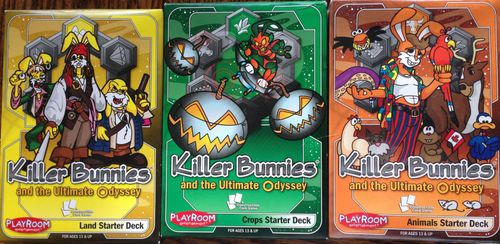
Killer Bunnies and the Ultimate Odyssey
Killer Bunnies and the Ultimate Odyssey Rulebook
Table of Contents
Table of Contents
How the Game Works
The basic strategy of the game is to gain Civilization (or Civ) Points by building up a collection of creatures (such as bunnies) in The Bunny Circle and structures (such as cities) in The Center Circle. Another strategy is for players to steal Civ Points by destroying their opponents' bunnies and cities. Both strategies can get vengeful, nasty, messy and painful, but most of all, it's really fun! The first player to reach a score of 60 Civ Points is the winner!
Getting Started
Each player may create a deck of no less than 60 cards from any cards that he owns. All Starter Decks of Killer Bunnies and the Ultimate Odyssey contain 60 cards and are ready to be played. Players who create their own decks may want to see Deck Creating Suggestions in The Bunny Bits.
Each player must shuffle his deck of 60 cards thoroughly and place it face down on the table. This is called the Draw Pile. Each player will have their own Draw Pile for their exclusive use only.
Each player should also have three dice. The d6 and d12 dice are for use during the game. The d20 die is used to keep track of your Civ Points. Each player starts the game with 10 Civ Points, so set your d20 die to the number 10.
Each player deals himself seven cards from his Draw Pile. Throughout the game each player will always have seven cards.
Setting Up the First Round
During the game, players must choose which two cards they will play two rounds in advance (one card per round). This requires a bit of planning.
Step One: Pick the first card that you will play and place it down on the table. This is called your TOP RUN card.
You may choose any card in your hand. However, the first card that you will want to play is a RESOURCE card. Here's why: most of the cards that are not RESOURCE cards have something called a Card Cost. The RESOURCE cards are what players use as the 'payment' for the Card Cost to play almost all of the other cards. When RESOURCE cards are played, they are automatically saved, and may be used throughout the entire game. See Card Cost under Card Conditions for more information.
What if I was unlucky and didn't get any RESOURCE cards? Most players will have at least one RESOURCE card in their initial draw of seven cards. However, if you did not receive any RESOURCE cards in your first draw of seven cards, then you have two choices:
- First, you may shuffle all of your cards back into your Draw Pile and deal yourself seven new cards. Unfortunately, this will cost you 5 Civ Points, so set your d20 die down to the number 5. Players may only trade in their cards (and pay the 5 Civ Points) once and at the start of the game only.
- Second, wait a few rounds to draw RESOURCE cards. If you choose this option, then you will have no choice but to discard (or burn) a few less important cards. Our suggestions would be to burn Aggressive cards such as weapons or Feed The Bunny cards, or city cards with a very high Card Cost. It is quite common for players to burn a few cards (mostly at the start of the game) before they have had a chance to save enough RESOURCE cards.
Step Two: Next, you will have to pick the second card that you will play. When you have chosen your second card to play, place it face down on the table below the first one. This is called your BOTTOM RUN card.
You may choose any card in your hand. Here are a few good choices:
- A RESOURCE card. You can't go wrong playing another RESOURCE card. The more RESOURCE cards that a player has saved, the greater the variety of other cards that he may use. Some players will play all of their RESOURCE cards first, because they have no Card Cost of their own, and because they are automatically saved and used throughout the entire game.
- A bunny card. Bunnies are good to play because they have a point value and add to your total Civ Point score. First, check to see if you have enough RESOURCE cards saved to play the bunny.
A few other good choices for the second card are:
- A weapon card. These cards allow you to attempt to kill an opponent's bunny right away and to steal the bunny's point value.
- A Feed The Bunny card. These cards also allow you to attempt to kill an opponent's bunny, but more slowly. The opponent may have Cabbage and Water to save his bunny. If the bunny dies, however, then you will receive the bunny's point value as Civ Points. See more about Feed The Bunny cards and Cabbage and Water in The Bunny Bits.
Once you have placed your cards down in the TOP and BOTTOM RUN positions, you may not change them. If you forget which cards you have put down, then you are allowed to take a quick peek! You are now ready to start the first round of play.
Please note that if a player wishes to play a weapon card or a Feed The Bunny card, then he will need a bunny card in The Bunny Circle first. Having a bunny in The Bunny Circle is a card condition for both a weapon card and a Feed The Bunny card. See Card Conditions for more information.
Many of the cards are very unique. Read carefully to see what each card will do and to make sure that you can 'pay' the Card Cost before you obligate a card in play.
Card Types
There are four types of Killer Bunnies Odyssey cards: RUN, SPECIAL, VERY SPECIAL and RESOURCE. All cards have their type printed in the top window of the card and a matching color bullet in the top left corner. Take a minute to make sure you know the type of each of your seven cards.
RUN Cards
To play a RUN card, a player must first place it down in the BOTTOM RUN position. On the next turn, the player will slide it to the TOP RUN position, and finally on the next turn, he will flip and play the card. All RUN cards work this way.
SPECIAL Cards
There are two ways to play a SPECIAL card:
- Players may play a SPECIAL card the same way that they would play a RUN card by placing it in the BOTTOM RUN position, sliding it to the TOP RUN position and flipping it over. When a player flips over a SPECIAL card, he may either play the card or save the card: a) SPECIAL cards may be played the same way that RUN cards are played. Don't forget to meet the card conditions for a SPECIAL card (Card Cost and the rectangular boxes on the left border) the same as for any RUN card. b) SPECIAL cards may be saved by placing them off to the side with a player's RESOURCE cards. All saved cards are placed face up.
- Players may play a SPECIAL card directly from their hand instead of flipping their TOP RUN card. Don't forget to meet the card conditions for a SPECIAL card (Card Cost and rectangular boxes on the left border) the same as for any RUN card. When a SPECIAL card is played in this manner, the player draws a replacement card and the TOP and BOTTOM RUN cards remain in place until his next turn.
Here are a few more facts about SPECIAL cards:
a) SPECIAL cards may be discarded directly from a player's hand as a turn. When a SPECIAL card is played in this manner, the player draws a replacement card and the TOP and BOTTOM RUN cards remain in place until his next turn. b) SPECIAL cards may not be saved directly from a player's hand as a turn. SPECIAL cards must go through the BOTTOM RUN and TOP RUN card cycle to save them. c) A player can use any number of saved SPECIAL cards during his turn in addition to his regular play.
VERY SPECIAL Cards
All of the rules for SPECIAL cards are the same for VERY SPECIAL cards with one difference. The difference between a SPECIAL card and a VERY SPECIAL card is that a SPECIAL card may only be played during a player's own turn whereas a VERY SPECIAL card may be played during any player's turn.
Here are a few more facts about VERY SPECIAL cards:
a) Playing a VERY SPECIAL card (either saved or directly from a player's hand) does not count as a player's turn. b) Any time that a player plays a VERY SPECIAL card, a replacement card must be drawn from his Draw Pile immediately.
RESOURCE Cards
It is highly recommended to play RESOURCE cards first in the game. Here's why: most of the cards that are not RESOURCE cards have something called a Card Cost. The cost to play a card is denoted by small colorful hexagon icons that are located on the right side of the top window of each card. When RESOURCE cards are played, they are automatically saved, and may be used throughout the entire game. The RESOURCE cards are what each player will use as the 'payment' for the Card Cost to play almost all of the other cards. All saved cards are placed face up.
Card Conditions
Each card may have up to three card conditions that players must meet before it can be played. Let's review each of the conditions so that no player accidentally places a card in the TOP or BOTTOM RUN position that he cannot use in play.
Green Rectangular Box (with a city icon). If your card has a Green Rectangular Box on the left border of the picture, then you will need a city in The Center Circle before you may use the card.
A city card is easy to spot because it is a horizontal card. Also, all city cards have a Green Circle (with a city icon) on the right border of the text window. If a player has at least one city in The Center Circle, then he can play any card with a Green Rectangular Box on the left border.
Pink Rectangular Box (with a bunny icon). If your card has a Pink Rectangular Box on the left border of the picture, then you will need a bunny in The Bunny Circle before you may use the card.
A bunny card is easy to spot because it usually has the word 'Bunny' as part of its title. Also, all bunny cards have a Pink Circle (with a bunny icon) on the right border of the text window. If a player has at least one bunny in The Bunny Circle, then he can play any card with a Pink Rectangular Box on the left border.
Card Cost. The Card Cost for each card is denoted by small colorful hexagon icons that are located on the right side of the top window of each card. Players must have enough RESOURCE cards saved that match the icons' color to use as 'payment' for the card that they wish to play.
A White RESOURCE Card Cost can be 'paid' with any color RESOURCE card saved.
For example, if a particular card has a Card Cost of two Blue hexagon icons and three White hexagon icons, then the player must have two Technology RESOURCE cards saved and three other RESOURCE cards of any color before he can play the card.
All Ground Weapon and Feed The Bunny cards have a Pink Rectangular Box, so a player will need to have a bunny in The Bunny Circle before using these cards. City Weapons have a Green Rectangular Box as well, so a player will need to have a city in The Center Circle before using these cards.
Sometimes a player is forced to place a card in the TOP or BOTTOM RUN position knowing that he cannot meet the card conditions. Maybe the player does not have enough RESOURCE cards saved yet to pay for his card or the card may require a bunny or a city to play it and he doesn't have one yet. When these cards are played, they are simply discarded (or burned). It is quite common for players to burn a few cards (usually at the start of the game) before they have had a chance to save enough RESOURCE cards to pay for higher Card Costs.
Transcriber's note: the printed sheet gives the starting hand as seven cards (Getting Started and Setting Up), but the Playing the Game and Game Mechanics panels refer to a "five-card hand" (A Turn, Back Fanning, Hexascrewup, Trading). Both are transcribed as printed; the source does not reconcile them.
Playing the Game
Before the game begins, each player has chosen the first two cards that he will play and has placed them face down on the table (explained in Setting Up The First Round). These two cards are called the TOP and BOTTOM RUN cards.
Determine with the roll of the d12 die, which player will go first.
The first player will follow these four steps (FLIP, SLIDE, DRAW, REPLACE):
- FLIP over the TOP RUN card.
- SLIDE the BOTTOM RUN card up to the TOP RUN card position.
- DRAW a replacement card from your Draw Pile.
- REPLACE the BOTTOM RUN card with any card from your hand.
Each player will take a turn clockwise around the table going through the four steps (FLIP, SLIDE, DRAW, REPLACE) and following the instructions on the card. This four-step cycle will continue for the entire game.
The game continues with each player playing one card per round as they follow the FLIP, SLIDE, DRAW, REPLACE mechanic.
Remember that each card may have card conditions that need to be met before it can be played. If the card conditions for a card cannot be met, then the card is discarded (burned) forming a Discard Pile for each player.
Gaining Civ Points
Players may gain Civ Points by placing bunnies in The Bunny Circle and cities in The Center Circle. A player's total Civ Point score is the combination of Civ Points on his d20 die and the point values of his bunnies in The Bunny Circle and cities in The Center Circle.
Players may also choose to steal their opponents' Civ Points by playing cards like Feed The Bunny, Ground Weapons or City Weapons that destroy their opponents' possessions. When a player destroys an opponent's bunny or city, they add Civ Points equal to the bunny's or the city's point value to the Civ Points on their d20 die.
For example: If an opponent's bunny is killed by the Ground Weapon shown, then the player who played the Ground Weapon adds (+1) Civ Point to his d20 die (the point value of the bunny). If an opponent's city is destroyed by the City Weapon shown, then the player who played the City Weapon adds (+9) Civ Points to his d20 die (the point value of the city and the point value of the bunnies inside the city).
A player's total Civ Point score is the combination of Civ Points on his d20 die and the point values of all of his creatures (bunnies) in The Bunny Circle and all of his structures (cities) in The Center Circle.
Ending the Game
The game is over when one of the players has reached or exceeded a total of 60 Civ Points. A player may win the game during another player's turn if he reaches or exceeds a total of 60 Civ Points.
Callouts printed on the illustration of the play area (no heading in the source):
- The Bunny Circle: All of the creatures that are in play form The Bunny Circle.
- The Center Circle: Players will place cities in The Center Circle.
- RESOURCE Cards: All players have saved RESOURCE cards that are simply put off to the side after they are flipped over. To keep track of how many saved RESOURCE cards a player has used in one round of play, he may simply slide them off to one side.
- Top RUN Card: The card you will play on your next turn.
- Bottom RUN Card: The card you will play on your turn after next.
- Draw Pile: Each player has his own Draw Pile.
- Discard Pile: Each player has his own Discard Pile.
- Saved Cards: Save your SPECIAL and VERY SPECIAL cards off to the side after they are flipped over.
- Dice: Each player should also have three dice. The d6 and d12 dice are for use during the game. The d20 die is used to keep track of your Civ Points.
Game Mechanics
A Turn, A Round
During a turn, each player may play a single card in one of four ways. The four options are:
a) Flip and play the TOP RUN card. b) Flip and discard the TOP RUN card if the player cannot or does not wish to use it. c) Flip and save the TOP RUN card, but only if it is a RESOURCE, SPECIAL or VERY SPECIAL card. d) Play a SPECIAL card directly from your five-card hand. This leaves the TOP and BOTTOM RUN cards in place.
A round is completed when every player has had one turn.
Adjacent
The phrase 'Adjacent players' on a card refers to both the player sitting to the left of you and the player sitting to the right of you. In a two-player game, this will be the same player on both sides.
The phrase 'Adjacent bunnies' means the bunny placed directly to the left and the bunny placed directly to the right of the 'target' bunny in The Bunny Circle. These bunnies may belong to the same player or to different players.
Aggressive Cards
All cards that have a Pink Rectangular Box on the left border of the card require a player to have a bunny in The Bunny Circle and are considered to be Aggressive.
Back Fanning
Back Fanning is when a player holds up his five-card hand with the backs of the cards facing an opponent and fans (spreads) the cards out a bit so that the opponent may choose one of the cards randomly.
Card Identification Number
The Card Identification Number is actually two letters and two numbers and is located at the bottom left and right corners of each card respectively. Therefore, each Card Identification Number is of the type (Letter/Letter/Number/Number).
Face Up
All of a player's saved cards (RESOURCE, SPECIAL and VERY SPECIAL) must be placed on the table face up so that everyone can see them.
Hexascrewup
Any player found to have an extra card in his hand (six instead of five) during play must allow the opponent who spotted the discrepancy to choose a card (at random) from the player's hand to be discarded. In addition, the player who had the extra card will subtract (-5) Civ Points from his d20 die.
In Play
Any creature in play refers to the creature either in The Bunny Circle or in a structure in The Center Circle.
Player And Opponent
When card text refers to the player, it means the person who is playing the card. When card text refers to an opponent (or opponents), it means all of the other people (not the player) who are playing the game.
Positioning Of Creatures And Structures
Players may place creatures (such as bunnies) anywhere they wish in The Bunny Circle as they are acquired (flipped into play, traded with other players, stolen from other players or revived from their Discard Pile). For example, if a player has two bunnies in The Bunny Circle, then a new bunny may be placed to the left, right or in between the two bunnies already there. A player may not, however, reposition creatures that are already in The Bunny Circle.
Diagram labels: To the Left Option / In Between Option / To the Right Option.
Players may place structures (such as cities) anywhere they wish in The Center Circle as they are acquired (flipped into play, traded with other players, stolen from other players or revived from their Discard Pile). A player may not, however, reposition structures that are already in The Center Circle.
Rectangular Boxes
A Pink Rectangular Box on the left border of the card requires a player to have a bunny in The Bunny Circle to use the card. A Green Rectangular Box on the left border of the card requires a player to have a city in The Center Circle to use the card.
Shuffling
Each time that a player adds cards or removes cards from his Draw Pile, he must shuffle it thoroughly and allow an opponent to cut his Draw Pile deck. An opponent cutting a player's Draw Pile deck must leave no less than 5 cards on both the top and bottom of the cut (unless, of course, the player's Draw Pile has less than 10 cards).
Trading
Trading may only occur during either of the players' turns that are involved in the trade and not while other players are taking their turns.
Any player may trade: saved RESOURCE cards, saved SPECIAL cards, saved VERY SPECIAL cards, creatures in The Bunny Circle or structures in The Center Circle (along with all of its occupants) in any amounts agreed upon by the players. All items may only be traded once during the game.
If a particular card tells a player to move another card from one player to another, then this does not constitute a trade.
Any player may trade cards from his five-card hand on a one-to-one basis so that no player has an extra card in his hand or is short a card after the trade. All players must have five cards in their hand at the end of the trade.
Cards in the TOP RUN and BOTTOM RUN positions can never be traded.